


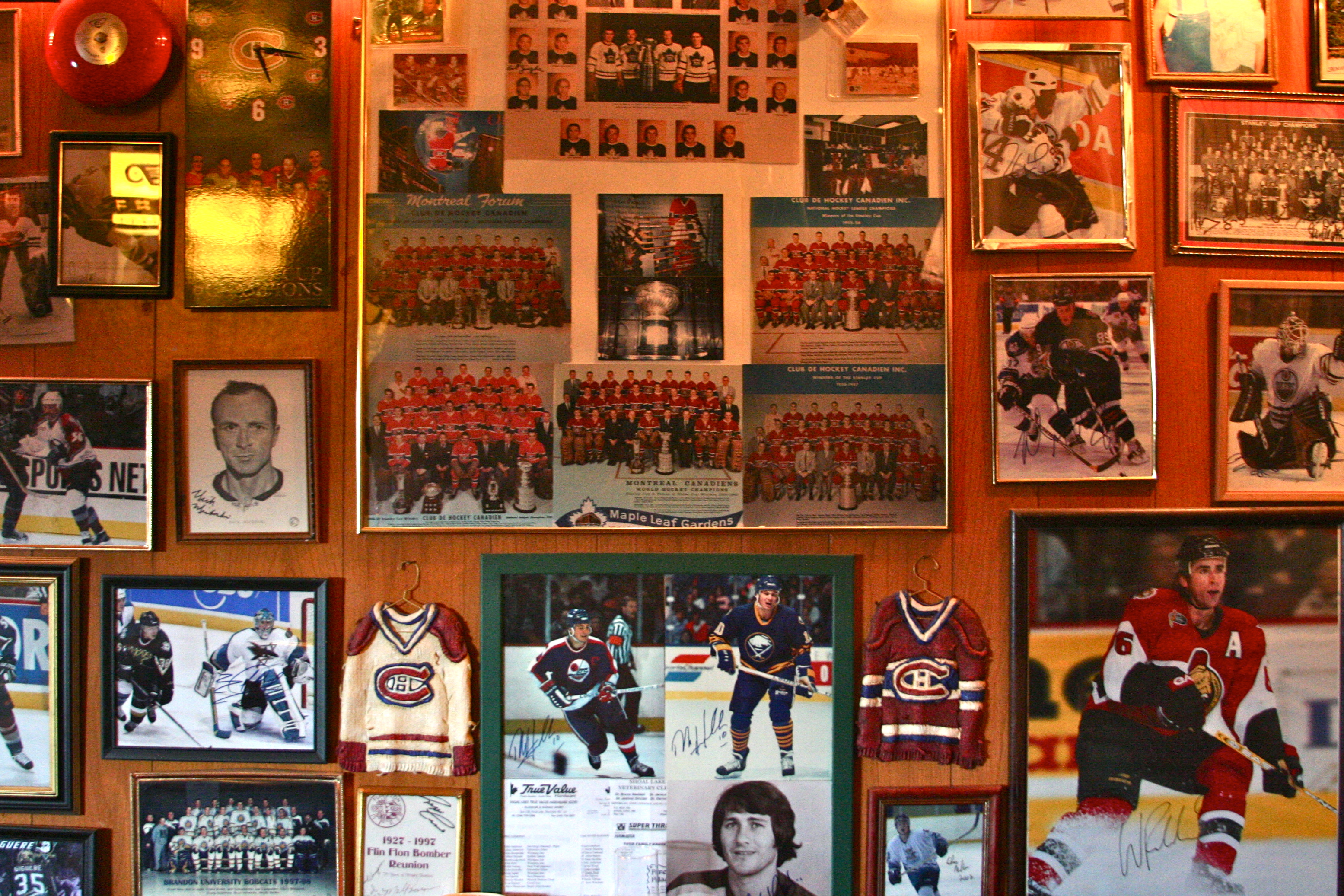


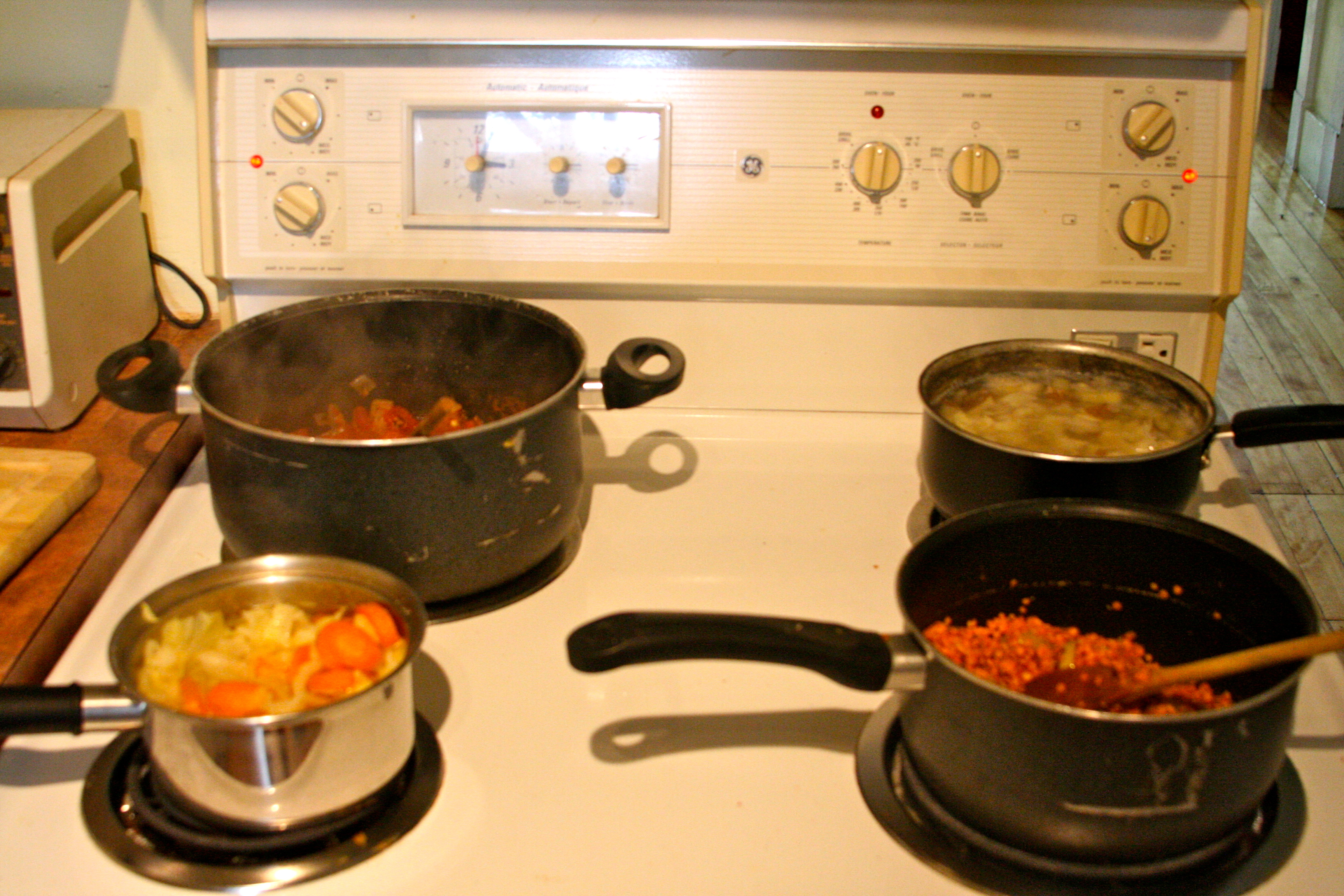
Eating food makes a monumental statement.
I can tell many things about a person based on what foods are on his or her plate at the beginning of a meal, and how much is left on his or her plate at the end of the meal. The variety, the amount, the colour, the condiments. That being said, what is on my plate coincides directly with my personality, weak-willed and often spicy.
Arriving at Primetime on a Sunday afternoon with a cream cheese container of chana was a common Sunday afternoon activity last year. We would sit around talking about how much Courtney misses pizza, and how good Jacynthe’s perogies are, and compare the sesame seed bagels from down the street. We would tell stories of mothers and grandmothers and vegan delights and how we enjoy our diets luxuriously and also frugally. The afternoon would always end up with me walking in the rain to Pizza du Parc or the depanneur or the PA for some snacking to accompany the yellowed popcorn and flat and stale beer.
In all the time we spend talking about food, and all the time we spend preparing, eating and gathering around it, we usually spend more time talking about how much more we ate than we should’ve, or the colour and shape of our faecal matter. We often neglect to talk about how eating a ‘balanced diet’ is undoubtedly excessive and irresponsible. We neglect to talk about the 300 families standing in line on Winnipeg Street waiting for moldy bread and deformed potatoes. We ignore the fact that we eat meat and desserts for nothing more than our own personal satisfaction when they are either cruel, unhealthy or completely unnecessary for survival. We dance around our prepackaged food dishes, plastic wrapped and microwave friendly foods that are more chemically based and chromosome shifting than actually nourishing. We label those who eat differently as idealist hippies looking for attention. We eat selfishly.
The privileged are no longer in a position to eat only for enjoyment or survival. We must now eat to make a statement. We must now eat to make a difference. By skipping meals, reducing or eliminating our meat intake, eating locally, donating to food banks, sharing with family and friends, and eating less, we can show exactly how much of an impact our three times a day routine can have. Like most things that we have in abundance, an abuse of these: food, technology, electricity, water, is an insult to those around the world that lack them. It is ignorant to say that we are blessed to live in a land with an abundance of food and take it no further than that. We must realize our extreme fortune and change our bad habits of excess and waste and then we must share with others.
Food is meant to be enjoyed but not abused. We must eat with our brains and not with our mouths. And if we decide to actually eat brains, then we must do so in moderation, and we must consider those without an abundance of brains to be eaten.
Balls of Rice Blog Action Day 2010: Water
Balls of Rice Blog Action Day 2009: Climate Change
BlogActionDay.com
Oxfam.ca
 This year I donated to help in the East African Food Crisis through Oxfam.ca.
I often wonder to myself, “If people aren’t thinking about what to write next, then what the hell are they thinking about?”
Food.
Hockey.
Sex.
Work.
Alcohol.
Deadlines.
Bills.
Healthcare.
Bacon.
Sex.
Laundry.
Elections.
Etcetera.
Oh.
Well.
I guess there is quite a bit on the average person’s mind.
My mind usually includes the following:
Witty titles for blogs.
Intellectual phrases for stories.
Lines for poems.
Obscure ideas.
Elections.
New ideas.
Myself.
Not being selfish.
Books.
Authors.
My book.
Stolen ideas.
Plus several others from the first list above. (You know which ones.)
Then, sometimes in the middle of thinking these things, or in the middle of an attempt at writing, in the single moment of clarity that I get in a month, I abruptly throw my hands in the air and groan, “Why do I fucking continue to kid myself?” This thought is born when I somehow compare myself to a writer of worth and realize that I will never reach where I wish to be. I realize that I am in a shop basement writing short stories with one-dimensional characters, sitting at a desk made of paint cans and used plywood at 10pm, staring at a black drywall screw holding up vinyl wood paneling. With this realization, any sort of motivation or feeling of worth dissolves on the concrete floor in the corner that the light doesn’t quite reach. Oh, it is disheartening. Enough to make me consider the deletion of all I’ve ever written and all I’ve ever thought about just to spite my own self.
I need to get real.
Get real in understanding that the world doesn’t need some amateur, second class ‘art’ to give it worth. Get real in understanding that my attempts at expression have been attempted and expressed far before my time. Get real in understanding that although it may not be hurting anyone, fiction or non-fiction or poetry, is all a form of rambling. Sometimes with a mediocre plot, sometimes without.
I won’t ever really know what other people think about if they aren’t thinking about writing. But at least they are lucky enough to be wasting their time thinking about something besides writing, nor will they be obligated to question the productivity or worth of their past five years of life. I will undoubtedly subconsciously continue to kid myself in thinking that what I am doing here is worthwhile, so that maybe someday I will accidentally stumble upon something that no one ever has.
There is no such thing.
A possible answer:
“When I sit down to write a book, I do not say to myself, ‘I am going to produce a work of art.’ I write because there is some lie that I want to expose, some fact to which I want to draw attention, and my initial concern is to get a hearing.”
-George Orwell
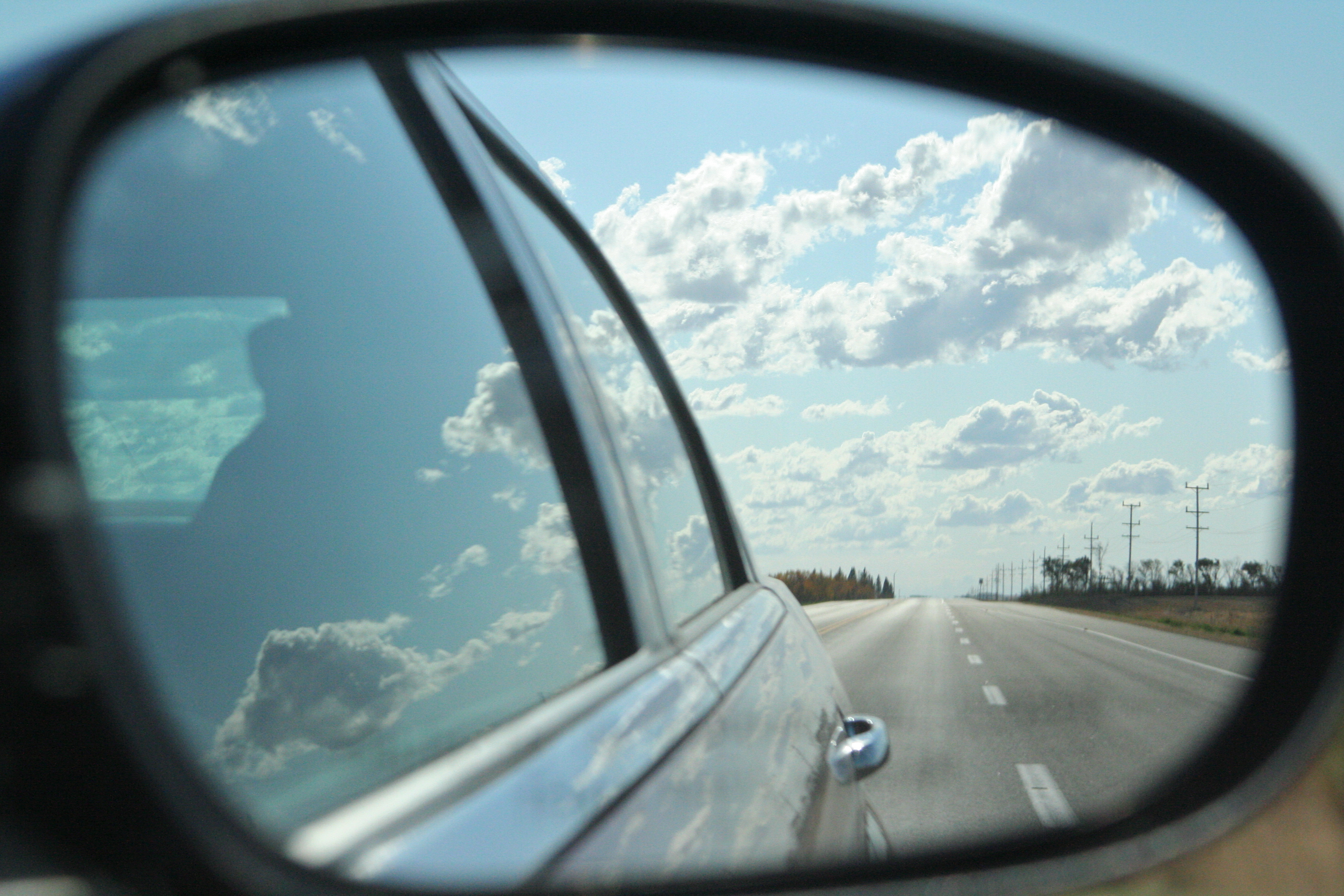 The past always seems brighter than the present. The sun shone brighter, the rain was warmer, the times meant more. Images are more impressive seen reflected off of a convex mirror, especially an extreme convex like the back of a spoon or chrome toaster. I have obtained a taste for mirror photography. Not the self-taken celebrity nudes, nor the internet photos of new haircuts in the bathroom, but reflections in interesting places, or through objects whose primary function is not reflection. Side view mirror shots are included in the category.
Upon settling in a place that is physically familiar but mentally foreign, I noticed that I continuously crave for what my life was a month previous. For the one month old life. Either I wish I hadn’t settled, or I wish I hadn’t left, but I always wish I was one month younger. I will never be one month younger. In all occasions, my life a month before was more certain than the present, and seemed like a better fit. When in Saskatchewan, I thought this of life on the road. When on the road, I thought this of life in Montreal. When in Montreal, I thought this of life in Saskatchewan. A certain regret for the present and a nostalgia for the past builds up an uncomfortable discontentment in any situation, and this breeds negativity. Contentment, in a certain regard, is needed in the present.
I need to live as if it were a bike ride with no side view mirrors. Straight ahead without any second thought, with a nice song playing in my ears to blank out the hums of cars and the signals of safety. Because safety and looking forward are not related very closely. Worrying about safety creates the reaction of looking backwards constantly.
The present is never worse than the past. The past is never worse than the past before that. Objects in the mirror are not as good as they appear, nor are they any worse than what is inside the car, or what is on the thin flat line of the horizon.
Lodi, CCR
Just about a year ago
I set out on the road
Seeking my fame and fortune
Looking for a pot of gold
Things got bad things got worse
I guess you will know the tune
Oh Lord, stuck in Lodi again
Rode in on the Greyhound
I’ll be walking out if I go
I was just passing through
Must be seven seven months or more
Ran out of time and money
Looks like they took my friends
Oh Lord, I’m stuck in Lodi again
The man from the magazine
Said I was on my way
Somewhere I lost connections
Ran out of songs to play
I came into town, a one night stand
Looks like my plans fell through
Oh Lord, stuck in Lodi again
If I only had a dollar
For every song I’ve sung
And every time I had to play
While people sat there drunk
You know, I’d catch the next train
Back to where I live
Oh Lord, I’m stuck in a Lodi again
Oh Lord, I’m stuck in a Lodi again

Read this book.
“Our culture of illusion, is, at its core, a culture of death. It will die and leave little of value behind. It was Sparta that celebrated raw militarism, discipline, obedience, and power, but it was Athenian art and philosophy that echoed down the ages to enlighten new words, including our own. Hope exists. It will always exist. It will not come through structures or institutions, nor will it come through nation-states, but it will prevail, even if we as distinct individuals and civilizations vanish. The power of love is greater than the power of death. It cannot be controlled. It is about sacrifice for the other—something nearly every parent understands—rather than exploitation. It is about honoring the sacred. And power elites have for millennia tried and failed to crush the force of love. Blind and dumb, indifferent to the siren calls of celebrity, unable to bow before illusions, defying the lust for power, love constantly rises up to remind a wayward society of what is real and what is illusion. Love will endure, even if it appears darkness has swallowed us all, to triumph over the wreckage that remains.”
Listing your talents as an adult is inevitably prideful. In the rare cases where it is necessary, like in a resumé, in a drug abuse support group, or on the adult playground (i.e. social networks), if you come up with a skill too quickly, then you likely think that you are better at it than you actually are. If you hesitate, then you look as if you are trying to be overly modest. If you can’t think of anything, then you are fooling yourself. Moderate giftedness is the immense swimming pool in which most people find themselves wading, and where their fingers and toes become wrinkly from being in for so long.
I maintain the idea that some people have obvious physical skills while others have less obvious human skills. Some can be considered artistic or mechanical or athletic, something that can be measured in items created or matches won, or something apparent that fills a person’s time as an occupation or a hobby. Those with the physical gifts are praised highly for their abilities; they are considered the greatest of our species and are known for making humankind better by continually improving at their trade. Humans with skills that cannot be charted or counted, those with social abilities, an emotional giftedness, are often attributed as ‘nice people’, or ‘very kind’, or ‘fun to be around’. As children, in classroom exercises where we would appreciate our peers with words on a paper, we would write, ‘Nic is very athletic!’ to those that we didn’t think were nice, and ‘Nic is very funny and nice!’ to those that we didn’t think were gifted. Now as adults we praise those with obvious gifts and tell the rest that they are ‘very funny and nice’. The unclassifiable gifts are regarded as less important. It is those with the quiet gifts, the talents that do not boast, that can define a people. Gifts that aren’t physically noticeable but relational, intellectual or emotional competencies are the translucent cousins to the categorizable gifts of the often labeled ‘talented’ humans. If you don’t have an obvious physical talent, then I will ensure you with a motherly kiss on the forehead that you are still special and gifted. That although we may not be noticeably appreciated as often as the musician or the cook, that we are of equal acclaim in the fabrication of our species.
Those of us with moderate talents, whether obvious talents or not, know of several acquaintances who seem to have incredible abilities in all things. People that can triumph every sport, can play several obscure musical instruments, can write all forms of literature, can speak seven languages, can bake an exquisite brie, can grow immaculate facial hair, have a glowing and linear smile without the help of dental cosmetics, can do a backflip on flat ground and are a great lay. And sometimes they are even extremely decent human beings. Obviously we always idolize these people, shake our heads at their dumb luck and good genes because they are somehow instinctually good at many of the obvious skills, and often better than we are at something we have spent a whole life practicing.
The normal: the ones with moderate abilities in one or two things and the ones with the gifts that are not immediately identifiable can still be great with an understanding that greatness isn’t a list of abilities and talents, but rather that greatness is humility in those gifts of whatever degree in whatever domain.
I was obviously born to draw better than most people, just as the widow Berman and Paul Slazinger were obviously born to tell stories better than most people can. Other people are obviously born to sing and dance or explain the stars in the sky or do magic tricks or be great leaders or athletes, and so on.
I think that could go back to the time when people had to live in small groups of relatives—maybe fifty or a hundred people at the most. And evolution or God or whatever arranged things genetically, to keep the little families going, to cheer them up, so that they could all have somebody to tell stories around the campfire at night, and somebody else to paint pictures on the walls of the caves, and somebody else who wasn’t afraid of anything and so on.
That’s what I think. And of course a scheme like that doesn’t make sense anymore, because simply moderate giftedness has been made worthless by the printing press and radio and television and satellites and all that. A moderately gifted person who would have been a community treasure a thousand years ago has to give up, has to go into some other line of work, since modern communications put him or her into daily competition with nothing but world’s champions.
The entire planet can get along nicely now with maybe a dozen champion performers in each area of human giftedness. A moderately gifted person has to keep his or her gifts all bottled up until, in a manner of speaking, he or she gets drunk at a wedding and tap-dances on the coffee table like Fred Astaire or Ginger Rogers. We have a name for him or her. We call him or her an “exhibitionist.”
How do we reward such an exhibitionist? We say to him or her the next morning, “Wow! Were you ever drunk last night!”
-Kurt Vonnegut, Bluebeard, Chapter 9, p74-5
When I read poetry, I write poetry. When I read fiction, I write fiction. When I look at black and white photos, I take black and white photos. The gap between ingestion and production is often several days, so if I want to write a decent poem I have to read fifty good poems a week in advance, and then the styles often cooperate, that is, I write how I read. From the source (X), idea filters through a screen to keep the insects out, and is regurgitated as new (Y).
X ≈ Y
i.e. X is pretty much equal to Y
The skeleton is the same.
In a day a human constantly observes new ideas, images, thoughts, literature, sights, styles that are not his or her own. Today when I wasn’t reading I was listening to music, when I wasn’t listening to music I was watching a movie, when I wasn’t watching a movie I was on the internet, when I wasn’t on the internet I was listening to the radio. These are all filtered through the mind’s small screen that cannot allow all of the data through, so the bits and pieces considered relevant or consequential but small enough to slip through the squares of the metal screen, make it through and end up with the personal flavour of the mind it travelled through.
To ensure decent production we must ensure decent ingestion, like an athlete’s body. The constant entertainment that we demand is created as mindlessly as we decide to devour it. Parallel to the nutritional food rhetoric that we have learned to ignore, we are the vapid television shows that we watch constantly. We are the money worshipping music that we put in our headphones. We are the poorly written sports articles that we browse daily. And if we put nothing in, nothing comes out. Our minds are our bodies.
I have become an easily influenced social leper. What I write is a direct coffee filter version of what I read. If I stopped reading, nothing would come out. I used all of my sociality when it was necessary on the road. I became comfortable with strangers and friends I haven’t seen in ages, but now, maybe out of social exhaustion, I have lost the ability to seem like I give a shit. My intake of the socially able has not subsided in any way but my production has halted as if the filter were clogged.
I am like echos off of a mountain wall. A bedroom with another layer of paint on it. For my production’s health I need to control what I take in, and enjoy the moments when there is nothing forcing itself upon my mind except trees in the wind or the light on the road. Or else my filter will become clogged and my production of decent thoughts will become like my recent social ineptitudes.

This is the amount of time that my body spent on a bus in the past 101 days. Nine percent of my past three months I spent marinating in my own odour. It is unknown how much time my mind spent on the bus in the past 101 days. It wasn’t always there. My body withered away while in constant wait. Trail mix and apples will thin a man out when it is all he eats for nine percent of a quarter of a year.
During this time I thought about every possible thing there is to think about. I thought about thought and wondered about the juncture when thought becomes useless. I have always wanted to be thoughtful, but constant thought will only ever make a man more stubborn or more confused. I am the latter. Maybe both. Arriving/settling only accentuates the fact.
A lobotomy performed with a cheese grater. It is like I have nothing left to think about so I can simply glide through the days as if they require no thought. As if every human has a certain fixed quantity of thought time for their life and I spent all of mine on the bus. Or as if my mind can’t keep up to where it seems it should be. Either I’ve thought too much or I’ve thought too little. Which is worse is hard to tell.
But where the bus stole my brain, which includes my reasoning abilities, my decision making abilities, my planning abilities, it gave me a lack of expectation. To expect the bus to be on time is to expect the impossible. The trip made me believe greatly in the possible.
Although my mind feels sterile after two-hundred and eighty seven hours of dizzying thought, I am confident that with a fresh start in an old city I can once again find something to fill it with, be it old cynicisms, or be it something I haven’t found before.


 Balls of Rice