Author: Nic Olson

  • Lyrics of the Month: April 2016 – The Weakerthans

    Had one of those days when you want to try heroin,
    drunk driving, some form of soft suicide.
    Sitting in silence and staring at ceilings
    or peeling the paint off of things to confide.

    Maybe someday the lies we’ve led around
    will crawl under our beds
    and sleep off the years.

    Teach me to wiggle my ears like that,
    show me the scar that you got when you fell off your bike.
    Ask me the questions you never want answers to.
    We can re-write them however we like.

    Maybe someday the lies we’ve led around
    will crawl under our beds
    and sleep off the years.

    Stop the hardwood floor’s lopsided grin.
    Leave the dirt and dead flowers in a brown coffee tin.
    Let your hand melt a hole in the frost.
    Peer out under a sky that looks just like a shirt I lost.

    Someday the lies we’ve led around
    will crawl under our beds
    and sleep off the years.

    -The Weakerthans, Fallow, Leash

  • Lyrics of the Month: March 2016 – Bikini Kill

    I can’t say everything about it
    In just one single song
    I can’t put how I feel in a package
    And sell it back to everyone

    But wait
    There’s another boy genius who’s fucking gone
    I hope the food tastes better in heaven
    I know there’s lots of rad queer boys up there
    I hope every time they talk to you
    They know they’re lucky to be yr friend

    Cuz look
    There’s another boy genius who’s fucking gone
    And I wouldn’t be so fucking mad so fucking
    Pissed off if it wasn’t so fucking wrong
    It’s all fucking wrong
    It’s not fair, it’s not fair, it’s not fair

    But no one said life was easy
    Yeah, but no one said, no one said
    Nothing’s supposed to happen right?
    No, no one told me anything
    To prepare me for fucking this

    There’s another boy genius who’s fucking gone
    Don’t tell me it don’t matter
    Don’t tell me I’ve had three days to get over it
    It won’t go away
    It just won’t go away

    -Bikini Kill, Reject All American, R.I.P.

  • Politics

    IMG_6881 - Version 2

    I drag my sorry ass outside in a desperation trip to the grocer. I don’t want to get groceries but I never want to get groceries, and I know that my one remaining pear won’t be enough to last me until Friday, even if I have no appetite. I forget my bike helmet in the apartment, so I risk permanent debilitation because I cannot look past the seven steps to my bedroom even though I know I may never walk again because of it. Politics.

    One of those days where starting smoking sounds like a good idea because of how it reflects inner thought.

    The grocer is sad. Only one jar of peanut butter on the shelf, wrinkled limes in the fridge, no deodorant left. But it has good intentions. I still manage to spend $60. Get home, eat a few crackers and a homemade hummus that tastes like tunafish, get back on the bike to go to the hockey rink.

    The ice is soft like our discussion of impotence. Existential non-boners. We play hockey on the ice anyway. Rather destroy what is left of the rink in the name of a good time than preserve it for someone who would enjoy it less.

    Somehow my Spam folder knows what I dreamt about the night before.
    HotH00kup Alert
    H0rny Sextmatch

    Couchsurfers from Quebec politely put up with my sad-man room and speak excitedly about their impending trips to brighter lands. The arcade is closed, the only sober thing to do in the city, so we go for a beer. We only get one beer, so it is good. Bed by ten. Not bad.

    Trying to to distract myself because good people die when bureaucrats want successful track records for their resumes and political futures. Because the real world and the citizenry run in never-overlapping circles and we make decisions for the citizenry. We make decisions for the taxpayers who pay the wages. Politics.

  • Lyrics of the Month: February 2016 – Kristofferson

    Mister Marvin Middle Class is really in a stew
    Wond’rin’ what the younger generation’s coming to
    And the taste of his martini doesn’t please his bitter tongue
    Blame it on the Rolling Stones.
    Blame it on the Stones; blame it on the Stones
    You’ll feel so much better, knowing you don’t stand alone
    Join the accusation; save the bleeding nation
    Get it off your shoulders; blame it on the Stones

    Mother tells the ladies at the bridge club every day
    Of the rising price of tranquilizers she must pay
    And she wonders why the children never seem to stay at home
    Blame it on the Rolling Stones.

    Blame it on the Stones; Blame it on the Stones
    You’ll feel so much better, knowing you don’t stand alone
    Join the accusation; save the bleeding nation
    Get it off your shoulders; blame it on the Stones

    Father’s at the office, nightly working all the time
    Trying to make the secretary change her little mind
    And it bothers him to read about so many broken homes
    Blame it on those Rolling Stones.

    Blame it on the Stones; Blame it on the Stones
    You’ll feel so much better knowing you don’t stand alone
    Join the accusation; same the bleeding nation
    Get it off your shoulders; blame it on the Stones

    Blame it on the stones, blame it on the stones.

    -Kris Kristofferson, Kristofferson, Blame it on the Stones
  • Season of the Badlands

    IMG_5565

    The following was originally published with photos in Of Land & Living Skies: A Community Journal on Place, Land, and Learning. For more interesting content and events, consider becoming a Sask Outdoors member at SaskOutdoors.orgDigital magazine available here.

    Just west of the yard in a field of summer fallow is a rock. Its existence alone isn’t remarkable; there are a multitude of rocks in the dirt around Horse Creek. All over the prairies there are rock piles, decades or centuries of rounded stones the size of softballs or buffalo skulls or lawnmowers, stacked as monuments to the neighbouring broken earth. But the rock west of the yard, picked out of the ground to clear the way for tilling, ended up being the size of a small car. Forty paces from the road it looks substantial but unremarkable; flat and several feet high, grey brown, leaning back with a salute to the sky, the remaining clover hissing at its base. But the illusion disappears when it is approached. It juts out significantly, looking like the missing nose of the Sphinx. A nearly immovable object, even with all the trucks and tractors around, because of its size and the damage it would do to the road and the ditch. It would look good in the garden but the force needed to move it is a force we do not have. So there it sits.

    My grandma was born in Horse Creek. I never knew this until a week before I headed there myself. Horse Creek is located on Treaty 4 Territory, seventeen miles south of McCord, 110 miles southwest of Swift Current and just sixteen miles as the crow flies from the American border. If you look for it on a map or even the internet, you may not find it. In a time of unions and co-operatives, grandma’s father was a carpenter in Horse Creek for her first year of life. Last November, I was in Horse Creek holding tape measures and nailing boards and starting my own imaginary union to provoke my anti-union, farming friends.

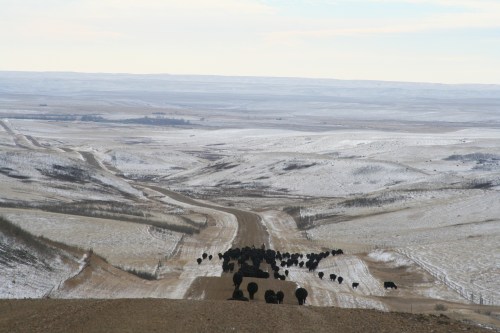
    Much of that summer was spent exploring the badlands of southern Saskatchewan. The first weekend of spring meant camping with three friends at Grasslands National Park, which shares the same hill ranges as Horse Creek. In 4x4s we were guided through pastures and down ravines to Storey Lowell’s, the local folklore touting it as an early hideout for horse rustlers, when it is more modestly two adobe shacks that made the home of an old homesteader. Later we hiked in at McGowan’s Visitor Centre and camped in a coulee just steps from the moon-like landscape of dirt and cliff. Before darkness settled we walked to the highest point in sight, overlooking the crumbling badlands, with heavy clouds and bursting light advancing from the south sky. Walking back in the heavy showers we purposefully searched out the storied quicksand piles by tossing rocks on odd looking pieces of dirt, then toeing them, then stepping on them, then stomping on them, tempting our fate for a movie-like reaction from the earth. We never found any quicksand.

    Later in summer we visited Castle Butte, a massive ice-age-created structure of sandstone and clay reaching to the sky of the Big Muddy. A few miles from there we navigated to Buffalo Effigy, the flat outline of rocks which shape a buffalo on the highest hill around——a sacred site now part of a pasture, luckily fenced off and somewhat preserved. A few weeks later we camped at St. Victor Petroglyph Park, timeworn carvings on horizontal rock on the top of another highest hill in the area. These three sites of identity and significance to the First Peoples, all purposefully placed on top of the highest of hills, existed long before my maternal grandparents settled in the area——around Harptree, Brooking, Radville——and began creating their own monuments in picked rock piles and homesteads.

    IMG_5447

    In the snow-covered shortgrass prairie of Horse Creek, I attempted to experience the ranching and farming life in which my family was once rooted. I picked bales and fixed fence and tried to be useful. When on break, to bolster my writing craft, I urinated poems into the snow in cursive.

    When heading south to move lumber or check on cows it looked as though the clouds that rested on the hills that enclose the badlands were the end of the world, which in my own way, is the truth. The badlands are dead land and past them is a barbed wire pasture fence that is patrolled with drones and satellites of the American border guard. Other border-adjacent land is sold off to multinational companies scavenging for oil whose only identity in the land they own is corporate identity. The end of the world and the end of identity exists in deserts and robots and contracts.

    I have a vested interest in preserving this land from such ominous ends because I feel connected to it in some vague, flaky kind of way. My friend who has lived here his whole life and whose family has farmed it for a century offers the same. Giving up his land would be the last thing he would do, and because of his connection to the land he acknowledges that he knows to some extent what it might have felt like when the settlers came. I identify with the land that sits atop the badlands because of personal history, but this land does not identify with me any more than it identifies with the farmers or ranchers or indigenous peoples or the Queen who leases it out or that rock west of the yard.

    The connection felt from being on the land, from spending time caring for it and working it, is universal and real. I am not entitled to this land, nor is any one person or group of people. Instead the land has an entitlement to be inhabited by people who identify with it, because those who identify with the land are more apt to treat it as it ought to be treated.

    To be an asset to the land, to be the type of person that the land is entitled to, I learn as much as I can about how it works and how to live well on it. About all its intricacies of connectedness, which offer lessons of how to exist and how to relate. Like the rock west of the yard, I am not out of place standing alone on the prairie, I only look that way when I am dug up from the city and thrown naked in a field. Like the rock, my ancestral composition lies in the soil, just as everyone else.

    Each time I visit the badlands and hills adjacent I seek out the highest geographical point possible——to feel the wind’s unmitigated power or to fully realize the thunderstorm that approaches. Monuments that mark time, the carvings and effigies and buttes of the area, are locations of height for a reason. They are standing points that we revisit to watch the thunderstorm of the future steadily move in. The easiest place to keep your feet grounded for change and resistance is in community and identity. Strengthening our connection with these highest places is the only way to ensure the thunderstorm doesn’t come in and drown us all out and to ensure that when we are walking home, we see the pits of quicksand that would otherwise swallow us up.

    I drove out of the yard and left the farm behind with a year of vagrancy and foreign experiences on the horizon. The rock west of the yard sat silent with the ice fog painted low in the background. The rock will quite likely be there when I get back.

    To look just on the surface, and think that what you see from horizon to horizon is all that is needed to survive, is to misunderstand your place on the ground which you stand. To scale its heights-to learn its lessons—one must be alive to the underlying structures that support the visible and not-so-visible world around you.

    -John Borrows (Kegedonce), Drawing Out Law: A Spirit’s Guide (University of Toronto Press, 2010, p72)

  • Learning to tie your shoes at 27.

    Shoelaces

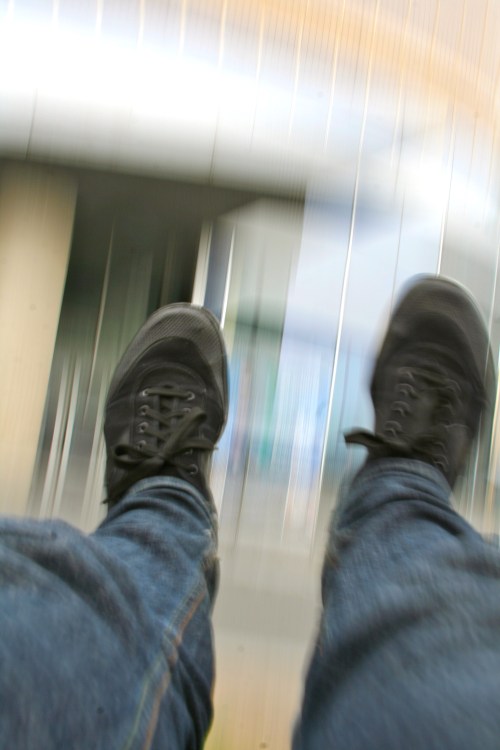
    “You’re tying your shoelaces wrong,” Grandpa told me after he slipped on his insulated rubber boots he wears when flooding the North Weyburn rink. I told him that he’d shown me before, thinking back to one of the other times someone tried to revolutionize my life at mid-age by teaching me more effective ways to tie shoes. Once, a Chinese student in my boarding school in grade 12 had some extremely efficient, one-motion trick he learned in the Chinese Army. The other, an employer told me that we use the ‘weak version’ of the bow knot, overhand instead of under. Neither stuck.

    “You make a loop with that there, then you wrap around twice, and feed it through, and pull it tight. Then it’ll never come undone and all you have to do is pull that one to undo it,” Grandpa said. And that’s how I learned to tie my shoes at the age of 27.

    We went outside, opened the valve in the pumphouse, hooked up the thick pipe to the protruding attachment sticking out of the earth five feet, insulated with foam and plastic so it wouldn’t entirely freeze through in the winter. He gave me the nozzle and I poured water over an already well-established base of ice, begging to be cut into. Get more water more in that corner, enough to melt all that snow. Don’t flood too much, that’s when you get those little hills. Close the nozzle partially, it’ll shoot further. Ice up the entranceway so the tractor doesn’t bring gravel in when we scrape. Flood between minus 5 and 15 degrees, otherwise it’ll crack. And other pieces of advice I proceeded to forget immediately after he offered them. We drained the hose of water to and left it sitting out in a ditch next to the little hill.

    After mandatory microwaved morning coffee and reading a few history books about homesteading Europeans that look like the cold survivalist versions of my grandparents, they set to making seemingly overcomplicated cabinets for the church kitchen remodel, and dropped me at the pottery wheel. Pottery, the making of receptacles primarily for food purposes, is heralded as a soul-calming, primal, spiritual experience between human being and the clay from which the human being is fabled to be formed. Pottery, that terrifying experience of being so close to failure at every minor hand motion, brings about in me an anxious rage that characterizes my last few years of life. It is so easy to lose centre. The metaphor is too damn easy.

    Each time I return to the humming potter’s wheel, once a year usually, I dread the guaranteed failure of destroying a pot, of a finger digging into the too-dry clay, the wheel flinging a half-made bowl across the room. I fear the re-realization of how little I know about anything in the world. But each time, I remember part of a hand motion, part of a technique, part of an idea. And the wads of clay slowly, after decades, start to resemble something more useful than a tiny bowl used for storing lint and thumb tacks. I made five bowls, all failures, simultaneously all worthwhile successes.

    The night before, Grandpa slipped on his shoes without bending over, using a four-foot shoe horn. He takes them off with a hand-crafted device of similar brilliance and simplicity. I want to forever to spend my time with those who can continue to teach and reteach me how to tie my shoes and are patient enough for me to figure out that getting rid of laces altogether is the final step to enlightenment.

  • Books of the Year: 2015

    Wages of Rebellion – Chris Hedges

    I do not know if we can build a better society. I do not even know if we will survive as a species. But I do know that these corporate forces have us by the throat. And they have my children by the throat. I do not fight fascists because I will win. I fight fascists because they are fascists (Sartre). And this is a fight that in the face of the overwhelming forces against us requires that we follow those possessed by sublime madness, that we become stone catchers and find in acts of rebellion the sparks of life, an intrinsic meaning that lies outside the possibility of success. We must grasp the harshness of reality at the same time as we refuse to allow this reality to paralyze us. People of all creeds and people of no creeds must make an absurd leap of faith to believe, despite all the empirical evidence around us, that the good draws it to the good. The fight for life goes somewhere—the Buddhists call it karma—and in these acts we make possible a better world, even if we cannot see one emerging around us.

    -Hedges, Wages of Rebellion, Sublime Madness, p226

    If I Fall, If I Die – Michael Christie

    Player Piano – Vonnegut

    I Wish There Was Something That I Could Quit – Aaron Cometbus

    What happened to me? How am I supposed to know? Ask someone else. That woman, she used to be so serious, so purposeful, so outgoing. Now look at her, she’s in pieces. Sleeps all day, then at night she gets drunk and throws herself at trains. Quite a life.

    Well, I’ll tell you what happened. Nothing, that’s what. Still the same. Just that now there’s no more reassuring feeling that everything will work out with time and get better. No more faith that if we yell loud enough, someone will listen. No more security even that if we just stay quiet and try to live our little lives, they’ll even let us. Not on our own terms, at least. As if these were even close to my own terms. Taking money from the government, that pretty much admits their claim that I’m crazy. And makes everything I have to say worthless, because who’s paying my rent? Right. But what am I gonna do, get a job at the donut shop instead? Well, maybe. Let’s not rule out anything at this point.

    -Aaron Cometbus, I Wish There Was Something That I Could Quit, Ch 12, p31-1

    All the Pretty Horses – Cormac McCarthy

    Catch-22 – Joseph Heller

    The Dispossessed – Ursula K. LeGuin

    It is of the nature of idea to be communicated: written, spoken, done. The idea is like grass. It craves light, likes crowds, thrives on crossbreeding, grows better for being stepped on.

    -Ursula K. LeGuin, The Dispossessed, Chapter3, p 172

    Crash Landing On Iduna – Arthur Tofte

    Oryx and Crake – Margaret Atwood

    Jesus’ Son – Denis Johnson

  • Albums of the Year: 2015

    Northcote – Hope Is Made Of Steel

    Rah Rah – Vessels

    Jenny Lewis – The Voyager

    Lucinda Williams – West

    Low – Ones and Sixes

    Code Orange – I Am King

    Geoff Berner – We Are Going To Bremen To Be Musicians

    Kris Kristofferson – Kristofferson

  • Lyrics of the Month: December 2015

    The Funeral Procession

    The funeral procession passed by here today. Confusion and questions left strewn in its wake. But I feel like I knew his pain-a mechanical failure while enduring the norm. Some of us fracture, others simply deform and lose their elasticity, never to return to the shape they were. I wonder which is worse? I try to keep my composure amidst the insanity, resigned to the truth that I will not live to see the dawn of a better day that might wash away the sadness of this age. I try to keep the voices calling me at bay, desperately clinging to any futile act of human decency. The voices love to remind me of my futility. Sitting on my hands hoping anyone else than me will do what should be done, it’s hard to not succumb as they call my name. You gotta keep on truckin’ anyways.

    -Propangandhi, Supporting Caste, The Funeral Procession

  • Good People

    I sat cross-legged in the cushioned armchair, scratching paint off my water bottle in the cozy, warmly coloured, obviously intentionally non-institutional office of my psychologist/psychotherapist/whatever.

    Isn’t it enough to just be a good person and treat people well? she asked after a near hour-long discussion of how far one needs to go to make the world less of a festering shit hole, with me grinding myself into a hole trying to figure out how to do so.

    I thought it over. I pictured the tax-paying, maybe church-going, home-owning, child-rearing city councillor who occasionally shovels his neighbour’s sidewalk and might even give a few bucks in December to one of the organizations that sent Christmas mail-outs. His kids are in hockey. He loves his spouse.

    No, I said. That’s a cop out. 

    I wondered what she thought—-that I was attacking her personally—-or if she was clinically breaking down my obvious guilt that stems from years in conservative religion, my fear that comes from the insecurity issues of being the youngest child, my anger from decades of not expressing myself in healthy mediums, and my depression which is induced by the daily watching of my friends dying while my other friends are not even able to give a shit. She was likely doing neither, she is significantly smarter than I.

    Because of constant deconstruction of social programs, the development of neighbourhoods that are exclusive in nature, and the importance financial-driven success, being a good person means keeping to one’s self. It means not being an evil person. Not being a murderer, rapist, tax-evader, alcoholic, street worker. Not beating your children or spouse. Not pouring toxic waste into a animal rescue facility. Not bothering your neighbour. Being a good person, by the standards of our colonial, patriarchal society, means staying in line. The fact that my day job exists entirely to remind people of their worth, that they aren’t bad people for needing a shot of morphine everyday by noon, that they aren’t bad people if they fall off the wagon, that they aren’t bad people for being on welfare, that they aren’t bad people for having a culture that precedes the current—-the fact that this day job even exists, shows that good people, in today’s standards, are those with privilege.

    I drank a sip from my water bottle, an action steeped in anxiety, done to make me look more natural. After a near hour of discussing my rage, my mind became blurry. By the time we got around to ways I can improve upon myself, I didn’t have the energy to comprehend new ideas. I pretended to take another sip of water from the empty bottle and nodded along with my psychological professional.

    Being a good person and treating people well wouldn’t be a cop out if it meant something else. If it means more than smiling in public and not using racial slurs, then it may be enough. Enough to make changes that matter, to staunch the wounds that pour blood into the alleys. But until it does, until the characteristics of being a ‘good person’ include understanding and standing up for those our system have methodically destroyed, being a good person is not enough.

    It’s not the fault of the good people that they are good people under the current model of good. We have been gutted and replaced with slop from the machine of individualistic, selfish commercialism. Our jobs don’t allow us the time to give a shit. In order to stay sane, we bask in the glory of our beautiful families and don’t look out the window to the family being kicked to the curb by a police officer, because we legitimately don’t have time, because the Mayor has stricken that topic from discussion in council, because if we do, we’ll get depressed. Good people everywhere don’t know how to participate in a change they want to make, so they rely on posting on internet, or they don’t do anything. I am that kind of good person.

    Tonight as I watched city council directly shut down citizen concerns, bully them by calling requests of accountability disrespectful, and promote gun violence as seen on their favourite television shows, I watched a room full of good people fighting for their definition of good. The uninformed relied on tokenism, touching stories, and fear tactics to justify their definition of good, that is, to justify the increase in funding for the organization that protects their privilege. The informed stood up and defended their idea of good, that is, they were willing to understand and stand up for the good people outside of the room who have been trampled by the uninformed, power-protecting policies of racial profiling and bad-person profiling. Everyone was working for their own idea of good. Some of them were just unfortunately, painfully, and dangerously uninformed. I left city hall with a renewed interest in changing our current definition of what makes a good person. How we go about doing that has never been my strength.

    I left the psychologist’s office $160 poorer, one-hour later, one vague understanding of fear and guilt, with one empty water bottle. I’m going to have to book another appointment. Or two.