Author: Nic Olson

  • Why people don’t get it.


    The following was first published in ARCANE CONTEMPORARY ART MAGAZINE. Get a digital copy for less than $3. Support emerging art, writing, creativity, and friends. 
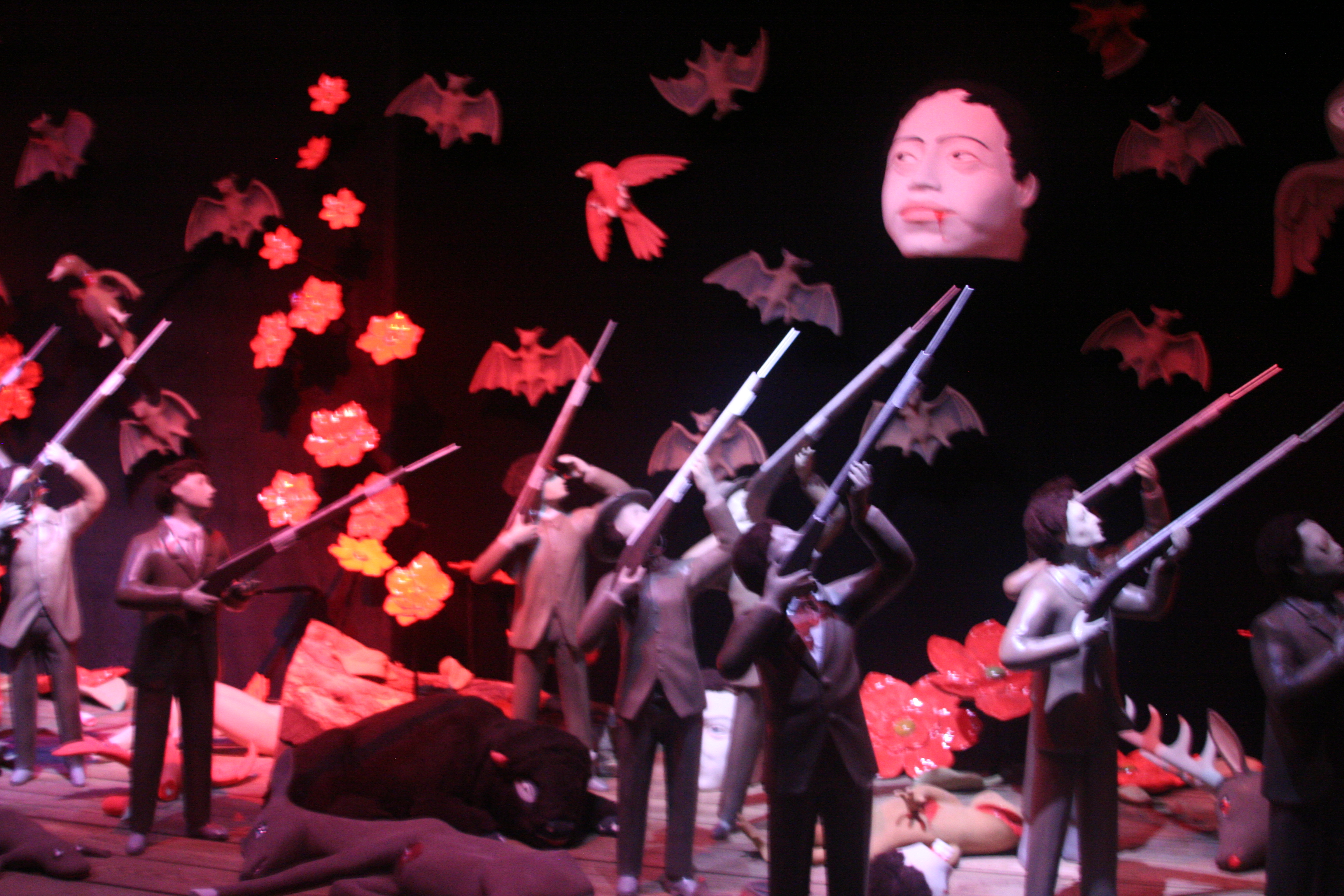
    Montreal Museum of Contemporary Art

    Four years ago when I was newly twenty and wandering around the Musée d’art contemporain de Montréal (Montreal Museum of Contemporary Art) on a Wednesday (the only free) night, I never would have guessed I would be one day writing an editorial for a contemporary art magazine. At that time I would take in any free event I could, even pretending to be a med student to get into wine and cheese events for newly graduated doctors. I walked around the Museum, staring at puppets and massive formations of wool and plaster and paper and metal, and I accepted the production and the process, all the while thinking in my head, “I don’t really get it.” And it’s true, I didn’t get it.

    Even then I knew people who made art; my girlfriend at the time painted abstract and I supported her in the selfish way a 21-year-old boyfriend supports something he doesn’t understand. I was used to reading depressing non-fiction books about the state of humanity; I could only really conceptualize straight-forward, simple, concrete ideas. Facts, not interpretation.

    Being in Montreal I often met people who willingly but begrudgingly worked as bartenders and grocery attendants while their peers from back home were child-rearing and flipping starter-homes. Societal norms state that people working these jobs aren’t contributing to society because they aren’t contributing to the economy, and thus in many ways, wasting their lives.

    “Yeah, one day I’ll get a real job,” is a phrase you’ll often hear from self-deprecating artists when talking with their more financially advanced friends. According to the norms of the world of creation, these people are working shitty jobs to have money to attempt the visualization—the realization—of some vague subconscious dream, of the tip of some idea that they don’t even quite understand, of a new feeling they can’t express any other way.

    There exists a new IT-based world of maximizing human efficiency and output. It benevolently wants us to waste absolutely no time on the mundane tasks with which our parents’ lives were filled, therefore improving our lives. New apps that are changing the ways we date, travel, sleep, are the foremost leaders in this push to free humans from the reality of being human, and to bask in all the free time we’ve gained. We praise the brilliance of our new tech-soaked free-market—an evolution of every capitalist generation’s attempt at increasing the productivity of the commodity that is human labour and thus, increasing capital. When productivity and value is based on output and dollar figures, soon art and creation are considered sluggish, lazy, and slow. And that’s the point when people don’t get it.

    Simply put, contemporary art is difficult for people to understand because art isn’t trying to sell something. The ‘art’ that people consume daily is limited to drab bus advertisements for cellphone companies, ten-second internet videos hoping to go viral, or kooky TV ads for razors. Ads make you feel hungry, inadequate, anxious and therefore, sell you something. Art forces you to sit down to decide what you feel, which always ends up being more significant than the pedestrian emotions stirred up by an ad. Art may portray ideas, even attempt to sway peoples’ opinions, but it isn’t selling a product besides itself. It is a series of emotions and ideas put together with paint and paper, mud and wire, mouse clicks and colour changes, foot movements and choreography, words and phrases.

    What I now realize, what I didn’t realize when I was walking around the Museum in Montreal, is that it’s not supposed to be easy. You’re not being sold something, so you don’t instantly, instinctively know what you’re consuming. Getting it may mean taking thirty seconds to sit and stare at it, to actually think about its colours and composition and lighting and materials, to consider something besides yourself and your walk to your car, something besides the digital billboard flashing in your face. It may mean to reread, re-watch, grab a seat and continue to look at all the corners of a canvas until you feel an emotion, when you feel that emotion, whatever it is, then you may get it.

    But then again, maybe not.
  • Lyrics of the Month: November 2015 – Geoff Berner

    My city has been in a housing crisis
    For fifteen years or more,
    Middle class families can’t afford to live here,
    And there’s a ten thousand dollar fine
    For being poor.
    They said if we let them build all these condo towers,
    The market would pull down the rent,
    Now we’ve got the most expensive city
    On the whole damn continent.
    Our Mayor says he wants Eco Density,
    And of course it’s a sin not to be Green,
    But when Mayor Happy Planet says Eco Density
    What does he really mean?

    He means
    Sunday, condos
    Monday, condos
    Tuesday and Wednesday
    Condos,
    Thursday, Friday,
    A few more condos,
    Saturday, for a change,
    Condos.

    What happened to a thousand culture buildings and counting?
    They knocked them down to build some condos.
    And the social housing on Little Mountain?
    Get rid of it!
    (We need more condos.)
    The Ridge, Richards, the Capital,
    That’s a special kind of condos—
    The kind of condos that you call
    After the thing that you knocked down to make the

    Sunday, condos
    Monday, condos
    Tuesday and Wednesday,
    Condos,
    Thursday, Friday,
    A few more condos Saturday, for a change,
    Townhouse condominiums.

    What’s the plan for the Georgia Viaduct?
    Well, they’re gonna knock it down and build some condos,
    And why’s the city four hundred million dollars on the hook? —–They’re fucked!
    They paid some guys to build Olympic condos.

    And what about the sacred burial site?
    Not as sacred as condos,
    Till the Musqueam Nation actually put up a fight,
    And that’s how you stop the condos.

    So what’s going to happen now, for God’s sake?
    Are we just going to let them build more condos?
    Or could there be a time when we finally put the brakes
    On Vancouver’s mad sickness for

    Sunday, condos
    Monday, condos
    Tuesday and Wednesday Condos,
    Thursday, Friday,
    A few more condos,
    Saturday, for a change,
    Market artist live/work studios.

    Geoff Berner, We Are Going To Bremen To Be Musicians, Condos

  • Blogging will save the world..

    White Butte

    I was accidentally put on a ‘panel of experts’ discussing homelessness at a recent documentary release. Politicians mingled with professors and service providers in an eatery that neighbours the dry men’s shelter. Concerned citizens arrived early to bounce pleasantries off one another, nibbling on fine sausage and kalamata olives. I showed up late, downed a whiskey to calm the nerves, and shook with anxious rage throughout the entire documentary.

    The panel discussion concluded past its allotted time, and the moderator hurriedly spilt the plan, funding model, and hopes for the upcoming year in the industry of homelessness, with no one really understanding what it all meant. The crowd left restless and confused as to how to help, and the panelists left more disgruntled than before, and a month later, mid-October, there are still people sleeping in the alley in Regina.

    As a white male, when I speak, people generally listen. They listen for two or three sentences until they realize that I don’t know what I’m saying, then they rightfully daydream about food and sports and sex. On this year’s Blog Action Day, a day where organizers attempt to unite writers under one socially-driven topic (a day that I use the prompt to get off my ass and write something off-topic), people were asked to consider the title Raise Your Voice. Writers, artists, and journalists have the responsibility to tell the stories of those who are unable to do so. But an important part of this is to give people the platform to tell their own stories. Those whose voices need to be heard—the marginalized, the people of colour, the refugees, the LGBTQ2, the Indigenous, the working class—are denounced because a wealth-driven patriarchal society determines whose voices have worth. For completely unjust reasons, I have a voice. Instead of only ever using my voice to amplify the voices of others, I attempt to use my voice and my actions to create a place where others can be heard without need for amplification. When you create a place where people have inherent value, their voices will inevitably be heard.

    To Raise Your Voice in the digital era by blogging, sharing, liking, or ranting is as effective as leaving scraps of paper with motivational slogans blowing in the gutters. Divisive and irritating, the internet only further entrenches beliefs and perpetuates ignorance. While speaking on the panel I kept repeating this idea that we can pressure and lobby government until our heads explode, but that this is only one, arguably ineffective, means to creating change. That the only way homelessness and class-divide will end is through a system-wide change, altering how we treat and relate to one another, and changing the wealth and social inequalities that oppress minorities. I left the event feeling empty and sick, for I sounded like a politician—pushing for an idea while offering no tangible examples of how it might work and while participating in no organizing that may lead realization of the idea.

    Appealing to the judicial, legislative, or executive branches of government in the hope of reform is as realistic as accepting the offer made by the March Hare during the Mad Tea-Party in Lewis Carroll’s Alice in Wonderland:
    “Have some wine,” the March Hare said in an encouraging tone.
    Alice looked all round the table, but there was nothing on it but tea.
    “I don’t see any wine,” she remarked.
    “There isn’t any,” said the March Hare.

    -Hedges, Wages of Rebellion, The Post-Constitutional Era, p 61

    On Thanksgiving Monday I biked to the advanced polls to participate in the experiment of democracy. My hands numb in the wind, I waffled left and right each time I saw an election sign posted in a front lawn, truly not knowing who’d get my vote upon arrival. I’d rather waffle left. I voted in a way that reflects my values. I voted in a way that is considered a throwaway. This is because I do not believe in the ability for real reform under the current economic system in which the major parties function, but I simultaneously participate in this economic system and rarely make an effort in being a part of breaking it down. When I raise my voice but drink my sorrows, doing nothing to participate in making true change, I am complicit.

    Later on Thanksgiving Monday I lost a game of cribbage to a person who I’ve only known for a few months. It definitely wasn’t the first game of crib I’ve ever lost, and sure, I gave away several pairs of sevens to the crib. After he pegged out and we congratulated ourselves on a game well-played, I laid on the floor and watched him paint while we listened to new Northcote and RahRah. My new friend has been housed for three months, homeless for years before that, and still requires regular and extensive assistance to live a healthy life. I am extremely privileged to be employed by one of the few places that actively works to repair the damages caused by the wealth inequality synonymous to the capitalism, however, continually cleaning up the messes left by a system that purposefully destroys the lives of a particular cultural group is ineffective. Working within the current system is necessary to a point, but a total dismantling of this system is required to ensure real, lasting equality.

    There is no morality in words. Morals are behavioural, based in how a person acts. A person can raise their voice to the heavens while sitting in their recliner. If you raise your voice without breaking a few walls, no one outside your already-converted group will hear you. Breaking walls means breaking laws, breaking norms, supporting (verbally and physically) oppressed minorities, and thinking outside of the “cult of the self”* in which we find ourselves.

    And I can say with certainty that I’ve never broke down a wall in my life…

    *Hedges

  • Lyrics of the Month: August 2015 – Incalculable Effects

    We were all together in the pouring rain. Solvents being passed around to dull the pain. The air was choked with the dismal smell. The reek of sadness and despair. Minds fucked-up beyond repair. She said she just turned six. She’s got some good jokes for a kid. She’s working hard to avoid a woman bleeding from her teeth. Her life goes on despite the fact her mom sleeps fucked-up on the cement. She flashed a look, an image burnt into my mind. I know that sinking feeling all too fucking well. Shame, frustration setting in. Confusion that burns us inside out. “I don’t know what’s wrong with me. I don’t know why she can’t wake up.” Her life goes on despite the fact. Her mom lays fucked-up on the cement. It’s an ugly fucking world.

    Propagandhi, Supporting Caste, Incalculable Effects

  • The Carmichael Free Press

    This originally appeared at CarmichaelOutreach.ca.

    Carmichael Free Press copy2
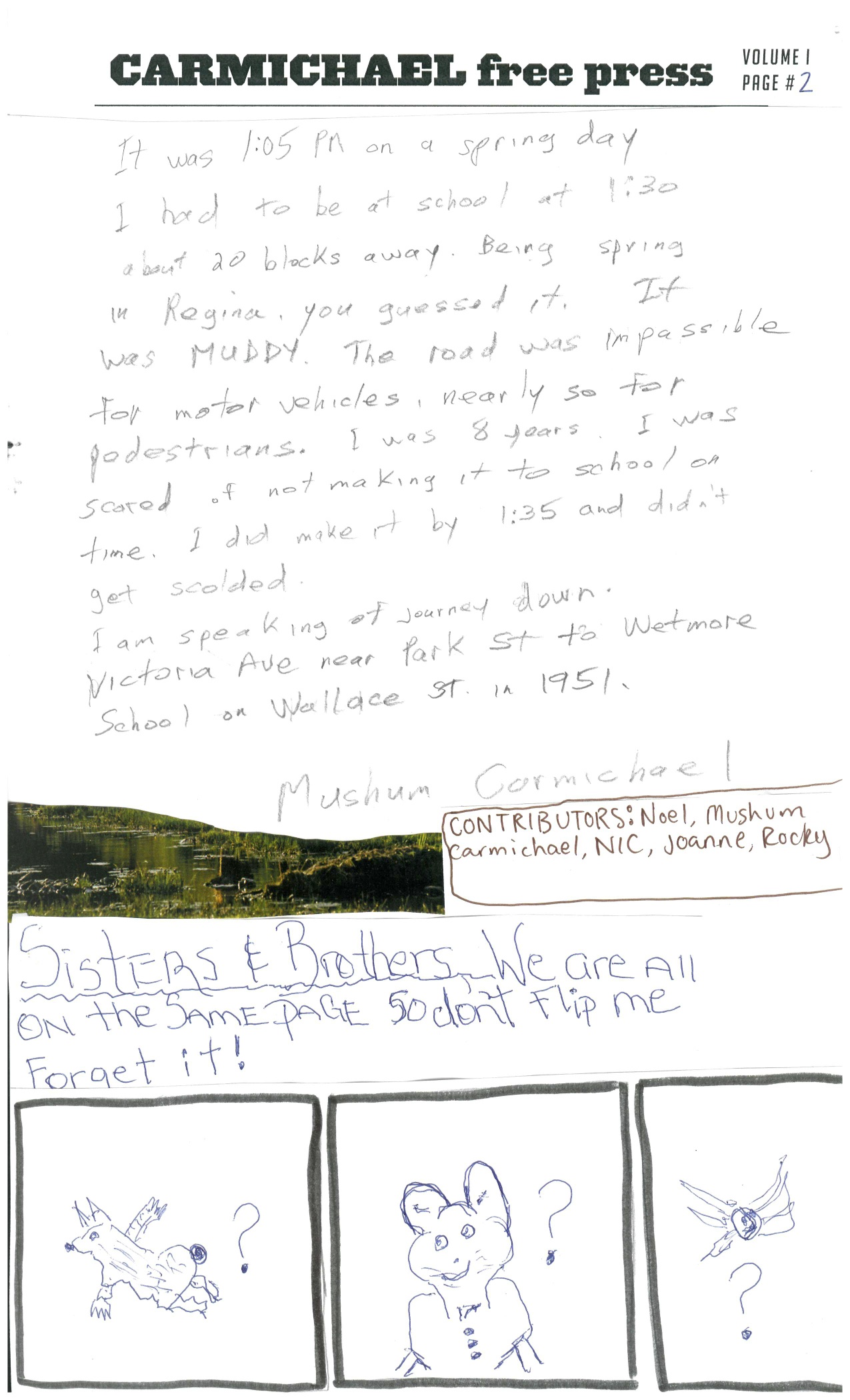
    Noel, Rocky, Mike and others sat in the coffee room on a Thursday afternoon and asked what was going on for programming that afternoon. “Art Class!” I proclaimed on my way downstairs. I brought up the box of scrapbooking supplies that former gourmet chef and art mastermind Mike Wysminity paid for with money he raised himself by selling tomato plants at the Farmers Market in pots hand-painted by Carmichael art participants.

    I tossed markers, fancy-edged scissors, stickers, moon-shaped hole punches on the table and people started creating. Noel wrote an inspirational quote and drew a cartoon. Mike wrote a poem. Lisa wrote a note to her son under a picture of him taken from a previous Carmichael Hockey Day. Brian wrote a story. Then staff members cut them out, organized them, and pasted them on the template, made copies, and printed them for the masses.

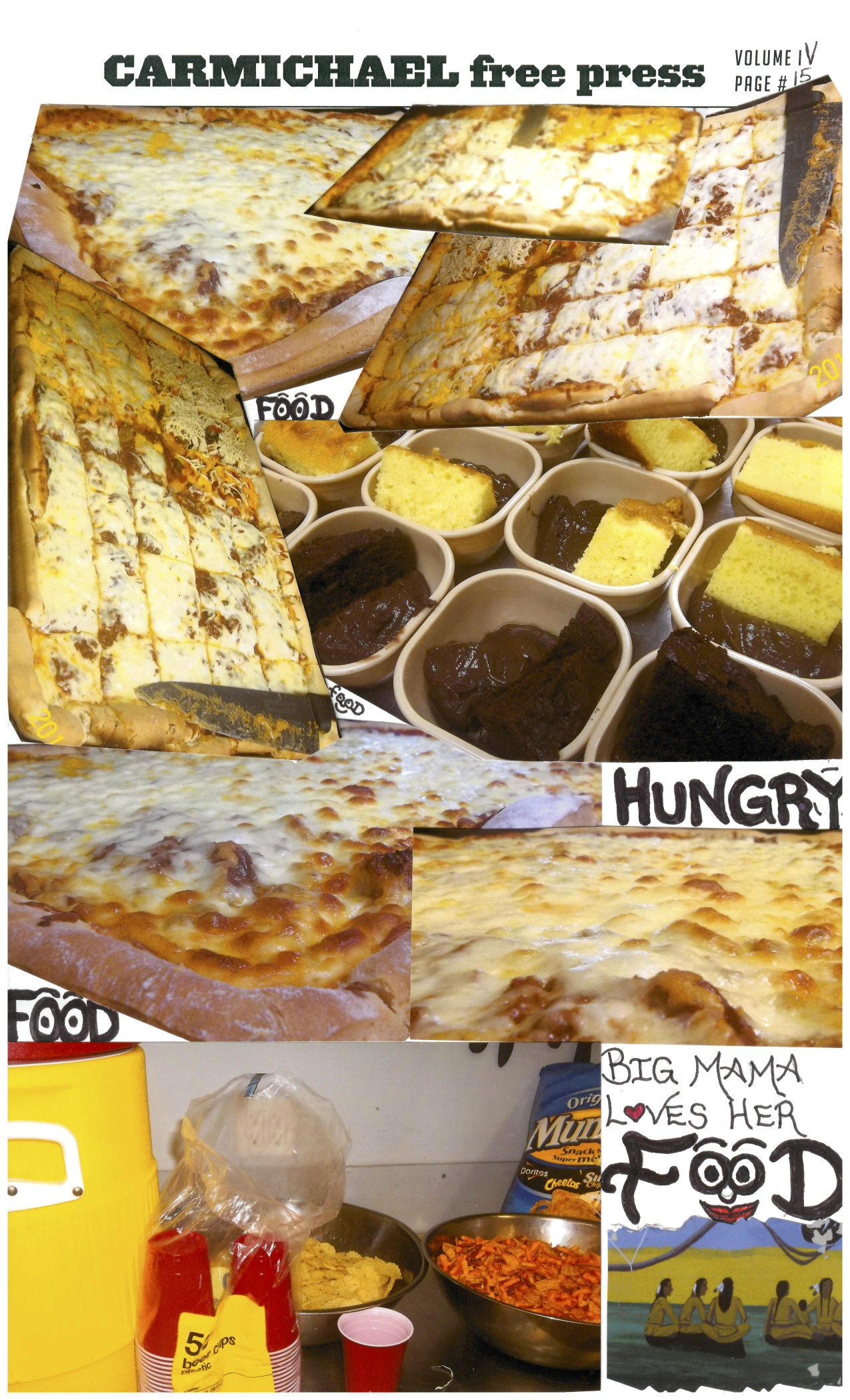
    The Carmichael Free Press is a grassroots publication on it’s fourth edition so far—a zine style scrapbooking newspaper that anyone can contribute to. Not topical, always different, the Free Press is a creative home for real, not-pretentious, unknown writers, artists, painters, comics, mothers, children, and more, not only to produce something they are interested in—they are proud of, that makes them laugh—but to have it shared with their group of friends, the Carmichael staff, and the greater community.

    The first ever headline of the Carmichael Free Press was borrowed from a photograph from a previous Carmichael photography class partnered with the Heritage Community Association and Sask Arts Board.

    “Here you go!” he said, as he passed his page to me with the inevitable nervous feeling of sharing something you just created. The headline read, “The Princess Royal Walk – Her Royal Highness Visiting Heritage Centre in Regina Sask…..” with an up-close picture of a loyal volunteer. Everyone in the room laughed at the joke. Real news be damned, street news is what matters. The experiences of people in your neighbourhood who you have never met are what truly matter, not the business interests of private national media. Hailed by its creators as “The most important newspaper in Saskatchewan,” the Free Press begins its climb to the top.

    Thursday afternoon Art Class at Carmichael has evolved as necessary from painting to drawing to scrapbooking to newspaper-making to who-knows-what-next, depending on interest, on funding, and on person skills of the facilitator. The informality and drop-in style of the Art Class is what makes it a success. Peter walked into the coffee room, saw his friend sitting at the table, saw markers, scissors, empty pages of the Carmichael Free Press, and sat down for ten minutes, drew a remarkable drawing of a pipe with the smoke forming a buffalo, eagle, bear. He thanked us for the time and headed on his way.

    Big Mama Page

    Every person has the right to have their voice heard, published, and distributed. People in your city are depressed, pissed off, a little bit high, lonely, in love, tired, dope-sick, or extremely happy, and they are entitled to these feelings. The power that is gained in sharing these feelings, putting them in some creative form, is invaluable. Outside of the online world of status updates and cartoon smiley faces, people need to have a forum to express themselves, and since Facebook and other online media aren’t accessible to those without internet access and aren’t really collective, the Free Press fills the void.

    Authors and artists work years to get things published or get their art hanging in a coffee shop in the over-marketed world of writing and art, but that doesn’t make the voice of the amateur any less important. If anything it makes it more significant; not being sold as a commodity or graded like a high school paper.

    The Carmichael Free Press is the perfect example of Carmichael programming—drop-in-style, no cost, inclusive to all, hilarious, frustrating, and motivating. Sober or not, published or not, practiced or not, community members can use the Carmichael Free Press as a home for personal expression, a place for injustices to be made public, love to be shared.

    The sign-off of our first edition reminds readers what the Free Press is trying to proclaim each and every edition—the importance of listening to and helping out people you have never met, and encouraging you to get to know them one way or another, possibly by participating in your local Free Press!

    “Sisters and Brothers, we are all on the same page. So don’t flip me!”

    Carmichael Free Press copy

  • Lyrics of the Month: July 2015 – Drunk on a Bike

    It happened so fast
    He didn’t have time to think
    Or maybe he had too much
    a bit too much to drink
    When he went riding off
    into the bright sunshine
    It turned out to be
    the lights of a car
    Can somebody help me please
    Scrape this man up off the road
    Can somebody help me please
    I cannot do it on my own
    As the police
    were scraping him off the fender
    A friend of his said
    that he had been on a bender
    and that he had a huge fight
    Yeah, he had a fight with his wife
    Then he got pissed off
    Then rode off on his bike
    He was drunk
    He was drunk on a bike

    -SNFU, The One Voted Most Likely To Succeed, Drunk on a Bike


  • Counter Assault

    We stood on the trail from the lake to our campsite, holding hands in fear of our premature deaths. What the fuck is that, I had wondered, an elk? It was a blondish brown patch of fur the size of a beach towel, stomping in the bush. It turned its body around for us to see enough of its shoulder to know that it wasn’t a charming, peaceful elk, but a medium-sized, overly curious grizzly. We backed our way down the path, jingled our keys and bear bells like distracted children at a Christmas pageant, trying to remember the advice from the Bear vs Human pamphlets. We spoke loudly, awkwardly. She recited poetry, I repeated it in booming baritone.

    Not to lose the feel of the mountains
    while still retaining the prairies
    is a difficult thing. What’s lovely
    is whatever makes the adrenalin run;
    therefore I count terror and fear among
    the greatest beauty. The greatest
    beauty is to be alive, forgetting nothing
    although remembrance hurts
    like a foolish act, is a foolish act.

    -John Newlove, excerpt from The Double-Headed Snake, The Wascana Poetry Anthology

    The fear of death brought the idea of practice into our minds. The more your practice it, the less you fear it. The next week, (although we saw no more quadrupedal omnivores on the trail) we felt stronger, more secure, more confident in grizzly country. But the pressurized can of capiscum in my back pocket, Counter Assault Bear Spray, may have been the source of that confidence. By the tenth time I see a bear, fear will be an afterthought and the Coghlin’s Brand Survival Horn that we bought for a sense of security will be even more of a prank.

    After nearly two weeks surrounded by a Matt Goud/Tim Barry/Ken Freeman/Allison Weiss tour, you learn to fear not death, but inaction. Don’t be afraid of dying, be afraid not to live, Tim would say most nights. A wasted life is worse than death. Not in a danceclub/yolo/butt-touch kind of way, but in a I’ve-wasted-enough-time-on-all-the-bullshit kind of way. These mantras ring throughout the art that most closely resonates with me. But ‘wasting’ is what needs to be discovered. What is living?

    The greatest
    beauty is to be alive, forgetting nothing

    I’m reading books about writers. Fiction books. Bohemian authors of San Francisco or Toronto talk about the noble craft and its apparent sexual exploits. Dry literature, to me, but classic to many. It somehow puts the fear in me. Not the fear of death, but the fear of running out of things to say that are worth anything, the fear of writing about writing; writing about extramarital affairs, writing about ‘cultural eras’. So here I am, trying to scare the fear away the only way I know how. With practice.

    I dream of quitting my day job to write. Drive across the country occasionally, wash dishes at the pizza place, sit in a grungy library facing a scuffed-up wall and do something as banal as ‘express myself’, being naive enough to think it might change someone’s perspective. But to me, not paying attention to your neighbour is a waste of both your life and theirs. Not living is comforts and distractions. Quitting to pursue a naive selfish dream of typing nonsense onto a dead tree or into a digital void, can seem like a waste. Is a waste.

    But it may also be a waste to isolate, to work 11 hours a day even in the vague name of social justice, to sit in a stiflingly humid bachelor apartment overflowing with hats, broken bicycles, interprovincial beer. So which is it?

    Not to lose the feel of the mountains
    while still retaining the prairies
    is a difficult thing…

    It becomes a lot easier to fear not death, when it isn’t literally knocking on your fire escape window, asking your deteriorating body if you want a huff. To have the privilege to even make this choice is what eats me alive like a starved grizzly south of the Crow’s Nest Pass. And these words are my only Counter Assault.

  • HAT FARM

    Hat Farm

    HAT FARM on Instagram

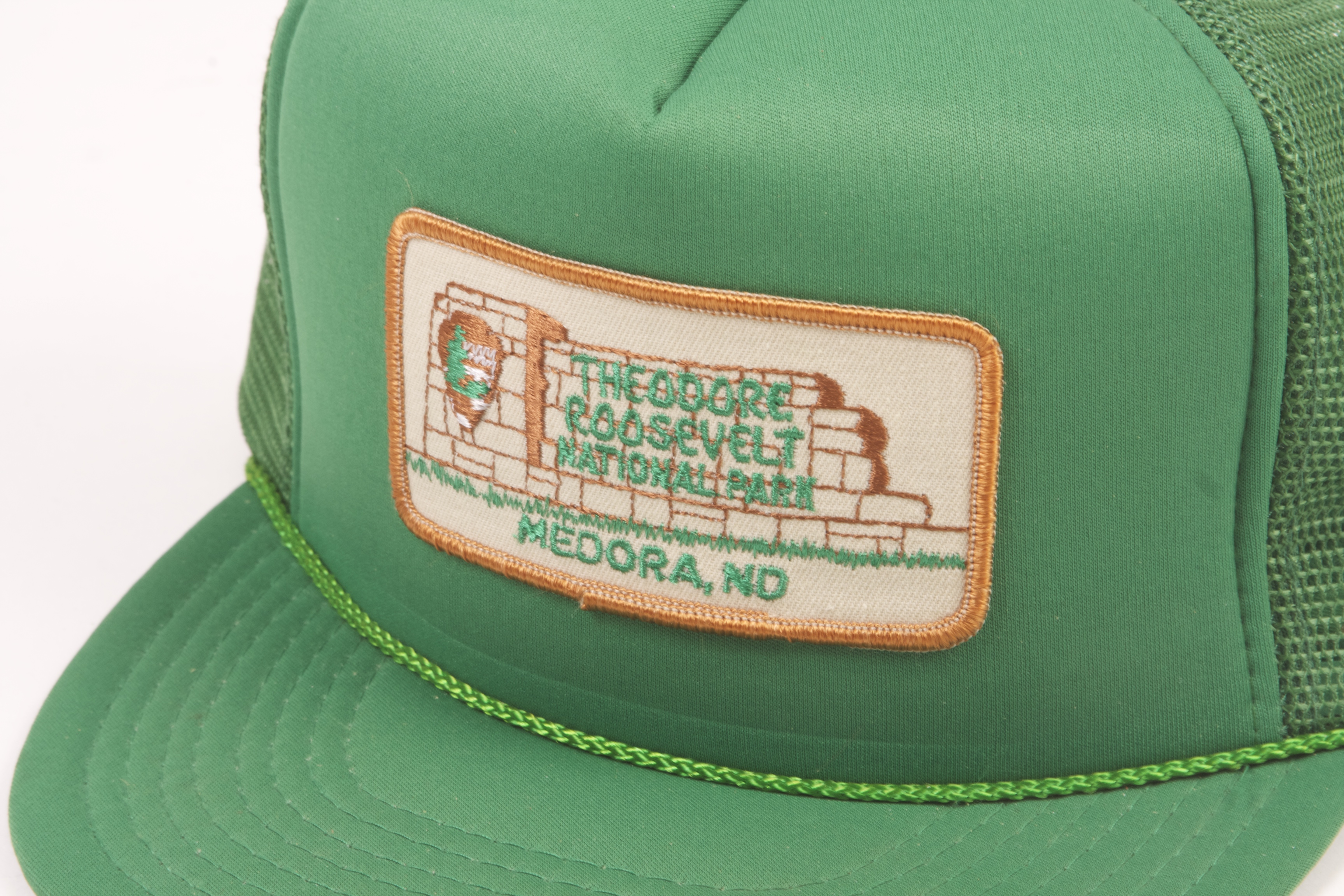
    Since it’s invention, the ball cap has been the preeminent accessory of comfort and the ultimate casual lifestyle. People participating in baseball games or other leisure activities, those hiding from the harsh rays of the sun, those who don’t know how else to deal with a bad hair day, or those who don’t take themselves too seriously, wear hats. But they also wear hats simply because hats are comfortable.

    HAT FARM was born out of a desperate need for simple funds for the Carmichael Outreach Housing Program, and the regular classic hat donations received by the Clothing Depot Donation Program. Carmichael’s Housing Support Team works to remove the barriers the community has in finding adequate and safe housing, which often includes small financial obstacles that aren’t covered in other budget lines or in housing clients’ budgets. The profits made here will go towards removing those barriers and thus housing people, and keeping them housed.

     Teddy

    The hat I wear daily is one I’ve had since I was 12 years old, but only started wearing it about a decade ago. I have separation anxiety when I don’t have it for long periods of time. I have nearly lost it out the window of moving vehicles, in fist fights on the beach in Mexico, in severe gusts of prairie wind, in the rivers of Thailand, off ferries on the west coast. I’ve repaired the plastic snap three separate times, and the once body-filled hat now rests limp and tattered like a discarded pair of briefs. I have moments of panic knowing that one day it will disappear in a drunken stupor or traumatic event, some instance where losing your head and what rests upon it is possible. For that reason I began auditions for a new, future everyday hat. Like when your best friend moves away, you start flipping through your contact book dejectedly for someone that may be able to partially fill the void, if anything at least for a weekly beer.

    When I began hat auditions I happened to be working at Carmichael Outreach, a community drop-in centre downtown Regina with free food, coffee, hygiene products, housing services, needle exchange, and clothing, open to anyone in the city. Hundreds of clothing donations are dropped off to the back door weekly where they are sorted and put out for the community depending on their seasonal use and if there is room in the tiny three-rack clothing depot. Community members browse daily for clothes, dishes, puzzles, Patsy Cline CDs, used printers, children’s books, all of which are free in the clothing depot, open all day Monday to Friday. Closets from all over Saskatchewan have been cleaned out after decades of storage bringing in vintage Star Wars toys, unworn embroidered cowboy shirts, antique decorative plates, slightly malfuctioning DVD players, and much more.

    Larsen's

    One day I walked into the clothing depot to find a stack of hats six feet long, the collection of hat connoisseurs around the province. Farm industry logos, country legends, family vacation destinations, family reunions, all immortalized on the unparalleled medium of the trucker hat. Several small town hat collectors dropped off their decades-old work so that hatless men in the city could feel the dignity of cranial comfort once again. Before the hats were put on the rack, I searched through the most classic, mint condition, collectors hats from all over the world, and documented the rest which have all been put back into the clothing store.

    All proceeds from the hats collected and sold here will go towards the Carmichael Outreach Housing Program, including funds for damage deposits, carpet cleanings, new small household items, fees for money orders for rent payments or identification applications, or any other potential barriers that might keep community members from maintaining stable housing in the City of Regina. Because as much as a person needs a nice ball cap to feel comfortable, a roof over their head does them one better.

    For more information, to buy, or to donate, email thehatfarm@gmail.com

    Halfway Husky

  • Lyrics of the Month: June 2015 – Good Clean Fun

    This is the new revolution we’re building a brand new society
    It’s about time we find a solution and not watch it slip away
    It’s time that we all work together
    This little thing we call unity has the power to make it all better
    And that is why today
    We’ll all be on the streets
    Saving the scene from the forces of evil
    Side by side, living our dreams
    All the positive people
    We’ll fight our way through the frustration
    Overcome negativity
    To us it is not a temptation
    Because that is not the way
    All that is needed to start this is a healthy dose of positivity
    We’ve found our way through all the darkness
    And on this brand new day
    We’ll all be on the streets
    Saving the scene from the forces of evil
    Side by side, living our dreams
    All the positive people
    -Good Clean Fun, On The Streets Saving The Scenes From The Forces Of Evil
  • Don’t Forget

    Nightly Inspection

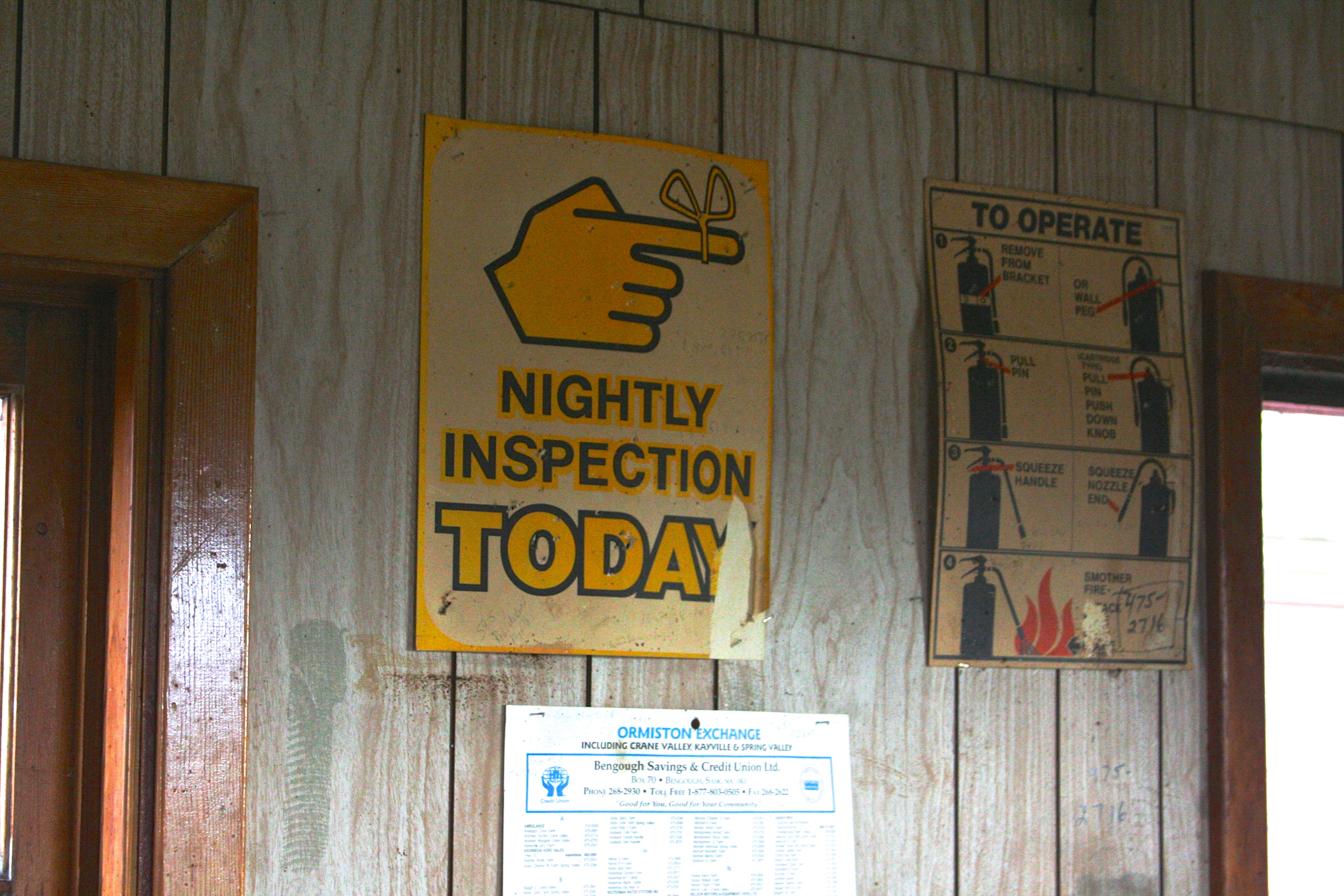
    Tie a string around your finger so you don’t forget. Use different coloured string for different levels of forgetfulness. A ribbon on your pinky reminds you to make kale chips when you get home. A shoelace around your thumb reminds you to tune up your vehicle. A wayward greasy carpet string around your ring finger reminds you to keep in touch with that person you’ve had a crush on for a few years. A wire coiled around your index finger, gouging your knuckle each time you make a fist, reminds you, most important of all, to remember the other strings on your hand.

    You need a string on your finger to remind you of leisure. Leisure that isn’t slovenly but leisure that is joyous, relaxing, not overthought. So you go for lunchbreak for the first time in years. You lounge next to a tree in the park with a friend, discussing light topics such as bicycles and ice cream and green grass and cats. You are succeeding at the leisure-string that you haven’t even tied on your finger. Maybe you don’t need to tie one on your finger at all.

    Then a man, the same one you heard at the cenotaph gracefully preaching fire and brimstone to Friday Noon-Hour Lunchers, walks up to you and hands you a wallet-sized card, a fear-mongering reminder of your chronic problem with sin. He, a thirty-something-year-old touts ideas you thought were reserved for the fundamentalist old people, but doesn’t make you uncomfortable because your beliefs aren’t accidental but somewhat calculated and purposeful. He openly and strongly curses murderers and rapists and liars and thieves and those who use the Lord’s name in vain. He curses them to hell (the last three of which he asked if you do, to which you flatly respond, of course, daily) because he knows the grace of God better than you, and nearly, without so many words, accuses you of being a rape apologist, something like Norm on Bill Cosby fans. Because you don’t believe in the right kind of justice.

    It’s difficult to have a conversation with a walking hate-filled preacher of love, a tape-recorder repeating language of heavenly bodies that is so far removed from the injustice of reality that a comprehension of human suffering is lost. His idea of justice is burning alive anyone who has ever farted and doesn’t share his belief system of how to get forgiveness for passing gas. Your idea of justice takes into account the victim, previous injustices, and human nature.

    These are some big ideas, you tell him, we’ll give them some thought. He leaves to make the next group of people he talks to feel scared and angry, just like what his teacher told him to do, right?

    A blue piece of floss around your outstretched middle finger. Remember that everyone has a right to a belief, but that right and wrong aren’t as clear as a heaven and hell.