Category: Books

  • Entitled to Poverty

    “I’m called crazy a lotta times already. It don’t bother me.

    My wife says, ‘Leon, you gotta expect it.’ She says, ‘People never understand a man who wants something more outa life than just money.’

    People think you gotta be one of two things: either you’re a shark or you gotta lay back and let the sharks eatcha alive—this is the world. Me, I’m the kinda guy’s gotta go out and wrestle with the sharks. Why? I dunno. This is crazy? Okay.”

    -Richard Yates, A Wrestler with Sharks, Eleven Kinds of Loneliness

    I have never done drugs. I have had very brief moments of controllable levels of alcoholism. I have lived in a life of love and unending comfort. And I curse myself for it. I curse my parents, though with thankful undertones. If I hadn’t been brought up in comfort, I’d know what people mean when they say addiction is a cave, where every step towards its mouth is also a step towards vulnerability’s gnawing teeth of open air and light. I’d know what they meant when they tell me about being dope sick, being shunned by lifelong friends. Instead, I’m that fucking ignorant suburban kid who got arrested once for being too much of a goddamn square to know how to spraypaint a wall in secret, who nods and says ‘it’s hard’, when I actually haven’t the slightest goddamn clue.

    After one of my cynical, over-tired rants about people who own Mercedes-Benz vehicles, my father asked me where the line is when wealth becomes acceptable. Mom wisely, fairly, replied, as I was walking out the door to get my dad to drive me to the pub, that each person must decide this line themselves. As I shut the door, I told her that everyone sucks at determining where wealth is acceptable, so maybe I should decide for them. The makings of a true communist dictator. We all smiled and soaked in the exaggerated version of my disgruntlement. Dad drove me to the pub. I brought my cynicisms to my boss on Monday morning. She said that she doesn’t think wealth is bad. Wealth is a dirty word to me. It is entitlement. Entitlement based on good decisions and investments, hard work, responsibility. Entitlement is based on the belief of personal ownership when really nothing in this world is wholly ours. Therefore entitlement is greed and arrogance. Entitlement in any form is unattractive and abrasive. Wealth is not unacceptable, but it must be responsible, sustainable, frugal, generous, moderate, fair.

    My recent public speaking engagement revolved around my travels, my writing, my work, and punk rock. I spoke to a group of twenty seniors who likely relate punk music to Elvis. I told them that it took me quitting university, going to India three times, travelling North America with the musically-inclined, writing a sorry excuse for a book, to finally find a place where I felt like I was supposed to be. And it has never been harder. I also told them that we all fit in in the same way, by an obligation to help those in need, in whatever means we can. However, it is not, and will never be, enough.

    Ann Livingston is a true wrestler of sharks. A co-founder of VANDU, she helped establish the first safe-injection site in North America as an act of civil disobedience, done before it was made legal by the government. She suggests that the obligation to save lives is always greater than the obligation to obey the law. This seems like common sense. Similarily, the obligation to help others is greater than the obligation to obtain wealth. This may (or may not) be widely agreed upon, but not widely practiced. I know that I am lucky to have the job I do. They could’ve hired another graduate student, straight off of the uninformed teat that is institutionalized education, who would be more able than I to write government grants and better know the system in which people must play to find comfort and peace. And there wouldn’t have been anything wrong with that. I am lucky to have a job that has a direct impact, and though it may seem otherwise, I do not give myself credit over others for it. I often do the opposite.

    It is important not to be the shark. There are enough of them. It is equally important to not allow the shark to ‘eatcha alive’. If each one of us decided to poke the shark, to throw a rock at the shark in the pool of water that it circles hungrily, the problems that I am unable to relate to would change substantially. We would leave our entitlements and privilege behind. We wouldn’t have to curse our parents for loving us.

    I love you, mom and dad.

    However, it is not, and will never be, enough.

    Why? I dunno. This is crazy? Okay.

  • Books of the Year: 2012

    The following five books were my best reads of the past year, only Days of Destruction Days of Revolt being released in 2012.
    Read these or your brain will fall out.

    Michael Christie – The Beggar’s Garden
    Franz Kafka – Metamorphosis
    George Orwell – A Clergyman’s Daughter
    Chris Hedges and Joe Sacco – Days of Destruction Days of Revolt
    Kurt Vonnegut – God Bless You, Mr. Rosewater

    Honourable Mentions:
    Franz Kafka – The Trial
    John Steinbeck – Grapes of Wrath

  • Youth (Me) and Why I Hate Them (Me)

    Santa called me at work. The recording of his voice seemed as if he cared less about Christmas than I do. Painfully forced. Knowing full-well that he hated his life. His voice brought forth images of a forty-nine year old male drinking from a 40oz of bad whiskey on the day before his birthday which also happened to be Christmas, wearing a vomit-stained cotton beard, just after calling his ex-wife about when he’ll pick up his sixteen-year-old over the holidays. A slouch. All the recording told me was that I need to be good so that he would deliver a present in my chimney this Christmas. Not even a promise of a free cruise. Just a pre-solicitation for something that may or may not include the loss of my anal virginity. This is Christmas.

    And children love him. They love the undoubtedly alcoholic, morbidly obese. The kids that cry at Santa photos are the ones with natural instincts to stay away from the downfall of mankind.

    But who am I to judge this digitally-recorded Santa? I have become that lonely old man who sits alone, thinking about the one(s) that got away, smelling the various disgusting parts of his body throughout the day. The man who constantly wonders what happened to the younger generation. Who loathes technology, the things considered as viable entertainment, many forms of social interaction. At twenty-four, I am that man. Different, but no better than the inebriated Santa robo-calling the nation with threats of gift-giving. But, I don’t know what previous generations were like, so I can’t responsibly say that I can see a cultural and intellectual decline. And saying that the world is worse off than it has ever been is history-ignoring naiveté.

    And when I’m thinking of points to my argument of why youth are despicable and why I don’t want to be a teacher or have a child, I have to check my email three times, look up the writer to an episode of television. My attention span has been shortened thanks to constant interruptions in my pocket and the ability to get any information that I ever wanted at any time.

    In the thirties, Evelyn Waugh’s characters of ‘Vile Bodies’ seemed to constantly critique the younger generation.

    ‘Don’t you think,’ said Father Rothschild gently, ‘…[t]hey won’t make the best of a bad job nowadays. My private schoolmaster used to say, “If a thing’s worth doing at all, it’s worth doing well.” My Church has taught that in different words for several centuries. But these young people have got hold of another end of the stick, and for all we know it may be the right one. They say, “If a thing’s not worth doing well, it’s not worth doing at all.” It makes everything very difficult for them.’

    ‘Good heavens, I should think it did. What a darned silly principle. I mean to say, if one didn’t do anything that wasn’t worth doing well–why, what would one do? I’ve always maintained that success in this world depends on knowing exactly how little effort each job is worth…distribution of energy…And, I suppose, most people would admit that I was a pretty successful man.’

    -Evelyn Waugh, Vile Bodies, p111

    The slight shift in the adage, and the youth become defeatist, single-use, one-task brains. Instead of attempting at excelling at many things—like how your dad can fix the car, build a bathroom, design a power plant, and your mom can fix jeans, bake the greatest pies known to man, know so much about health and the world—the youth decide that they will attempt to perform a single task adequately, while being useless at everything else. Because they can.

    The wise adults of this book then talk of success being the bare minimum with maximum profit and high efficiency. Success. Suddenly moronic youth with one skill-set and the inability to focus sound pretty reasonable. Like the success-hunting adults, but with a sense of humour.

    If Santa calls me back, I would like to talk to him. Not just listen to his nightmarish recording. He has seen the youth and he has seen them grow up. They have sat on his lap for the hundred years that he has existed, and he has seen them grow up into these success-hunting adults, placing their new children on his lap, and so on, and so on. He would know. He’d be able to tell me if the youth are getting dumber. If technology is ruining our ability to focus, or ability to give a shit, or ability to be shocked, or ability to learn and retain. I mean, he is the one making most of these toys and giving them to our kids. And at that revelation, Santa’s drunk voicemail message seems more threatening than before. Not only does Santa want to deflower my anus, he also wants the be a part of the plague of idiocy in our children. The dumber the children become, the more they need his gifts. The more they need his gifts, the fatter he becomes. The fatter he becomes, the more women he gets.

    Don’t call back, Santa. I’m already plenty dumb.

  • Losing Faith

    Nenem

    I recently received this in an email from a friend in India:

    Do you still remember my youngest sister Nenem, you may take her to be your wife if you have any interest. But it would depend upon your choice only though I say anything. Actually young girls needs a trustworthy, abled man for husband and they should be loyal. A lot of marriages are broken causing a lot of problems consquencly.

    Directly after receiving this email, I booked a flight, moved to India, and took Nenem as my first wife. She is currently cooking rice and tending to our Kama-Sutra-conceived children while I sit in a mango tree, my feet being massaged by jewelled monkeys, my scalp being pampered by one hundred barbershop gurus.

    And just now, as the basement furnace powers up and blows cold air at my feet, I am transported back to my cobwebbed corner in my hole in the frozen ground—left only to the gurus of daddy-long-legs and head lice that pamper my once routinely- and professionally-kneaded head.

    Sweet India. Land of many faiths, land where I lost my own.

    The last time I returned from India a new man. It wasn’t I-lived-in-an-ashram changed, nor I-tried-forty-kinds-of-marijuana changed, or even I-was-almost-raped-three-times changed. I came back with a newly-filled gap in my mind. I came back with no interest in the functioning church in which I grew up, and which I partially went to support. I lost complete interest in proselytization or evangelism. I lost my faith and replaced it with a set of values. I became so fed up with the culture of organized belief, the culture of changing people’s beliefs, and the language of faith that inhibits people to speak in the realm of reality—reality, where suffering occurs but where nothing is done because of often blinding visions of a possibly non-existant afterlife utopia—that I handed it in and haven’t really looked back. My friend, Nenem’s brother, was unable to speak of anything but the Glory of Our Lord and the financial support he required to live and to preach. I didn’t write a list of for and against. It wasn’t an immediate disbelief in the resurrection that made me never return to church. It was part of a constant evolution of the mind that peaked while travelling alone, as it tends to do.

    It is a mysterious thing, the loss of faith—as mysterious as faith itself. Like faith, it is ultimately not rooted in logic; it is a change in the climate of the mind.

    -Orwell, A Clergyman’s Daughter, p249

    Propagandhi’s Supporting Caste coincidentally came out during my last trip in India, and I somehow managed a minor miracle to download the album off of Indian iTunes. It was my only friend while travelling. One night, after calling home on my prepaid Indian cellphone, sitting on the beaches of Cochin at night, after four months of solo-travel, I finally realized that the greatest moments in life are better when shared. I have been able to enjoy things alone, but having the ability to acknowledge the greatest things with someone else, is the creation of joy. Joy isn’t a seasonal shopping opportunity at the Victoria Square Mall. Joy isn’t a faith-only feeling. I realized this again over the last few nights when watching my favourite band of all time. I enjoyed parts of the set alone, but the moments I was most elated were those when I sang aloud in the arms of good friends. Imagine the everlasting joy I would have if I actually just took part in arranged marriage to a conservative Christian girl in a village in India. Never-ending, tantric, yogic, conservative joy.

    My faith was replaced with something else. Something no less powerful. It was replaced with some sort of logical desire for decency and equality in the real and tangible world, both rooted in my Christian upbringing and my love for socially-conscious punk rock. Not that values didn’t exist in my life beforehand, they just sat at the back on my brain, washed out by uncertainty and contentedness. And as much as it pains my father to hear it, my faith was partially replaced with many of the tenets of a Winnipeg punk band. Neither the band nor the church would quickly agree that (what I would identify as) their basic doctrines line up—absolute equality, that the “unifying principle of this universe is love” (Propagandhi, Duplicate Keys Icaro). I connected my early life in the church basements in which I had grown up, to the realities of poverty, inequality, and hypocrisy that I had seen while travelling, and filled that gap with a set of discernible values that I seemed to lack previously. A serious respect still exists in the utmost for people who adhere to systems of faith, as it is another means to the end I am constantly seeking, and it helped mould my values to what they are now.

    The smell of glue was the answer to her prayer. She did not know this. She did not reflect, consciously, that the solution to her difficulty lay in accepting the fact that there was no solution; that if one gets on with the job that lies to hand, the ultimate purpose of the job fades into insignificance; that faith and no faith are very much the same provided that one is doing what is customary, useful, and acceptable.

    -Orwell, A Clergyman’s Daughter, p295

    A man of faith is the same as a man of no faith, as long as both are acting positively in regard to humanity. Both are inevitably flawed. One puts hope in the unknown, one puts hope in something else—science, humans, another form of the unknown. Perhaps I put my hope in myself, not in a self-righteous, superiority-complex kind of way, but in the way that I am the only thing that I know can make an absolute change in, and hope things can move on from there.

    This is no where near the first time I’ve been proposed to, or propositioned, by someone in India, but it has been some time. Though I am flattered, though I wish I could get fifty-cent haircuts in India once a week, and though I think it could potentially work out better than a love-marriage, I will not take him up on the offer. This man, Nenem’s brother, is still a friend. And though many of his thought-processes irritate me as anti-productive or misdirected, I do not see my new vague set of values as greater than his faith. Mine will waver and transform as does anything philosophical. I merely lost my faith a while back, replaced it with something new. If he forgets his ultimate purpose, and I realize that I don’t have an ultimate purpose, and we work together to help those we know need it, then we can be mutually productive. The fact that he offered me his sister without her even knowing it, or likely even speaking English, is another issue that we’ll have to sort out after the marriage. Curry feast to follow.

  • Human Progress is a Sasquatch

    Sections of the few naturally-occurring trees in southern Saskatchewan have been cleared to make roads and paths. These lead to lakes and rivers and adjacent to these lakes and rivers more trees have been cleared for what is known as the commercial campsite. Commercial because you pay for it. Campsite only because that is what they call it. Very rarely is it used for actual camping. I discovered that my idea of camping differs greatly from that of some people, even those I am close to. This past week at Greenwater Provincial Park, each time I walked by a trailer that was nestled nicely beside a seadoo trailer, a boat trailer, a mosquito zapper, a belching generator and a satellite dish, I thanked God that we knocked trees down for these goofballs. But they might ask, as believers in the advancement and intellectual supremacy of the human species, why not bask in our dominance over nature? I would answer that camping is connecting with how humans are supposed to live, reliant on and connected to nature, without distraction, where time doesn’t matter and phones are useless, entranced by the natural and primal thought-nurturing wisps of a late-night fire. But for our neighbours across the way, camping means watching the Olympics on a slightly smaller flat-screen television, slightly closer to a seaweed-ripe body of water, distracted by the shallow and personless characters on a screen. Our campsite of four tents and eight people, a fire and several chairs, a hatchet and a flashlight, compared to their campsite (listed above) shows how much we have advanced technologically as humans, but shows how as humans we remain the exact same.

    Human progress. The idea that we as humans can advance through technology, science, industrial efficiency, or mass production to become greater than the previous level attained, whether that means mentally, spiritually and even anatomically. That the advancements in how we do things, as if a catalyzed form of evolution, will propel us into a sort of utopia.

    Some may consider our ability to live in absolute comfort anywhere we want Human Progress. Who needs fires and tents and knives when we have generators, fifth-wheel trailers with two bathrooms, and slap-chops? The progression of our systems does not ensure the progression of humans. Our innovations are not making us better humans that are approaching perfection, they are taking us downwards, into an ignorant, illiterate, unaware cell that is not greater than the fire pits, the nomadic life, the simplicity from whence we came.

    Progress not only failed to preserve life but it deprived millions of their lives more effectively than had ever been possible before.

    Bruno Bettelheim via Chris Hedges’ TruthDig Column

    Almost seventy years ago this week, Nagasaki and Hiroshima were bombed. World War II and the few years after, epitomized by the final acts in Japan, are what Vonnegut’s Kilgore Trout calls ‘The Finale Rack of so-called Human Progress.” A Finale Rack, the set of fireworks wired together by a pyrotechnician to light as the ‘grand finale’ for the gazing patriots and children. The nuclear bombs were dropped and we have been making them ever since. “It was science, industry and technology that made possible the 20th century’s industrial killing,” Hedges says. It was our ‘Human Progress’ that made possible the destruction of hundreds of thousands of humans.

    Apparently, Human Progress is an odd looking creature, like what we can imagine a Sasquatch might look like: floppy ears, hairy face. Non-existent. But if it does exist, what better place to find it than the tree-cleared campgrounds of Southern Saskatchewan. It is probably cozied up in its trailer watching the Rider game with the firepit dead and cold ten-feet away.

    “What a relief it was, somehow, to have somebody else confirm what I had come to suspect toward the end of the Vietnam War, and particularly after I saw the head of a human being pillowed in the spilled guts of a water buffalo on the edge of a Cambodian village, that Humanity is going somewhere really nice was a myth for children under 6 years old, like the Tooth Fairy and the Easter Bunny and Santa Claus.

    -Vonnegut, Hocus Pocus, Chapter 26, p204

    The myth of Human Progress, characterized perfectly in contrasting campsites, is eating away at our world. It is tearing apart the environment, making mass-murder more and more accessible, and at the same time we remain the same clueless, occasionally barbaric human beings, only now with larger tools to highlight our cluelessness and barbarism. Instead of whittled willow twigs we have the sturdiness of a bent piece of wire. To complement those, we have wire racks to hold them over the embers. If we get lucky we can use a grill instead of a wire, and if we really show our advancements, we would just use a propane range. Our hotdogs and marshmallows have advanced in the way we cook them, but in the end we are still eating the same damn thing.

  • The Deadlifts of Success

    My person has been threatened. By another person that is greater, more successful, wittier than I. I mean, a clever writer that also enjoys spending time on the floor? Goddamn. Talk about identity theft, man. If only I had been lucky enough to get a useless arts degree and have to move home to my parents’ farm, where hilarious, pathetic, obstacle-surpassing events could have occurred. I got dealt a shit hand in the world of semi-original writers of essays.

    My roommate Bryce, the one who spends his days doing ‘dead-lifts’ (whatever the hell those are), weighing his turkey bacon, the household vegetable, down to the gram, and bench-pressing pizza pops, a very motivated and determined man, told me that the best thing we can all do is to give up. Several times in a day, even. If this is what a soon-to-be provincial record-holder says, then what on earth would an unmotivated wiener like me do? He would agree, of course.

    Once we hit seven billion, I knew it was over. The chances of being an original, one-of-a-kind individual when there are that many people in the world are slim. Not-worth-putting-a-dollar-on-it slim. There is someone out there that looks a lot like you, only with smaller ears and a nicer gum line. There is someone out there with your exact mannerisms, only far easier to tolerate and definitely more charming. There is someone out there that wrote what you wrote only with bigger words, less swears and more marketable jokes. So you might as well give up. So says Bryce, my personal trainer in the game of life.

    My dad gave me a copy of The Globe and Mail, “a newspaper with decent writing”, he said as he looked at the copy of the Leader Post in our mailbox. Compared to our local publications I would tend to agree with him. However, compared to real, actual, impartial, worthwhile writing, I would disagree. Regardless, there was a section on CanLit, he told me, and being a potential part of the CanLit scene, albeit an unestablished, unimportant, mostly inutile one, I figured I’d look it over. One of the ‘up-and-comers’ (a term I loathe) that the article mentioned, Iain Reid, author of ‘One Bird’s Choice‘, seemed like that one-or-two-out-of-seven-billion successful versions of myself. Published as opposed to self-published. Writing a second book in the shadow of success and already under contract, instead of writing a second book already planning on how much money I will lose in self-publishing again. Looking good with short hair instead of like a fresh-out-of-juvie gang member. And I guess I’m jealous. Of his accolades. Of his ability. Of his newspaper-worthiness.

    But I don’t want to give up. I write because I enjoy it, at least that is I tell myself when I am editing/staring at the wall trying to distinguish between the off-putting odours arising from my body. I do it because, although I cannot make everything happen that I want to happen in life, despite what real life-coaches and the successful tell you, I can make it happen on paper. (Only the successful tell you that you can do anything you put your mind to, when I bet most of them just got really fucking lucky.) The day I discovered that writing can be absolutely anything, that it doesn’t have to be done to please a teacher, that it doesn’t have to be real, logical, simple, or formatted, was maybe the day that instead of giving up on writing, I gave up on writing for others.

    And I’ve finally learned exactly what my life-teacher meant. That I should give up so much, that I give up on giving up. I’ve given up on mostly everything I’ve started, so why not try giving up on that. Goddamn Bryce, you genius.

  • Nobody reads.

    Nobody reads anymore.

    My book, in my mind, is written for the ultimate casual reader. Short chapters. Easy topics. Non-fiction. Penis jokes. Swears. I may start counting the number of people that have told me that they haven’t finished my book. It is large. I’m guessing half of those I sold. And I don’t blame the readers as much as I blame the writer, I can think of thirty-thousand things I’d rather read and I’d suggest you read instead, however the inability to finish a book written by a child who pretends to be adult, strikes me. Makes me sad in both the ‘yeah, I can’t write‘ kind of way, and also the ‘yeah, people can’t read‘ kind of way.

    I am in a current struggle editing stories. The phase I dread more than anything. The one that reminds me of why I hated English in school, and why I quit. One person who would think they could see the goddamn rings of Jupiter, a person that I asked to help, and is helping greatly. Stories are difficult enough, and when I write them in hopes that they are suitable for people that don’t like to read, I must do something even greater. Appeal to those that don’t care while making it interesting for those that do. A daunting task even for a practiced wordsmith. I’m hooped. But it was Vonnegut who told me to write for one person.

    “If you open a window and make love to the world, so to speak, your story will get pneumonia.”

    Vonnegut said, “Nobody reads anymore” when describing a book I’ve never read. I don’t have the balls to say that phrase with authority. I’m not well-read enough. Later on in his introduction he says that a short story, “because of its physiological and psychological effects on a human being, is more closely related to Buddhist styles of meditation than it is to any other form of narrative entertainment.” Nobody reads because nobody has to. Entertainment has technologically surpassed it. Digitally we are limited to reading infinitesimal posts and our attention span suffers for it. Nobody reads because nobody can bring themselves to sit down for a minute and meditate like a Buddhist.

    Vonnegut’s first rule of Creative Writing states that a story should be written so that the reader will not think their time had been wasted. I guess that is where my first book went wrong, and so far, every story I’ve ever written, or anything I’ve ever done. Wasting time in a creative manner is no better than wasting time in a destructive manner. I guess I’m searching out the place where wasting time becomes being productive. Wasting my time and yours. I guess I’m searching the person who decides that.

    I hope I’m not that person.

  • QC

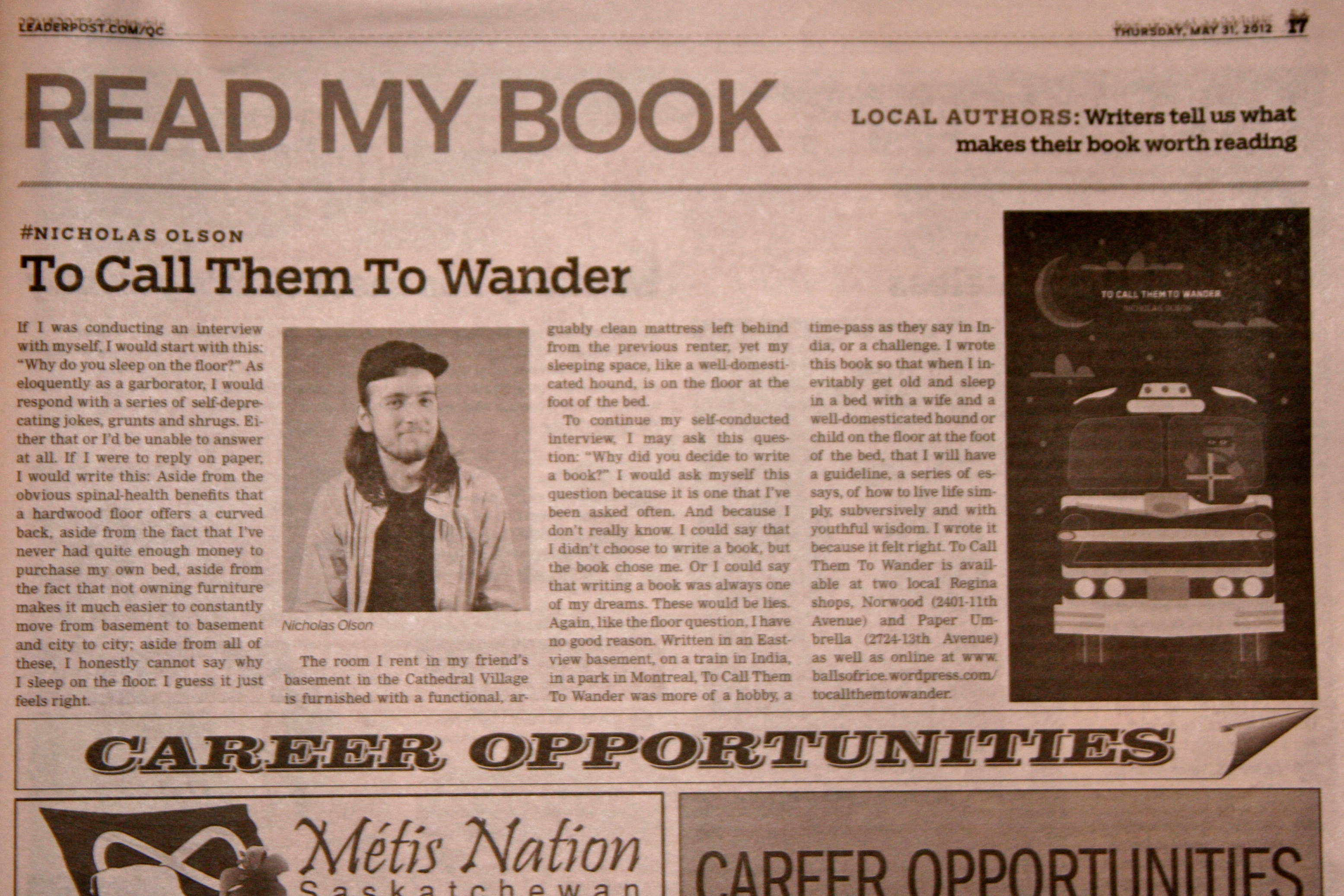
    This write-up recently appeared in QC newspaper’s Read My Book column, complete with glamour shot by Noel Wendt. 

    If I was conducting an interview with myself, I would start with this: “Why do you sleep on the floor?” As eloquently as a garborator I would respond with a series of self-deprecating jokes, grunts and shrugs. Either that or I’d be unable to answer at all. If I were to reply on paper, I would write this: Aside from the obvious spinal-health benefits that a hardwood floor offers a curved back, aside from the fact that I’ve never had quite enough money to purchase my own bed, aside from the fact that not owning furniture makes it much easier to constantly move from basement to basement and city to city; aside from all of these, I honestly cannot say why I sleep on the floor. I guess it just feels right. The room I rent in my friend’s basement in the Cathedral Village is furnished with a functional, arguably clean mattress left behind from the previous renter, yet my sleeping space, like a well-domesticated hound, is on the floor at the foot of the bed.

    To continue my self-conducted interview, I may ask this question: “Why did you decide to write a book?” I would ask myself this question because it is one that I’ve been asked often. And because I don’t really know. I could say that I didn’t choose to write a book, but the book chose me. Or I could say that writing a book was always one of my dreams. These would be lies. Again, like the floor question, I have no good reason. Written in an Eastview basement, on a train in India, in a park in Montreal, To Call Them To Wander was more of a hobby, a time-pass as they say in India, or a challenge. I wrote this book so that when I inevitably get old and sleep in a bed with a wife and a well-domesticated hound or child on the floor at the foot of the bed, that I will have a guideline, a series of essays, of how to live life simply, subversively and with youthful wisdom. I wrote it because it felt right.

    To Call Them To Wander is available at Norwood (2401-11th Avenue) as well as online at http://www.ballsofrice.wordpress.com/tocallthemtowander.

  • Into The Abyss

    On Saturday nights—when you are drinking weekend beers with your friends, when you are snuggled up close to your loved one, when you are deep in your weekend sleep—I mop up vomit. I mop up vomit at a place that describes itself as a lounge. A lounge that is pure, and one that is ultra. I have not yet discovered any of these to be true. As I mop, I think of my resumé. I think about stacking my resume with these marketable skills, as if it were my education, as if learning to spread coffee grounds over semi-digested foods on dancefloors was a highlightable skill for the future. I think of what is ahead while I mop up vomit, while rich undergrads smash bottles and spill glasses on purpose. I think of my three levels of savings accounts.

    I have recently discovered a fear of death, sort of like how someone discovers they have a taste for wine, through gradual exposure, trying it out with different foods in different settings. My fear is not one that causes me to stay at home where I am safe, nor one that will bring me to the altar on my knees. More of a fearful interest. For several reasons, it has been an evident theme lately.

    Through the first few chapters, the book ‘The Warden’ by Anthony Trollope includes men fighting over the will of a rich clergyman. On Easter Sunday my family and I lightly discussed our last wishes. My possibly hyperbolized wishes included selling my ten dirty t-shirts, putting all of my money in a chest and burying it in a field somewhere. They also included burning my body in a field, on the Ganges, or in some other sort of humble effigy. My parents mentioned the necessity of lawyers and I cringed. They told stories, similar to that in ‘The Warden’, of people feeling entitled and therefore hiring lawyers and fighting family members. You can fucking have it, I figured. Smiling, Dad told me that I can have the money, as long as I have the house, the cars, the investments, and keep them. I’ll opt for the the tent and Indian spices. A will is a glorified, end-of-life resumé. Where we gather our experience of investments and property and distribute it among our family, those references that are ‘available upon request’.

    Watching the documentary ‘Into the Abyss’ by Werner Herzog did not help my fear of death. A dark study on the themes of death, violence, capital punishment, and time, it forced me to essentially witness three murders and the ten years that followed them. It forced me to watch as death was handed out like Metro newspapers in downtown Regina. Speaking of the man who was about to receive a lethal injection, the woman who had her mother and brother murdered said that some people just don’t deserve to live. The former executioner says that no one has the right to take a life. Schoolyard law still rules sometimes, schoolyard disagreements always will. And so it goes.

    My fear of death could have to do with all this. With the savings accounts. Vomit is the physical incarnation of regret. And I am its janitor. Other than that, I will not begin to speculate as to the the reason of this new found fear.

    And like death, the unanswerable phenomenon, I will end this blog abruptly. Without conclusion. Surprising and empty.

  • Time Travel

    Had I been a literary man I might, perhaps, have moralized upon the futility of all ambition. But as it was, the thing that struck me with keenest force was the enormous waste of labour to which this sombre wilderness of rotting paper testified.
    -H.G. Wells, The Time Machine, Chapter 11, p131

    We can walk through walls. When I was in grade seven my friend told me that his older brother learned this in university. Physics class told him that it was technically possible for us to walk through walls if we lined up our particles perfectly with the gaps of the particles of the wall or door or window. Physics is mysticism. I would maybe ask a different question. Why bother walking through walls when we can teleport anywhere we want? To take our physical being, the particles that make us up, and come up with some wavelength that could capture them, and send them far away to the destination they wish. But does such an extraction of physical being also carry with it the soul of a person, or does that get sucked up in the mass of all the rest of the souls swirling in the atmosphere? Science fiction becomes real, just ask the inventors of Skype. ‘The Jetsons’ are science fiction.

    Then you may ask, if you were discussing such topics with people with scientific minds, unlike my rotting philosophical mind, if you would rather be teleported to be able to see who you want when you want, or if you would rather travel through time. The moral implications of time travel are different than the business implications of teleportation. Undoubtedly institutions such as the Canadian Government would quickly shut down open discussion about things such as teleportation because dialogue with educated professionals is apparently unhealthy, and teleportation would make obsolete Canada’s fastest growing source of income, also known as ‘The Tar Sands of Our World’s Demise.’ As titled by me. But I’m sure in the vast expanses of the Canadian North, the oil companies and Harper would be able to find some rare mineral that a teleportation device would require to run, market that and start to ban discussion on time travel, which most level-headed people would want to use to escape the natural-resource raped present in which we find ourselves.

    Later, when I was in grade nine, I learned firsthand about time travel when I starred in the White City School production of H.G. Wells’ The Time Machine. I was the Time Traveller. I wore Chuck Taylors, my time machine was a wheelchair with a silver-spray painted lever and a laptop. Once, at the start of a scene walking with the Eloi named Weena, my futuristic wireless microphone provided a shriek of feedback into the ears of the audience. I grimaced and pretended that nothing happened, but have always looked back upon this occasion in regret that I didn’t improvise and say something like, “There are many unsourced and unpleasant noises in this future time.” At the end of the play, my grandparents complimented me by saying, “You sure had to memorize a lot of lines,” instead of what I was hoping for: “You sure acted the hell out of that play, Nic.” I still think I could have done better. If only I had a time machine to go back and restart my acting career.

    As for the previous question, I would opt for teleportation. My curiosity as to what goes on in the future is less than my desire to see the current world as I wish. The current world, something I do not know enough about, still needs to be properly discovered before I can learn about the future. The same logic applies to my recent selection of books. We can now only hope that when teleportation is inevitably invented (this inevitability based on ‘The Jetsons’ science fiction logic) that the Government ceases to hide facts of the past and the present like climate change and the ice age, possibly coinciding phenomena, to save an industry that is killing us all. Either that or we can focus on a time machine, travel far into the future or past to escape a present that we seemingly cannot change.

    While biking home last night I encountered a train. It was a long train. I saw and heard it coming, pedalled as hard as I could with the cool air burning my lungs, but the striped reflective arm of the railroad crossing came down like the fist of God. Would it have been better for me to own a time machine to go back to leave five minutes earlier, or to have a teleportation device to leave exactly when I wanted to? A time machine suggests more of an escape route masked with scientific intentions. A teleportation device is not as pretentious in suggesting simple, expedient, clever transportation that says, “It is nice to be where you want to be.”

    Face this world. Learn its ways, watch it, be careful of too hasty guesses at its meaning. In the end you will find clues to it all.
    -H.G. Wells, The Time Machine, p99, Chapter 7