Category: Mental Health

  • Good People

    I sat cross-legged in the cushioned armchair, scratching paint off my water bottle in the cozy, warmly coloured, obviously intentionally non-institutional office of my psychologist/psychotherapist/whatever.

    Isn’t it enough to just be a good person and treat people well? she asked after a near hour-long discussion of how far one needs to go to make the world less of a festering shit hole, with me grinding myself into a hole trying to figure out how to do so.

    I thought it over. I pictured the tax-paying, maybe church-going, home-owning, child-rearing city councillor who occasionally shovels his neighbour’s sidewalk and might even give a few bucks in December to one of the organizations that sent Christmas mail-outs. His kids are in hockey. He loves his spouse.

    No, I said. That’s a cop out. 

    I wondered what she thought—-that I was attacking her personally—-or if she was clinically breaking down my obvious guilt that stems from years in conservative religion, my fear that comes from the insecurity issues of being the youngest child, my anger from decades of not expressing myself in healthy mediums, and my depression which is induced by the daily watching of my friends dying while my other friends are not even able to give a shit. She was likely doing neither, she is significantly smarter than I.

    Because of constant deconstruction of social programs, the development of neighbourhoods that are exclusive in nature, and the importance financial-driven success, being a good person means keeping to one’s self. It means not being an evil person. Not being a murderer, rapist, tax-evader, alcoholic, street worker. Not beating your children or spouse. Not pouring toxic waste into a animal rescue facility. Not bothering your neighbour. Being a good person, by the standards of our colonial, patriarchal society, means staying in line. The fact that my day job exists entirely to remind people of their worth, that they aren’t bad people for needing a shot of morphine everyday by noon, that they aren’t bad people if they fall off the wagon, that they aren’t bad people for being on welfare, that they aren’t bad people for having a culture that precedes the current—-the fact that this day job even exists, shows that good people, in today’s standards, are those with privilege.

    I drank a sip from my water bottle, an action steeped in anxiety, done to make me look more natural. After a near hour of discussing my rage, my mind became blurry. By the time we got around to ways I can improve upon myself, I didn’t have the energy to comprehend new ideas. I pretended to take another sip of water from the empty bottle and nodded along with my psychological professional.

    Being a good person and treating people well wouldn’t be a cop out if it meant something else. If it means more than smiling in public and not using racial slurs, then it may be enough. Enough to make changes that matter, to staunch the wounds that pour blood into the alleys. But until it does, until the characteristics of being a ‘good person’ include understanding and standing up for those our system have methodically destroyed, being a good person is not enough.

    It’s not the fault of the good people that they are good people under the current model of good. We have been gutted and replaced with slop from the machine of individualistic, selfish commercialism. Our jobs don’t allow us the time to give a shit. In order to stay sane, we bask in the glory of our beautiful families and don’t look out the window to the family being kicked to the curb by a police officer, because we legitimately don’t have time, because the Mayor has stricken that topic from discussion in council, because if we do, we’ll get depressed. Good people everywhere don’t know how to participate in a change they want to make, so they rely on posting on internet, or they don’t do anything. I am that kind of good person.

    Tonight as I watched city council directly shut down citizen concerns, bully them by calling requests of accountability disrespectful, and promote gun violence as seen on their favourite television shows, I watched a room full of good people fighting for their definition of good. The uninformed relied on tokenism, touching stories, and fear tactics to justify their definition of good, that is, to justify the increase in funding for the organization that protects their privilege. The informed stood up and defended their idea of good, that is, they were willing to understand and stand up for the good people outside of the room who have been trampled by the uninformed, power-protecting policies of racial profiling and bad-person profiling. Everyone was working for their own idea of good. Some of them were just unfortunately, painfully, and dangerously uninformed. I left city hall with a renewed interest in changing our current definition of what makes a good person. How we go about doing that has never been my strength.

    I left the psychologist’s office $160 poorer, one-hour later, one vague understanding of fear and guilt, with one empty water bottle. I’m going to have to book another appointment. Or two.
     

  • Blogging will save the world..

    White Butte

    I was accidentally put on a ‘panel of experts’ discussing homelessness at a recent documentary release. Politicians mingled with professors and service providers in an eatery that neighbours the dry men’s shelter. Concerned citizens arrived early to bounce pleasantries off one another, nibbling on fine sausage and kalamata olives. I showed up late, downed a whiskey to calm the nerves, and shook with anxious rage throughout the entire documentary.

    The panel discussion concluded past its allotted time, and the moderator hurriedly spilt the plan, funding model, and hopes for the upcoming year in the industry of homelessness, with no one really understanding what it all meant. The crowd left restless and confused as to how to help, and the panelists left more disgruntled than before, and a month later, mid-October, there are still people sleeping in the alley in Regina.

    As a white male, when I speak, people generally listen. They listen for two or three sentences until they realize that I don’t know what I’m saying, then they rightfully daydream about food and sports and sex. On this year’s Blog Action Day, a day where organizers attempt to unite writers under one socially-driven topic (a day that I use the prompt to get off my ass and write something off-topic), people were asked to consider the title Raise Your Voice. Writers, artists, and journalists have the responsibility to tell the stories of those who are unable to do so. But an important part of this is to give people the platform to tell their own stories. Those whose voices need to be heard—the marginalized, the people of colour, the refugees, the LGBTQ2, the Indigenous, the working class—are denounced because a wealth-driven patriarchal society determines whose voices have worth. For completely unjust reasons, I have a voice. Instead of only ever using my voice to amplify the voices of others, I attempt to use my voice and my actions to create a place where others can be heard without need for amplification. When you create a place where people have inherent value, their voices will inevitably be heard.

    To Raise Your Voice in the digital era by blogging, sharing, liking, or ranting is as effective as leaving scraps of paper with motivational slogans blowing in the gutters. Divisive and irritating, the internet only further entrenches beliefs and perpetuates ignorance. While speaking on the panel I kept repeating this idea that we can pressure and lobby government until our heads explode, but that this is only one, arguably ineffective, means to creating change. That the only way homelessness and class-divide will end is through a system-wide change, altering how we treat and relate to one another, and changing the wealth and social inequalities that oppress minorities. I left the event feeling empty and sick, for I sounded like a politician—pushing for an idea while offering no tangible examples of how it might work and while participating in no organizing that may lead realization of the idea.

    Appealing to the judicial, legislative, or executive branches of government in the hope of reform is as realistic as accepting the offer made by the March Hare during the Mad Tea-Party in Lewis Carroll’s Alice in Wonderland:
    “Have some wine,” the March Hare said in an encouraging tone.
    Alice looked all round the table, but there was nothing on it but tea.
    “I don’t see any wine,” she remarked.
    “There isn’t any,” said the March Hare.

    -Hedges, Wages of Rebellion, The Post-Constitutional Era, p 61

    On Thanksgiving Monday I biked to the advanced polls to participate in the experiment of democracy. My hands numb in the wind, I waffled left and right each time I saw an election sign posted in a front lawn, truly not knowing who’d get my vote upon arrival. I’d rather waffle left. I voted in a way that reflects my values. I voted in a way that is considered a throwaway. This is because I do not believe in the ability for real reform under the current economic system in which the major parties function, but I simultaneously participate in this economic system and rarely make an effort in being a part of breaking it down. When I raise my voice but drink my sorrows, doing nothing to participate in making true change, I am complicit.

    Later on Thanksgiving Monday I lost a game of cribbage to a person who I’ve only known for a few months. It definitely wasn’t the first game of crib I’ve ever lost, and sure, I gave away several pairs of sevens to the crib. After he pegged out and we congratulated ourselves on a game well-played, I laid on the floor and watched him paint while we listened to new Northcote and RahRah. My new friend has been housed for three months, homeless for years before that, and still requires regular and extensive assistance to live a healthy life. I am extremely privileged to be employed by one of the few places that actively works to repair the damages caused by the wealth inequality synonymous to the capitalism, however, continually cleaning up the messes left by a system that purposefully destroys the lives of a particular cultural group is ineffective. Working within the current system is necessary to a point, but a total dismantling of this system is required to ensure real, lasting equality.

    There is no morality in words. Morals are behavioural, based in how a person acts. A person can raise their voice to the heavens while sitting in their recliner. If you raise your voice without breaking a few walls, no one outside your already-converted group will hear you. Breaking walls means breaking laws, breaking norms, supporting (verbally and physically) oppressed minorities, and thinking outside of the “cult of the self”* in which we find ourselves.

    And I can say with certainty that I’ve never broke down a wall in my life…

    *Hedges

  • The Carmichael Free Press

    This originally appeared at CarmichaelOutreach.ca.

    Carmichael Free Press copy2
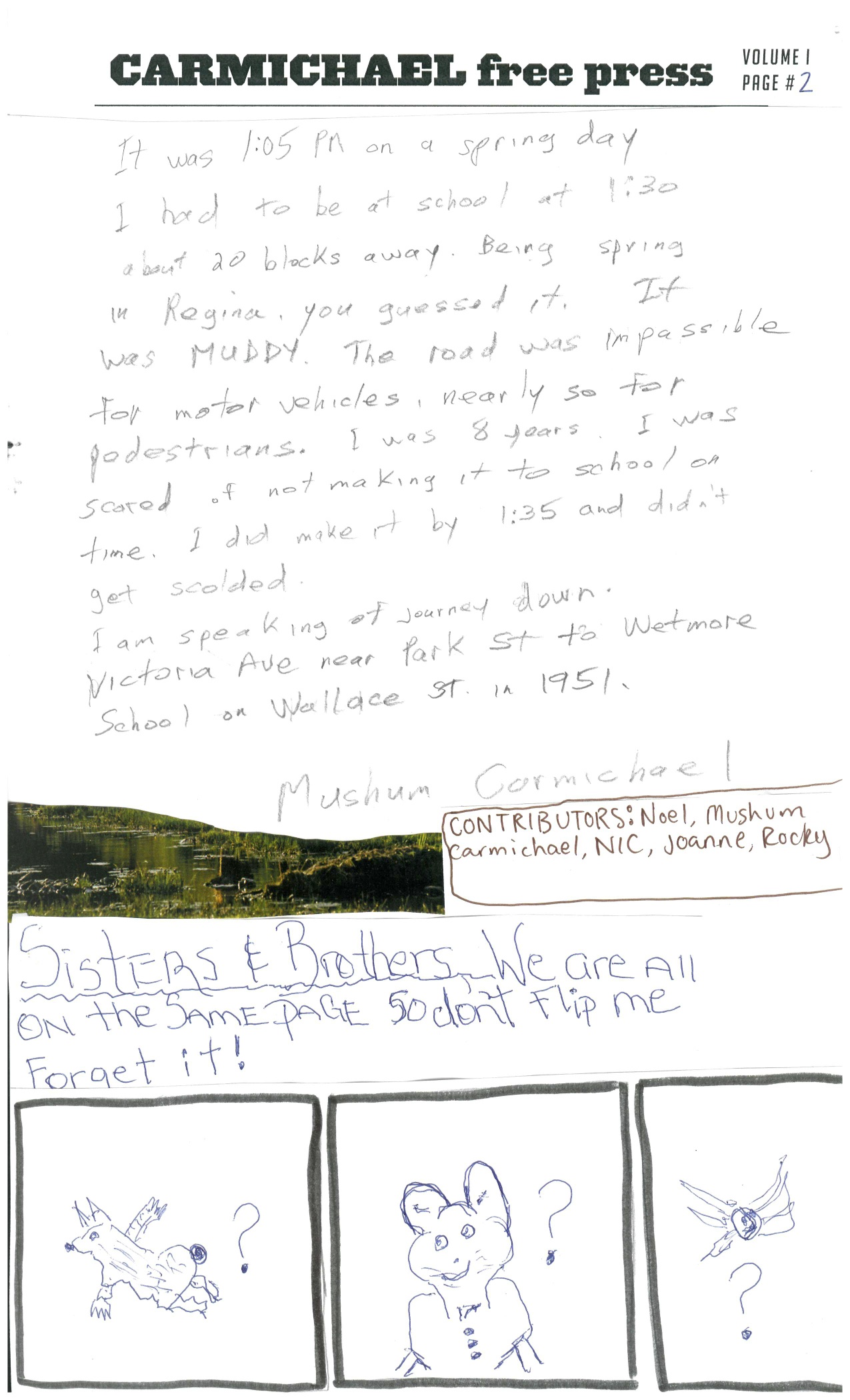
    Noel, Rocky, Mike and others sat in the coffee room on a Thursday afternoon and asked what was going on for programming that afternoon. “Art Class!” I proclaimed on my way downstairs. I brought up the box of scrapbooking supplies that former gourmet chef and art mastermind Mike Wysminity paid for with money he raised himself by selling tomato plants at the Farmers Market in pots hand-painted by Carmichael art participants.

    I tossed markers, fancy-edged scissors, stickers, moon-shaped hole punches on the table and people started creating. Noel wrote an inspirational quote and drew a cartoon. Mike wrote a poem. Lisa wrote a note to her son under a picture of him taken from a previous Carmichael Hockey Day. Brian wrote a story. Then staff members cut them out, organized them, and pasted them on the template, made copies, and printed them for the masses.

    The Carmichael Free Press is a grassroots publication on it’s fourth edition so far—a zine style scrapbooking newspaper that anyone can contribute to. Not topical, always different, the Free Press is a creative home for real, not-pretentious, unknown writers, artists, painters, comics, mothers, children, and more, not only to produce something they are interested in—they are proud of, that makes them laugh—but to have it shared with their group of friends, the Carmichael staff, and the greater community.

    The first ever headline of the Carmichael Free Press was borrowed from a photograph from a previous Carmichael photography class partnered with the Heritage Community Association and Sask Arts Board.

    “Here you go!” he said, as he passed his page to me with the inevitable nervous feeling of sharing something you just created. The headline read, “The Princess Royal Walk – Her Royal Highness Visiting Heritage Centre in Regina Sask…..” with an up-close picture of a loyal volunteer. Everyone in the room laughed at the joke. Real news be damned, street news is what matters. The experiences of people in your neighbourhood who you have never met are what truly matter, not the business interests of private national media. Hailed by its creators as “The most important newspaper in Saskatchewan,” the Free Press begins its climb to the top.

    Thursday afternoon Art Class at Carmichael has evolved as necessary from painting to drawing to scrapbooking to newspaper-making to who-knows-what-next, depending on interest, on funding, and on person skills of the facilitator. The informality and drop-in style of the Art Class is what makes it a success. Peter walked into the coffee room, saw his friend sitting at the table, saw markers, scissors, empty pages of the Carmichael Free Press, and sat down for ten minutes, drew a remarkable drawing of a pipe with the smoke forming a buffalo, eagle, bear. He thanked us for the time and headed on his way.

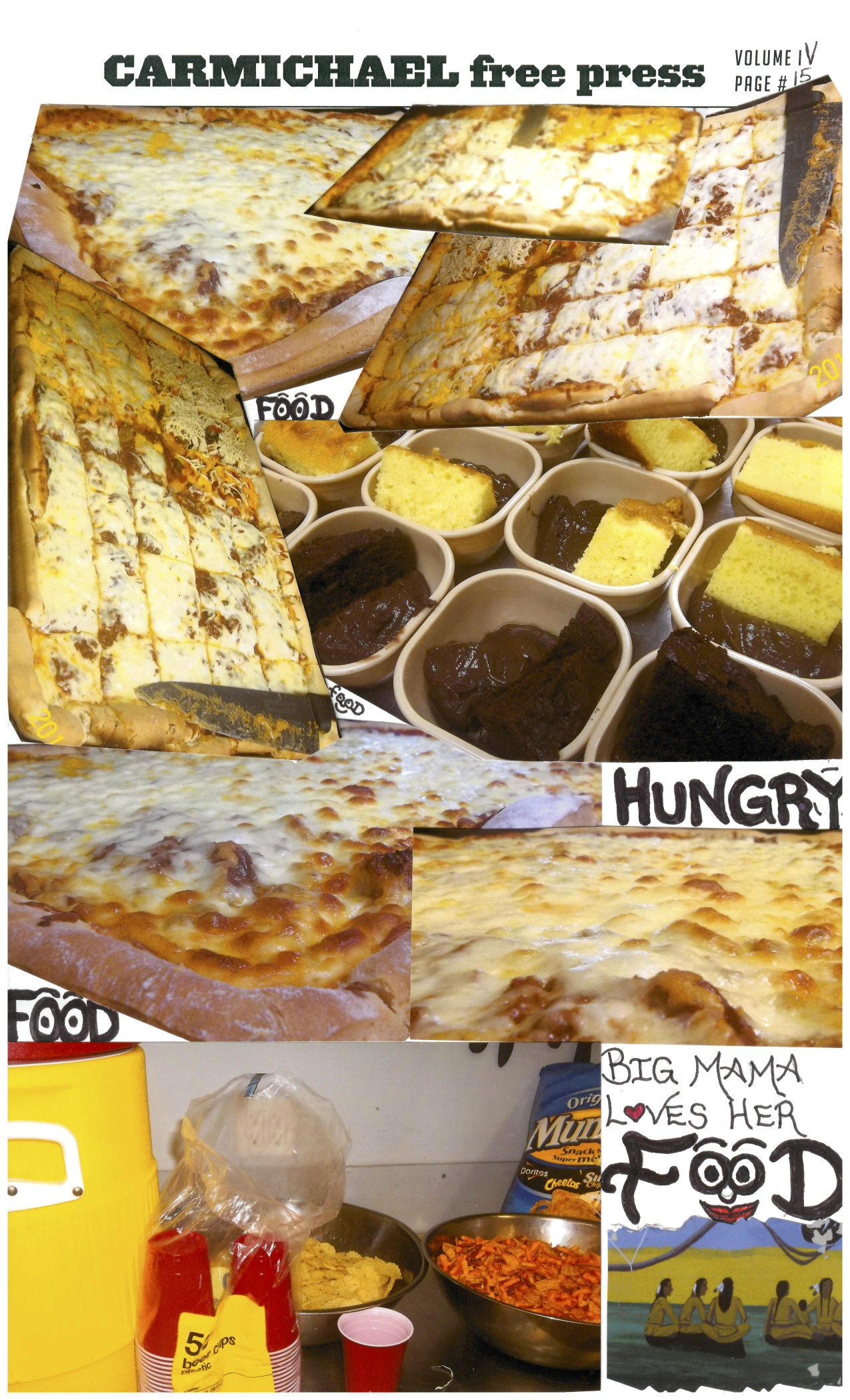
    Big Mama Page

    Every person has the right to have their voice heard, published, and distributed. People in your city are depressed, pissed off, a little bit high, lonely, in love, tired, dope-sick, or extremely happy, and they are entitled to these feelings. The power that is gained in sharing these feelings, putting them in some creative form, is invaluable. Outside of the online world of status updates and cartoon smiley faces, people need to have a forum to express themselves, and since Facebook and other online media aren’t accessible to those without internet access and aren’t really collective, the Free Press fills the void.

    Authors and artists work years to get things published or get their art hanging in a coffee shop in the over-marketed world of writing and art, but that doesn’t make the voice of the amateur any less important. If anything it makes it more significant; not being sold as a commodity or graded like a high school paper.

    The Carmichael Free Press is the perfect example of Carmichael programming—drop-in-style, no cost, inclusive to all, hilarious, frustrating, and motivating. Sober or not, published or not, practiced or not, community members can use the Carmichael Free Press as a home for personal expression, a place for injustices to be made public, love to be shared.

    The sign-off of our first edition reminds readers what the Free Press is trying to proclaim each and every edition—the importance of listening to and helping out people you have never met, and encouraging you to get to know them one way or another, possibly by participating in your local Free Press!

    “Sisters and Brothers, we are all on the same page. So don’t flip me!”

    Carmichael Free Press copy

  • Lyrics of the Month: July 2015 – Drunk on a Bike

    It happened so fast
    He didn’t have time to think
    Or maybe he had too much
    a bit too much to drink
    When he went riding off
    into the bright sunshine
    It turned out to be
    the lights of a car
    Can somebody help me please
    Scrape this man up off the road
    Can somebody help me please
    I cannot do it on my own
    As the police
    were scraping him off the fender
    A friend of his said
    that he had been on a bender
    and that he had a huge fight
    Yeah, he had a fight with his wife
    Then he got pissed off
    Then rode off on his bike
    He was drunk
    He was drunk on a bike

    -SNFU, The One Voted Most Likely To Succeed, Drunk on a Bike


  • Ethical Life Under Crapitalism

    Data Collection:

    My coworker has been named the Woman of Distinction for Community Leadership and Enhancement in the City of Regina. She is brilliant.

    A 72 year old community member is a lonely man with failing kidneys who considers suicide but laughs a lot.

    There are three separate piles of change on the floor of my new, empty bachelor suite. I sleep in the closet.

    We make jokes about huffing lacquer because we don’t know how else to psychologically deal with it.

    I have a phone that is paid for, but am too stubborn to use it.

    I don’t know where my cutlery went, so I dump curry into my mouth using man’s ultimate tool: gravity.

    The end of each day, my chest is pulled taut and my brain is a piece of processed-cheese on top of a sun-soaked dumpster lid.

    I fell asleep with my thumb in a book, reading about work.

    My only piece of furniture is a crokinole board.

    The most traumatic event I experienced as a child was finding a marijuana pipe in the ditch next to the house.

    I get paid lower-middle-class salary and feel exceedingly guilty about it.

    Just finished reading one of the worst books I’ve ever read and now aspire to write exactly like the author.

    I bought backpack that encourages cycling and fair labour, but doesn’t fit my groceries.

    My values are clear but my knowledge is stunted, so I cling to the ideas of the knowledgeable people I know, and when challenged in them I shrivel like a wintery weiner.

    I desperately grab the first job I can that is based in community, because as a person with no education, finding a job that aligns with my values is like finding a bedbug on the pink mattress in the gang-monitored apartment. But we did find a bedbug.

    Findings:

    Do what you can/Don’t try so hard. Forget about religious guilt. Always ask others if they are comfortable with something. Don’t be selfish. Seek happiness in others. Eat well.