Category: Non-University

  • Still don’t know.

    Di Fara Pizza

    A man walks down a dark Brooklyn side street with his pants at his ankles, genitals flailing. I am looking for pizza. Legitimate conerns are raised about that man getting shot by police but we push on to get some garlic knots at Ganni’s at midnight.

    The Republican convention wraps up and everyone I know, including myself, fears the next four years, but knows full well they’ll survive it. The man walking down the Brooklyn side street, the newly arrived Syrian refugees, the Central American blamed with stealing American jobs, don’t have the privilege of knowing the same thing. In Hedges’ 2010 book Death of the Liberal Class, Chomsky prophesies of a population that seeks out fascism because of a series of politicians beforehand who have sold the rights of the population to corporate power. All they need, he says, is a charismatic leader who tells it like it is. And now he warns this.


    “How much is this one?” I ask.

    “Which one?” the shopkeep asks.

    “The all black one with gold numbers.”

    “$10.” He pulls it out, puts it on my wrist, it fits and feels as though I haven’t wore a watch in fifteen years, which I haven’t.

    “Great.” I place $10 on the table.

    “This one is $15,” he says. I place five more dollar bills on the table and leave, feeling as though I have paid the 50% tourist tax necessary to create a balance in the inequality of wealth that I have benefited from my entire life. The tourist tax necessary to quell my own personal guilt for existing in a marketplace and quitting my community job to travel the world for free. The watch looks great and hasn’t died yet. It fits oddly on my bulging ulna bone.

    I finish my $9 juice and sit on a bench, calling my credit union and credit card company to tell them that I am in fact in the US and that no, my cards have not been compromised, and that yes, I’d like to withdraw money from my accounts so I can spend more money on American juice.

    I loosen the watch strap one notch to relieve the sweat that accumulates under it in the New York humidity in what will likely be the 15th consecutive hottest month on record. I bought a watch so I could avoid pulling my phone out of my pocket so I could avoid wrecking my pants pockets so I could avoid buying new pants so I could avoid buying pants from a hellish factory in south east asia. And so I could avoid using my phone at all. My vain attempts at personal change are conscience clearing but not effective. I still don’t know how to live a life that affects change or isn’t dripping in privilege. You think by 27.667 years of life you’d know everything there is to know in the world.


  • Advocating for Alcohol Harm Reduction Policy in Regina, Saskatchewan

    Advocating for Alcohol Harm Reduction Policy in Regina Saskatchewan
    Understanding Chronic Addiction and Responsible Public Health Practices
    Nicholas Olson – Housing Support Worker – Carmichael Outreach

    Background

    Severe alcohol dependence is common in individuals experiencing or at risk of homelessness in Regina, Saskatchewan. For individuals who have experienced violent or psychological trauma, alcohol is often used as a way to cope with the mental and physical pain that comes when this trauma is left untreated. Aboriginal populations overrepresent those experiencing homelessness in Saskatchewan and Canada, and many of the traumas they have experienced are directly related to unstable family settings caused by the lasting effects of residential and public schools and other programs created under colonial policy. Homeless populations have a high rate of alcohol dependence and for this reason face significant barriers to stable and safe housing, and are often unable to access shelter systems. In Regina, the few housing support programs that are willing to work with individuals with severe alcohol dependence are finding that the Housing First model is not always enough to keep individuals housed, healthy, and stable. Alcohol harm reduction is the next clear step to support Regina’s most vulnerable.

    What is Alcohol Harm Reduction?

    Alcohol Harm Reduction aims to reduce the harms associated with the use of alcoholic substances in people that are unable or do not desire to stop (International Harm Reduction Association). Harm reduction functions under the idea that all individuals deserve the dignity and respect to be treated in a manner that best supports them as a whole person, not just as an addict, and to be treated medically in a way that is understanding, empowering, and compassionate to their specific needs as a person experiencing an alcohol addiction. For many, the traditional abstinence model is unrealistic and does not take into account the desires of the individual who may not want, or be able, to discontinue use. Alcohol Harm Reduction aims to support the individual to live a healthy life regardless of whether they intend to become abstinent. This may be done by assisting them to consume healthy forms and volumes of alcohol through different programs tailored to the individual, supporting them to be safe during and after consumption, and working with them to maintain good health and, if desired by the individual, to reduce their alcohol consumption overall.

    Alcohol Treatment

    The development of Alcohol Harm Reduction through a Managed Alcohol Program (MAP), Alcohol Swap Program, Beer Co-op, and/or Prescription Alcohol is the best practice in supporting the addictions of a marginalized population in Regina primarily between the ages of 30-55. Since individuals experiencing or at risk of homelessness often have fixed or no incomes, beverage alcohol is unaffordable due to the high cost of controlled substances in Saskatchewan. This, coupled with the marginalization of individuals experiencing poverty, addiction, and mental health, has made beverage alcohol even more inaccessible because these individuals are often not permitted to enter establishments that sell beverage alcohol, and in many cases are unable to even access basic health and emergency services. Non-beverage alcohol (NBA) purchased in grocery stores, convenience stores, and pharmacies including mouthwash, hand sanitizer, hairspray, and rubbing alcohol is being consumed in large quantities because of its potency and availability.

    Non-beverage alcohol can be any form of alcohol that is not fit for human consumption. Ethanol, or ethyl alcohol, is found in beverage alcohol and is safe to consume in moderate amounts. Denatured ethanol, or alcohol denat, found in products such as mouthwash, hairspray, and some hand sanitizers, is ethanol with chemical product added to make the alcohol unfit for human consumption. The chemical additives also allow the producer to avoid the product being designated as a controlled substance. Methanol, or methyl alcohol is toxic and has caused death when consumed through hand sanitizer (CBC). Isopropyl alcohol, found in rubbing alcohol and some hand sanitizers, is toxic if ingested as well. While it is often stated that the extremely high alcohol content in non-beverage alcohol is the most toxic ingredient, with sustained use and high dosage, serious risks are present from the other toxic ingredients in each solution. Hairspray, for example, can have long term effects such as internal bleeding, kidney and liver damage, respiratory problems and death (CBC). Each receptacle of non-beverage alcohol clearly warns of the risks of consumption and strongly advises to contact poison control if consumed in any volume (Pauly 10).

    Alcohol Contents and Types
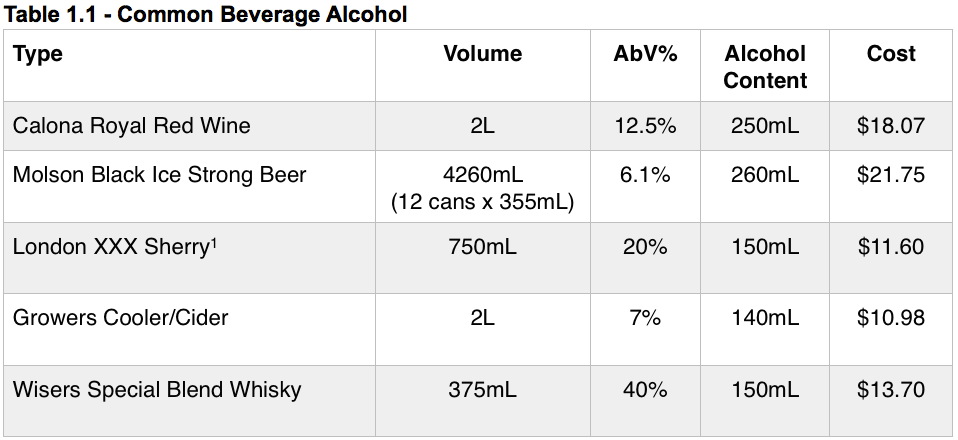
    Table1.1
    (costs listed are based on saskliquor.com)
    (approximate calculations were done at http://www.cleavebooks.co.uk/scol/ccalcoh4.htm and should not be used as a substitute for medical advice)
    1 The LCBO is recalling four brands of sherry (LONDON XXX SHERRY INCLUDED) that tested positive for a potential carcinogen. “This is not like E. coli or botulism where you’re acutely affected. To be affected by something like this, you would have to consume it for a long time for many years, so there is no risk at all,” he said. “It’s very, extremely difficult for anyone to get cancer from this type of chemical, unless you’re consuming it on [a] daily basis and you’re drinking large amounts of it.” (http://www.cbc.ca/news/lcbo-recalls-sherry-for-carcinogen-risk-1.619474)
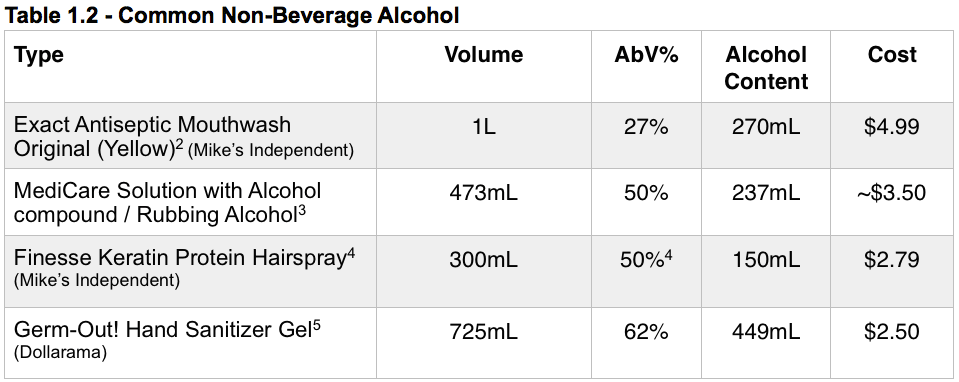
    Table1.2
    (costs listed based on retail prices at given locations)
    (approximate calculations were done at http://www.cleavebooks.co.uk/scol/ccalcoh4.htm and should not be used as a substitute for medical advice)
    2 Medicinal Ingredients: Eucalyptol (Eucalyptus Clobulus-Leaf) 0.092%W/V, Menthol 0.042%W/V, Methyl Calicylate 0.060%W/V, Thymol 0,064%W/V
    Notice: If more than used for rinsing is accidentally swallowed, get medical help or contact a poison control centre right away.
    3 Ingredients: Aqua, Ethyl Alcohol, Denatonium Benzoate, Camphor
    Notice: For External Use Only, Poison, Inflammable. If swallowed, do not induce vomiting. Call a physician immediately. If patient is unconscious, give them air. Danger: Harmful or fatal if swallowed.
    4 Ingredients: Alcohol denat, water (aqua), acrylates copolymer, aminomenthyl propanol, fragrance, octylacrylamide/acrylates/butylaminoethyl methacrylate copolymer, PEG-12 dimethicone, tritely citrate, hydrolyzed silk, hydrolyzed keratin. Alcohol content TBD but could be between 50-70%.
    5 Medicinal Ingredient: 62% Ethyl Alcohol. Non-Medicinal Ingredients: Aqua, polysorbate 20, carbomer, aminomethyl propanol, glycerin, tocopheryl acetate (vitamin E acetate), denatonium benzoate.
    Warnings: For external use only, do not ingest. In case of accidental ingestion contact your physician or a Poison Control Centre.

    Limiting availability of these products has proven to be an ineffective means of managing the consumption of the toxic forms of alcohol, as many or all of those accustomed to drinking non-beverage alcohol regularly travel to the suburban areas of the city to purchase from larger box stores and centres where they haven’t yet been banned. When individuals don’t have to spend their energy finding their next source of alcohol and managing their withdrawal symptoms, it allows them to begin to spend that energy on developing life skills, focusing on housing, setting goals, and working on improving their overall health.

    The only responsible, healthy, and compassionate way to support those who consistently consume non-beverage alcohol is to understand that in these cases abstinence is potentially a dangerous, unhealthy, and unrealistic treatment, and that reducing the harm they are causing to themselves means assisting them with the consumption of safe forms of alcohol. This can be done with Managed Alcohol Programs where individuals are given a regulated amount of alcohol at regular intervals during the day to help them deal with withdrawal symptoms and feel normal and well, Alcohol Swap Programs where individuals not necessarily receiving comprehensive housing supports can swap out certain quantities of non-beverage alcohol for beverage alcohol, a Beer Co-op where individuals are trained in proper and safe ways to brew their own alcohol for safe consumption, and Prescription Alcohol, which like a MAP, would regulate volumes and quantities based on medical assessments and administered in similar harm reduction models such as methadone. These programs, specifically MAPs, have been implemented across Canada and the US to reduce both the harms inflicted upon alcohol-dependent individuals, and the subsequent costs upon the health and justice systems.

    While other potential treatments for alcohol dependence include medications such as benzodiazepines, which include diazepam, or Valium, the lifestyle and the desires of the patient must be taken into account, and for many, discontinuing alcohol use is not desired and is not a possible solution. Using diazepam as a treatment for alcohol withdrawals does not respond to the fact that many individuals would rather not discontinue alcohol use, and even with regulated and prescribed diazepam treatment, many individuals will continue to drink different forms of alcohol when it is presented to them. This would lead to an increased risk of addiction to diazepam, and a “high risk of overdose, loss of consciousness, coma, and death.”(American Addiction Centers) Benzodiazepines are also used as a short term treatment option, with only 1-2 percent of adults continuing treatment for 12 months or longer, and carry substantially higher risks of dependence and misuse in populations with a history of substance abuse (Longo). When supporting an individual living in community, monitoring all the substances that enter the home is impossible, therefore it is best to prescribe that which reduces the most risk and harm to the individual.

    The harm reduction framework aims to support individuals to make healthy choices and this begins with offering assistance in managing quantities of beverage alcohol, and accessing beverage alcohol in a cost-effective manner, while at the same time being careful not to perpetuate the stigma of using non-beverage alcohols that is often present in community supports and medical services. Many populations are stigmatized even within social circles for drinking non-beverage alcohol, and this stigma is magnified in many professional health settings. Following the harm reduction framework means focusing on the needs and desires of the individual, not reducing addictions to a moral or ethical choice, and understanding the barriers that have led to less-safe alcohol consumption. It is important that harm reduction treatments are in place and practiced by health professionals, as professional knowledge is needed to create public health policy that can be safely and confidently administered by community entities.

    Understanding

    Each individual receiving alcohol harm reduction support will consume a different variety, style, and amount of beverage and non-beverage alcohol each day. It is important to understand what the approximate quantities of non-beverage alcohol are to ensure that the proper volume of beverage alcohol is supplied to each individual. Having a set schedule of beverage alcohol consumption would ensure that a moderated amount of alcohol is consumed, which, ideally could be lessened over time based on the desires of the individual. Clinical medical advisement through a MAP or prescription may be required to ensure that the individual is getting a safe dosage, and that an understanding of the individual’s history with addiction and their personal and traumatic history is taken into consideration. In an evaluation of a MAP in Vancouver, BC, alcohol consumption did not necessarily decline in six months for all of the participants, however the consumption of non-beverage alcohol did decline, and most participants reported improvements in mental health, social connectedness, and general well-being, and consumed alcohol in a safer setting with less harms that come from drinking large quantities at one time (Stockwell 6,7).

    Below are some comparisons of alcohol contents. Though it is clear that the ethanol present in beverage alcohol is different than the types of alcohol present in non-beverage alcohol (denatured alcohol/ethanol, isopropyl alcohol) and the “high” achieved through using non-beverage alcohol would therefore be different, the comparisons below are a guideline for quantities consumed knowing that the denatured alcohol and isopropyl alcohol have added chemicals that are toxic for human consumption.

    For example, as shown in Table 2.1, one litre (1L) of Antiseptic Mouthwash has an alcohol content of 270mL, which is equivalent to 12.5 cans (4.4L), of strong percentage beer, or nearly two bottles of a strong sherry wine. Similarly, as shown in Table 2.2, it takes nearly 10 times as much strong beer to equal the same alcohol content of 449mL that is obtained through 725mL of Hand Sanitzer Gel. While the point of alcohol harm reduction isn’t necessarily to meet the alcohol content that an individual would consume drinking non-beverage alcohol, it is important for service providers and community supports to understand just how much beverage alcohol it takes to help cope with withdrawal symptoms.


    Table2.1-2.2

    Conclusions

    It is clear both to the uneducated outsider and to the affected individual that the consumption of non-beverage alcohol is extremely damaging to one’s physical and mental health. By offering support to individuals in their addiction through alcohol harm reduction programs, the dignity of these individuals is upheld as they are receiving compassionate medical treatment that views them as a whole person. Through these programs, these individuals would be able to access supports that are often only accessible to less-stigmatized populations, including detoxification programs that in Regina are inaccessible to many with reduced mobility and high physical needs.

    Access to inexpensive, clinically regulated and adequately strong forms of beverage alcohol is key to the physical and mental health and well-being of the individual. Regulated quantities of alcohol must be customized to each individual based on their own personal symptoms and histories. While having professional medical advice involved is clearly the best practice, disallowing access to safe forms of alcohol because of lack of confirmed policy is irresponsible and lacks the compassion necessary in the human services sector and in a responsible community.

    Policy driven by the Regina Qu’Appelle Health Region, monitored and planned by medical professionals, delivered by community organizations, and tailored to the needs of the individual are imperative to the success of an alcohol harm reduction program, and the timely nature of its implementation is extremely important to ensure the safety, health, and survival of a large population of vulnerable people. A responsible community and health region would not allow the continued consumption of controlled poison when clear, simple, and practical alternatives exist.

    Sources
    International Harm Reduction Association, What is harm reduction?, http://www.ihra.net/what-is-harm-reduction
    CBC News, Hand sanitizer ingestion linked to 2 Ontario deaths, Oct 25, 2013, http://www.cbc.ca/news/canada/toronto/hand-sanitizer-ingestion-linked-to-2-ontario-deaths-1.2252046)
    CBC News, Hairspray abuse plagues northern town, Feb 16, 2001, http://www.cbc.ca/news/canada/hairspray-abuse-plagues-northern-town-1.293513
    Pauly, B., Stockwell, T., Chow, C., Gray, E., Krysowaty, B., Vallance, K., Zhao, J. & Perkin, K. (2013) Towards alcohol harm reduction: Preliminary results from an evaluation of a Canadian managed alcohol program. Victoria, BC: Centre for Addictions Research of British Columbia.
    Carnahan RM, Kutscher EC, Obritsch MD, Rasmussen LD. Acute ethanol
    intoxication after consumption of hairspray. Pharmacotherapy. 2005 Nov;25(11):1646-50. PubMed PMID: 16232026.
    http://www.ncbi.nlm.nih.gov/pubmed/16232026?report=docsum
    American Addiction Centers, Dangers in Mixing Valium and Alcohol or Drugs, http://americanaddictioncenters.org/valium-treatment/dangers/
    Longo LP, Johnson B., Addiction: Part I. Benzodiazepines–side effects, abuse risk and alternatives. Am Fam Physician. 2000 Apr 1;61(7):2121-8. Review.,
    http://www.aafp.org/afp/2000/0401/p2121.html
    Stockwell, T., Pauly, B., Chow, C., Vallance, K., Perkin, K. (2013). Evaluation of a managed alcohol program in Vancouver, BC: Early findings and reflections on alcohol harm reduction. CARBC Bulletin #9, Victoria, British Columbia: University of Victoria
    http://www.uvic.ca/research/centres/carbc/assets/docs/bulletin9-evaluation-managed-alcohol-program.pdf
  • Season of the Badlands

    IMG_5565

    The following was originally published with photos in Of Land & Living Skies: A Community Journal on Place, Land, and Learning. For more interesting content and events, consider becoming a Sask Outdoors member at SaskOutdoors.orgDigital magazine available here.

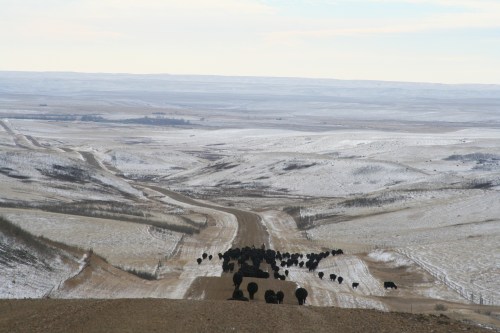
    Just west of the yard in a field of summer fallow is a rock. Its existence alone isn’t remarkable; there are a multitude of rocks in the dirt around Horse Creek. All over the prairies there are rock piles, decades or centuries of rounded stones the size of softballs or buffalo skulls or lawnmowers, stacked as monuments to the neighbouring broken earth. But the rock west of the yard, picked out of the ground to clear the way for tilling, ended up being the size of a small car. Forty paces from the road it looks substantial but unremarkable; flat and several feet high, grey brown, leaning back with a salute to the sky, the remaining clover hissing at its base. But the illusion disappears when it is approached. It juts out significantly, looking like the missing nose of the Sphinx. A nearly immovable object, even with all the trucks and tractors around, because of its size and the damage it would do to the road and the ditch. It would look good in the garden but the force needed to move it is a force we do not have. So there it sits.

    My grandma was born in Horse Creek. I never knew this until a week before I headed there myself. Horse Creek is located on Treaty 4 Territory, seventeen miles south of McCord, 110 miles southwest of Swift Current and just sixteen miles as the crow flies from the American border. If you look for it on a map or even the internet, you may not find it. In a time of unions and co-operatives, grandma’s father was a carpenter in Horse Creek for her first year of life. Last November, I was in Horse Creek holding tape measures and nailing boards and starting my own imaginary union to provoke my anti-union, farming friends.

    Much of that summer was spent exploring the badlands of southern Saskatchewan. The first weekend of spring meant camping with three friends at Grasslands National Park, which shares the same hill ranges as Horse Creek. In 4x4s we were guided through pastures and down ravines to Storey Lowell’s, the local folklore touting it as an early hideout for horse rustlers, when it is more modestly two adobe shacks that made the home of an old homesteader. Later we hiked in at McGowan’s Visitor Centre and camped in a coulee just steps from the moon-like landscape of dirt and cliff. Before darkness settled we walked to the highest point in sight, overlooking the crumbling badlands, with heavy clouds and bursting light advancing from the south sky. Walking back in the heavy showers we purposefully searched out the storied quicksand piles by tossing rocks on odd looking pieces of dirt, then toeing them, then stepping on them, then stomping on them, tempting our fate for a movie-like reaction from the earth. We never found any quicksand.

    Later in summer we visited Castle Butte, a massive ice-age-created structure of sandstone and clay reaching to the sky of the Big Muddy. A few miles from there we navigated to Buffalo Effigy, the flat outline of rocks which shape a buffalo on the highest hill around——a sacred site now part of a pasture, luckily fenced off and somewhat preserved. A few weeks later we camped at St. Victor Petroglyph Park, timeworn carvings on horizontal rock on the top of another highest hill in the area. These three sites of identity and significance to the First Peoples, all purposefully placed on top of the highest of hills, existed long before my maternal grandparents settled in the area——around Harptree, Brooking, Radville——and began creating their own monuments in picked rock piles and homesteads.

    IMG_5447

    In the snow-covered shortgrass prairie of Horse Creek, I attempted to experience the ranching and farming life in which my family was once rooted. I picked bales and fixed fence and tried to be useful. When on break, to bolster my writing craft, I urinated poems into the snow in cursive.

    When heading south to move lumber or check on cows it looked as though the clouds that rested on the hills that enclose the badlands were the end of the world, which in my own way, is the truth. The badlands are dead land and past them is a barbed wire pasture fence that is patrolled with drones and satellites of the American border guard. Other border-adjacent land is sold off to multinational companies scavenging for oil whose only identity in the land they own is corporate identity. The end of the world and the end of identity exists in deserts and robots and contracts.

    I have a vested interest in preserving this land from such ominous ends because I feel connected to it in some vague, flaky kind of way. My friend who has lived here his whole life and whose family has farmed it for a century offers the same. Giving up his land would be the last thing he would do, and because of his connection to the land he acknowledges that he knows to some extent what it might have felt like when the settlers came. I identify with the land that sits atop the badlands because of personal history, but this land does not identify with me any more than it identifies with the farmers or ranchers or indigenous peoples or the Queen who leases it out or that rock west of the yard.

    The connection felt from being on the land, from spending time caring for it and working it, is universal and real. I am not entitled to this land, nor is any one person or group of people. Instead the land has an entitlement to be inhabited by people who identify with it, because those who identify with the land are more apt to treat it as it ought to be treated.

    To be an asset to the land, to be the type of person that the land is entitled to, I learn as much as I can about how it works and how to live well on it. About all its intricacies of connectedness, which offer lessons of how to exist and how to relate. Like the rock west of the yard, I am not out of place standing alone on the prairie, I only look that way when I am dug up from the city and thrown naked in a field. Like the rock, my ancestral composition lies in the soil, just as everyone else.

    Each time I visit the badlands and hills adjacent I seek out the highest geographical point possible——to feel the wind’s unmitigated power or to fully realize the thunderstorm that approaches. Monuments that mark time, the carvings and effigies and buttes of the area, are locations of height for a reason. They are standing points that we revisit to watch the thunderstorm of the future steadily move in. The easiest place to keep your feet grounded for change and resistance is in community and identity. Strengthening our connection with these highest places is the only way to ensure the thunderstorm doesn’t come in and drown us all out and to ensure that when we are walking home, we see the pits of quicksand that would otherwise swallow us up.

    I drove out of the yard and left the farm behind with a year of vagrancy and foreign experiences on the horizon. The rock west of the yard sat silent with the ice fog painted low in the background. The rock will quite likely be there when I get back.

    To look just on the surface, and think that what you see from horizon to horizon is all that is needed to survive, is to misunderstand your place on the ground which you stand. To scale its heights-to learn its lessons—one must be alive to the underlying structures that support the visible and not-so-visible world around you.

    -John Borrows (Kegedonce), Drawing Out Law: A Spirit’s Guide (University of Toronto Press, 2010, p72)

  • Learning to tie your shoes at 27.

    Shoelaces

    “You’re tying your shoelaces wrong,” Grandpa told me after he slipped on his insulated rubber boots he wears when flooding the North Weyburn rink. I told him that he’d shown me before, thinking back to one of the other times someone tried to revolutionize my life at mid-age by teaching me more effective ways to tie shoes. Once, a Chinese student in my boarding school in grade 12 had some extremely efficient, one-motion trick he learned in the Chinese Army. The other, an employer told me that we use the ‘weak version’ of the bow knot, overhand instead of under. Neither stuck.

    “You make a loop with that there, then you wrap around twice, and feed it through, and pull it tight. Then it’ll never come undone and all you have to do is pull that one to undo it,” Grandpa said. And that’s how I learned to tie my shoes at the age of 27.

    We went outside, opened the valve in the pumphouse, hooked up the thick pipe to the protruding attachment sticking out of the earth five feet, insulated with foam and plastic so it wouldn’t entirely freeze through in the winter. He gave me the nozzle and I poured water over an already well-established base of ice, begging to be cut into. Get more water more in that corner, enough to melt all that snow. Don’t flood too much, that’s when you get those little hills. Close the nozzle partially, it’ll shoot further. Ice up the entranceway so the tractor doesn’t bring gravel in when we scrape. Flood between minus 5 and 15 degrees, otherwise it’ll crack. And other pieces of advice I proceeded to forget immediately after he offered them. We drained the hose of water to and left it sitting out in a ditch next to the little hill.

    After mandatory microwaved morning coffee and reading a few history books about homesteading Europeans that look like the cold survivalist versions of my grandparents, they set to making seemingly overcomplicated cabinets for the church kitchen remodel, and dropped me at the pottery wheel. Pottery, the making of receptacles primarily for food purposes, is heralded as a soul-calming, primal, spiritual experience between human being and the clay from which the human being is fabled to be formed. Pottery, that terrifying experience of being so close to failure at every minor hand motion, brings about in me an anxious rage that characterizes my last few years of life. It is so easy to lose centre. The metaphor is too damn easy.

    Each time I return to the humming potter’s wheel, once a year usually, I dread the guaranteed failure of destroying a pot, of a finger digging into the too-dry clay, the wheel flinging a half-made bowl across the room. I fear the re-realization of how little I know about anything in the world. But each time, I remember part of a hand motion, part of a technique, part of an idea. And the wads of clay slowly, after decades, start to resemble something more useful than a tiny bowl used for storing lint and thumb tacks. I made five bowls, all failures, simultaneously all worthwhile successes.

    The night before, Grandpa slipped on his shoes without bending over, using a four-foot shoe horn. He takes them off with a hand-crafted device of similar brilliance and simplicity. I want to forever to spend my time with those who can continue to teach and reteach me how to tie my shoes and are patient enough for me to figure out that getting rid of laces altogether is the final step to enlightenment.

  • Good People

    I sat cross-legged in the cushioned armchair, scratching paint off my water bottle in the cozy, warmly coloured, obviously intentionally non-institutional office of my psychologist/psychotherapist/whatever.

    Isn’t it enough to just be a good person and treat people well? she asked after a near hour-long discussion of how far one needs to go to make the world less of a festering shit hole, with me grinding myself into a hole trying to figure out how to do so.

    I thought it over. I pictured the tax-paying, maybe church-going, home-owning, child-rearing city councillor who occasionally shovels his neighbour’s sidewalk and might even give a few bucks in December to one of the organizations that sent Christmas mail-outs. His kids are in hockey. He loves his spouse.

    No, I said. That’s a cop out. 

    I wondered what she thought—-that I was attacking her personally—-or if she was clinically breaking down my obvious guilt that stems from years in conservative religion, my fear that comes from the insecurity issues of being the youngest child, my anger from decades of not expressing myself in healthy mediums, and my depression which is induced by the daily watching of my friends dying while my other friends are not even able to give a shit. She was likely doing neither, she is significantly smarter than I.

    Because of constant deconstruction of social programs, the development of neighbourhoods that are exclusive in nature, and the importance financial-driven success, being a good person means keeping to one’s self. It means not being an evil person. Not being a murderer, rapist, tax-evader, alcoholic, street worker. Not beating your children or spouse. Not pouring toxic waste into a animal rescue facility. Not bothering your neighbour. Being a good person, by the standards of our colonial, patriarchal society, means staying in line. The fact that my day job exists entirely to remind people of their worth, that they aren’t bad people for needing a shot of morphine everyday by noon, that they aren’t bad people if they fall off the wagon, that they aren’t bad people for being on welfare, that they aren’t bad people for having a culture that precedes the current—-the fact that this day job even exists, shows that good people, in today’s standards, are those with privilege.

    I drank a sip from my water bottle, an action steeped in anxiety, done to make me look more natural. After a near hour of discussing my rage, my mind became blurry. By the time we got around to ways I can improve upon myself, I didn’t have the energy to comprehend new ideas. I pretended to take another sip of water from the empty bottle and nodded along with my psychological professional.

    Being a good person and treating people well wouldn’t be a cop out if it meant something else. If it means more than smiling in public and not using racial slurs, then it may be enough. Enough to make changes that matter, to staunch the wounds that pour blood into the alleys. But until it does, until the characteristics of being a ‘good person’ include understanding and standing up for those our system have methodically destroyed, being a good person is not enough.

    It’s not the fault of the good people that they are good people under the current model of good. We have been gutted and replaced with slop from the machine of individualistic, selfish commercialism. Our jobs don’t allow us the time to give a shit. In order to stay sane, we bask in the glory of our beautiful families and don’t look out the window to the family being kicked to the curb by a police officer, because we legitimately don’t have time, because the Mayor has stricken that topic from discussion in council, because if we do, we’ll get depressed. Good people everywhere don’t know how to participate in a change they want to make, so they rely on posting on internet, or they don’t do anything. I am that kind of good person.

    Tonight as I watched city council directly shut down citizen concerns, bully them by calling requests of accountability disrespectful, and promote gun violence as seen on their favourite television shows, I watched a room full of good people fighting for their definition of good. The uninformed relied on tokenism, touching stories, and fear tactics to justify their definition of good, that is, to justify the increase in funding for the organization that protects their privilege. The informed stood up and defended their idea of good, that is, they were willing to understand and stand up for the good people outside of the room who have been trampled by the uninformed, power-protecting policies of racial profiling and bad-person profiling. Everyone was working for their own idea of good. Some of them were just unfortunately, painfully, and dangerously uninformed. I left city hall with a renewed interest in changing our current definition of what makes a good person. How we go about doing that has never been my strength.

    I left the psychologist’s office $160 poorer, one-hour later, one vague understanding of fear and guilt, with one empty water bottle. I’m going to have to book another appointment. Or two.


  • Why people don’t get it.


    The following was first published in ARCANE CONTEMPORARY ART MAGAZINE. Get a digital copy for less than $3. Support emerging art, writing, creativity, and friends. 

    Montreal Museum of Contemporary Art

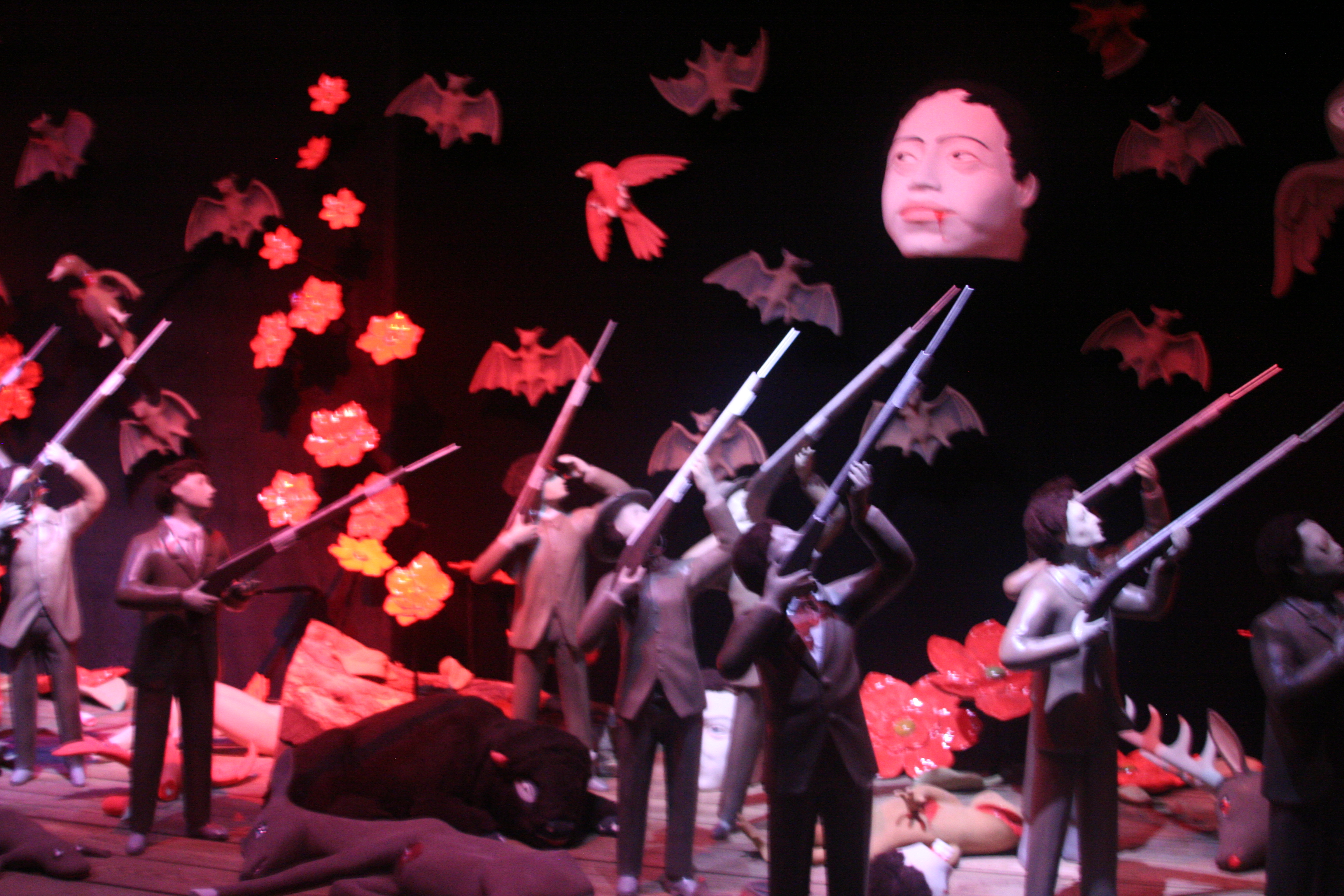
    Four years ago when I was newly twenty and wandering around the Musée d’art contemporain de Montréal (Montreal Museum of Contemporary Art) on a Wednesday (the only free) night, I never would have guessed I would be one day writing an editorial for a contemporary art magazine. At that time I would take in any free event I could, even pretending to be a med student to get into wine and cheese events for newly graduated doctors. I walked around the Museum, staring at puppets and massive formations of wool and plaster and paper and metal, and I accepted the production and the process, all the while thinking in my head, “I don’t really get it.” And it’s true, I didn’t get it.

    Even then I knew people who made art; my girlfriend at the time painted abstract and I supported her in the selfish way a 21-year-old boyfriend supports something he doesn’t understand. I was used to reading depressing non-fiction books about the state of humanity; I could only really conceptualize straight-forward, simple, concrete ideas. Facts, not interpretation.

    Being in Montreal I often met people who willingly but begrudgingly worked as bartenders and grocery attendants while their peers from back home were child-rearing and flipping starter-homes. Societal norms state that people working these jobs aren’t contributing to society because they aren’t contributing to the economy, and thus in many ways, wasting their lives.

    “Yeah, one day I’ll get a real job,” is a phrase you’ll often hear from self-deprecating artists when talking with their more financially advanced friends. According to the norms of the world of creation, these people are working shitty jobs to have money to attempt the visualization—the realization—of some vague subconscious dream, of the tip of some idea that they don’t even quite understand, of a new feeling they can’t express any other way.

    There exists a new IT-based world of maximizing human efficiency and output. It benevolently wants us to waste absolutely no time on the mundane tasks with which our parents’ lives were filled, therefore improving our lives. New apps that are changing the ways we date, travel, sleep, are the foremost leaders in this push to free humans from the reality of being human, and to bask in all the free time we’ve gained. We praise the brilliance of our new tech-soaked free-market—an evolution of every capitalist generation’s attempt at increasing the productivity of the commodity that is human labour and thus, increasing capital. When productivity and value is based on output and dollar figures, soon art and creation are considered sluggish, lazy, and slow. And that’s the point when people don’t get it.

    Simply put, contemporary art is difficult for people to understand because art isn’t trying to sell something. The ‘art’ that people consume daily is limited to drab bus advertisements for cellphone companies, ten-second internet videos hoping to go viral, or kooky TV ads for razors. Ads make you feel hungry, inadequate, anxious and therefore, sell you something. Art forces you to sit down to decide what you feel, which always ends up being more significant than the pedestrian emotions stirred up by an ad. Art may portray ideas, even attempt to sway peoples’ opinions, but it isn’t selling a product besides itself. It is a series of emotions and ideas put together with paint and paper, mud and wire, mouse clicks and colour changes, foot movements and choreography, words and phrases.

    What I now realize, what I didn’t realize when I was walking around the Museum in Montreal, is that it’s not supposed to be easy. You’re not being sold something, so you don’t instantly, instinctively know what you’re consuming. Getting it may mean taking thirty seconds to sit and stare at it, to actually think about its colours and composition and lighting and materials, to consider something besides yourself and your walk to your car, something besides the digital billboard flashing in your face. It may mean to reread, re-watch, grab a seat and continue to look at all the corners of a canvas until you feel an emotion, when you feel that emotion, whatever it is, then you may get it.

    But then again, maybe not.

  • Blogging will save the world..

    White Butte

    I was accidentally put on a ‘panel of experts’ discussing homelessness at a recent documentary release. Politicians mingled with professors and service providers in an eatery that neighbours the dry men’s shelter. Concerned citizens arrived early to bounce pleasantries off one another, nibbling on fine sausage and kalamata olives. I showed up late, downed a whiskey to calm the nerves, and shook with anxious rage throughout the entire documentary.

    The panel discussion concluded past its allotted time, and the moderator hurriedly spilt the plan, funding model, and hopes for the upcoming year in the industry of homelessness, with no one really understanding what it all meant. The crowd left restless and confused as to how to help, and the panelists left more disgruntled than before, and a month later, mid-October, there are still people sleeping in the alley in Regina.

    As a white male, when I speak, people generally listen. They listen for two or three sentences until they realize that I don’t know what I’m saying, then they rightfully daydream about food and sports and sex. On this year’s Blog Action Day, a day where organizers attempt to unite writers under one socially-driven topic (a day that I use the prompt to get off my ass and write something off-topic), people were asked to consider the title Raise Your Voice. Writers, artists, and journalists have the responsibility to tell the stories of those who are unable to do so. But an important part of this is to give people the platform to tell their own stories. Those whose voices need to be heard—the marginalized, the people of colour, the refugees, the LGBTQ2, the Indigenous, the working class—are denounced because a wealth-driven patriarchal society determines whose voices have worth. For completely unjust reasons, I have a voice. Instead of only ever using my voice to amplify the voices of others, I attempt to use my voice and my actions to create a place where others can be heard without need for amplification. When you create a place where people have inherent value, their voices will inevitably be heard.

    To Raise Your Voice in the digital era by blogging, sharing, liking, or ranting is as effective as leaving scraps of paper with motivational slogans blowing in the gutters. Divisive and irritating, the internet only further entrenches beliefs and perpetuates ignorance. While speaking on the panel I kept repeating this idea that we can pressure and lobby government until our heads explode, but that this is only one, arguably ineffective, means to creating change. That the only way homelessness and class-divide will end is through a system-wide change, altering how we treat and relate to one another, and changing the wealth and social inequalities that oppress minorities. I left the event feeling empty and sick, for I sounded like a politician—pushing for an idea while offering no tangible examples of how it might work and while participating in no organizing that may lead realization of the idea.

    Appealing to the judicial, legislative, or executive branches of government in the hope of reform is as realistic as accepting the offer made by the March Hare during the Mad Tea-Party in Lewis Carroll’s Alice in Wonderland:
    “Have some wine,” the March Hare said in an encouraging tone.
    Alice looked all round the table, but there was nothing on it but tea.
    “I don’t see any wine,” she remarked.
    “There isn’t any,” said the March Hare.

    -Hedges, Wages of Rebellion, The Post-Constitutional Era, p 61

    On Thanksgiving Monday I biked to the advanced polls to participate in the experiment of democracy. My hands numb in the wind, I waffled left and right each time I saw an election sign posted in a front lawn, truly not knowing who’d get my vote upon arrival. I’d rather waffle left. I voted in a way that reflects my values. I voted in a way that is considered a throwaway. This is because I do not believe in the ability for real reform under the current economic system in which the major parties function, but I simultaneously participate in this economic system and rarely make an effort in being a part of breaking it down. When I raise my voice but drink my sorrows, doing nothing to participate in making true change, I am complicit.

    Later on Thanksgiving Monday I lost a game of cribbage to a person who I’ve only known for a few months. It definitely wasn’t the first game of crib I’ve ever lost, and sure, I gave away several pairs of sevens to the crib. After he pegged out and we congratulated ourselves on a game well-played, I laid on the floor and watched him paint while we listened to new Northcote and RahRah. My new friend has been housed for three months, homeless for years before that, and still requires regular and extensive assistance to live a healthy life. I am extremely privileged to be employed by one of the few places that actively works to repair the damages caused by the wealth inequality synonymous to the capitalism, however, continually cleaning up the messes left by a system that purposefully destroys the lives of a particular cultural group is ineffective. Working within the current system is necessary to a point, but a total dismantling of this system is required to ensure real, lasting equality.

    There is no morality in words. Morals are behavioural, based in how a person acts. A person can raise their voice to the heavens while sitting in their recliner. If you raise your voice without breaking a few walls, no one outside your already-converted group will hear you. Breaking walls means breaking laws, breaking norms, supporting (verbally and physically) oppressed minorities, and thinking outside of the “cult of the self”* in which we find ourselves.

    And I can say with certainty that I’ve never broke down a wall in my life…

    *Hedges

  • The Carmichael Free Press

    This originally appeared at CarmichaelOutreach.ca.

    Carmichael Free Press copy2
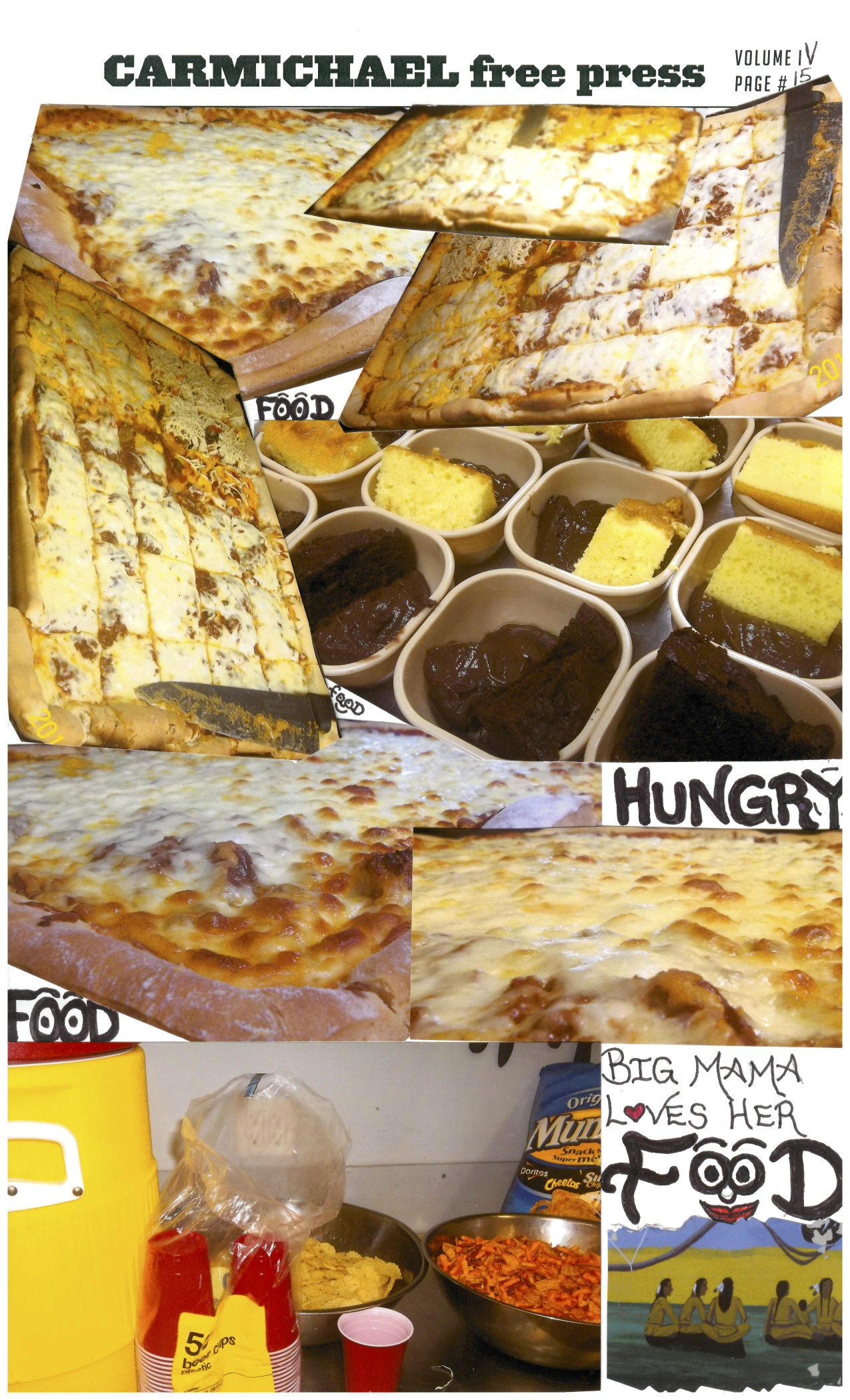
    Noel, Rocky, Mike and others sat in the coffee room on a Thursday afternoon and asked what was going on for programming that afternoon. “Art Class!” I proclaimed on my way downstairs. I brought up the box of scrapbooking supplies that former gourmet chef and art mastermind Mike Wysminity paid for with money he raised himself by selling tomato plants at the Farmers Market in pots hand-painted by Carmichael art participants.

    I tossed markers, fancy-edged scissors, stickers, moon-shaped hole punches on the table and people started creating. Noel wrote an inspirational quote and drew a cartoon. Mike wrote a poem. Lisa wrote a note to her son under a picture of him taken from a previous Carmichael Hockey Day. Brian wrote a story. Then staff members cut them out, organized them, and pasted them on the template, made copies, and printed them for the masses.

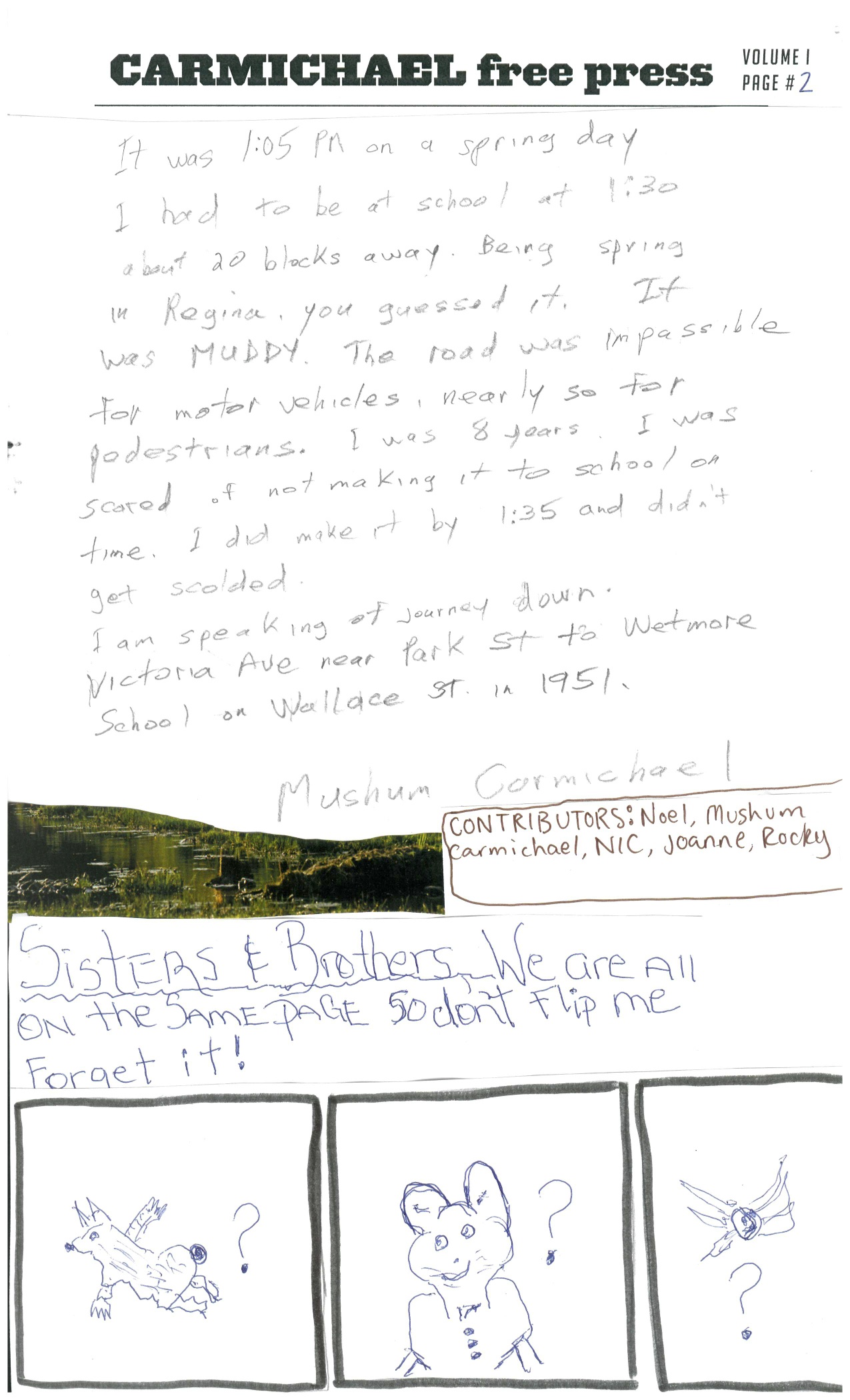
    The Carmichael Free Press is a grassroots publication on it’s fourth edition so far—a zine style scrapbooking newspaper that anyone can contribute to. Not topical, always different, the Free Press is a creative home for real, not-pretentious, unknown writers, artists, painters, comics, mothers, children, and more, not only to produce something they are interested in—they are proud of, that makes them laugh—but to have it shared with their group of friends, the Carmichael staff, and the greater community.

    The first ever headline of the Carmichael Free Press was borrowed from a photograph from a previous Carmichael photography class partnered with the Heritage Community Association and Sask Arts Board.

    “Here you go!” he said, as he passed his page to me with the inevitable nervous feeling of sharing something you just created. The headline read, “The Princess Royal Walk – Her Royal Highness Visiting Heritage Centre in Regina Sask…..” with an up-close picture of a loyal volunteer. Everyone in the room laughed at the joke. Real news be damned, street news is what matters. The experiences of people in your neighbourhood who you have never met are what truly matter, not the business interests of private national media. Hailed by its creators as “The most important newspaper in Saskatchewan,” the Free Press begins its climb to the top.

    Thursday afternoon Art Class at Carmichael has evolved as necessary from painting to drawing to scrapbooking to newspaper-making to who-knows-what-next, depending on interest, on funding, and on person skills of the facilitator. The informality and drop-in style of the Art Class is what makes it a success. Peter walked into the coffee room, saw his friend sitting at the table, saw markers, scissors, empty pages of the Carmichael Free Press, and sat down for ten minutes, drew a remarkable drawing of a pipe with the smoke forming a buffalo, eagle, bear. He thanked us for the time and headed on his way.

    Big Mama Page

    Every person has the right to have their voice heard, published, and distributed. People in your city are depressed, pissed off, a little bit high, lonely, in love, tired, dope-sick, or extremely happy, and they are entitled to these feelings. The power that is gained in sharing these feelings, putting them in some creative form, is invaluable. Outside of the online world of status updates and cartoon smiley faces, people need to have a forum to express themselves, and since Facebook and other online media aren’t accessible to those without internet access and aren’t really collective, the Free Press fills the void.

    Authors and artists work years to get things published or get their art hanging in a coffee shop in the over-marketed world of writing and art, but that doesn’t make the voice of the amateur any less important. If anything it makes it more significant; not being sold as a commodity or graded like a high school paper.

    The Carmichael Free Press is the perfect example of Carmichael programming—drop-in-style, no cost, inclusive to all, hilarious, frustrating, and motivating. Sober or not, published or not, practiced or not, community members can use the Carmichael Free Press as a home for personal expression, a place for injustices to be made public, love to be shared.

    The sign-off of our first edition reminds readers what the Free Press is trying to proclaim each and every edition—the importance of listening to and helping out people you have never met, and encouraging you to get to know them one way or another, possibly by participating in your local Free Press!

    “Sisters and Brothers, we are all on the same page. So don’t flip me!”

    Carmichael Free Press copy

  • Counter Assault

    We stood on the trail from the lake to our campsite, holding hands in fear of our premature deaths. What the fuck is that, I had wondered, an elk? It was a blondish brown patch of fur the size of a beach towel, stomping in the bush. It turned its body around for us to see enough of its shoulder to know that it wasn’t a charming, peaceful elk, but a medium-sized, overly curious grizzly. We backed our way down the path, jingled our keys and bear bells like distracted children at a Christmas pageant, trying to remember the advice from the Bear vs Human pamphlets. We spoke loudly, awkwardly. She recited poetry, I repeated it in booming baritone.

    Not to lose the feel of the mountains
    while still retaining the prairies
    is a difficult thing. What’s lovely
    is whatever makes the adrenalin run;
    therefore I count terror and fear among
    the greatest beauty. The greatest
    beauty is to be alive, forgetting nothing
    although remembrance hurts
    like a foolish act, is a foolish act.

    -John Newlove, excerpt from The Double-Headed Snake, The Wascana Poetry Anthology

    The fear of death brought the idea of practice into our minds. The more your practice it, the less you fear it. The next week, (although we saw no more quadrupedal omnivores on the trail) we felt stronger, more secure, more confident in grizzly country. But the pressurized can of capiscum in my back pocket, Counter Assault Bear Spray, may have been the source of that confidence. By the tenth time I see a bear, fear will be an afterthought and the Coghlin’s Brand Survival Horn that we bought for a sense of security will be even more of a prank.

    After nearly two weeks surrounded by a Matt Goud/Tim Barry/Ken Freeman/Allison Weiss tour, you learn to fear not death, but inaction. Don’t be afraid of dying, be afraid not to live, Tim would say most nights. A wasted life is worse than death. Not in a danceclub/yolo/butt-touch kind of way, but in a I’ve-wasted-enough-time-on-all-the-bullshit kind of way. These mantras ring throughout the art that most closely resonates with me. But ‘wasting’ is what needs to be discovered. What is living?

    The greatest
    beauty is to be alive, forgetting nothing

    I’m reading books about writers. Fiction books. Bohemian authors of San Francisco or Toronto talk about the noble craft and its apparent sexual exploits. Dry literature, to me, but classic to many. It somehow puts the fear in me. Not the fear of death, but the fear of running out of things to say that are worth anything, the fear of writing about writing; writing about extramarital affairs, writing about ‘cultural eras’. So here I am, trying to scare the fear away the only way I know how. With practice.

    I dream of quitting my day job to write. Drive across the country occasionally, wash dishes at the pizza place, sit in a grungy library facing a scuffed-up wall and do something as banal as ‘express myself’, being naive enough to think it might change someone’s perspective. But to me, not paying attention to your neighbour is a waste of both your life and theirs. Not living is comforts and distractions. Quitting to pursue a naive selfish dream of typing nonsense onto a dead tree or into a digital void, can seem like a waste. Is a waste.

    But it may also be a waste to isolate, to work 11 hours a day even in the vague name of social justice, to sit in a stiflingly humid bachelor apartment overflowing with hats, broken bicycles, interprovincial beer. So which is it?

    Not to lose the feel of the mountains
    while still retaining the prairies
    is a difficult thing…

    It becomes a lot easier to fear not death, when it isn’t literally knocking on your fire escape window, asking your deteriorating body if you want a huff. To have the privilege to even make this choice is what eats me alive like a starved grizzly south of the Crow’s Nest Pass. And these words are my only Counter Assault.

  • HAT FARM

    Hat Farm

    HAT FARM on Instagram

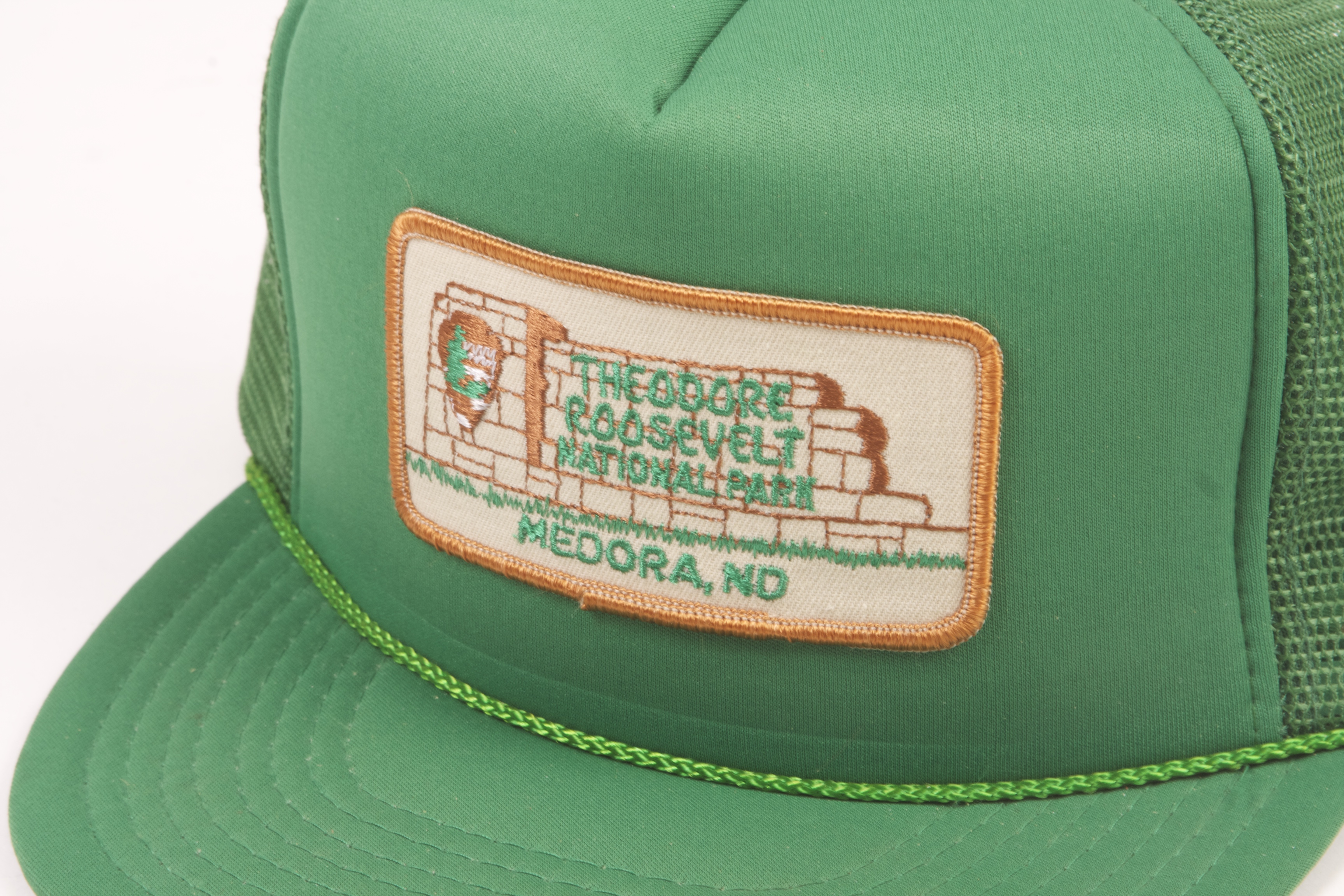
    Since it’s invention, the ball cap has been the preeminent accessory of comfort and the ultimate casual lifestyle. People participating in baseball games or other leisure activities, those hiding from the harsh rays of the sun, those who don’t know how else to deal with a bad hair day, or those who don’t take themselves too seriously, wear hats. But they also wear hats simply because hats are comfortable.

    HAT FARM was born out of a desperate need for simple funds for the Carmichael Outreach Housing Program, and the regular classic hat donations received by the Clothing Depot Donation Program. Carmichael’s Housing Support Team works to remove the barriers the community has in finding adequate and safe housing, which often includes small financial obstacles that aren’t covered in other budget lines or in housing clients’ budgets. The profits made here will go towards removing those barriers and thus housing people, and keeping them housed.

     Teddy

    The hat I wear daily is one I’ve had since I was 12 years old, but only started wearing it about a decade ago. I have separation anxiety when I don’t have it for long periods of time. I have nearly lost it out the window of moving vehicles, in fist fights on the beach in Mexico, in severe gusts of prairie wind, in the rivers of Thailand, off ferries on the west coast. I’ve repaired the plastic snap three separate times, and the once body-filled hat now rests limp and tattered like a discarded pair of briefs. I have moments of panic knowing that one day it will disappear in a drunken stupor or traumatic event, some instance where losing your head and what rests upon it is possible. For that reason I began auditions for a new, future everyday hat. Like when your best friend moves away, you start flipping through your contact book dejectedly for someone that may be able to partially fill the void, if anything at least for a weekly beer.

    When I began hat auditions I happened to be working at Carmichael Outreach, a community drop-in centre downtown Regina with free food, coffee, hygiene products, housing services, needle exchange, and clothing, open to anyone in the city. Hundreds of clothing donations are dropped off to the back door weekly where they are sorted and put out for the community depending on their seasonal use and if there is room in the tiny three-rack clothing depot. Community members browse daily for clothes, dishes, puzzles, Patsy Cline CDs, used printers, children’s books, all of which are free in the clothing depot, open all day Monday to Friday. Closets from all over Saskatchewan have been cleaned out after decades of storage bringing in vintage Star Wars toys, unworn embroidered cowboy shirts, antique decorative plates, slightly malfuctioning DVD players, and much more.

    Larsen's

    One day I walked into the clothing depot to find a stack of hats six feet long, the collection of hat connoisseurs around the province. Farm industry logos, country legends, family vacation destinations, family reunions, all immortalized on the unparalleled medium of the trucker hat. Several small town hat collectors dropped off their decades-old work so that hatless men in the city could feel the dignity of cranial comfort once again. Before the hats were put on the rack, I searched through the most classic, mint condition, collectors hats from all over the world, and documented the rest which have all been put back into the clothing store.

    All proceeds from the hats collected and sold here will go towards the Carmichael Outreach Housing Program, including funds for damage deposits, carpet cleanings, new small household items, fees for money orders for rent payments or identification applications, or any other potential barriers that might keep community members from maintaining stable housing in the City of Regina. Because as much as a person needs a nice ball cap to feel comfortable, a roof over their head does them one better.

    For more information, to buy, or to donate, email thehatfarm@gmail.com

    Halfway Husky