


Category: Non-University
-
World Crokinole Championships – The Great Paternal Experiment
The following piece was featured on Ominocity.com out of Saskatoon, Saskatchewan.

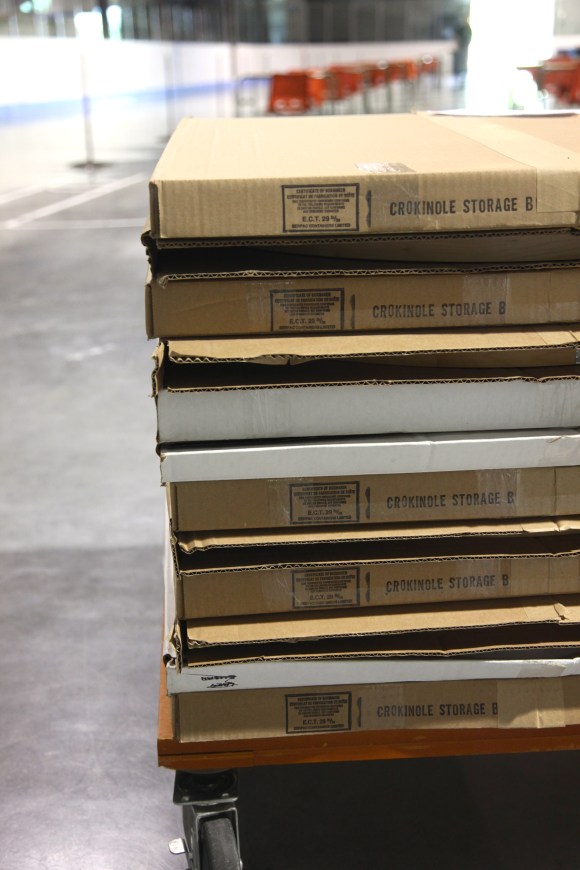
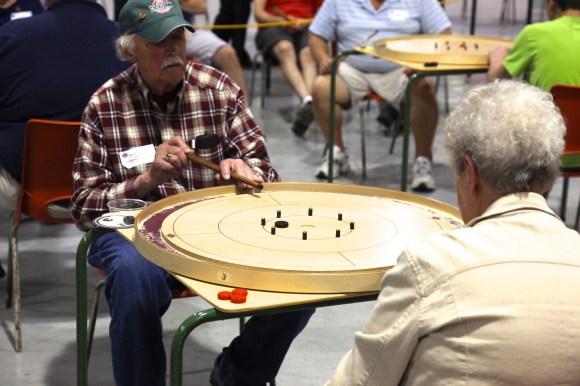
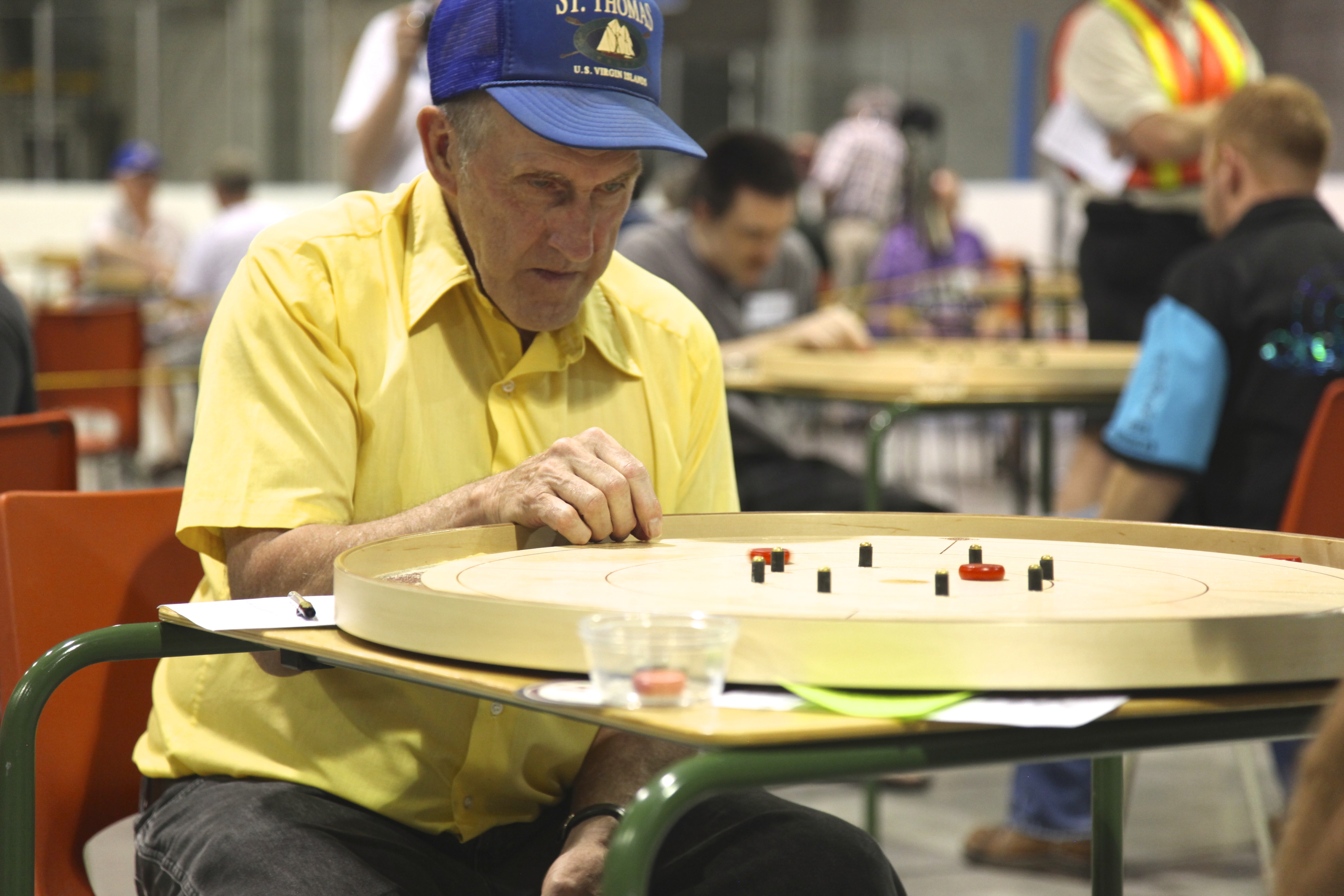
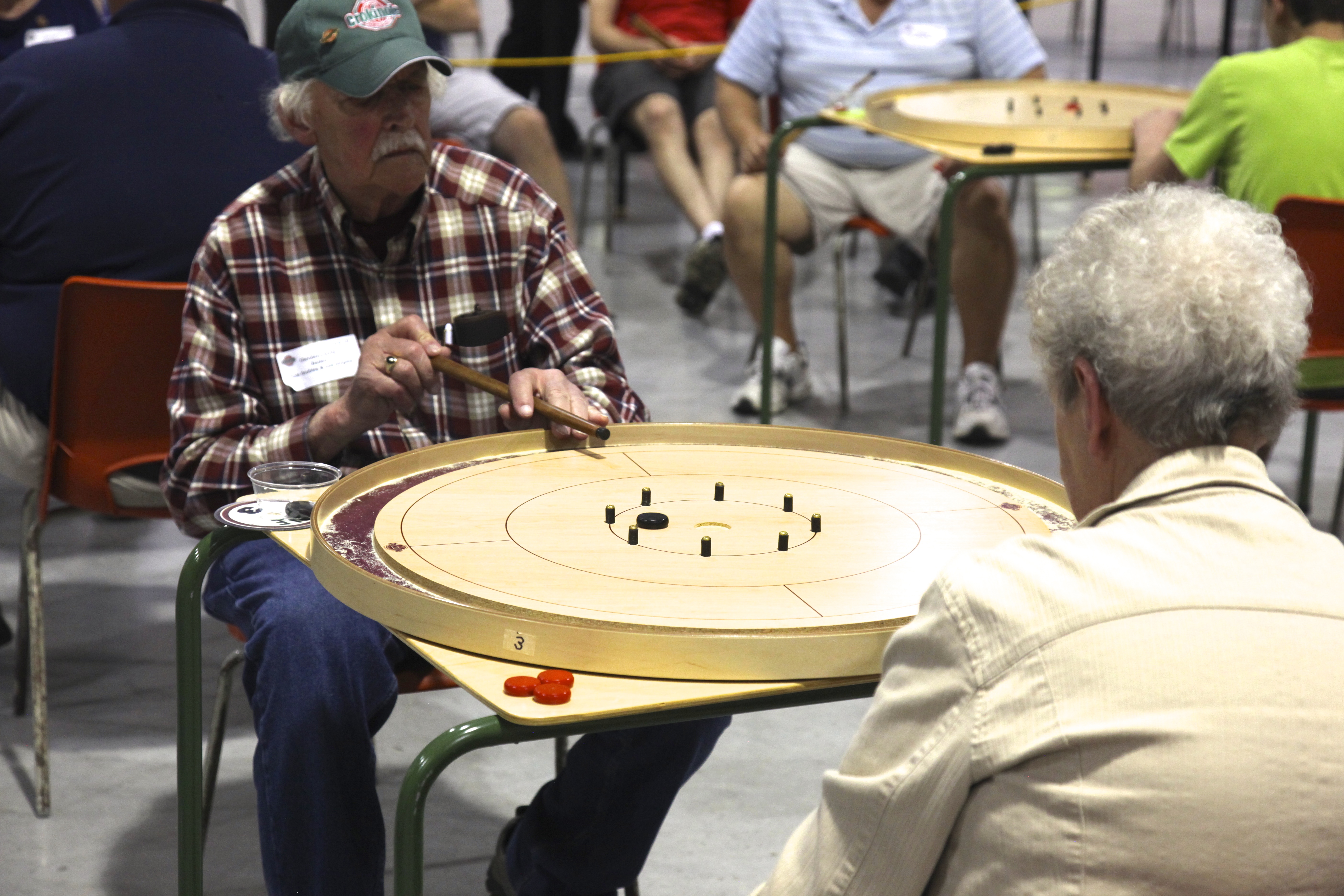
If you’ve never heard of crokinole, you’re likely not a citizen of the disintegrating Canadian countryside. If you are from the North of 49 and you still haven’t heard of crokinole, you either a) are from a city, b) didn’t grow up in a church, c) grew up with a Nintendo, or d) had unloving parents. Crokinole is a two or four person game played on a 66cm-diameter circular board, in which each player has a determined number of discs made of lathed wood. Each player purposefully flicks these buttons with a finger or wooden cue towards a hole in the centre of the board a quarter-of-an-inch deep and only slightly larger than the button itself, attempting to avoid the eight stationary pegs that guard it like pawns on a chess board.
It is a game you may have played with your loud uncle and your wrinkly aunt before Christmas dinner. A game in which your grandpa is likely indomitable in between heavy naps in a dusty cardigan on an itchy couch. It is a game you may have tinkered with not knowing the rules (of which there are perhaps three), or, as previously determined, a game you may not have ever even heard of. For myself and my father, it is the game in which we competed at the World Championship in Tavistock, Ontario on June 1, 2013. The World Crokinole Championship, widely revered as the Stanley Cup of crokinole tournaments, the Kentucky Derby of the forefinger stallions, centre stage of peculiar rural males aged 39-88, was obscurity and sportsmanship perfectly defined.

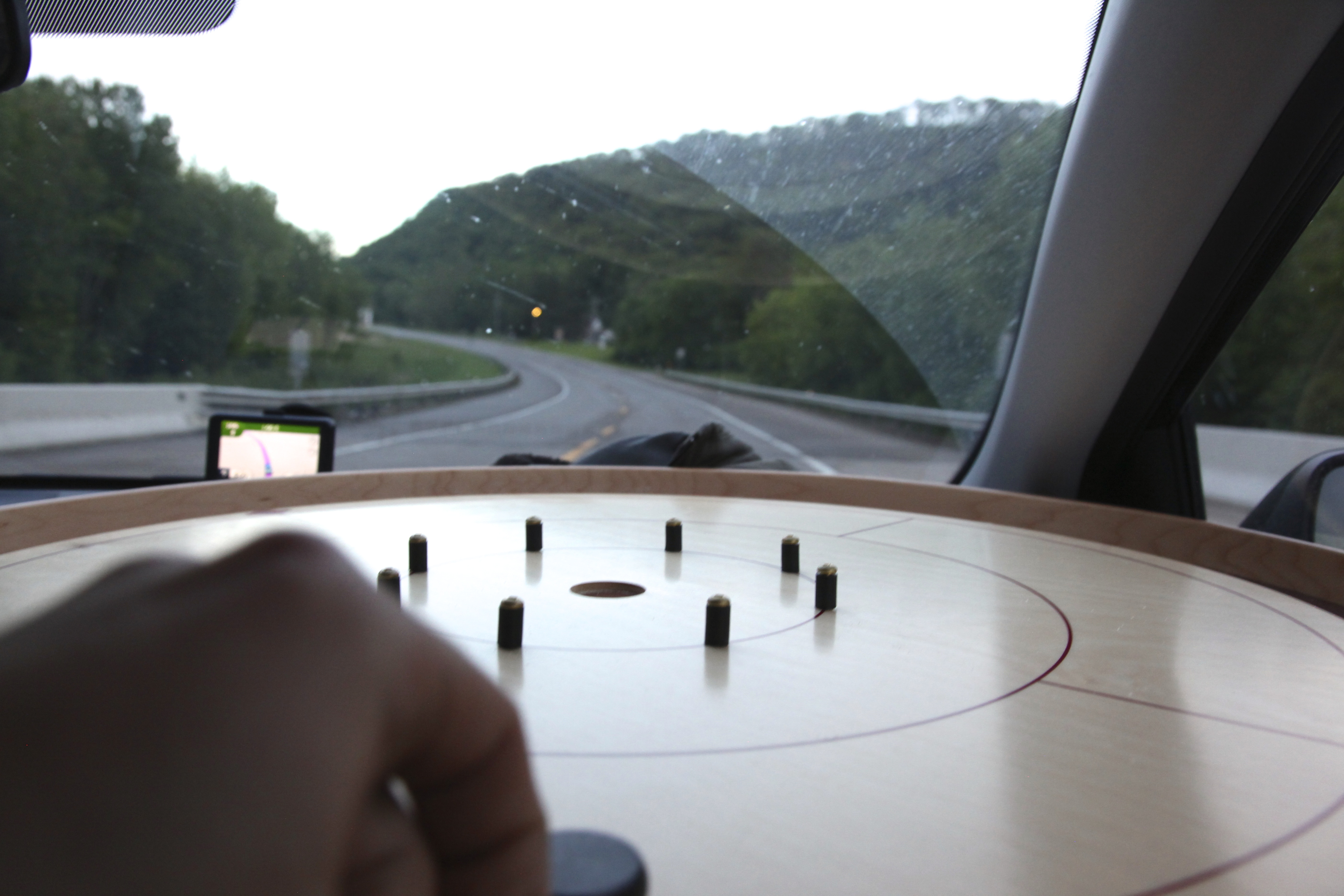
After driving straight through six U.S. states and two Canadian provinces, we pulled into Tavistock, home of the oldest known crokinole board dating back to 1876. During the drive, when our periods of silence (often reaching four or five hours at a time) were broken, we discussed religion in many contexts; traditional theology, silage and dairy production in devout farming lives, and most importantly, righteousness through crokinole techniques. We made our ecclesiastical pilgrimage, fasting from sleep and whole foods in the goal of reuniting westerly disciples with the holy land of immaculate wooden conception. We were pilgrims for the board of life. The home of crokinole was like I had dreamed it would be as a kid of twenty-four years old. An established farming community of dairy producers with a Main Street that boasted a two-decade old Chinese Restaurant, local credit union, and butcher shop. As one might expect, side streets were dotted with various forms of seniors’ homes.
Upon arrival, silence was broken by John Schultz, the bald, wiry, extremely pleasant chairman of the World Croknole Championship, asking, “Are you folks here for the crokinole tournament?” He woke us napping in the park—our first hours of horizontal sleep in two days—and it finally occurred to me what we’d done. We drove twenty-two hours for crokinole. In the same amount of time I could’ve driven to the flawless forests of northern California. I could’ve driven to Nunavut. “Holy shit,” I thought, “I could’ve just travelled an hour and played a game of crokinole with my grandpa.” But instead I drove twenty-two hours to play with all of the grandpas of southern Ontario. John Schultz continued to tell us that other folks drove in from Michigan, New York, Ohio, P.E.I.. We cleaned up, grabbed our board, and began our pre-tournament practice on a picnic table in the shade of Queens Park.

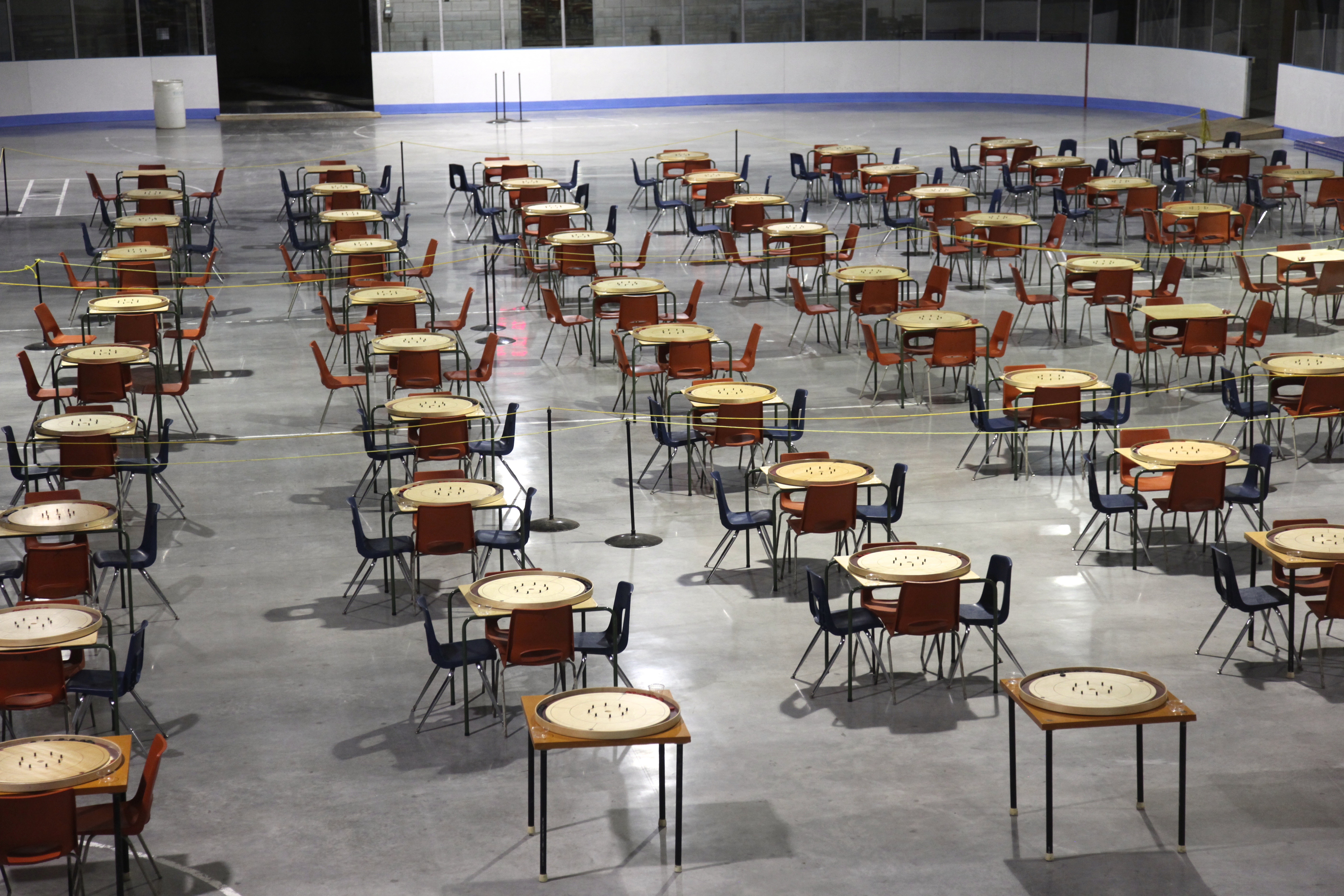
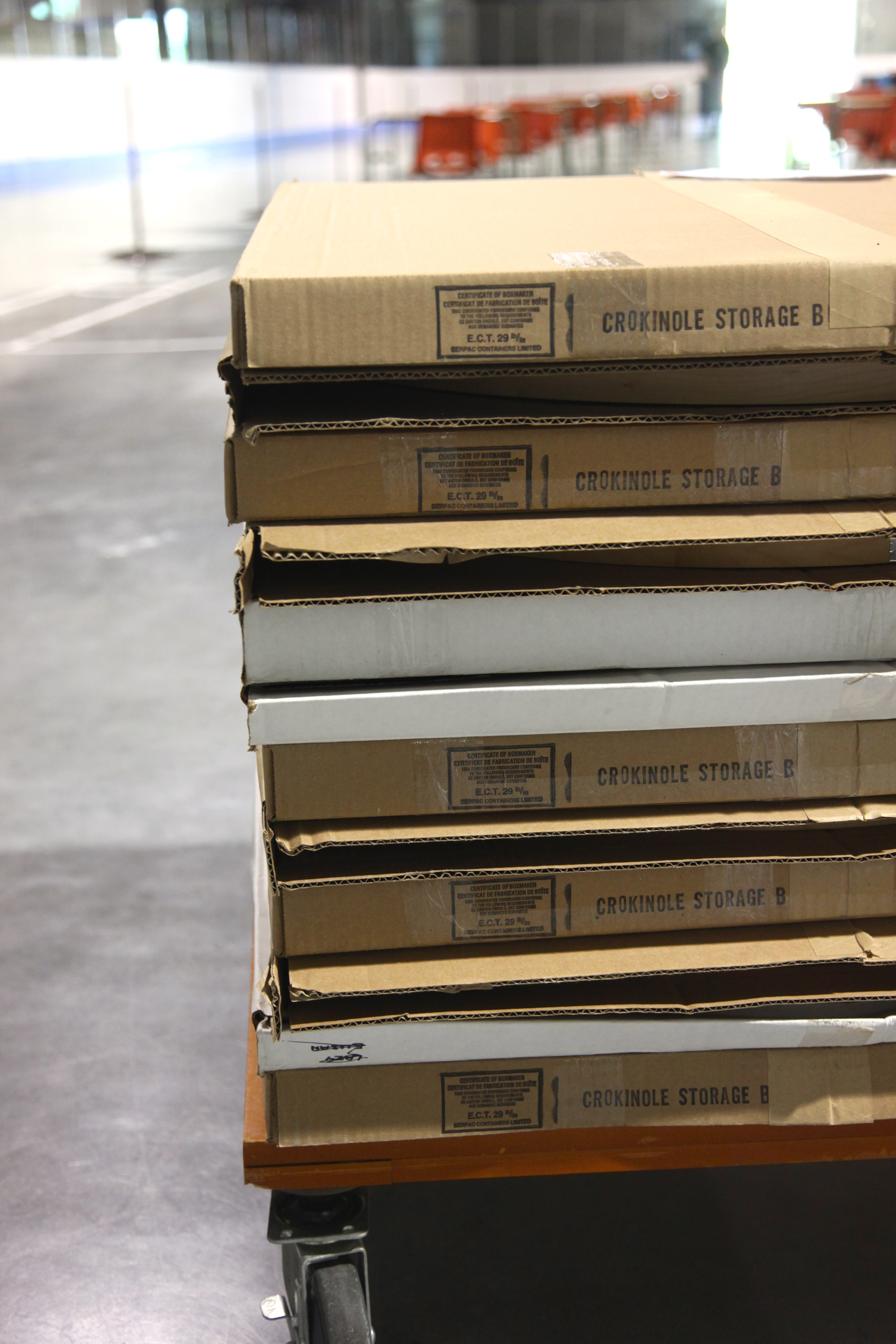
On Saturday morning when I woke up at dawn to practice before competition began at 8:30, the Ontario air was thick. The humidity weighed down the crokinole buttons as if Mother Nature rubbed each one on her sweaty chest. After a breakfast fine-tuned for finger endurance I followed my father into the arena which housed over 64 freshly waxed, previously untouched boards set up in a grid on the concrete slab of the dried up hockey ice, all partitioned by yellow rope. Competitors and spectators in jean shorts and agriculturally branded caps floated around the merchandise on the perimeter of the rink. Those keen on capitalizing on the lucrative crokinole market sold World Championship t-shirts, ballcaps, boards and board accessories. People competed in the skill shot competition and captured photos of the trophies which were handmade for the event (it is difficult to find a golden plastic figurine of a man playing crokinole to fix to the top of a regular trophy). When tournament competition began, over 280 competitors showed their masterly applied-geometry skills and muscle memory. Each competitor sat down at a table with ten strangers for eight minutes at a time until the horn sounded, shaking hands and wishing luck to people they hoped to blank eight points to zero. Saturated in Canadian politeness, if crokinole isn’t a game of true sportsmanship, it isn’t anything at all.

As for the competition, unfortunately the prophesy from aged-competitor Dave Skipper that, “people with beards and moustaches shoot better on these boards,” didn’t prove true. I, one of the few participants with a gnarly beard, didn’t even place in the top half of the draw, and the eventual singles champion, John Conrad, had the hairless face of a teenager, although he was surely approaching his golden years. My father proved to be worthy competition, scaling the ranks of eleventh of 86 participants in the main draw, making the playoff round with the true elites. The final match drew crowds upwards of forty, those who had already sweat through their crokinole team jerseys and sweat bands, groaning and whispering with the final shots of the game. Hands become shaky with such pressure. For one of his final shots, Conrad made an incredible triple take-out. Someone in the crowd said in praise, “I think that was a statement.” In the finals, fathers sat behind the yellow rope, watching sons in competition, offering familial support. My father and I participated in the great paternal experiment that is crokinole.
While discussing board consistency during the final round, a man who placed third in the doubles category, making no excuses, commented: “The heat, the humidity—we have been battling the elements all day long,” as though it were an Ironman competition, which, in a way it was. The oldest participant was 88-years old, and was celebrating his 50th wedding anniversary at the tournament. He had competed in all previous fifteen World Championships that had been held.
If it were a televised event, and if the champions were interviewed and asked to describe their feelings, I imagine that like any other world final, they would stumble and mumble in speechlessness. There is no way to properly explain a world championship of any sport, and it only becomes more grueling when it is a celebration of nearly-perfected obscurity. We travelled knowing full-well that we were participating in an antiquated parlour game that itself was competing against screen-bright technologies for space in the family room. What we didn’t know was that our hands would shake and that we would miss shots from fried nerves in a game usually as relaxing as a free massage. We didn’t know that we’d have to practice for another year to make even a dent in the crokinole kingdom.
Back to the grind. Back to the board.
-
Roof-Ready Regina: Let’s Try One More Time
If you missed it last time, I will be presenting at City Council again this Monday, June 10. Below is what I will say to a a group of dead-eyed politicians. If you want to know more I enjoy discussing the topic, that is, if you enjoy buying me supper or beer. Or even otherwise, I guess.
It is evident that housing is a priority for city council. The Mayor’s Housing Summit was the necessary first step in presenting new ideas to include in conversations between government and the private and non-profit sectors. Now the conversations begin.
The City of Regina has come up with plans to improve the rental market housing issue in Regina. Positive steps such as ‘capital incentives which focus on larger projects with a minimum unit number for eligibility for private developers, with no minimum for non-profits,’ (page 19, Appendix A, Comprehensive Housing Strategy Implementation Plan) have been taken. The lack of rental market housing is an evident problem in our city, however the City of Regina does not adequately address rental housing, in that truly affordable rental housing is not given priority. Properly addressing homelessness on a municipal level would include taking the aforementioned plan of capital incentives on larger projects one step further, and requiring developers to include affordable rental housing in medium and large projects as well, as has been done in Montreal. This is a municipal initiative that ensures an adequate percentage of affordable rental housing is produced. Instead of offering incentives to developers, who will build regardless in such times of prosperity, we must take advantage of these times to ensure that affordable rental housing is a part of the plan, thus ensuring that those who need help the most get it.
Offering incentives to developers for truly affordable housing makes sense. However, offering incentives to developers based on the Plan’s current definition, that is, “at or below market rates”, is not an immediate cure for the lack of affordable housing in the city. The “trickle-down” effect, best-case scenario, would take years to properly represent what CMHC would consider affordable rental housing, that is, “the cost of adequate shelter not exceeding 30% of a person’s income.” Affordable housing is a necessary tool in the transitionary Housing First model, which is briefly mentioned in the Implementation Plan of the Comprehensive Housing Strategy (page 65, Appendix A, Comprehensive Housing Strategy Implementation Plan), and recommended by several presenters at the Housing Summit. Other cities have taken multi-year pledges to eliminate homelessness on a municipal level, taking the lead by advocating strongly to the provincial and federal governments, as well as implementing strategies similar to those that have been previously shared through the Roof-Ready Regina Document, and other community-based initiatives. With the current Implementation Strategy the City of Regina is taking steps to improve the rental housing market, but is effectively doing nothing to eliminate homelessness.
Please, as you move forward with the Implementation Plan of the Comprehensive Housing Strategy, consider the importance of affordable housing in a healthy community and economy, and take every possible step a municipal government can to address these issues. Homelessness is not just a provincial or federal issue. If homelessness is to be ended, municipal governments must also take significant steps. Let us use what we learned from our counterparts in Calgary and Vancouver and take a proactive step in ending homelessness, starting with a proper plan to include affordable housing.
-
Entitled to Poverty
“I’m called crazy a lotta times already. It don’t bother me.
My wife says, ‘Leon, you gotta expect it.’ She says, ‘People never understand a man who wants something more outa life than just money.’
People think you gotta be one of two things: either you’re a shark or you gotta lay back and let the sharks eatcha alive—this is the world. Me, I’m the kinda guy’s gotta go out and wrestle with the sharks. Why? I dunno. This is crazy? Okay.”
-Richard Yates, A Wrestler with Sharks, Eleven Kinds of Loneliness
I have never done drugs. I have had very brief moments of controllable levels of alcoholism. I have lived in a life of love and unending comfort. And I curse myself for it. I curse my parents, though with thankful undertones. If I hadn’t been brought up in comfort, I’d know what people mean when they say addiction is a cave, where every step towards its mouth is also a step towards vulnerability’s gnawing teeth of open air and light. I’d know what they meant when they tell me about being dope sick, being shunned by lifelong friends. Instead, I’m that fucking ignorant suburban kid who got arrested once for being too much of a goddamn square to know how to spraypaint a wall in secret, who nods and says ‘it’s hard’, when I actually haven’t the slightest goddamn clue.
After one of my cynical, over-tired rants about people who own Mercedes-Benz vehicles, my father asked me where the line is when wealth becomes acceptable. Mom wisely, fairly, replied, as I was walking out the door to get my dad to drive me to the pub, that each person must decide this line themselves. As I shut the door, I told her that everyone sucks at determining where wealth is acceptable, so maybe I should decide for them. The makings of a true communist dictator. We all smiled and soaked in the exaggerated version of my disgruntlement. Dad drove me to the pub. I brought my cynicisms to my boss on Monday morning. She said that she doesn’t think wealth is bad. Wealth is a dirty word to me. It is entitlement. Entitlement based on good decisions and investments, hard work, responsibility. Entitlement is based on the belief of personal ownership when really nothing in this world is wholly ours. Therefore entitlement is greed and arrogance. Entitlement in any form is unattractive and abrasive. Wealth is not unacceptable, but it must be responsible, sustainable, frugal, generous, moderate, fair.
My recent public speaking engagement revolved around my travels, my writing, my work, and punk rock. I spoke to a group of twenty seniors who likely relate punk music to Elvis. I told them that it took me quitting university, going to India three times, travelling North America with the musically-inclined, writing a sorry excuse for a book, to finally find a place where I felt like I was supposed to be. And it has never been harder. I also told them that we all fit in in the same way, by an obligation to help those in need, in whatever means we can. However, it is not, and will never be, enough.
Ann Livingston is a true wrestler of sharks. A co-founder of VANDU, she helped establish the first safe-injection site in North America as an act of civil disobedience, done before it was made legal by the government. She suggests that the obligation to save lives is always greater than the obligation to obey the law. This seems like common sense. Similarily, the obligation to help others is greater than the obligation to obtain wealth. This may (or may not) be widely agreed upon, but not widely practiced. I know that I am lucky to have the job I do. They could’ve hired another graduate student, straight off of the uninformed teat that is institutionalized education, who would be more able than I to write government grants and better know the system in which people must play to find comfort and peace. And there wouldn’t have been anything wrong with that. I am lucky to have a job that has a direct impact, and though it may seem otherwise, I do not give myself credit over others for it. I often do the opposite.
It is important not to be the shark. There are enough of them. It is equally important to not allow the shark to ‘eatcha alive’. If each one of us decided to poke the shark, to throw a rock at the shark in the pool of water that it circles hungrily, the problems that I am unable to relate to would change substantially. We would leave our entitlements and privilege behind. We wouldn’t have to curse our parents for loving us.
I love you, mom and dad.
However, it is not, and will never be, enough.
Why? I dunno. This is crazy? Okay.
-
Norwood KnowMag Spotlight
A version of the following article was released in the Volume II Issue II edition of the KnowMag. An online version of the magazine can be found here.
Also check out NorwoodShop.ca, Hansen Leather Goods, Norwood Tumblr, Norwood Instagram, Benedict Moyer, Norm Rockwell.
If you were to take a step out of the door at 2401-11th Avenue in Regina, Saskatchewan, turned left to face west, and walked until you reached a rise or fall in elevation greater than a metre, you would likely arrive in the Rocky Mountains. If, instead, you were to walk directly north on Smith Street, the cross-street of 2401-11th Avenue, you would end up walking for three straight days until you reached a heavily forested area with naturally growing trees, as opposed to the wind-breaking hand-planted farm trees in the south. It is in the flat and the barren where real strength is gained. Extreme meteorological conditions can (and will) lift and drop a human being’s spirit daily. When you come from a place where you must walk a minimum of several days to reach the luxuries of natural shelter provided by trees or elevation, you will become innovative and resourceful in many ways. You will because you have no choice. Some born into these conditions take to building structures, some learn an instrument, some read books. Some collect antiques and vintage trinkets to fill the voids. Others sit in basements drilling holes through pressed-steel handsaws to make display cases. The latter is Norwood. A softly-lit amalgam of pine, fir, and birch that brings back warm memories of your grandparents’ basement, or the family cottage at the lake when the leaves have fallen off the trees.
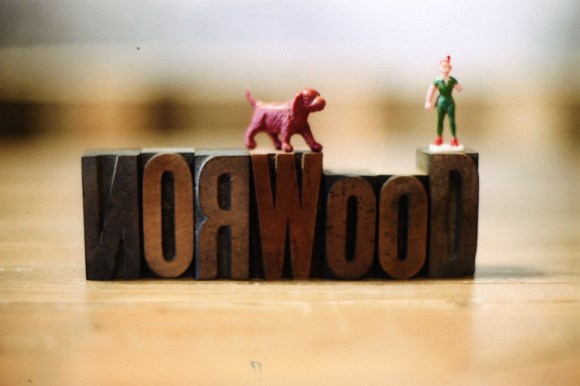
When Noel Wendt, proprietor of the staple Canadian skateshop the Tiki Room, asked me to help him brainstorm names for the new shop he was opening, I was living in Montreal. I hadn’t seen the space and hadn’t been back to Saskatchewan in nearly a year. I didn’t understand his vision. So my list included generic gems such as The Cabin, The Workshop, as well as moronic suggestions such as Grime and Punishment, The Brothel, or Blown Hips (it has recently been given the nickname the Gnarbar, or Gnarburator by the few workers that spend too much time there). For some reason, none of my brilliant suggestions caught wind. Instead, just weeks before the shop opened, someone noticed a rusted iron cap with the diameter of a pasture fence-post inlayed in the concrete at the corner of Smith and 11th. The cap read ‘Norwood’, an old Canadian iron foundry that buried their caps in the sidewalks of cities across the prairies. The name fit the aesthetic. Norwood was born.
The 1000-square-foot storefront is filled with household and industrial items from the days of old, when purchasing something meant a life-long commitment. When objects were built well, with proper materials, and purchased only upon necessity. Norwood carries brands that reflect this mentality. Simplicity, quality craftsmanship, responsibility. Pendleton pillows and blankets sit upon a modified bakery rack against the building’s eastern-most column. Belts, lanyards, and accessories from local leather-maker, Hansen Leather Goods, adorn a vintage hand dolly. Ray Ban sunglasses boast their attractiveness from the previously mentioned glass-case made up of six rusty handsaws. Red Wing Shoes stand proudly under the spotlight on a massive chopping block. Mens coats hang from a coat rack salvaged from a church foyer, and another rack created and designed in-shop, made up of one-inch iron pipes threaded and fitted for the space. Norse Projects hats and sweaters rest comfortably on wooden milk crates and wooden toboggans next to the door. The Levi’s denim decorates the west wall, hanging from a John Deere truss taken from a torn down barn at a sheep farm in Cupar, Saskatchewan. The barn was an acquisition specifically for the creation of the shop–an ad was posted on the internet that Wendt would pay $50 if he could tear down a barn and keep the lumber–the weathered planks from the prairie structure are the appropriate backdrop to the hand-drafted map of Regina from 1957 that hangs as a centrepiece to the entire shop. The barn was torn down in the middle of February in the unforgiving winters of Saskatchewan. The pine floor was milled in Love, Saskatchewan, and the counter top is made of reclaimed fir beams of an old swimming pool, both made and installed with the DIY-values upon which Norwood was founded. The creative balance between product and prop makes for a relaxing visit, no matter the mood you’re in, the time of day, or the type of weather you may see out the North and East windows. An honest, agrarian cabin in the core of a prairie city.
And that’s only half of the space. When the hand-made drawbridge (yes, there is an actual drawbridge) is drawn, one can meander downstairs, into the workshop-dungeon where so much of the work was done for the upstairs shop. A miniature woodworking shop, a small photo studio, a desk made of plywood and paint cans, and soon to be a darkroom for the developing and printing of film photography, the basement is the creative workspace where artistic ideas come to life, where the skeleton of Norwood is pieced together, joint by joint, limb by limb.
In just over one year of existence, Norwood has grown into its own as a fine vendor of classic goods to serve the growing city with increasingly diverse demands. As it gains notoriety and evolves in its design, and as it grows into a community of people committed to quality, Norwood will only become greater through the strength of many, staying true to the motto of the province in which the shop was proudly established.
Small cities may not possess the attractions and allure of larger metropolises. In small cities the pace is slower, the streets are quieter, the people are usually friendlier. Norwood Shop cozies right in with the themes and values of a prairie town, but boasts the ability, know-how, and craftiness to contend with any shop in any major city.
If you were to walk directly south on Smith Street past the windows of Norwood, past the city limits, and through the farmers’ fields, stepping over newborn calves, hurdling barbwire fences, again you would not soon reach a change in elevation that would make your legs ache. If you were to walk straight east on 11th Avenue until you found a shop that better embodied the values of the people whom it serves, you’d likely end up chin deep in the salty Atlantic Ocean.
-
Youth (Me) and Why I Hate Them (Me)
Santa called me at work. The recording of his voice seemed as if he cared less about Christmas than I do. Painfully forced. Knowing full-well that he hated his life. His voice brought forth images of a forty-nine year old male drinking from a 40oz of bad whiskey on the day before his birthday which also happened to be Christmas, wearing a vomit-stained cotton beard, just after calling his ex-wife about when he’ll pick up his sixteen-year-old over the holidays. A slouch. All the recording told me was that I need to be good so that he would deliver a present in my chimney this Christmas. Not even a promise of a free cruise. Just a pre-solicitation for something that may or may not include the loss of my anal virginity. This is Christmas.
And children love him. They love the undoubtedly alcoholic, morbidly obese. The kids that cry at Santa photos are the ones with natural instincts to stay away from the downfall of mankind.
But who am I to judge this digitally-recorded Santa? I have become that lonely old man who sits alone, thinking about the one(s) that got away, smelling the various disgusting parts of his body throughout the day. The man who constantly wonders what happened to the younger generation. Who loathes technology, the things considered as viable entertainment, many forms of social interaction. At twenty-four, I am that man. Different, but no better than the inebriated Santa robo-calling the nation with threats of gift-giving. But, I don’t know what previous generations were like, so I can’t responsibly say that I can see a cultural and intellectual decline. And saying that the world is worse off than it has ever been is history-ignoring naiveté.
And when I’m thinking of points to my argument of why youth are despicable and why I don’t want to be a teacher or have a child, I have to check my email three times, look up the writer to an episode of television. My attention span has been shortened thanks to constant interruptions in my pocket and the ability to get any information that I ever wanted at any time.
In the thirties, Evelyn Waugh’s characters of ‘Vile Bodies’ seemed to constantly critique the younger generation.
‘Don’t you think,’ said Father Rothschild gently, ‘…[t]hey won’t make the best of a bad job nowadays. My private schoolmaster used to say, “If a thing’s worth doing at all, it’s worth doing well.” My Church has taught that in different words for several centuries. But these young people have got hold of another end of the stick, and for all we know it may be the right one. They say, “If a thing’s not worth doing well, it’s not worth doing at all.” It makes everything very difficult for them.’
‘Good heavens, I should think it did. What a darned silly principle. I mean to say, if one didn’t do anything that wasn’t worth doing well–why, what would one do? I’ve always maintained that success in this world depends on knowing exactly how little effort each job is worth…distribution of energy…And, I suppose, most people would admit that I was a pretty successful man.’
-Evelyn Waugh, Vile Bodies, p111
The slight shift in the adage, and the youth become defeatist, single-use, one-task brains. Instead of attempting at excelling at many things—like how your dad can fix the car, build a bathroom, design a power plant, and your mom can fix jeans, bake the greatest pies known to man, know so much about health and the world—the youth decide that they will attempt to perform a single task adequately, while being useless at everything else. Because they can.
The wise adults of this book then talk of success being the bare minimum with maximum profit and high efficiency. Success. Suddenly moronic youth with one skill-set and the inability to focus sound pretty reasonable. Like the success-hunting adults, but with a sense of humour.
If Santa calls me back, I would like to talk to him. Not just listen to his nightmarish recording. He has seen the youth and he has seen them grow up. They have sat on his lap for the hundred years that he has existed, and he has seen them grow up into these success-hunting adults, placing their new children on his lap, and so on, and so on. He would know. He’d be able to tell me if the youth are getting dumber. If technology is ruining our ability to focus, or ability to give a shit, or ability to be shocked, or ability to learn and retain. I mean, he is the one making most of these toys and giving them to our kids. And at that revelation, Santa’s drunk voicemail message seems more threatening than before. Not only does Santa want to deflower my anus, he also wants the be a part of the plague of idiocy in our children. The dumber the children become, the more they need his gifts. The more they need his gifts, the fatter he becomes. The fatter he becomes, the more women he gets.
Don’t call back, Santa. I’m already plenty dumb.
-
Why I Got Arrested
There could be two ways of telling this story. I will tell both.
1. In the year 2000, a man named Pat Fiacco was elected Mayor of Regina. I was newly twelve. We had just finished our PeeWee football season and were celebrating by going to LazerQuest—the dream of all twelve-year-olds. Getting out of the car we heard early election results from the radio: Pat Fiacco had defeated Doug Archer, who had been mayor since I was born. Mr. Thibault, driver of the car, eventual SaskParty MLA-hopeful, father of a teammate who almost broke a kid’s neck, expressed his delight with the outcome. We went inside. I shot friends with lasers. Nothing else mattered.
I was never able to vote in a civic election in which Pat Fiacco ran for mayor. I supported his I Love Regina campaign, which seemed to rouse up civic pride in a city that has little more appeal than decent folks and short commutes. I bought the shirts, I shared the shirts, I gave the shirts as gifts.
Eventually, as politics became more important and professional sports became more absurd, in the latter part of Pat’s mayoral career, I began to question his legitimacy as mayor. Sure, it’s a tough job. Never enough money, lots to do, boring council meetings to attend, a populace to actually care for. But the more I saw the failed developments in a city that Pat encouraged me to love, the less I could stand it. I love the city too much. I saw the stadium as inevitable and necessary. I saw it as a positive if done correctly, timely, and not at the cost of a part of the population that couldn’t find a place to live. But instead the stadium project became fishier by the day. Hurried, sketchy, reeking of illegitimate money, and mostly all presented just before or during an election. Handled worse than a sopping jock strap. Instead of his first vision—a statue of himself shadow-boxing shirtless to be placed at city hall—Pat instead opted for the quarter-billion-dollar stadium project for all of us to remember him by. So that he wouldn’t be remembered for the goofy smile, the phantom moustache, the over-moussed hair. He would be remembered for the glorious ride on which he took us, instilling unwarranted levels of civic pride in our hearts with t-shirts and an ill-gotten stadium.
Some might say that I was arrested because Pat Fiacco was an unfit mayor.2. As a twenty-four-year-old who hasn’t accomplished much, the allure of political activism and vandalism drew me in like it were the aroma of a bowl of popcorn or a pretty lady’s hair. Live a little, it whispered in my ear. Don’t roll over and let them ram that stadium up your ass, it admonished. So, I somehow came up with this piece of art, tried it several times on several different materials with several different versions of moustache. Speckled. Muffled. Filtered. Full-on. The slogan came naturally (that is, poetically, with no research and based on conjecture). I came up with a route, I came up with an outfit, I didn’t wear a hat, I didn’t wear glasses, my jacket was manufactured with a hideable balaclava. The surveillance videos would lead them to anyone but myself.
But then I ran. Paranoia got the best of me, as it usually does with poser try-hards. Civilian cars started to look a lot like cop cars. Cop cars looked a lot like jail. Jail looked like something worse than a stadium up the ass. I ran, forgetting that I’m an out of shape bum and that running gave them reason to pursue. They caught me, cuffed me, realized that I wasn’t casing cars. They asked me my name when my nose was on the concrete, breathing deeply with leaves shooting out from under my head from my heavy exhale. Andrew Gurr was the only name that came to mind, following my plan to never give my real name if I ever got arrested. Then, in my first moment of clarity of the night, I realized that a fake name would only make it worse. I was cooperative. I slept in a cell. I got fingerprinted. Mugshot. Tattoo information. Left with one charge, five times. They caught the real bad guy.
Some might say I was arrested because I am a moron. Most would say this.As a football-loving PeeWee, had I been able to see Fiacco’s vision of a ‘state-of-the-art’ stadium meant to cup the balls of an already over-celebrated professional football team, I would have been ecstatic. The Riders were my idols, of course they would deserve the greatest our money had to offer, even at the cost of the city’s lower class. I would’ve celebrated with Mr. Thibault, and entered LazerQuest with a little more victory in my heart. But alas, I grew up. I grew up with the ability to prioritize. I grew up with recklessness and a mind partial to moronic errors. I grew up into the graffiti-slinging, overly-idealistic, dissenting, once-upright child that you now see before you, fresh from his second court date where the Honourable Judge amended the curfew with an order to ‘Keep the Peace.’
Innocent no more. The stadium will be built and shortly thereafter rammed up my ass. My twelve-year-old-self congratulates you, former Mayor Fiacco. You win once again. You will forever be immortalized as the mayor that started the botched stadium project and left thousands of people out in the very real, very wintery cold. But with me, you will forever be immortalized in a stencil and five charges, under the slogan of your twelve year career: Greatest mayor ever sold.
Does this post count as an inability to ‘Keep the Peace’? If so, lock me up.
Calm down, Nic.
-
The Chair Project
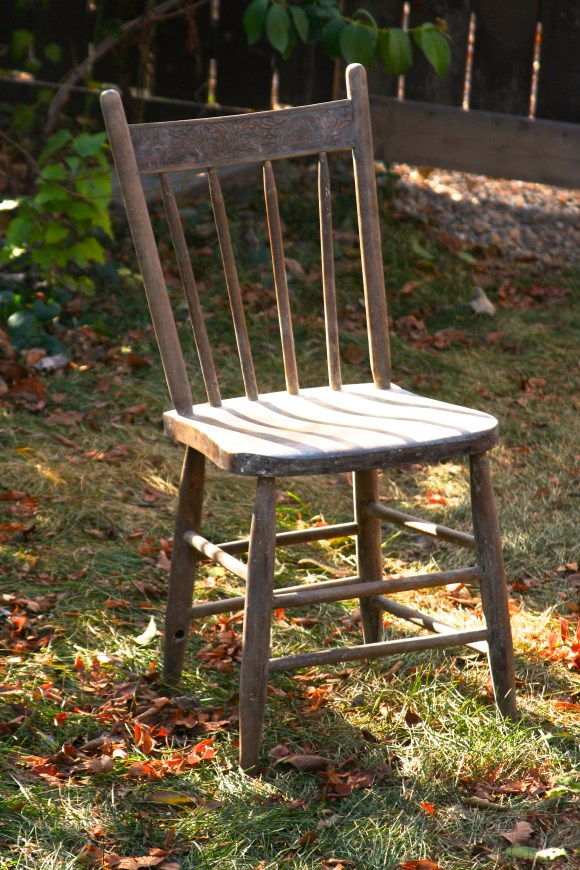 Long before summer hit us with its tube-top good times, but after the snow had melted and evaporated, I found this chair. I had put in a morning volunteering at Carmichael Outreach, came out the back door to see a beat up white chair upside-down in the trash barrel, ready to be taken to the city dump to be buried with shitty diapers and half-eaten pizza pops. The bottom right rung was snapped off. The chair was unloved. Instead of letting it be disrespected, I strapped it onto the handlebars of my bicycle and rode home. On the way I picked up a garbage bag filled with recyclables to fully adopt the poverty stereotype, and rode home talking to myself and chuckling.
After six layers of paint that I stripped with some environmentally-friendly goop and a few paint scrapers I couldn’t figure out why a person would paint such a chair in the first place, and why they decided they needed to do it five more times, from blue to yellow to white to powder blue to seafoam green to white again. The pressed-back was strangled by the paint. Painting things; walls, furniture, teeth, cars, faces, has never computed with me. A temporary, always artificial facade that hides only the truth of natural aesthetic. Truth is better than beauty. Like I’ve said since I was an obnoxious pre-teen: dyeing your hair is living a lie. Painting your chair is as good as murder. Make-up on a girl’s face is often great, but always unnecessary. But alas, I am simply a peasant with no taste.
Regardless, my chair now sits in my basement prison as just one more thing that isn’t anywhere near as comfortable as a beanbag, just one more apparatus to hang clothes off of. I only hang clothes off of antique furniture, restored by the hands of a skilled craftsman. The project is finished, the chair is functional and I have learned nothing but the fact that seeing through to the end of a project is an infinitely difficult task for me. Must be a lack of character.

-
Heavy Hands
It is with a heavy heart that I write this today.
My editor often comments that my writing is heavy-handed. Does this mean that my head is heavy-brained? Or does it mean that my hands are heavy-fingered? I usually don’t know what the hell he’s talking about, so I often have to ask him several times for several explanations. Those things you pick up in University that replace colloquialisms and make you sound smarter. If he just said, “That part sucks, that part sucks marginally less,” I’d get it.
I just finished another Vonnegut book. I have read many, remember few, and still have more to go. He has the ability to write stories about humankind without being heavy-handed. Maybe it is because he seems to use short phrases the make the narrator seem like your quirky middle-school teacher.
Hi ho.
So it goes.
And so on.
Or maybe it is because he is smart enough to convey meaning in properly-placed, simple sentences. Or maybe he was a hard worker. I think he just got lucky.
My heavy-handedness, which I see as the inability to subtly put meaning behind fiction that I am currently experimenting with, may stem from my tendency to over-think things. Or to keep things to myself. Or to think I’m smarter than I am. But let’s not get too heavy in the hand that offers psychological analysis, here.
Recently while in the land of milk and honey and beer and tacos and large bridges and fog, the land of the originators of the fortune cookie, I got two fortune cookies. The first read, ‘Your future is rife with mediocrity.‘ The second; ‘You are to the opposite sex what “OFF” is to mosquitoes.‘ That seems somewhat heavy-handed. Like they took their hand, gripped a brick, and hit my face with it. At least it is the first fortune cookie that ‘hit the nail on the head’ (is that a colloquialism, or an idiom? I just taught myself both words. Self-education). I am still awaiting a sum of money that a fortune cookie promised me in high school. The second San Francisco fortune was maybe the most accurate. I am sitting on a stool wearing both pants and underpants and I can still clearly see my the hairs of my upper thigh through a hole in my crotch the size of a holiday ham. I am repellant to myself most days. Fortune cookies are always heavy-handed, even more so when they are pointing out your foibles.
I guess maybe my editor just wants me to leave my overly philosophical way of analyzing things, my overly logical way of complaining about things, to this blog which has been rife with mediocrity for over six years, and is doomed to the same fate for six years to come. Because I am not eloquent enough to mask my complaints in literary metaphors. My hand is far too heavy for that. Heavy with the weight of the thousands of souls that have been lost from reading my writing.
You are now soulless.
Hi ho.
-
Apologia Pro Hippy Vita Sua
The following short letter was written in response to a ‘Street Wear’ section in Prairie Dog Magazine that highlighted how grungy I am. The letter following that is my response.
I’ve been reading your mag for years, even though I’m a staunch conservative; many aspects of it I love. Please though, stop featuring bums in your Street Wear section. These people are mostly wannabe hippies who work low-end jobs and are recognized for doing nothing more than working in a clothing store or coffee shop. Please start featuring people who contribute to society whether through the arts, science, education, politics…something! We all have the power to make a difference!
No Name
Presumed ReginanDear Staunch Conservative,
I feel that you best be more forgiving of these hippies that sell you your clothing, coffee, and meals. Although should I assume that you only shop at Walmart? (If you keep voting the way I assume you do there won’t be any immigrant labour to work there, so I don’t know who you expect to run your shops and sell you food—the elderly are dying off quickly. How staunch are you, exactly?) The fact that these hippies don’t have post-secondary educations, they sleep on the floor, they don’t have cell phones, they don’t eat meat, they don’t own cars, and they work at what was recently named by Prairie Dog Voters as ‘Regina’s Best New Store’, is obvious reason to assume they contribute nothing to society. Often I am too busy smoking illicit substances (Legalize, man!), playing bongos in Vic Park, or creating my own pachouli concoction to help out my community through volunteerism, or to actively take part in politics. I’d rather just lounge on my beanbag chair next to my hookah and watch documentaries about Buddhism. I do, however, agree that the ‘Style’ section is a waste of space. I have no style, you have no style. We live in Regina, man. People just stopped frosting their tips last week. But maybe we should include a business section in which you write a column suggesting how lowly shopkeeps could do something worthwhile with their lives (business degree, violin lessons, cure cancer, run for mayor), leaving their low-end jobs for the immigrants and those on welfare. We lower class citizens would truly appreciate the guidance.
Peace and Love.
Your Local Wannabe Hippy,Nic Olson




 Balls of Rice