Category: Politics

  • The Adirondack Haystack Still Tours

    The Adirondack Haystack Still Tours Mini Book Tour/Camping Trip

    July 12 – Kokopelli Salon w/ Son Howler, 2052 Commercial Dr, Vancouver BC, 8pm
    July 16 – Oaklands Sunset Market, 1-2827 Belmont Ave, Victoria BC, 4pm
    July 18 – Pages Books, 1135 Kensington Road NW, Calgary AB, 7:30pm

    See posters below. Click below for PDF versions.

     The Adirondack Haystack Still Tours The Adirondack Haystack Still Tours Poster

    Market July-page-001

    July 16 – Victoria

  • Yes, Coal.


    IMG_9278In a brief moment of respite, I stopped the the work van, a recently discontinued Dodge Caravan, and idled behind a small compact car. I sat there with a weight on my chest, my first break seemingly in a week, my work anthem playing in the background as I read a slogan on the back of the compact ahead of me in line to the next red light. The owner of this car was either very uncertain of his convictions, or was so sure of the resale value of his import, that instead of sticking the stickers on the bumper of the car, they were scotch-taped to the rear window. On the left side of the window was a sticker-length version of a memorable Albert Einstein quote, written specifically about politicians. The right ‘window sticker’ was probably a vote of support for solar power, or unions, or The Brotherhood of Solar Panel Installers Local 179. Sitting sweaty in the van, I applauded his uncertain efforts.

    Grandma gave me a calendar for Christmas. It was a monthly wall calendar for 2014 which she thought held daily thoughts and inspirations for someone like myself; a person with flagrant internal rage and one of those websites that a person can say whatever they want to inflate their self-worth. She wanted to give me ammunition to write more often and write about things that mattered. The calendar, it turned out, only had one piece of knowledge per month often no greater than, ‘When I am sad, I dream about owning a million pairs of shoes’. I told Grandma that the calendar unfortunately didn’t have daily advice, only monthly, and shortly thereafter came a box came in the mail with a new calendar—a daily flip calendar with real thoughts that transcended the very real epidemic of retail therapy. On March 24, the uncertain bumper/window sticker reappeared.

    Albert Einstein observed, “The significant problems we face cannot be solved at the same level of thinking we were at when we created them.”

    In Saskatchewan, social change generally means the grand opening of a new tavern or the retirement of a washed up wide receiver in the CFL. Students greet tuition hikes with annoyed tweets, and any sort of popular movement gets propagandized to become the ire of the middle class. Fear-mongering using the threat of economics convinces the friendly neighbour to become selfish, survivalist, and hateful. Bumper stickers and social media are considered a form of real protest and social involvement.

    A friend recently arranged a community art exhibit entitled ‘Hands’. The exhibit encouraged a discussion of Missing and Murdered Indigenous Women in Canada aimed at discouraging victim blaming in both conversation and in the media’s portrayals of the violence, and to focus on the perpetuators of the violence, not particularly on individual levels, but rather on a larger societal level. She greatly succeeded in allowing those with the luxury of purposeful indifference to participate in the greater discussion of which they may not have otherwise been a part. She succeeded in partially shifting the obligation of the solution from the perpetuator to the people.

    Calling on the federal government and RCMP to conduct a public inquiry, which is a common and ongoing demand of this movement, is asking the perpetuators of the gender violence to either point fingers at individual abusers and victims, or to give reasons and excuses for their long-lasting colonial violence. In doing this, nothing will be solved because people with the same level of thinking will be at the helm. The responsibility of finding a solution needs to be transferred from the policy-makers to the people.

    The gender violence that is a part of Canada’s history with colonialism cannot be solved by perpetuators of colonialism. Real social change will occur, as Hedges states, “among the poor, the homeless, the working class, and the destitute.

    As the numbers of disenfranchised dramatically increase, our only hope is to connect ourselves with the daily injustices visited upon the weak and the outcast. Out of this contact we can resurrect, from the ground up, a social ethic, a new movement. We must hand out bowls of soup. Coax the homeless into a shower. Make sure those who are mentally ill, cruelly abandoned on city sidewalks, take their medication. We must go back into America’s segregated schools and prisons. We must protest, learn to live simply and begin, in an age of material and imperial decline, to speak with a new humility.”

    By asking the perpetuators to solve the problems which they themselves created, we hand the wheel of a fast moving car to a driver unwilling to keep their eyes open. If we do that, not only will bumper sticker protests be too smashed up and damaged to be read, but calendars will no longer be a place for profound thought, but only a place to count the days between abominable genocidal events. Change can begin with personal investment in the gaining and sharing of new knowledge and an independence from oppressive arms of the state. In such ways, communities and movements are formed.

    Bumper stickers and internet campaigns only temporarily quell the liberal guilt of such complex problems. As with most ignorant attempts at change, they are divisive; they take complex issues and turn them into two-word statements of certainty and damnation.  It is “in the tangible, mundane, and difficult work of forming groups and communities to care for others that we will kindle the outrage and the moral vision to fight back, that we will articulate an alternative.” (Chris Hedges, Death of the Liberal Class, Chapter 5, p156)

  • The Five-Dot Eagle

    The new year has already had me clean up several kinds of faeces, including human, off of the snow-covered ground. It has had me see the reproductive organs of two single, middle-aged, grey-haired males, both dropping their pants in places that would not be deemed appropriate by a court of law. The new year has seen me drag a half-conscious man from a snowbank into a building to escape from a -40 degree Celsius Saskatchewan windchill. Two thousand fifteen can’t come soon enough.

    Seeing penises does not make me a better person. I have a rewarding job, people often tell me. If this is the reward, then you must have an odd sense of payoffs. Nice to be able to make a difference, others claim. If the difference is that I get paid to ensure people don’t freeze to death on the street, then I claim that every citizen should somehow participate in this difference.

    Later in the same day that I dragged Leon into the coffee room, I was walking to the library in the early evening darkness. A plastic bag was fluttering in the wind, but caught under the packed snow of the street. I bent down to grab the bag to put it in the proper receptacle, and had a flash of my action earlier in the day; dragging a man, foaming from the mouth, into his proper receptacle, that being Carmichael, and shortly after that, a police cruiser. I fleetingly feel shame in comparing Leon to a plastic bag stuck under road snow, but then again, this is how the man is treated. His proper receptacle is one of three locations with a span of three blocks, Carmichael, detox, or cells. The system has made his proper receptacle sanitized State-run facilities of oppression. An extermination hidden behind poor State-run social programs. I despise dragging a man, normally on crutches, grabbing him from under his armpits, as though I am hauling a piece of meat in a slaughterhouse (I couldn’t decide if this or leaving him lay in a snowbank was more dehumanizing). I despise calling the the undertaker, his hearse a police cruiser, but it is, through much experience, the only thing I can do in the current system of care to make sure Leon doesn’t freeze to death in the outdoor cooler. Passed around from under the armpit until he eventually dies and the program of cultural genocide continues.

    Heartbreaking. Tragic. After calling in on a single person fifteen times, after two penises, after several species of shit, it isn’t heartbreaking or tragic. It ensues rage. It ensues rage for the reason that those who dictate these people’s lives through policy, through programming the state and public mentalities, are uninformed. Those of them who are informed are often purposefully-distant, economically- and socially-conservative tools of the State. Leon, they see as an inevitability, a ‘well-we’ve-come-this-far’ colonial stepping-stone, as a financial burden. And only when Leon can be seen as less of a financial burden, by proving to them that their system of oppressive police systems, court systems, correctional systems costs more than treating Leon as if he weren’t a bag caught in a snowbank, but as a human, only then will they listen. Only then will they consider his humanity. And when he becomes a taxpayer and not a leech off of the system, then will he be truly rehabilitated, and the program of forced assimilation continues.

    Those are the two outcomes, deliberate and purposeful.

    But Leon will never rehabilitate. He will likely never sober up. He will likely die in a snowbank, as he told me he wanted to, while he laid in a snowbank. And at his funeral, if the State were to attend, they would eulogize him by absolving their responsibility to help such a person and say that they offered him supports but he just couldn’t sober up. Because his addiction was the reason he was homeless and unable to rehabilitate—not the fact that he was the victim of a multi-generational genocide planned and carried out by several levels of government, and assisted in the apathy of the general populace. No, he was always fond of drink, they’d say.

    Conservatives are not heartless, and progressives aren’t flawless. But conservative politics are heartless, based on and committed to a market-driven capitalist system that leaves people who cannot help themselves out in the snow, whether their supporters know it or not. If they do know it, and feel that it is neither the role of government, nor their role as citizens is to bring justice to the marginalized, then, well, they are as selfish as their politics. An ideology where an accountability to the market trumps an accountability to a human being is frightening when one looks into the already dimming future. And progressive politics are utopian, equally as damaging when they are bred in a bleeding-heart ignorance. Selfishness and ignorance, we are bound by thee.

    I’m tired of penises and I’m tired of calling the police on people whose only crime is nearly dying outside. I’m tired of participating in a system of oppression. I’m also tired of my ignorance that leaves me helpless in offering change to a system so badly flawed. And if I got an education, I would be tired of dealing with politicians with track-blinders on, and a Social Services system designed for the likeable, sober, employable, white homeless man you saw as a kid in the PeeWee Herman movie—designed for the eradication of a culture that represents the opposite of a consumption-based existence. And if I got an education and participated in the reform of the system, I’d likely be tired of something else. Probably tired of living in the dregs of socialism.

    The next day, over a bowl of chilli, Leon and I compared tattoos. He stuck his hand up my t-shirt sleeve to get a better look at mine, then he pulled up his leather jacket sleeve to show me his—four of five dots on his forearm that he did himself before the tattoo gun broke and he couldn’t continue. It was an eagle, he said, flying free in the sky. He gave a toothless grin, took his chilli and crutched his way to the north coffee room of his community-run receptacle.

  • Lyrics of the Month: January 2014 – Phil Ochs

    http://www.youtube.com/watch?v=u52Oz-54VYw

    I cried when they shot Medgar Evers
    Tears ran down my spine
    I cried when they shot Mr. Kennedy
    As though I’d lost a father of mine
    But Malcolm X got what was coming
    He got what he asked for this time
    So love me, love me, love me, I’m a liberal

    I go to civil rights rallies
    And I put down the old D.A.R.
    I love Harry and Sidney and Sammy
    I hope every colored boy becomes a star
    But don’t talk about revolution
    That’s going a little bit too far
    So love me, love me, love me, I’m a liberal

    I cheered when Humphrey was chosen
    My faith in the system restored
    I’m glad that the commies were thrown out
    of the A.F.L. C.I.O. board
    I love Puerto Ricans and Negros
    as long as they don’t move next door
    So love me, love me, love me, I’m a liberal

    The people of old Mississippi
    Should all hang their heads in shame
    I can’t understand how their minds work
    What’s the matter don’t they watch Les Crain?
    But if you ask me to bus my children
    I hope the cops take down your name
    So love me, love me, love me, I’m a liberal

    I read New Republic and Nation
    I’ve learned to take every view
    You know, I’ve memorized Lerner and Golden
    I feel like I’m almost a Jew
    But when it comes to times like Korea
    There’s no one more red, white and blue
    So love me, love me, love me, I’m a liberal

    I vote for the democratic party
    They want the U.N. to be strong
    I attend all the Pete Seeger concerts
    He sure gets me singing those songs
    I’ll send all the money you ask for
    But don’t ask me to come on along
    So love me, love me, love me, I’m a liberal

    Once I was young and impulsive
    I wore every conceivable pin
    Even went to the socialist meetings
    Learned all the old union hymns
    But I’ve grown older and wiser
    And that’s why I’m turning you in
    So love me, love me, love me, I’m a liberal

    -Phil Ochs, I’m a Liberal

  • November 5th, 2013

    There is a crokinole board as a permanent fixture in front of a free hide-a-bed couch. Next to the couch is a stack of books from the library, easily ingested thanks to the lack of distractions of the internet or the television. Next to the stack of books is a bedroll laid on the hardwood with several blankets rumpled up on top. On the windowsill is a bottle of whiskey, two plants, a kerosene lamp, all gifts from friends and family. Next to the windowsill is a rickety card-table/desk with a few more books, a laptop computer. Opposite the desk next to the door is a bicycle which sits upside-down, dripping dirty melting snow and ice onto a tarp below.

    This is my bachelor apartment. I have never been surrounded by such solitude and peace in my life. Nothing I despise exists inside this setting of personality. Only distractions that I wish to have, only smells I create myself, only one light on at a time. No human interference except for when I wish to have human interference. I have abandoned formal education, thus informal, personally motivated knowledge is all I have. If I’m not working, I’m wasting. Accepting the truths of others is irresponsible. Truths must be discovered individually. And truths can’t be discovered when you are living in someone else’s filth. Before this attempt at personal solitude I believed I would miss the unplanned visitors and roommate experiences of living in a home, but now I know that comfort in the presence of people and distraction in happenings kept me unable to progress. Albeit I have only lived here a week, and I will undoubtedly become wretchedly lonely when this couch eventually gives me bed sores.

    Introversion doesn’t necessarily have to mean loneliness, or even solitude. But daily I find myself more inclined to stay home, to be quiet, to read. And while I crave human interaction, I only crave it to the point of surrounding myself with the people I like, and only for short amounts of time. This, also, is largely because the humans I wish to surround myself with have their own adult lives that don’t welcome a third-wheel for extended periods of time. But I do wish I’d have visitors every now and then. I do wish someone would ring my doorbell without telling me via text beforehand that they are going to do so. But my antiquated ways of communication likely won’t be shared anytime soon.

    People often say they hate people, and people usually laugh. But real misanthropy is more than a frustration with the foibles of humankind. Where annoyance becomes misanthropy is the point where one finds himself talking to his plants and never leaving his couch. I can’t imagine a sociable misanthropist, though they may well exist. A person that requires the company of people to relieve their stress, all the while cursing every person for their inanities and selfishness. Either confused, or just diabolical.

    I don’t hate people, but I do talk to my plants. And I do like my own company more than that of most others. The real love of a select few instead of the pretend love of a wide variety is how I survive. When drinking with a group of friends recently, one of the females convinced us to participate in the ‘what we are thankful for’ game while waiting for a cab. And although the cab interrupted my answer, I was thankful for a small group of friends and family that I know would look after me if life ever got too real. I can sit alone for hours comfortably knowing that fact.

  • Coffee is a human right.

    Coffee is a human right, we decided at work today. We have a coffee room so that the ultra-marginalized can have access to that steaming, aromatic, bold flavour to start each morning. As a non-coffee-drinker, coffee is far from something I would ever consider an important provision. Treating people as they ought to be treated, whether or not they can afford to purchase the right to be a customer of a Robin’s Donuts, is an important necessity, however. And if some foreign, non-fair trade caffeinated liquid does that, if coffee does that, then I guess I can support it. Treating people as humans even if they cannot participate in a market economy is a human right, thus, coffee is a human right where I work.

    Water, actually, is a human right. At work, we have cancelled our water service from Nimbus, one of those brilliant companies that sells necessities to spoiled morons who don’t know that it is essentially free in half of the rooms of their home. We cancelled the Nimbus because of cost, but in my mind, because of the classism that comes with letting only staff drink filtered moron water. I drank tap. Water is a human right, but it can be classed.

    Housing is a human right, though most forms of government act as if it weren’t. They watch, coddling the testicles of ‘the market’ in one hand, creating sub-committees out of thin air with the other hand, and let the erect shaft of the market decide. The market, therefore, decides what is a human right. Water and coffee don’t stand a chance.

    The topic of this year’s Blog Action Day is human rights. A few hundred or thousand hack writers delusionally pretend that a cob-webbed corner of the internet constitutes a conversation. The internet is a tool of monitorship and distraction with the veil of community and connectivity. Blogging will not save the world. Forms of virtual kudos and sharing will not save the world. Change.org petitions will not save the world. Blog Action Day will not save the world. You will not save the world.

    Nor will negativity. But nor will the market. And if we continue, as a human species, to live on hope and the poor writing of laypersons on the internet, if we continue to rely on shit media campaigns to start conversations, then sweet fuck, things are going to take a while.

    Blogging for human rights could be equated to smiling to end racism, or clapping to apartheid, or patting yourself on the back to start a revolution.

    Coffee is ready. (This coffee was brewed with good intentions and paid for by the market.)

  • Compliance or Complaints

    The CarpetI used to think selfishness was the basic flaw in most of humankind. That all problems in the world could be cured with a cure for selfishness (see How to Cure a Man, in this award-winning piece of horseshit). This hypothesis is perhaps too flattering to the human species. Selfishness takes the presence of mind to know what a person wants, whether it destroys another human being or not in the process is irrelevant. Selfishness is bold. It is daring enough to step over an injured child on the side of the road to catch a fluttering $5 bill in the tempestuous prairie wind.

    Obedience, a compliance or submission to some form of authority, real or imagined, takes nothing. It takes cowardice and brainlessness. It takes cowering in a corner and an inability to think for one’s self. It takes the physical ability to nod.

    When I consider the ghastly orders obeyed by underlings of Columbus, or of Aztec priests supervising human sacrifices, or of senile Chinese bureaucrats wishing to silence unarmed, peaceful protesters in Tiananmen Square only three years ago as I write, I have to wonder if obedience isn’t the basic flaw in most of humankind.

    -Kurt Vonnegut, Sucker’s Portfolio, Episode Seven – The Last Tasmanian, p132

    As young mushroom-hair-cutted brats of 1998 (photographed above) we were taught to be compliant. Schools are dens of obedience. Being conditioned to work well with others, to finish projects without accessing the portion of your brain that requires questions that make the teacher do more work. Being conditioned to keep quiet and not to ask stupid questions. Conditioned to see the virtues of obedience as opposed to those of knowledge. To avoid sounding too conspiratorial, I will avoid using the term ‘the system’, but the molding of impressionable sock-footed suburban kids is done intentionally to make a smoother transition into the system of obedience. (Dammit, I said ‘system’.) When we come out as full-fledged adults, procreating in healthy uteri or test-tubes, spending money and buying dinnerware, we are well-prepared to nod our heads when told what to do by the prevailing order.

    We are taught to obey politicians, those brave and intellectual souls who do what is best for their country without even a thought about themselves or their friends’ corporate interests. We are taught to obey societal and relational norms and end up reclusive, in debt, and lonely. We are taught to obey the market, the ultimate form of democracy, the system that leaves no one behind. We are taught to obey the status quo.

    Without rebellion from the opinion of corporate powers (even as minor as voting yes), souls will continue to be crushed by the forces that originally indoctrinate children with obedience. Without disobedience, creative thought would cease to exist. Without disobedience, those in power will continue to rape the land without end. Without disobedience, the population, you, will be complicit in everything you hate.

    In works such as On Power and Ideology and Manufacturing Consent, Chomsky has, more than any other American intellectual, charted the downward spiral of the American political and economic system. He reminds us that genuine intellectual inquiry is always subversive. It challenges cultural and political assumptions. It critiques structures. It is relentlessly self-critical. It implodes the self-indulgent myths and stereotypes we use to aggrandize ourselves and ignore our complicity in acts of violence and oppression.

    -Chris Hedges, Death of the Liberal Class, Chapter 2, p35

    Obedience is death.

    Deciding which is a worse human abomination, selfishness or obedience, is maybe an impossible task (like Oprah vs Dr. Phil, or politicians vs lawyers) and wouldn’t accomplish much. We are naturally selfish, and this is something that we will never grow out of. We are taught to be obedient, however. It is easier to unlearn something learned than to override a natural instinct.

    Blind obedience is foolish. Selfishness is barbaric.
    The fool is cowardly, while the barbarian doesn’t know better.

    It doesn’t really matter which is worse, it matters that we can acknowledge both in our own person. Let us unlearn, then let us defy natural instinct. Our children’s haircuts will be all the better for it.

  • Indians and Indians

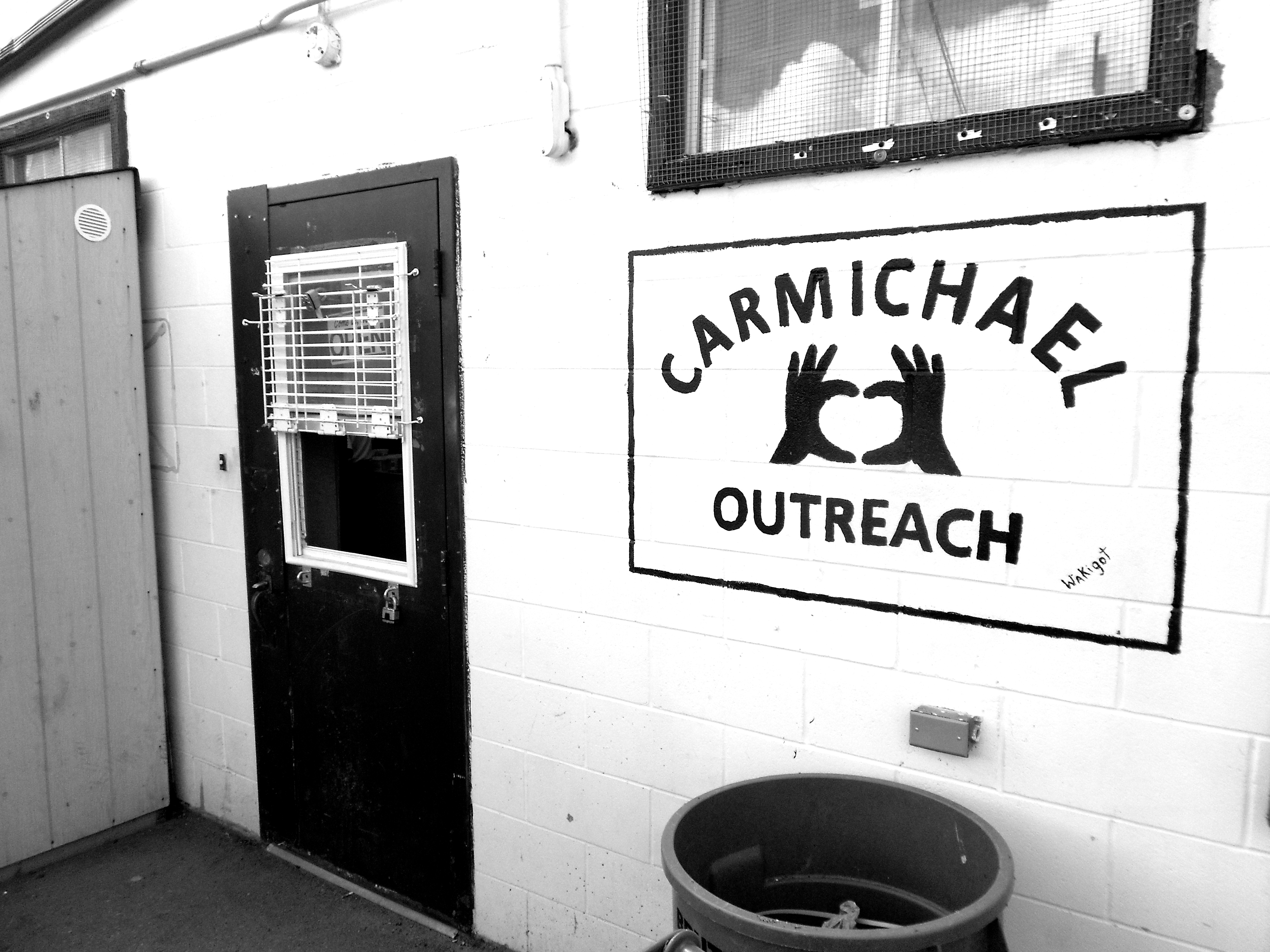
    Carmichael WindowThe Red Indians. That is how I remember friends from India refer to Aboriginal peoples in North America. Please excuse the politically incorrect nature of the title of this essay.

    As Cook and Food Recovery Program Coordinator (the more words you have in the title, the more important you are on a global scale) one of the duties is to run a nutrition program. If my roommates are a typical sample selection, I can guarantee that I eat healthier than most single men my age, but in no way does this qualify me to pretend I know more than mothers-of-five or middle-aged men. I stumble through repetitive weekly sessions about budgeting and Canada’s Food Guide for First Nations, Inuit and Metis populations trying not to brainwash them into vegetarianism that could realistically jeopardize their culture. Currently, the program consists of several Aboriginal mothers and fathers and one Punjabi woman with no children.

    Daily I feed hundreds of people who lack a regular source of healthy food. I attempt to do this with absolutely no ability or knowledge in serving them food that respects their culture, let alone their dietary preference. I serve westernized semi-processed foods out a back window to people verging on physical malnutrition and cultural assimilation. Carmichael Casserole or Spaghetto and Meatsauce sustains their bodies for a while longer and at times it doesn’t even achieve that. I am overwhelmed with how little I know.

    Then I read such articles. Things which are 100% relevant to my current position and I begin to reel. If the government or people are not willing to properly reconcile, then I become immaturely overwhelmed as to how to do so out of a 6′ x 6′ kitchen. Leanne Simpson, Indigenous author, writes:

    “I wonder how we can reconcile when the majority of Canadians do not understand the historic or contemporary injustice of dispossession and occupation, particularly when the state has expressed its unwillingness to make any adjustments to the unjust relationship….

    It reminds me of an abusive relationship where one person is being abused physically, emotionally, spiritually and mentally. She wants out of the relationship, but instead of supporting her, we are all gathered around the abuser, because he wants to ‘reconcile.’ But he doesn’t want to take responsibility. He doesn’t want to change. In fact, all through the process he continues to physically, emotionally, spiritually and mentally abuse his partner. He just wants to say sorry so he can feel less guilty about his behaviour. He just wants to adjust the ways he is abusing; he doesn’t want to stop the abuse.”

    -Leanne Simpson, Dancing On Our Turtle’s Back

    I cannot host reconciliation out of a kitchen. And this is because, according to the synopsis of Simpson’s book (see the above link), “reconciliation must be grounded in political resurgence and must support the regeneration of Indigenous languages, oral cultures, and traditions of governance.” I cannot catalyze reconciliation because I do not really understand the historic or contemporary injustice of occupation. And that is what gets me. Reconciliation is not done solo out of a grimy kitchen. It is done through processes which may have nothing to do with me and steps which I cannot control, but processes and steps in which I can participate in some way. Processes which I can learn about to potentially approach a climate that is fair for future reconciliation.

    The fact that I cannot adequately express my intentions with the word Indian demonstrates my obvious inability to help promote and preserve a culture that is not mine through an ill-prepared nutrition program and sloppy meals. The infinite nature of my naiveté and glaring inability is burning me out. They make me want to run away to the land of the Not-Red Indian in a fit of hedonistic, selfish admission of my lack of knowledge. My lack of commitment. My lack of connection to the issue, which is maybe the worst part—that I could get on a plane and forget about hundreds of years of colonialism and assimilation, because I can.

    I am here to stick around for as long as I can before my brain explodes and I find myself crying in some colonially-cultivated blossoming organic flax field, because I do not want to “adjust the ways” we have been abusing, rather I want to stop the abuse. One of the only ways to do this is participation, knowledge, and handing out egg salad sandwiches to two-hundred people a day.

    Or at least that’s what I’m going to tell myself so I don’t drown in egg salad.

  • Roof-Ready Regina: Let’s Try One More Time

    If you missed it last time, I will be presenting at City Council again this Monday, June 10. Below is what I will say to a a group of dead-eyed politicians. If you want to know more I enjoy discussing the topic, that is, if you enjoy buying me supper or beer. Or even otherwise, I guess.

    It is evident that housing is a priority for city council. The Mayor’s Housing Summit was the necessary first step in presenting new ideas to include in conversations between government and the private and non-profit sectors. Now the conversations begin.

    The City of Regina has come up with plans to improve the rental market housing issue in Regina. Positive steps such as ‘capital incentives which focus on larger projects with a minimum unit number for eligibility for private developers, with no minimum for non-profits,’ (page 19, Appendix A, Comprehensive Housing Strategy Implementation Plan) have been taken. The lack of rental market housing is an evident problem in our city, however the City of Regina does not adequately address rental housing, in that truly affordable rental housing is not given priority. Properly addressing homelessness on a municipal level would include taking the aforementioned plan of capital incentives on larger projects one step further, and requiring developers to include affordable rental housing in medium and large projects as well, as has been done in Montreal. This is a municipal initiative that ensures an adequate percentage of affordable rental housing is produced. Instead of offering incentives to developers, who will build regardless in such times of prosperity, we must take advantage of these times to ensure that affordable rental housing is a part of the plan, thus ensuring that those who need help the most get it.

    Offering incentives to developers for truly affordable housing makes sense. However, offering incentives to developers based on the Plan’s current definition, that is, “at or below market rates”, is not an immediate cure for the lack of affordable housing in the city. The “trickle-down” effect, best-case scenario, would take years to properly represent what CMHC would consider affordable rental housing, that is, “the cost of adequate shelter not exceeding 30% of a person’s income.” Affordable housing is a necessary tool in the transitionary Housing First model, which is briefly mentioned in the Implementation Plan of the Comprehensive Housing Strategy (page 65, Appendix A, Comprehensive Housing Strategy Implementation Plan), and recommended by several presenters at the Housing Summit. Other cities have taken multi-year pledges to eliminate homelessness on a municipal level, taking the lead by advocating strongly to the provincial and federal governments, as well as implementing strategies similar to those that have been previously shared through the Roof-Ready Regina Document, and other community-based initiatives. With the current Implementation Strategy the City of Regina is taking steps to improve the rental housing market, but is effectively doing nothing to eliminate homelessness.

    Please, as you move forward with the Implementation Plan of the Comprehensive Housing Strategy, consider the importance of affordable housing in a healthy community and economy, and take every possible step a municipal government can to address these issues. Homelessness is not just a provincial or federal issue. If homelessness is to be ended, municipal governments must also take significant steps. Let us use what we learned from our counterparts in Calgary and Vancouver and take a proactive step in ending homelessness, starting with a proper plan to include affordable housing.

  • Lyrics of the Month: April 2013 – Rio De San Atlanta, Manitoba

    Our cities seem to function quite the same: sweeping ghettos undeer one big rug makes them easier to contain, so the upper-middle class can sleep (or shop in peace) and convince themselves that “trickle-down” will solve this poverty. Yes, murderers walk our streets and their weapons are their pens, desks, policies and P.R. campaigns (fed by the spoils of war) against the “lazy, shiftless” populations of the poor. This system cannot be reformed…(so how about we try something different?)

    Propagandhi, Rio de San Atlanta, Manitoba, Less Talk More Rock