Category: Politics

  • Apologia Pro Hippy Vita Sua

    The following short letter was written in response to a ‘Street Wear’ section in Prairie Dog Magazine that highlighted how grungy I am. The letter following that is my response.

    I’ve been reading your mag for years, even though I’m a staunch conservative; many aspects of it I love. Please though, stop featuring bums in your Street Wear section. These people are mostly wannabe hippies who work low-end jobs and are recognized for doing nothing more than working in a clothing store or coffee shop. Please start featuring people who contribute to society whether through the arts, science, education, politics…something! We all have the power to make a difference!

    No Name
    Presumed Reginan

    Dear Staunch Conservative,

    I feel that you best be more forgiving of these hippies that sell you your clothing, coffee, and meals. Although should I assume that you only shop at Walmart? (If you keep voting the way I assume you do there won’t be any immigrant labour to work there, so I don’t know who you expect to run your shops and sell you food—the elderly are dying off quickly. How staunch are you, exactly?) The fact that these hippies don’t have post-secondary educations, they sleep on the floor, they don’t have cell phones, they don’t eat meat, they don’t own cars, and they work at what was recently named by Prairie Dog Voters as ‘Regina’s Best New Store’, is obvious reason to assume they contribute nothing to society. Often I am too busy smoking illicit substances (Legalize, man!), playing bongos in Vic Park, or creating my own pachouli concoction to help out my community through volunteerism, or to actively take part in politics. I’d rather just lounge on my beanbag chair next to my hookah and watch documentaries about Buddhism. I do, however, agree that the ‘Style’ section is a waste of space. I have no style, you have no style. We live in Regina, man. People just stopped frosting their tips last week. But maybe we should include a business section in which you write a column suggesting how lowly shopkeeps could do something worthwhile with their lives (business degree, violin lessons, cure cancer, run for mayor), leaving their low-end jobs for the immigrants and those on welfare. We lower class citizens would truly appreciate the guidance.

    Peace and Love.
    Your Local Wannabe Hippy,

    Nic Olson

  • Blog Action Day 2012 – The Power of We


    In my career as an eligible voter I have celebrated no victories. Not a single representative I have voted for has been elected, not a single party I have supported has won. On the contrary, they have usually lost quite successfully. I am well aware that my beliefs and values do not reflect those of the majority, Balls of Rice and my voting record reflect that quite well. This has all led me to a familiar cynical place where I have found myself many times before, for many different life issues. The Underdog Syndrome, where whenever I cheer for the underdog, they are doomed to fail. Sports, nerdy gentlemen in a bar, elections. The principle is the same, and my support seems to kill it.

    Because of my lack of success in democracy, I have been debating whether it is worth my time to vote at all, not out of apathy or resignation, but as a form of protest. Because the voting system is off, and democracy is nothing more than choosing between egotistic businessmen who are often charismatic beings, but not exceptional people who love people—the wealthy who are already in positions of power, but want greater power to create greater wealth, and yes, I have a hard time not seeing all political leaders in that way. I still do believe that one human being should not and cannot properly represent an entire population, and that it is possible for there to be order and progress with no single person in charge. I’m still stuck on this one, but until I decide, I will continue to vote.

    Then I came to understand protest. Dissent. The Occupy Movement, which many see as a futile collection of hippies, bums, and anarchists who decided to join together in several groups around the world to be able to collect welfare and charity more easily. A group of undemocratic urchins who, if they really cared about the system, would pull themselves out of the mire and contribute to society in a pragmatic, businesslike way. And this is likely why it resonated. Groups of likeminded people gathered to express their dissatisfaction with the structure of the system, the inequality and corruption. My ability to relate to such a movement likely came from my upbringing and affinity with the punk scene. Coming together in hundreds of different communities with no clear goal apart from stoking the young flames of revolt. Disapproval shown in groups of people physically gathering together. It felt right.

    Despite the overly utopian seeming title of this year’s Blog Action Day, I have grown to understand the power of groups of people that come together with dissent, goals, and hope in common. The more I see the importance of participating in politics, the more I see that this means something greater than simply voting when an election is called. Although I will likely never in my lifetime see someone I voted for in a position of power, I can rest comfortably knowing that other actions can be taken. That groups of people outside of the realm of electoral politics can change policy, and are often necessary to do so. Regardless of whether or not my vote will ever be on the winning side or not, it is evident that the solidarity between groups of people is equally as important as being politically active. A group of people with a common goal may not make an obvious difference, but it always has the power to make a significant one.

    When the cops and the courts refuse to confess the sins of the few, what is there left to do? The answer’s there right before your eyes: rise.

    Propagandhi, Note to Self, Failed States

  • The Fury of the Dispossessed

    When I’m excited, I ride my bicycle very fast. After a day that lacks progress, one that sees no new knowledge or discovery, I bicycle home like a grandmother on a cruiser bike. Most days, average days, I ride home in the middle of my three gears, head up and feet wide. Today after starting a new job, and after a lecture by one of the greats, I biked home on the highest gear, bouncing on my low front tire, more excited than I’ve been in a long time to finally feel, for once in years, that I am where I am supposed to be.

    Chris Hedges, journalist and intellectual, lectured at the University of Regina. The writer that I will forever aspire to be, the thinker that I will undoubtedly never become, gave a rousing account of how we came to where we are now, stuck in an “inverted totalitarianism” where we are ruled by the faceless being of corporate capitalism. Where the cannibalization of nature exists for straight profit and greed. He spoke of how after World War I we were placed into the “psychosis of permanent war” where the masses would offer up their own slavery, and how we have now reached an age of the moral nihilist. (I am essentially just listing my notes in sentence form.) We have reached a point where food, water, air, and human beings themselves are being treated and sold as commodities and this has built a quality of self-annihilation.

    When he spoke of “sacrifice zones,” the places that were abandoned by unbridled capitalism, left in disrepair and a humiliating culture of dependency after being used and left behind because of their lack of monetary worth, I thought of Saskatchewan in fifty years. A place where natural resources are plentiful and long term thought is not. Accelerated environmental review processes that inhibit the ability for proper research and long-term preparedness have been put into place while Saskatchewan is in its infancy of exploiting these resources. I envisioned ghost towns, alien landscapes after plundering the earth and failed nature reclamation projects. I saw people abandoned by the elite that they once, for some reason, loved and trusted. I could see the future because of what has happened in other parts of North America. The current policy makers refuse or are unable to see what Hedges has shared in his latest book, Days of Destruction, Days of Revolt, and because of the propaganda of the elite, the people are often unable to see it either.

    One might ask how I could be so excited, riding home banging my head with a bike-lane-wide grin after a night of being pummelled with the desperately depressing truths that we find ourselves facing. All of Hedges books that I have read deal with these deflating facts, hundreds of pages of them, but always end in a short breath of hope that the elite will fall. I cycled home feeling like I’ve finally found even a small piece of a greater purpose, directly assisting those the system left behind. Feeling like I’ve found the inspiration and motivation to create, to think, to encourage others to think, and to practice dissent. Knowing that the “fury of the dispossessed” can eventually bring enough fear into those mediocre in positions of power, and will see reform because of it. “The formal systems of power are no longer capable of reform,” he said. We need acts of resistance. This excites me.

    “You can’t use the word “hope” if you don’t carry out acts of resistance…But we have a moral obligation to the world the corporate state is bequeathing to our children. We have betrayed their future. At least that generation will be able to look back on those of us, hopefully their parents, and say that they tried, even if we fail. Not to try is to be complicit in what is happening.”

    -Hedges in Katherine Norton’s article.

    Someday, as I told my father, I hope to be smart enough to be able to ask a coherent question at a lecture to a man such as Hedges. Instead, for now, I will continue to skim off of his brilliant works to make mine look greater than they are. But I’m trying, and I guess you have to try.

    For more Hedges go here, for more Balls of Rice articles that ride on the coattails of Hedges go here.

  • Days with Food Poisoning

    Days with food poisoning are good because they remind you how invincible you feel on the days without food poisoning. The drastic difference between my Wednesday morning—coiled in a ball, vulnerable as a newborn puppy on the basement floor, nearly unable to climb the stairs to relieve my knife-stabbing stomach—and my Thursday evening—searching for sweets in my cupboard—makes it that much easier to compare. The last time I possibly ‘called in sick’, as in, showed up to work for two hours and was sent home, was for the same reason. I was housesitting, the ingredients for cannelloni were readily available, with the exception of cottage cheese, which I figured I would do without. Just before awkwardly hand-stuffing small pasta cylinders with runny pink sauce, I found an unopened container of cottage cheese in the fridge. I mixed it in liberally, excited for my Italian masterpiece that I was to share with a friend. Early the next morning, around 4, I was awoken to the same unpleasant feeling, this time, however, the feeling came out of two different directions of my body. I sat at my housesitting house and watched Breaking Bad for a day and a half, thinking I had the flu until I read the Best Before date on the unopened container of cottage cheese, which would have still been good to use, two and a half months previous.

    But they enjoyed Disneyland, so that’s all that matters.

    This time, after a thirteen hour recovery sleep, I can’t sleep for more than five the next night. I sit on the ground at 7am in the dark without glasses, reading political articles about how invincible the government feels (they must’ve had the worst bout of food poisoning that ever did exist), closing my good eye in order to strengthen my bad eye, squinting like I’m on a motorcycle in a sandstorm. I heard a sound like an animal in my room, and after discovering a hole in the bottom of the drywall next to my bed, a hole that looks like a classic mouse hole from Pixie and Dixie‘s residential home, I have been waiting to hear this sound. I crawled on on my hands and knees in my underwear the dark, no glasses, the most pathetic predator that ever lived, trying to locate the source of the scratching and nibbling sound at one of the corners of my bedroom. Oh, the places food poisoning can take you. Days with food poisoning are good because they remind you how invincible you feel on the days without food poisoning, and this is me at my most invincible. I have failed to acheive the same level of notoriety as many of my contemporary cartoon headliners. Perhaps the idea of a man chasing non-existent mice simply isn’t novel enough for the infinite reaches of the internet.

    It turned out to be a beetle.

  • Human Progress is a Sasquatch

    Sections of the few naturally-occurring trees in southern Saskatchewan have been cleared to make roads and paths. These lead to lakes and rivers and adjacent to these lakes and rivers more trees have been cleared for what is known as the commercial campsite. Commercial because you pay for it. Campsite only because that is what they call it. Very rarely is it used for actual camping. I discovered that my idea of camping differs greatly from that of some people, even those I am close to. This past week at Greenwater Provincial Park, each time I walked by a trailer that was nestled nicely beside a seadoo trailer, a boat trailer, a mosquito zapper, a belching generator and a satellite dish, I thanked God that we knocked trees down for these goofballs. But they might ask, as believers in the advancement and intellectual supremacy of the human species, why not bask in our dominance over nature? I would answer that camping is connecting with how humans are supposed to live, reliant on and connected to nature, without distraction, where time doesn’t matter and phones are useless, entranced by the natural and primal thought-nurturing wisps of a late-night fire. But for our neighbours across the way, camping means watching the Olympics on a slightly smaller flat-screen television, slightly closer to a seaweed-ripe body of water, distracted by the shallow and personless characters on a screen. Our campsite of four tents and eight people, a fire and several chairs, a hatchet and a flashlight, compared to their campsite (listed above) shows how much we have advanced technologically as humans, but shows how as humans we remain the exact same.

    Human progress. The idea that we as humans can advance through technology, science, industrial efficiency, or mass production to become greater than the previous level attained, whether that means mentally, spiritually and even anatomically. That the advancements in how we do things, as if a catalyzed form of evolution, will propel us into a sort of utopia.

    Some may consider our ability to live in absolute comfort anywhere we want Human Progress. Who needs fires and tents and knives when we have generators, fifth-wheel trailers with two bathrooms, and slap-chops? The progression of our systems does not ensure the progression of humans. Our innovations are not making us better humans that are approaching perfection, they are taking us downwards, into an ignorant, illiterate, unaware cell that is not greater than the fire pits, the nomadic life, the simplicity from whence we came.

    Progress not only failed to preserve life but it deprived millions of their lives more effectively than had ever been possible before.

    Bruno Bettelheim via Chris Hedges’ TruthDig Column

    Almost seventy years ago this week, Nagasaki and Hiroshima were bombed. World War II and the few years after, epitomized by the final acts in Japan, are what Vonnegut’s Kilgore Trout calls ‘The Finale Rack of so-called Human Progress.” A Finale Rack, the set of fireworks wired together by a pyrotechnician to light as the ‘grand finale’ for the gazing patriots and children. The nuclear bombs were dropped and we have been making them ever since. “It was science, industry and technology that made possible the 20th century’s industrial killing,” Hedges says. It was our ‘Human Progress’ that made possible the destruction of hundreds of thousands of humans.

    Apparently, Human Progress is an odd looking creature, like what we can imagine a Sasquatch might look like: floppy ears, hairy face. Non-existent. But if it does exist, what better place to find it than the tree-cleared campgrounds of Southern Saskatchewan. It is probably cozied up in its trailer watching the Rider game with the firepit dead and cold ten-feet away.

    “What a relief it was, somehow, to have somebody else confirm what I had come to suspect toward the end of the Vietnam War, and particularly after I saw the head of a human being pillowed in the spilled guts of a water buffalo on the edge of a Cambodian village, that Humanity is going somewhere really nice was a myth for children under 6 years old, like the Tooth Fairy and the Easter Bunny and Santa Claus.

    -Vonnegut, Hocus Pocus, Chapter 26, p204

    The myth of Human Progress, characterized perfectly in contrasting campsites, is eating away at our world. It is tearing apart the environment, making mass-murder more and more accessible, and at the same time we remain the same clueless, occasionally barbaric human beings, only now with larger tools to highlight our cluelessness and barbarism. Instead of whittled willow twigs we have the sturdiness of a bent piece of wire. To complement those, we have wire racks to hold them over the embers. If we get lucky we can use a grill instead of a wire, and if we really show our advancements, we would just use a propane range. Our hotdogs and marshmallows have advanced in the way we cook them, but in the end we are still eating the same damn thing.
  • Pissing on that refugee’s soon-to-be grave.

    With this last bit of news I am officially ashamed to be from this country. Not since I was maybe ten, when I dressed up for Halloween as the made-up superhero, the Canada Kid, where I wore a Canadian flag as a cape, along with a red toque, red tights and a red t-shirt, would I say I was patriotic. Supporting Olympic athletes, thanks to the corporate encouragement from Maple-flavoured Wheaties, and free Esso collectable cups, was one of my greatest passions. I would draw pictures of the Canadian Olympic logo, dream of the distant lands of Nagano, and talk about getting a tattoo on my ass that said, ‘Made in Canada’. I could’ve ended up like this.

    But thanks to years of cynicism, informative reading, thrashy music, I haven’t.

    And thanks to years of governments ruling the country as if it was a coloured piece of land on a board game, I haven’t.

    There is maybe nothing else a government could do to embarrass me more (I am currently, and constantly, knocking on wood). The environmental-raping side of Bill C-38 makes ‘sense’ in a twisted, soulless, no-foresight kind of way. But this, sweet Lord, this makes me feel like I just ran over a family of immigrants in my car, which was maybe what they were going for. I feel like I was at the driver’s seat. I feel responsible. I can no longer make this political banter poetic or ambiguous. I can no longer dance around my views to avoid this as an idiot-styled opinion blog. We reduce our foreign aid for those billions that don’t live here, but taking away funding for the hundreds of thousands that barely made it here, and only did so to save their own lives, is, put lightly, misdirected. If put truthfully, it is selfish. It is inhumane and uncivilized.

    I can only imagine how many fabled jobs this will create, as if job creation were the cure to the illnesses of our likely already employed refugees. Hard work cures all. Hard work makes you forget your ills. Hard work leaves no time to go to the doctor. Hard work kills. Hard work reduces the amount of refugees. The Omnibus is now departing, and the Omnibus now makes sense.

    Here is to the creation of jobs, the trump card used in every possible governmental situation to make cuts sound reasonable. Those temporary, resource and location-based, earth-pillaging jobs. I can’t wait to get one.

    On that Halloween as the Canada Kid, in between houses where we scavenged processed sweets from wealthy extra-suburban families, I found my bladder full of carbonated beverages. I stopped at a group of bushes, my cape blowing heroically behind me until a new gust sent it back my way, intercepting my stream of warm, patriotically-digested sodapop. I pissed all over it. A fortunate bit of foreshadowing as to what I wish I could do now if I had a flag on ground level, or if my rainbow of piss could reach the height of a flagpole.

    I would gladly piss all over this place now. And on the many symbols that represent it. As it has already pissed all over us. Several times over the past year.

    Read more here.

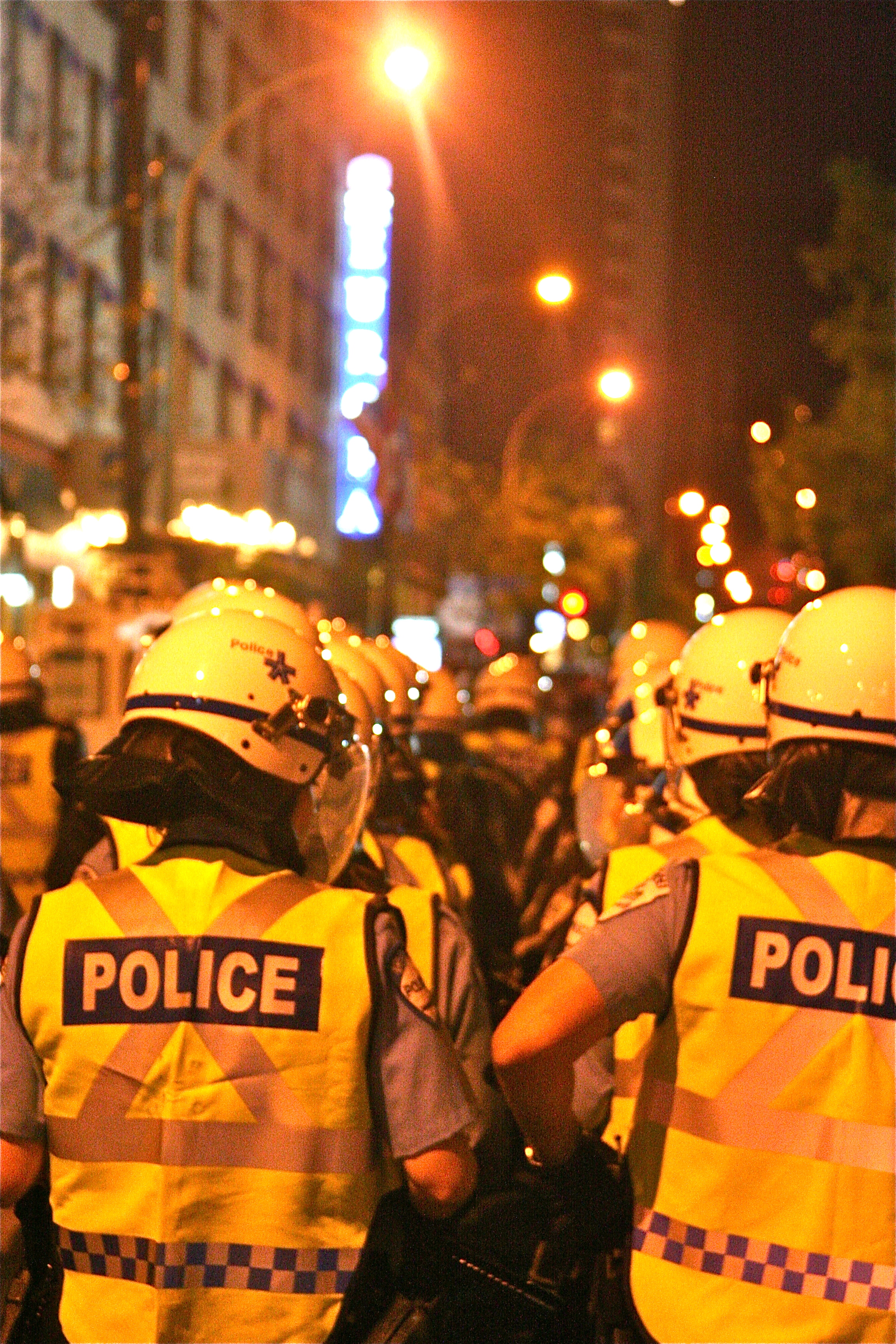
  • Pro-Protest

    Giving a shit is not easy. This is made obvious when you begin to do so. It is exhausting and abrasive. It is uncomfortably hot and smells bad. It is judged unfairly and looked upon as naive or unnecessary.

    But it is necessary.

    Apathy sets in quite easily when you live in comfort. When your meals are covered and you have clothes and can afford salad spinners and a fridge full of beer. Apathy is easy when you are not directly affected.

    The only thing close to rioting that I ever witnessed had to do with hockey. Giving a shit about hockey is easy. You sit on your couch or in the stands and stress about something completely out of your hands. When you realize that a sports loss isn’t everything that ever mattered and that you are still breathing and the earth is still in existence, you go home and eat a nice meal and go to bed. Easy.

    The peoples’ right to protest is the peoples’ right to disagree. When this is taken, so is one of the main tenets of democracy. Canada’s West often does not understand the motivations of Quebecois protesters. They are seen as the troublemakers causing unnecessary violence. Socialists spoiled with low tuition, cheap booze and thirty flavours of real poutine. They should learn to live with it, like we do, especially when our oil and potash are paying for their province’s existence. These opinions make it seem as if we have been beaten down and embarrassed enough to accept our ‘fate’ of high tuition, cuts to the arts, a resource raped land and expensive liquor, as if it is something that we had no control over. Considering the fact that post secondary education can and should be free, we have been conditioned to accept the ‘inevitability’ of incredible debt. Like a well-trained child at the supper table, we eat what we are told and we don’t ask why. When the government won’t listen to the reason of the people, we should begin to question the purpose, worth and effectiveness of such a system of leaders with nothing more than financial agendas. The people shouldn’t simply learn to live with the decisions of the lawmakers that they elected. They shouldn’t have to put up with the decisions of the ruling elite. The people are why they exist. The lawmakers need to properly represent the people.

    One hundred days and half a million people. A battle for accessible education turned into a battle for equality. Students joined by the general public in their dislike of how the government has been handling the tuition debate, highlighted by an agreement in the undemocratic quality of new anti-protest bills. Breaking laws which are made to stifle the population is not an irresponsible action. Challenging those in power through protest and defiance should not be looked upon as counterproductive or disruptive, but needs to be understood as a necessary sign of democracy, thought and human progression.

    The more we care about the issues that affect others more than ourselves, the more we put thought, effort, time, and support into these issues, the better humans we will be, the better cities and towns we will live in, and the better, more equal, more human world we will have. Our future greatly depends on how much we give a shit.

    “Acts of resistance are moral acts. They take place because people of conscience understand the moral, rather than the practical, imperative of rebellion. They should be carried out not because they are effective, but because they are right. Those who begin these acts are always few. They are dismissed by those in the liberal class, who hide their cowardice behind their cynicism. Resistance, however marginal, affirms the sanctity of individual life in a world awash in death. It is the supreme act of faith, the highest form of spirituality.”

    -Chris Hedges, Death of the Liberal Class, Chapter 6, p205

    Check CUTV for coverage on the protests in Montreal.

    For English translations of French articles: translatingtheprintempserable.tumblr.com/

  • The Age of the Beast

    They wouldn’t accept my blood. The proper receptacle, the Canadian Blood Services, would not take my blood that I was willingly offering. I am a strapping young lad, if I do say so myself. Although I may not be able to squat three hundred pounds, although I may sweat after climbing two sets of stairs to take a five-second piss, although my hygiene leaves something to be desired, I am a regular limber and nimble Hulk Hogan. And all because I entered the land of Mexico for a brief two weeks. Somehow, according to Heath Canada, malaria-ridden mosquitos inhabit the Mexican states that neighbour the United States, but they dare not cross the border, likely because of ‘up the ass’ border treatment and the ‘you look like a threat’ Immigration Agents of Arizona. They are all a threat. Mosquitos I mean…

    And although the professionals didn’t want my tainted, tattooed, malarial, gold-infused blood, someone else is constantly trying to suck it from me. The recent rise in vampire popularity is entirely caused by the fact that people can relate getting sucked dry by lifeless, immortal, unstoppable beings. The bloodsuckers, the bastards, stare directly into the souls and habits of the weak individual, taking from them the pieces that make them warm-blooded animals. Take away the arts, take away supporting other human beings, take away hockey, take away the environment. This bloodsucking beast, a multi-headed, sharp-clawed collection of a profit-first government and profit-first corporations, takes what it wants. We are in the age of the beast.

    Although it may seem dramatic to describe policy makers as evil, as in, lacking any good or regard for others, I will stick to it. There must be good there, it is just hidden behind blood-stained teeth and human-digesting stomach acids. Deep below the five serpent heads, past the sickly heart pumping the vitriol, possibly wrapped in the bowels, strangled and without light.

    A friend eloquently told me this: We all have basic needs. The reason that we are here, where we are, is heavily based on wants. It is those people that perpetuate the mentality of wants that need to be controlled. That is, the bloodsuckers need to be controlled. Our blood, what makes us human, what makes us good, is being sucked dry. It is being is being frozen. Becoming sludge. We can revive our crumbling culture, we can offer a blood transfusion, by controlling those who need to be controlled. Those who perpetuate the mentality that profit, fast profit, matters more than our health and our education and our culture and our neighbours.

    Don’t become lethargic because they have sucked you dry. Your blood is all you’ve really got.

    (Balls of Rice 666th post)

  • The Golden Rules

    One hundred years ago the Titanic sank in the Atlantic. Undoubtedly amazing stories have come from the wreck from the few survivors and from imaginative writers; several movies have been made about it since, several books have been written describing the pain and wreckage of such a catastrophe. The wreck still lays on the ocean floor, decaying and eroding, somewhat preserved by the saline water that surrounds it. When the 1997 blockbuster movie came out I was nine years of age, and as all the girls of grade four and five swooned over a young Leo, I, without seeing the movie, decided of my dislike for it solely because of how the girls spent more time talking of a fictional girlish-looking boy that drowned in the ocean instead of spending time talking about me. I likely, as I did with the Backstreet Boys, claimed that Leo secretly came out to the newspapers to affirm that he was actually a woman. Most kids talked about the boob scene, or about the small orchestral group that played their instruments all the way into the freezing water and the drama of it all. In grade four or five, one of our class units was about the Titanic. Mrs. Buchanan fashioned the bottom of a ship out of paper that stuck out from the ceiling and the students all made different sea creatures that hung beside the boat. We were underwater. One project with this unit was to write a journal-style short story as if you were a passenger of the Titanic. Indirectly everyone had to make the choice as to whether their character would be one of the few survivors, or if their character would drown in a painful fit, gargling salt water in their lungs. My character was named Wayne Fleming, Second Captain or First Mate or something along those lines. Like Leo, he fell in love, but tragically, if I remember correctly, he jumped off of the rising stern of the boat to save his lover, reaching terminal velocity once he hit the water, dying on impact. In grade four I was sadistic bastard.

    Twenty years ago the movie Aladdin was released. Of equal significance to the crashing of the unsinkable boat, at least in movie production quality. Aladdin taught me that even if you are a homely, poor kid, you can trick a princess into liking you, a lesson I have taken seriously. It taught me that if you steal loaves of bread from the rich, the Sultan will reward you. That if you get tricked by an old man to go into the Cave of Wonders, that a genie will give you three wishes and become your best friend. It also taught me Jafar‘s Golden Rule:

    “You’ve heard of the golden rule, haven’t you? Whoever has the gold makes the rules.”

    If you frequent a church or have a knowledge of the Bible, you may have heard of a different version of the Golden Rule–to love others more than yourself. This rule is not solely a Christian tenet, but a human one. To claim it as Christian is like claiming gravity as a Canadian phenomenon and that all others are just borrowing it, or to claim water as a drink for only those who can afford it. Whether it is from living in a city where people aren’t as friendly as they should be, or whether my cynicisms just blind me from human decency, it seems that Jafar’s Golden Rule is taking over from the natural human action of the original Golden Rule. His Golden Rule seems to ring true with my vision of politicians, especially the ones in power where I currently live. This is not to say that I believe all human decency is gone, my cynicisms have receded slightly since I believed that, but as is evident in the economic breakdowns of the recent past, which I have just recently accepted as true, the system of capitalism has not worked, and will not work. It embraces Jafar’s Golden Rule and ignores the other. If we laud this system as unbreakable, good for all, unsinkable, we shift the Golden Rule’s focus from people to money. We are doomed to crack in half, sink, fall and begin to decay and rust at the bottom of a salty ocean, preserved for generations to see how foolish we were. Pieces of our money-loving present will be held in museums and travel around the world for people to gawk at, astonished that we could be so short-sighted to the health of our planet and the people that live on it. We will be underwater. We will be spectacles.

    It has become common place that the wealthy become the lawmakers, either directly, as in Mitt Romney, or indirectly, as politicians jump from the private sector to the government using their newly found power to help out their buddies making investments. It has become so common that wealth has been deified. That our Golden Rule, the rule that overrides all others, and the one that we use to gauge ourselves as human beings, is in the process of changing.

    If someday the only way to save our loved ones from this sinking ship is to jump off of the high and rising stern to prove our absolute love and devotion to them, and to enforce to the real Golden Rule, then I hope someday I will be able to act on this. But until then I can demonstrate that my love for others is greater than my love for wealth, this is easy. What may be difficult is to demonstrate that my love for others is greater my love for self. I’m working on it.

  • Failed States

    When history is crafted in the service of power, evidence and rationality are irrelevant.

    -Noam Chomsky, Failed States, p100

    I am in the business of joy. Lowercase j. I am directly employed by Santa himself to greet the masses of joyless souls and bring the rapture of new merchandise to their lives. Running a business as if it were a business makes sense, as long as a service is provided or goods are traded for money. People convinced they they have a right to demand things in the form of a Christmas list because they believe that forced giving is the thoughtful thing to do, are running their lives like a business, taking advantage of situations and people and money. This does not make sense.

    In structure, the political counterpart to a corporation is a totalitarian state. There are rewards for loyalists, and quick punishment for those who “cross party leaders.” The antidemocratic thrust has precedents, of course, but is reaching new heights. It should surprise no one familiar with history that it is accompanied by the most august missions and visions of democracy.

    -Noam Chomsky, Failed States, p238

    Running a government as if it were a business frightens me. It makes humans commodities and necessities marketable. More regard for the dollars earned than the humans living in conditions where it is impossible to earn enough for basic human comforts. The past and the present have been crafted in the service of power. The connection between the system governed by the powerful and wealthy and the consumerism of this season is not coincidental. Someone, or a series of someones, have carefully crafted this holiday season that is loved by so many into a two-month shopping obligation. Our love for one another that is best expressed through fellowship and merriment has been changed so that we feel the only way to express it is through the giving of unnecessary items. And it has only strengthened their position of power. They have taken what we love more than anything and inverted it into another means of profit. Power is a business.

    Among the most salient properties of failed states is that they do not protect their citizens from violence—and perhaps even destruction—or that decision makers regard such concerns as lower in priority than the short-term power and wealth of the state’s dominant sectors.

    -Noam Chomsky, Failed States, p38

    Violence can be demonstrated in many ways. A boot stamping on a human face forever. An army occupying another country to control the energy reserves and elections to stifle the power of a population. Several levels of government building a handsome yet useless multimillion dollar sidewalk ignoring a housing crisis that continually worsens. Poverty is violence.

    Our state has used garlands and lights and parades to help us forget that it has indeed failed. And these lights and garlands have trained us to continue to support the failed state through red Santa hats and a marketable ‘Christmas Spirit.’ Either each year the situation becomes more grave than the last, or each year my cynicisms mount even higher than Santa’s pyramid of elf skulls that he compiles at year end, a physical exposition of the slave labour that his capitalist methods require.

    We can demonstrate our power by running our lives as the human lives they are, not as the businesses that they are told to be. We can take back the power from the failed state by refusing to participate in the season that characterizes their abuses and violence more than any other time of the year. We can go a year without ‘celebrating’ to show that our Joy (capital J) is founded in something more than a self-serving system that they created for us to mindlessly follow. We can buy nothing and be better, more generous, less selfish people because of it.