Category: Uncategorized

  • Thou Mayest

    I sat at the Housing Strategy Public Forum at noon on Thursday. I listened as four city representatives justified a plan to fix a city, scrambling to answer questions from dozens of disgruntled citizens about housing in various forms. Providing housing for the masses is a priority, they said. Just not as serious of a priority as making a lot of money, they neglected to say. The citizens’ sole chance to have their say in a hotel lobby with free cookies and Fruitopia. Democracy works.

    I wondered whether it counts as having a voice if you are speaking to those do not have ears.

    So mom said this, “I think sometimes for your own sanity you have to believe that people will eventually do the right thing.” I genuinely do not believe that people will eventually do the right thing. I only have so many years of life to impatiently wait. What I do believe, for my own sanity, is that people can do the right thing. They have the choice and this puts me at greater ease. Because I expect nothing. Because I am not waiting with fried nerves for the sun to explode. I’ve got to believe at least this or I will give up, and giving up is a cardinal sin in anyone that matters. I’ve got to believe this or I might kill myself. I’ve got to believe it whether it is true or not. My cynicisms no longer reach as far as believing in an inherently evil humanity. I have passed that point in my perpetual anger. If that were the case, we would have starved long ago.

    “Maybe it’s true that we are all descended from the restless, the nervous, the criminals, the arguers and brawlers, but also the brave and independent and generous. If our ancestors had not been that, they would have stayed in their home plots in the other world and starved over the squeezed-out soil.”

    -Steinbeck, East of Eden, Chapter 51.2, p568

    Though we may not be an evil people, we are still not inherently good. We are inherently selfish, and this to me seems concrete. As animals we instincually make decisions to ensure our personal survival. This is not news. Humans can, however, break this conditioning. There is still a choice.

    In East of Eden, Lee studies the story of Cain and Abel.

    Lee’s hand shook as he filled the delicate cups. He drank his down in one gulp. “Don’t you see?” he cried. “The American Standard translation orders men to triumph over sin, and you can call sin ignorance. The King James translation makes a promise in ‘Thou shalt,’ meaning that men will surely triumph over sin. But the Hebrew word, the word timshel—‘Thou mayest’—that gives a choice. It might be the most important word in the world. That says the way is open. That throws it right back on a man. For if ‘Thou mayest’—it is also true that ‘Thou mayest not.’ Don’t you see?”

    “Yes, I see. I do see. But you do not believe this is divine law. Why do you feel its importance?”

    “Ah!” said Lee. “I’ve wanted to tell you this for a long time. I even anticipated your questions and I am well prepared. Any writing which has influenced the thinking and the lives of innumerable people is important. Now, there are many millions in the sects and churches who feel the order, ‘Do thou,’ and throw their weight into obedience. And there are millions more who feel predestination in ‘Thou shalt.’ Nothing they may do can interefere with what will be. But ‘Thou mayest’! Why, that makes a man great, that gives him stature with the gods, for in his weakness and his filth and his murder of his brother he has still the great choice. He can choose his course and fight it through and win.” Lee’s voice was a chant of triumph…

    “…This is not theology. I have no bent toward gods. But I have a new love for that gilttering instrument, the human soul. It is a lovely and unique thing in the universe. It is always attacked and never destroyed because ‘Thou mayest.’”

    -Steinbeck, East of Eden, Chapter 24.2, p301-302

    I still question the effectiveness of a political process that is so inane as a public relations exercise with five different types of cookies. I question the point in trying to penetrate the infinitely-layered inclined mountain of bureaucracy. But possibilities arise. Thou mayest triumph over sin. Thou mayest triumph over ignorance. Thou mayest triumph over selfishness. This, Steinbeck says, is what makes man great. He still has “the great choice. He can choose his course and fight it through and win.”

    It doesn’t matter what others do—I must remind myself of this. Letting the poor decisions and monumental mistakes of others disrupt your progress along the line of choice is foolish. Thou mayest. Or thou mayest not, and it doesn’t fucking matter to me what the innumerable morons of the world decide to do. As long as I remember that both they and I had a choice.

    Because ‘Thou mayest.’

  • Apathy is Contagious

    Apathy is an undercover leader. When you first saw it, you were revolted by it. Its lazy gut poking out of its stained t-shirt, soaking in the selfish UV waves of a television screen, hand cupping testicles, focusing on its next step for personal survival. Its breath was like fish and cheese puffs.

    You avoided it at all costs. Avoided being near it, avoided even thinking of it. Then, after a few drinks, your friend introduced you at the pub. You shared a few beer and found that you related to it on many levels. It hated the government as a youth. It didn’t like conversations with strangers. It figured recycling was a load of crock. It wasn’t as disgusting as you remembered it being—it had neat hair, was sharp-dressed, smelled like Old Spice. It was someone you could hang around with occasionally, still hold onto your own interests and passions, and not have to worry about what your friends thought.

    After meeting Apathy you continued on your path of work. You tormented yourself with productivity to the point that you couldn’t sit comfortably at home on a day off without feeling like you were wasting time. Your energy was depleted, your enthusiasm was spent. People and their oddities and selfishness made you want to be alone at all times. You had a difficult time finding joy in anything because it took you away from work. Work is your life and you do it until you hate it. Then you need a beer.

    Apathy is persuasive. Always there to say, “I told you so.”

    You invited Apathy home once or twice after work. You just wanted the company. Someone to vent to. Apathy brought the beer. It told you about a great documentary on Netflix, about a great place to order take-out. It remained intelligent—talked knowledgeably of current events and how it found they weren’t worth running your life. It threw a blanket over you, unbuttoned your pants for you, turned up the volume. It was helpful. It helped you forget about your exhausting life trying to make a difference in some pathetic way.

    The next day, when you woke up on the couch in your stained ill-fitting t-shirt, Apathy came over without asking, booze on its breath, stinking of cigarettes, tired from a long night of coercing people at the watering hole. Apathy is an alcoholic. Its face was dark and lined and it pushed you over on the couch, ate a cheeseburger hotdog, and scowled at you. You were again revolted. You felt how you originally did. But now you were on the couch, under a blanket, runny nose, no energy, and you figured you’d deal with it later. You had gotten sick.

    Apathy is contagious. Apathy begins to set in like a hot fever. It makes your body ache until you lay down and think about nothing. Do nothing.

    Apathy is heavy. It sits on top of you, and even when you return to your thoughts of passion and productivity that once made you feel alive, you can’t seem to push yourself off your stomach when it is sitting cross-legged on your back.

    Apathy frightens. It tells you that you can’t have balance. You can’t have passions and ideals and hobbies while being happy, relaxed. It tells you that if you aren’t wailing on the castle doors, rallying the troops, changing policy, protesting wars, then you’re useless. And if you are doing these things, then you are a delirious.

    In the near future when Apathy has its foot on your neck, about to heave and permanently end thought, you will remember people. People who once drove you to madness, who drove you into the arms of Apathy, but people who made life worth living. People who, with their idiosyncrasies, more often disappointed than amazed. But when they amazed, work and Apathy and survival and food disappeared. People gave you conviction, and conviction is communal. Conviction is strong. Conviction is communicable. The sharp pressure of Apathy’s foot will release, and Apathy will walk away to rekindle its love affair with your neighbour. And you will remember the one reason that we live, the one reason that life continues, is caring for and surrounding yourself, with people.

  • Best Before

    The year and a half has passed since you have returned. Thus, like a sour carton of cow’s milk, your Best Before date has also passed. Nearly a year in the same house, over a year in the same city. You haven’t done this since highschool, and your allergic reaction is anxiety, rage, uselessness, sloth, booze. This time you have the adulthood-weight of the first job in your life that you wanted to be in. The timing was poor and the circumstances were worse, but hey, you got the job! Well, actually, you got the part-time consellation-prize of a job. Not that anyone told you this (especially your university, your high school teacher, your job fair) but you’ve learnt that the right job does not indeed create happiness. Nor does money. Nor does happiness. That’s right. Happiness does not create happiness. The only thing that does is flakiness and temporary relationships. At least in your life.

    You have set personal deadlines for your book. You have set personal timelines for fleeing. The former is far too early, the latter is far too far away. But they are appropriate, because you selected these dates in a moment of clarity. What kind of character can’t hold up personal deadlines, anyway? I guess the kind of character that cannot live in the same place for more than nine months, and the same character that cannot hold a relationship for more than the same amount of time.

    Those activities that you do to save yourself from insanity (writing a book, casual drinking, frugality) end up as a contributing factor. Friends that you spend time with can’t do much to remedy your issues. Holidays can’t come soon enough. There isn’t enough angry or sappy music to play in one evening—the Descendents only wrote so much music.

    Your instinct is to flee. A damaging, selfish, immature instinct, but one you have perfected without even knowing that you practiced it. Now you try to combat your instinct by sticking around for ‘a year minimum’ to prove to yourself that you are an able decision-maker and even-keeled human.

    As a reponse to all this you are drinking boxed wine playing crokinole alone in the living room at 1am. The only depressing part of that sentence is that many have never played crokinole before.

  • Aggressive Tendencies And What To Do With Them

    Riding my bicycle. The very thought of my mother’s ten year old Rialto Torago that I took from their garage and ride regularly makes me want to put an axe in the hood of every single mid-nineties family mini-van in Regina. It’s not the bicycle—though it only has three gears, shoddy breaks, a back wheel mechanism that slips, and ten-dollar used winter tires that have studs for nothing else but good conscience and show. It’s not the winter—riding a bicycle in -40 weather is warmer than the thigh-chafing that comes with walking, or sitting on your lazy ass and driving. What brings about the rage is being surrounded by morons and assholes who are too goddamn impatient to drive less than fifty kilometres per hour for five blocks, too uneducated to know that their fossil fuel addiction will be the death of their children, and too goddamn ignorant to know the legal way to ride a bicycle in the city. I’ve been honked at or called a ‘piece of shit’ this winter on an almost daily basis. My skin is only as thick as the tread on my used, ten-dollar, likely pilfered bicycle tires.

    Sitting in the basement. Sitting alone in the basement is either the greatest moment of my day or the worst part of my week. It is either the absolute peace of smothered sounds through a pair of earplugs, blocking out the painfully moronic television show blaring above me as I read stories by men able to harness their aggression into a productive means of communication. Or it is the loneliest place in the entire world. Lately it has been both, but when I finally achieve a thoughtful focus, it is interrupted by none other than the local armed forces. Checking up on me two months after my curfew has been amended, three hours before my curfew was actually supposed to be imposed. Three times. Thoughtful focus taken. Hateful rage instilled. Fair trade.

    When two things that you usually take pleasure in become two things that make you want to get drunk and belligerent and aggressive, then the rest of your daily activities will be difficult to enjoy. When the same two things that are usually a receptacle for aggression become the cause of it, there is a surplus. I have not yet taken to drink. I have instead taken to listening to more aggressive music, cursing at full volume, partaking in more asinine activities such as television and human interaction. But liquor works better.

    I no longer have an adequate way to release my aggression, if I ever did. Sports only worsen it. Live music in this town is as rare as a three-teated horse. Crokinole makes me swear more than most things. New writing is overshadowed by hellish edits and cover letters that need to be finished in a certain amount of time to follow a set of unattainable goals which were set to convince myself that I’m not wasting my life.

    I constantly think about what Darren told me. About being a kettle. And I just hope that I have the strength to control it when it finally does want come to surface in a series of accusing, friendship-ruining, damaging outbreaks. If I am unable, this is my apology.

    And no, writing this didn’t seem to help.

  • Jazzy Darren

    Darren SanguaisA slightly shorter piece on Darren Sanguais can be found at the Carmichael Outreach blog.

    “I’m no fan of Justin Bieber, but–uh, haha!”  If there is anyone I know that could be described as jazzy, it would be Darren Sanguais.

    Darren is a shortish man of forty-eight years, but looking at him you would think he may be ten years younger than that. This is likely due to his laugh, his work ethic, and his hair. His hair is jet black and always well-groomed—short and styled on top with a long strip that rolls down his back—usually loose, occasionally in a braid. His sharp hairstyle is undoubtedly inspired from his days studying at Richard’s Beauty College in Regina, where he learned dyeing, cutting, and all other men’s and women’s esthetics. When it isn’t too cold, Darren will wear his hand-beaded leather jacket with tassels. When the temperature dips, he wears his fur coat and fur hat. Darren is a sharp-dressed man.

    Two months ago, Darren was living in the back of a truck. From January to September he curled up in what he called ‘Hotel Darren’, the cab of an old pickup, heated only by two tea-light candles, with only a few old blankets and the clothes on his body. The first time I met Darren was one of my first days at Carmichael, and was one of his first days out of Detox. He and I were commissioned to clean out the Carmichael Community Garden. It was late September and frost had already set in, but the red fruits were covered up by the bowed stalks and the fallen leaves, thus untouched by the cold. We took a few boxes of tomatoes back to the office, pulled several bundles of hand-painted garden signs and closed up the garden for the year, which Darren had helped tend throughout the growing season. From the first time we talked, walking down the alley from the garden next to Souls Harbour on Halifax to Carmichael on Osler, he told me that the hardest part about changing, about sobering up, was the people around trying to bring you down. Friends, family, acquaintances drinking everything, everywhere. Giving him shit for thinking he is better than them. Wanting to fight if he doesn’t join in with their drinking. And even two months down the road while we sat down for a burger and fries he said:

    “I’m like a kettle, man. I just throw it in the back, throw it in the back, but it’s gonna boil sometime. It hurts, man. The people, talking shit. It’s hard.”

    “But in the back of my mind I keep thinking, I’m a survivor, man. I’m a survivor.”

    When he says things like this, I cannot offer any advice—he is twice my age. He has seen more than I ever will. He is tougher than I will ever know how to be. When he tells me about people giving him shit, I can only tell him what I know for certain: that I am always around to hang out, and that even if the doors are closed for the day, there is always someone to talk to from Carmichael. And that Carmichael always has work to keep him busy. He is twice my age but has seen far more than twice the things I have, and is twice as wise as I expect to be at forty-eight. I asked him if it was ok if I wrote a bit about him for the Carmichael site. He often uses the word ‘jazzy,’ and he might’ve in this case.

    “Really? For sure, for sure, that’s cool. I’m not ashamed of where I come from. I’m not. I want people to know where I come from. I’ve got lots of stories.” And he told me a few thereafter.

    Darren was born in Grenfell, Saskatchewan. Most of his family was born on the reserve in Sakimay First Nation, but being maybe his mother’s eighth child they went to town for his birth. One winter night on the reserve as a child, his step-father kicked him out of the house for being a nuisance. He wandered outside during a blizzard and nearly froze to death until a pair of dogs found him, he told me. A few of his fingers still show the damage from the relentless bite of a Saskatchewan winter.

    He has lived in and around Regina most of his life, spent five years in Edmonton, part of that time incarcerated. He figures he has had over one-hundred convictions on his record, one of attempted murder—he was jumped one night when he was drunk, fought back, stabbed a guy, all while he was blacked out. This got him three and a half years in federal prison—the last sentence of a fifteen-year stretch where he wasn’t out of jail for more than three months at a time. If they picked him up for anything now, he’d have no chance because of his previous record, he says.

    After listening to a half-dozen of his stories, I felt like I needed to create a balance and tell him something of myself. So I told him of my recent legal battles, childish and non-serious, but a story nonetheless.

    “That’s stupid. Don’t they have bigger fish to fry? I mean, come on. They’ve got bigger fish to fry here, and they’re frying me, haha.”

    Instead of walking the streets or hanging out at home alone, Darren comes to Carmichael. He makes sandwiches. He shovels the seemingly endless Carmichael parking lot. We bond over the breaking down of cardboard boxes. (Whenever I go out back to start on cardboard, he joins in without hesitation. I always make sure to say “thanks,” and he says, “Shit yeah, man.”)  He can often be found at the back food-window, taking orders for burgers and fries when we are serving macaroni, singing choruses of old rock ballads. And he is almost always laughing. He now has casual employment with a local construction company, and when he is not there, he is at Carmichael. He has an apartment of his own, a bank account for the first time in a decade. He gets to see his grandkids. He has a support group of peers and staff at Carmichael.

    Darren is the reason that Carmichael exists—friendship and accountability, food security and assistance with daily necessities, housing help and employment opportunities—an open door with available programs and services to help, no matter a person’s living arrangements, family situations, financial circumstances, health issues, or addiction battles. Darren is also why Carmichael is a joy to go to on a daily basis. His commitment and determination is inspiring. His joy of life is contagious. The reason that Darren seems like the fountain of youth, is because his heart is young. And because he is a self-proclaimed jazzy man.

  • Hard Drugs of the Brain

    A scientist somewhere along the line decided that our bodies are run by a brain that uses chemicals to transmit data from neurons to target cells which cause a physical reaction. When you are sick, the chemicals in the brain get screwy, and data gets changed.

    This explains why I killed someone. Or at least why I had the feeling that I killed someone, on three separate occasions on Wednesday, December 26. At least, that is the only way I can possibly explain the feeling. The feeling that someone gave me speed unknowingly, that I blacked out for a moment, and that I when I realized what I had done, with the voices of hundreds of thousands of consciences yelling at me at once, the world was travelling exponentially faster. Depth and depth of field are altered exaggeratedly. Purposefully slowing my breath and my movements yields nothing. Fever-caused hallucinations will be the only ones for me. The brain has its own chemicals.

    And it all starts with a feeling. The softest material in the world, woven in infinite length, clear as angels hair. Someone attempts to cut it, box it, distribute it. And I am jolted with blood on my hands.

    None of this makes sense to you, I am sure. Four-day sweats and dreams about building and efficiency and waste, dreams made hellish with searing anxiety. It doesn’t make much sense to myself, but I can feel it. We once assumed these hallucinations were directly related to an allergy to nighttime cold medicine. Now I am moved to believe that it is just the hard drugs of the brain.

    Several years ago I tried explaining this hallucinatory phenomenon in an essay for my book. It was juvenile. When talking with a reformed friend recently about hard drugs, she said not to even bother trying them, not that I had even planned to. Call me a prude or call me a square. I can see the world at a new angle by taking a step forward. Or by tripping on my body’s own hard chemicals. I can enjoy myself as myself, by myself.

    Being sick for a week has given me a new focus. One that demands slowness, even less shits-given, and more security in personal time. Most of these seem to be out of resignation and the tiring of effort. Because more and more I see that the only person I can affect is me. And if I can’t even take the time to do that, then I might as well start taking hard drugs because my brain wouldn’t be worth anything anyhow.

  • Seventeen Days of Food

    I just finished peanut butter on toast and am drinking a can of Pilsner. I can’t say that I’m glad to be home.

    Every kilometre closer to home I got, the worse the food was. I left the San Francisco apartment at 9am, unable to find a Mexican restaurant that was open, so instead I got a pretty decent deli sandwich and the hangover-fighting goodness of a coconut water. I bought three apples at the Farmer’s Market, an It’s It at the tobacco store. Upon arriving in Denver, slightly nauseous and reeling, I ordered a 12″ cheese pizza from Dominos. It was delivered to me undercooked; I ate the whole pizza. The apples were tough like biting into cowhide, and void of flavour like sucking on a brick of styrofoam. And now I am home, sipping overpriced, mediocre beer (I fully support taxing alcohol and tobacco in order to never have to learn the difference between Medicare and Medicaid, something no one could explain to me whilst in the USA), and eating dumpstered bread.

    Cover me in tacos and call me Delicious Susan.

    Still my stomach is sour and flinching from the vacation-titled reward of beer breakfasts and taco-dominated diet. But I will persevere.

    With the exception of my 5-day food-and-beer bender, the times I have eaten the best, most balanced, full meals in the past seventeen days were the times that I went grocery shopping in the dumpster. Or to mom’s house. The quality of the food differs greatly between the two, however the quantities and personal cost differ in no way. Limitless and free. I’ve been meaning to tell my mother this. That I once cooked her a meal with my girlfriend in Montreal that was composed largely of dumpster food items. Free, shared, washed, dumpster foods. For a while she had a photograph of me on the fridge, rooting around in the dumpster. Dad took the photo while they were in Montreal. It was staged, they didn’t find me like that.

    I haven’t purchased a vegetable in the last three months. Unlike my roommates, this doesn’t mean that I haven’t eaten a vegetable in the last three months. I have grown them myself. And though it looks like I’m wasting away, I am doing so in as healthy and cheap a way as possible. But through spending time with those that eat properly, and being suggested TED Talks about Mitochondria, it becomes evident that my eating is for survival, very rarely for enjoyment until I binge in a city with forty taco spots in a ten block radius, and just scrapes the surface of health. These friends, and this video, bring up the argument that food is likely the most important thing you spend your money on, and it directly affects your future, and that of the environment. But I’d rather put my nuts in the microwave and eat canned refried beans. I don’t have time otherwise. I’ve got movies to watch, screens to worship.

    One of the greats was in town just before I left, a friend with whom I always end up talking at length about food. I delivered dahl to her at the shittiest bar on earth, and she recently returned the favour recently with cookies, cheesecakes, and more. She suggested that people get offended when they are called out on their bad food habits, likely because it is something that, as supposedly responsible adults, they should know how to do properly. They should know the difference between a bag of microwave burritos, and a homegrown burrito, and when they notice their foolishness and their laziness, it is not as easy to swallow as a bite of a cheesy, warm, mushy microwave Mexican-food.

    I will likely continue to waste away, each week my pants droop further so that my shoelace belt will eventually wrap my waist twice. But it will be done in great health, with nothing purchased or found gone to waste. I will undoubtedly continue to live and eat frugally, so that I can save up and make up for my inadequate diet while I am partying in cities cooler than my own. Or maybe I will eat better, finally fill out my Medium-sized t-shirts and it will force you to ask the question that my father asked me a few weeks ago at the University lecture: “Have you ever seen an obese environmentalist?”

    I’m still waiting for the punchline. Likely about dumpster soups or eating recycled bicycle parts. Let’s hear it.

  • Days with Food Poisoning

    Days with food poisoning are good because they remind you how invincible you feel on the days without food poisoning. The drastic difference between my Wednesday morning—coiled in a ball, vulnerable as a newborn puppy on the basement floor, nearly unable to climb the stairs to relieve my knife-stabbing stomach—and my Thursday evening—searching for sweets in my cupboard—makes it that much easier to compare. The last time I possibly ‘called in sick’, as in, showed up to work for two hours and was sent home, was for the same reason. I was housesitting, the ingredients for cannelloni were readily available, with the exception of cottage cheese, which I figured I would do without. Just before awkwardly hand-stuffing small pasta cylinders with runny pink sauce, I found an unopened container of cottage cheese in the fridge. I mixed it in liberally, excited for my Italian masterpiece that I was to share with a friend. Early the next morning, around 4, I was awoken to the same unpleasant feeling, this time, however, the feeling came out of two different directions of my body. I sat at my housesitting house and watched Breaking Bad for a day and a half, thinking I had the flu until I read the Best Before date on the unopened container of cottage cheese, which would have still been good to use, two and a half months previous.

    But they enjoyed Disneyland, so that’s all that matters.

    This time, after a thirteen hour recovery sleep, I can’t sleep for more than five the next night. I sit on the ground at 7am in the dark without glasses, reading political articles about how invincible the government feels (they must’ve had the worst bout of food poisoning that ever did exist), closing my good eye in order to strengthen my bad eye, squinting like I’m on a motorcycle in a sandstorm. I heard a sound like an animal in my room, and after discovering a hole in the bottom of the drywall next to my bed, a hole that looks like a classic mouse hole from Pixie and Dixie‘s residential home, I have been waiting to hear this sound. I crawled on on my hands and knees in my underwear the dark, no glasses, the most pathetic predator that ever lived, trying to locate the source of the scratching and nibbling sound at one of the corners of my bedroom. Oh, the places food poisoning can take you. Days with food poisoning are good because they remind you how invincible you feel on the days without food poisoning, and this is me at my most invincible. I have failed to acheive the same level of notoriety as many of my contemporary cartoon headliners. Perhaps the idea of a man chasing non-existent mice simply isn’t novel enough for the infinite reaches of the internet.

    It turned out to be a beetle.

  • Common decent people and their decent common shits

    I recently decided that wasting food is worse than eating meat. Marginally worse. So for that reason, and for that reason only, I’ve eaten meat three times in the last four days. Chicken, pork, and I don’t remember. I gave meat the benefit of the doubt, and it has given me the benefit of clean and loose bowel motions, as if I were cleaning myself out with Ayurvedic medicine. I have been to the toilet at least eight times today.

    I believe in common decency. The common good of man, all that flowery shit. When someone is hitchhiking, they are likely just cheap or broke. When someone is looking for a place to stay on Couchsurfing, complete strangers, they are likely just interesting, frugal, travellers like me, not out to case the house and give me bags of laced drugs. When someone walks into the shop, they are likely just a bit of a douchebag, and not a douchebag that is clueless and soulless and trash enough to steal from a locally owned store.

    But then there are the cases when I’m wrong. When hitchhikers kill their drivers, or demand sexual favours. When Couchsurfers are ungrateful, dirty thieves, freeloading and abusing the system. When young, rich, well-dressed assholes come into the shop and steal because they would rather spend that money on cocaine or parts for the car their parents bought them.

    And then I get upset. Because I am branded as naive. As too trusting and too innocent. I automatically revert into my natural self, cynical and distrustful. It has taken time to grow into that person, the one that gives the benefit of the doubt.

    None of this has happened. I haven’t been killed by a hitchhiker. I haven’t been ripped off by a Couchsurfer. I have, however, been stolen from at the shop before. The nature of retail, they say. The nature of man, I say. When common decency takes a common shit. And ruins it for us all.

    The man camping across from me, also alone, invited me over for a meal. I was sitting in front of my barbecue fire, eating raw carrots and beets, breathing in the loneliness that I have grown accustomed to. He fed me homemade sausage, the pork I spoke of, and corn on the cob. He left me with five cobs of corn for the following day, two huge potatoes from his garden, and a handshake. I didn’t trust him, then I likely trusted him too much. Then I went to sleep, woke up, and eventually cooked a massive meal of corn and potatoes.

    This was supposed to be one of the few uplifting posts that Balls of Rice produces. About how no matter what, there is a common good in all people. But dammit, I’m not so sure.

    I have given the benefit of the doubt, and I’m just waiting for that doubt to come running out of bowels. To shank me and take my wallet.

  • Things that hang from my ceiling

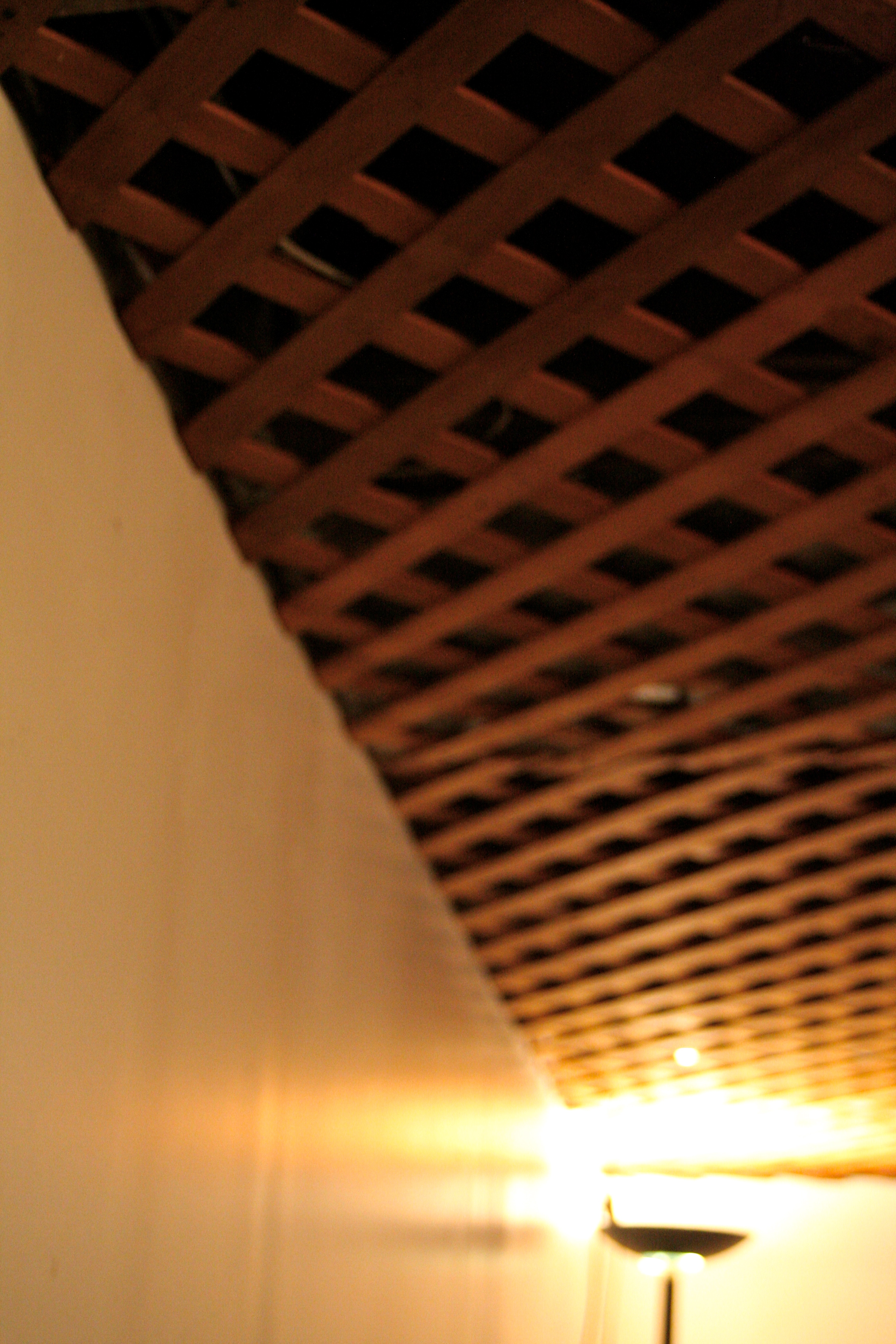
    The things that hang from my ceiling are plentiful. They are colourful. They are trash. The heralded lattice ceiling that I have often mentioned has never let me down. Besides the time that a glass of water was spilt in the living room upstairs and it directly poured through the floorboards into my room. But I am uncertain how I lived without it before. Spackled ceiling has had me befuddled since childhood. Such a useless, aesthetically questionable detail of a home, whereas latticed ceiling knows exactly what it is: ugly and useful, two things I would be glad to consider myself. The following is a comprehensive list of the things hanging from my ceiling:

    • thirty-feet of yellow rope, used as a clothesline
    • the rainbow horse/donkey head of a piñata that I drunkenly wore home on my head from a recent wedding. The ears of the donkey fit perfectly into the holes of the lattice for an adhesive-free hang job
    • my button-up shirts on hangers. The walls of room are unpainted, patchy and smeared, I hang my shirts there to cover the wall and to keep the shirts wrinkle free
    • a bare lightbulb, now burnt out, hanging from a piece of thread over my desk, my source of inspiration, or object to blame when ideas do not surface, undecided thus far

    Things hanging from my wall very near the ceiling include a pizza box from Vancouver (Fatih’s!), a plastic bag from India (found blowing down the street in Regina), a feel-good Christian pamphlet called ‘Nick’s Discovery’ about a man in a wheelchair who found God (the premise and title for my new book), a plastic Montreal Canadiens mini hockey stick (a gift), this poster (my brother always swore it was a lady in the photo) and more garbage. Actual garbage, yes.

    Throughout the summer I have been toiling over an old wooden chair I found in the dumpster. The refurbishing of chairs has become a bit of a hobby for my grandparents in their massive wood shop in North Weyburn. And as I walked through the house, this time with a new appreciation for old chairs, they told me exactly when and where they found the furniture, what they did to repair it, where it had been poorly repaired before, how much it cost, and the history they knew of it from before they owned it. Not once did they reach a desk and say, “This desk is made of glue and sawdust from a million shaved 2x4s from the boreal forest. Oh, and this lovely table we bought from the Wal-Mart when it first opened in 2001, it was made by a Vietnamese woman about our age in a factory of aluminum pipes and plastic pieces used as tops. Great workmanship, that table really means a lot.” The story of the things we own should include more than the place we bought it and the vehicle we used to drive it home, just as the story of ourselves should include more than a list of the place we were born, and the places we have worked, and the place we sit while people more powerful than us use us as something to sit on.

    Like our attitude towards food, we have grown so disconnected with the objects that we own that owning a billion things seems to matter none, and throwing them out seems to matter even less. Our wallets, our environment and our identity will suffer if we continue down such a road. My burnt-out-lightbulb of an idea, inspired by this damned bulb hovering above me, is that as long as we have an understanding of the process of our food, of our household items, of the trash that we hang from our ceilings and the stories behind them, we might become wise enough to own less, to consume less and to have a story of our own that is different than one taken from the gentrified pages of a home improvement magazine.