Category: Work

  • Fuck Art, man

    Sometimes they say that I work in the Arts. Sometimes they call it the industry. I tend to believe I work in the business of happiness; making people happy by selling them Art pressed into wax and Art pressed onto cotton, manufactured by people who are unhappy, someone’s boot pressed in the middle of their back, picking cotton, weaving cotton, sewing cotton, inhaling cotton, shipping cotton. And maybe wax.

    Happiness follows the law of conservation of mass. Happiness cannot be created or destroyed. The total mass of the reactants equals the total mass of the products.

    Ice to water, water to steam.

    Former-happiness to cotton. Cotton to t-shirt. T-shirt to Art. Art to happiness.

    Art doesn’t walk around town handing out twenty-dollar bills or cab vouchers or new rental lease agreements. Art doesn’t have its lifeguard safety—it doesn’t save people who are already drowning. Art is like whiskey, it makes you feel warm even though you’re losing your leg to the cold.

    Where was Art when your friend was evicted by Regina Housing Authority and slept outside for a month and died in his friend’s kitchen? Had we finally convinced him to draw a picture for the Free Press, would Art have saved him?

    Where was Art when your wheelchair-bound friend kept getting his cigarettes stolen by his brother who could have been painting miraculous animal scenes and selling prints but instead stole blind people’s cell phones to sell for crystal meth?

    Art was in an office building, denying grants. Art was at a wine-and-cheese opening wearing a well-fitting shirt.

    Fuck Art, man. Fuck the fact that this piece of prose is (debatably) a piece of Art.

    Rocky sits in the the empty coffee room of a fading drop-in centre drawing portraits of people who may or may not exist, to give away to the first person she knows will praise her for it. Rocky draws because it’s the only thing that can help her cope with the fact that everyone she knows is dying in front of her.
    Fred.
    Her aunt from Cote.
    Hilliard, found frozen outside.
    All in a week. She draws because what the hell else can we do?

    Fuck Art.

    That is, unless it’s used for its one and only true purpose, as with Rocky, as the antidote in a place dripping in poison.

  • Up-and-Coming

    Three blocks from the venue, down an industrial street in Denver like that in any North American city that boomed in the 1950s, was a small store inside of repurposed shipping containers that sold US-made backpacks, outerwear, and slacks. The store was clean and simple and catered to the young outdoorsy types who live inside but are able to sleep in tents in exotic locations outside.

    “We were one of the first businesses in this part of town,” said the shopkeeper sitting bored behind a handmade counter, hair messily gathered in a bun on the top of her head like she had just crawled out of a tent in the Rockies that surrounded her city. “Since then all sorts of businesses have opened here, which is too bad, it used to be a cheap part of town. Now there’s a luxury hotel going up just up Larimer.” The woman expresses her displeasure just as I would. I agreed as I tried on a pair of outerwear pants behind the changing curtain. Their shop and brand are participating in making the neighbourhood more expensive by selling $150USD pants, but they are at least trying to create a manufacturing industry by making their products in the USA. I left without buying pants, wondering where the nearest goodwill was.

    The next day, the venue was plopped in the same part of town, only in a city that was 500 miles away, a state and a half to the east. After load-in and soundcheck, the soundman asked “Where’d you go for food? The burrito place? How was it? I heard it wasn’t that good. Yeah, this was the part of town no one would come, until my boss opened this bar and the other one, we started booking shows here, and then other businesses started coming too. It was kinda the bad part of town, now it’s the up-and-coming part of town.” At the expensive coffee joint across from the bar arcade, next to the burrito place, they were giving out a free, one-page newspaper/zine/leaflet. In it read,

    “Most American cities are run by real estate interests… In Omaha, the tactic for encouraging gentrification is Tax Increment Financing or TIF. TIF is a way for cities to return tax money to developers as an incentive to put up projects that the city wants (and the public makes up the difference). Unfortunately, no provision is made for the people who used to live in the cheap housing turned into gentrified apartments. The former residents are simply scattered to the four winds. Surprised by ‘shots fired’ near 108th and Maple? This is your City gentrification policy in action.”

    A similar but more developed street newspaper in Seattle uses the G-word, gentrification, describing places like Africatown in Seattle being dismembered, breaking up the “home and haven for Seattle’s Black families and businesses”, and highlighting stories of people failing to maintain housing in a rapid-rehousing program because of the recent inflation in costs of rent. Large newspapers will only use the G-word when describing vandals in Montreal or Vancouver who are terrorizing business owners, as business is the uncriticizable holy grail of progress.

    I am fortunate to be able to tour with world-class musicians, but each time I’m on the road I wonder how long such jobs will exist. How long will I be paid to burn fuel and watch music in ‘up-and-coming’ parts of American cities, while around the block, that neighbourhood’s previous inhabitants are clamouring to find shelter under a bridge or in a condemned building. I do it because there’s something in music and creation that is able to be unpolluted by corporate greed, though most times it has already been bought and sold.

    When people ask what I got to see this trip, Linh Dinh answers for me in his book, Postcards from the End of America, in which he visits communities across the United States left with little or no economy:

    You can’t really see a city or town from a motorized anything, so if you claim to have driven through Los Angeles, for example, you haven’t seen it. The speed and protection of a car prevents you from being anywhere except inside your car, with what’s outside rushing by so fast that each face, tree, and building is rudely dismissed by the next, next and next…Like television, the private automobile was invented to wean us off our own humanity. From each, we’ve learned how to amp up our impatience and indifference towards everything, and with life itself.


    After tour ends I fly home to an ailing Saskatchewan. I’d heard of the government cuts while in San Francisco, when a friend texted saying WHAT. THE. FUCK. with a link to an article about the shutting down of the province-owned small town transportation and parcel shipping company. Now home, walking through the downtown, worried citizens are passing colourful clipboards around, asking passers-by to sign one of the multitudes of petitions that are circulating to Save Our Libraries, Save our Bus System, Save our Schools. I sign them all, knowing full well that no petition will be worth the millions of dollars that the government squandered on stadiums and tax cuts on resource extraction companies. The angry protests and province-wide campaigns might get them to preserve something, but the effectiveness of these actions will only go so far if we continue to work within the system that props up corporate interest over that of the public. Though it plays into the hands of the fearmongering government and high income class, one can see why smashing windows in Montreal seems more effective.

    Government MLAs show their responsibility, boasting their 3.5% paycuts, which to them means 3.5% less income to spend on boats and cottages and home renos and filet mignon. The paycuts they make to those on social assistance, the paycuts they make to those once employed by the rural transportation system, the cuts they make to the libraries, all mean that thousands of low income individuals won’t have food, shelter, a way to travel for medical treatment, books, and significantly more.

    Several years ago, after seeing Chris Hedges speak at the University, I worried that Saskatchewan was the next sacrifice zone—the places that are abandoned by industry, left in disrepair and a humiliating culture of dependency after being used and left behind because of their lack of monetary worth. This could be the beginning of that reality.

    It starts with the desperate government selling its struggling assets to the highest bidder, then selling its most profitable assets. They begin begging oil companies to relocate to the province to help the crumbling economy, start giving public land to large corporate bidders. At this point, entire cities and provinces will be bloated with corporate-controlled land and buildings, and towns end up, in a way, like the middle-class urban centres of post-manufacturing North American cities, where no one can afford to pay rent. Eventually, when the government isn’t coddling big business enough, they’ll pack up and move to find a different government who will subsidize their existence. Thirty years later, when our industries have died and all that’s left is cheap bars and empty buildings, businesses that pander to middle class tastes will further move into parts of town with abandoned buildings and cheap rent and begin the process of displacement of those marginalized by the loss of industry, struggling to survive in the older neighbourhoods. We are no better than the economic destruction seen in the United States, we are just a generation behind.

    All that will help in the midst of a breakdown of free, communal places of existence and of the breakdown of social programs, is the creation and maintaining of communities that support one another and support the other, the different communities who are similarly affected. I am the middle class that is being pandered to, and while being in these places, eating their burritos, buying their pants, is not inherently bad, it makes it all the more imperative to support and participate in the communities that are contrary to austerity. These communities—social groups, churches, activist collectives, sports teams, artist groups, musicians—must band together to build movements that support the racialized, marginalized, the poor, Indigenous, immigrant communities, who are most harshly affected by public cuts and an economy sucked dry.

    Linh Dinh, states the obvious:

    For any community to be healthy, local initiatives must be encouraged, nurtured and protected, so let’s reclaim our home turf, reestablish the common, and, in the process, regain our collective sanity and dignity.

  • Ten Years

    IMG_3007

    It is ten years to the day that I started writing Balls of Rice.

    If you read from the painfully embarassing first post, to the lost and meandering most recent post, you’d see how I went from proud flag-loving Canadian to dissident anarchist-in-training. You can see a public journal of mental health. Ten years later I still don’t know why I write, still don’t know what I’m doing with my life, still eating peanut butter and banana sandwiches for supper. All I know is that Balls of Rice has both saved my life and ruined it.

    Naturally, the only posts worth reading were written in the last four years. The six years before that was trial and error, with more error than anything. These days there is less trial and about the same amount of error. The list below is not a list of the best writings, because reading over every single post could only end in crushing depression. But these ones are alright, I think.

    Thanks to whoever has read this in the past decade for the encouragement. If it weren’t for you, I’d probably be a successful engineer by now. Instead I’m a squatter in the back of a pizzeria.

    Thanks for still reading, mom and dad. Oh you stopped reading it in 2012?

    Yeah. Me too.


    Notable Posts:

    Realistic Ideas – August 30, 2012

    Losing Faith – December 2, 2012

    Cheap Attempts at Warping History – April 2, 2013

    Dear Mouse, – September 17, 2014

    I wasn’t shot dead in the CN Railyard – December 29, 2015

    Still don’t know – July 26, 2016

  • Still don’t know.

    Di Fara Pizza

    A man walks down a dark Brooklyn side street with his pants at his ankles, genitals flailing. I am looking for pizza. Legitimate conerns are raised about that man getting shot by police but we push on to get some garlic knots at Ganni’s at midnight.

    The Republican convention wraps up and everyone I know, including myself, fears the next four years, but knows full well they’ll survive it. The man walking down the Brooklyn side street, the newly arrived Syrian refugees, the Central American blamed with stealing American jobs, don’t have the privilege of knowing the same thing. In Hedges’ 2010 book Death of the Liberal Class, Chomsky prophesies of a population that seeks out fascism because of a series of politicians beforehand who have sold the rights of the population to corporate power. All they need, he says, is a charismatic leader who tells it like it is. And now he warns this.


    “How much is this one?” I ask.

    “Which one?” the shopkeep asks.

    “The all black one with gold numbers.”

    “$10.” He pulls it out, puts it on my wrist, it fits and feels as though I haven’t wore a watch in fifteen years, which I haven’t.

    “Great.” I place $10 on the table.

    “This one is $15,” he says. I place five more dollar bills on the table and leave, feeling as though I have paid the 50% tourist tax necessary to create a balance in the inequality of wealth that I have benefited from my entire life. The tourist tax necessary to quell my own personal guilt for existing in a marketplace and quitting my community job to travel the world for free. The watch looks great and hasn’t died yet. It fits oddly on my bulging ulna bone.

    I finish my $9 juice and sit on a bench, calling my credit union and credit card company to tell them that I am in fact in the US and that no, my cards have not been compromised, and that yes, I’d like to withdraw money from my accounts so I can spend more money on American juice.

    I loosen the watch strap one notch to relieve the sweat that accumulates under it in the New York humidity in what will likely be the 15th consecutive hottest month on record. I bought a watch so I could avoid pulling my phone out of my pocket so I could avoid wrecking my pants pockets so I could avoid buying new pants so I could avoid buying pants from a hellish factory in south east asia. And so I could avoid using my phone at all. My vain attempts at personal change are conscience clearing but not effective. I still don’t know how to live a life that affects change or isn’t dripping in privilege. You think by 27.667 years of life you’d know everything there is to know in the world.


  • Lyrics of the Month: June 2016 – Neko Case

    Everything’s so easy for Pauline
    Everything’s so easy for Pauline
    Ancient strings set feet a light to speed to her such mild grace
    No monument of tacky gold
    They smoothed her hair with cinnamon waves
    And they placed an ingot in her breast to burn cool and collected
    Fate holds her firm in its cradle and then rolls her for a tender pause to savor
    Everything’s so easy for Pauline

    Girl with the parking lot eyes
    Margaret is the fragments of a name
    Her bravery is mistaken for the thrashing in the lake
    Of the make-believe monster whose picture was faked
    Margaret is the fragments of a name
    Her love pours like a fountain
    Her love steams like rage
    Her jaw aches from wanting and she’s sick from chlorine
    But she’ll never be as clean
    As the cool side of satin, Pauline

    Two girls ride the blue line
    Two girls walk down the same street
    One left her sweater sittin’ on the train
    The other lost three fingers at the cannery
    Everything’s so easy for Pauline

    -Neko Case, Fox Confessor Brings the Flood, Margaret Vs. Pauline

  • Advocating for Alcohol Harm Reduction Policy in Regina, Saskatchewan

    Advocating for Alcohol Harm Reduction Policy in Regina Saskatchewan
    Understanding Chronic Addiction and Responsible Public Health Practices
    Nicholas Olson – Housing Support Worker – Carmichael Outreach

    Background

    Severe alcohol dependence is common in individuals experiencing or at risk of homelessness in Regina, Saskatchewan. For individuals who have experienced violent or psychological trauma, alcohol is often used as a way to cope with the mental and physical pain that comes when this trauma is left untreated. Aboriginal populations overrepresent those experiencing homelessness in Saskatchewan and Canada, and many of the traumas they have experienced are directly related to unstable family settings caused by the lasting effects of residential and public schools and other programs created under colonial policy. Homeless populations have a high rate of alcohol dependence and for this reason face significant barriers to stable and safe housing, and are often unable to access shelter systems. In Regina, the few housing support programs that are willing to work with individuals with severe alcohol dependence are finding that the Housing First model is not always enough to keep individuals housed, healthy, and stable. Alcohol harm reduction is the next clear step to support Regina’s most vulnerable.

    What is Alcohol Harm Reduction?

    Alcohol Harm Reduction aims to reduce the harms associated with the use of alcoholic substances in people that are unable or do not desire to stop (International Harm Reduction Association). Harm reduction functions under the idea that all individuals deserve the dignity and respect to be treated in a manner that best supports them as a whole person, not just as an addict, and to be treated medically in a way that is understanding, empowering, and compassionate to their specific needs as a person experiencing an alcohol addiction. For many, the traditional abstinence model is unrealistic and does not take into account the desires of the individual who may not want, or be able, to discontinue use. Alcohol Harm Reduction aims to support the individual to live a healthy life regardless of whether they intend to become abstinent. This may be done by assisting them to consume healthy forms and volumes of alcohol through different programs tailored to the individual, supporting them to be safe during and after consumption, and working with them to maintain good health and, if desired by the individual, to reduce their alcohol consumption overall.

    Alcohol Treatment

    The development of Alcohol Harm Reduction through a Managed Alcohol Program (MAP), Alcohol Swap Program, Beer Co-op, and/or Prescription Alcohol is the best practice in supporting the addictions of a marginalized population in Regina primarily between the ages of 30-55. Since individuals experiencing or at risk of homelessness often have fixed or no incomes, beverage alcohol is unaffordable due to the high cost of controlled substances in Saskatchewan. This, coupled with the marginalization of individuals experiencing poverty, addiction, and mental health, has made beverage alcohol even more inaccessible because these individuals are often not permitted to enter establishments that sell beverage alcohol, and in many cases are unable to even access basic health and emergency services. Non-beverage alcohol (NBA) purchased in grocery stores, convenience stores, and pharmacies including mouthwash, hand sanitizer, hairspray, and rubbing alcohol is being consumed in large quantities because of its potency and availability.

    Non-beverage alcohol can be any form of alcohol that is not fit for human consumption. Ethanol, or ethyl alcohol, is found in beverage alcohol and is safe to consume in moderate amounts. Denatured ethanol, or alcohol denat, found in products such as mouthwash, hairspray, and some hand sanitizers, is ethanol with chemical product added to make the alcohol unfit for human consumption. The chemical additives also allow the producer to avoid the product being designated as a controlled substance. Methanol, or methyl alcohol is toxic and has caused death when consumed through hand sanitizer (CBC). Isopropyl alcohol, found in rubbing alcohol and some hand sanitizers, is toxic if ingested as well. While it is often stated that the extremely high alcohol content in non-beverage alcohol is the most toxic ingredient, with sustained use and high dosage, serious risks are present from the other toxic ingredients in each solution. Hairspray, for example, can have long term effects such as internal bleeding, kidney and liver damage, respiratory problems and death (CBC). Each receptacle of non-beverage alcohol clearly warns of the risks of consumption and strongly advises to contact poison control if consumed in any volume (Pauly 10).

    Alcohol Contents and Types
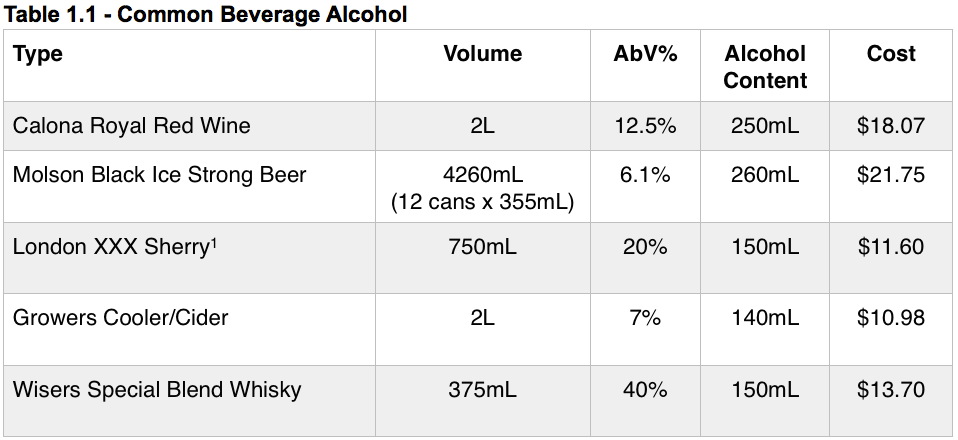
    Table1.1
    (costs listed are based on saskliquor.com)
    (approximate calculations were done at http://www.cleavebooks.co.uk/scol/ccalcoh4.htm and should not be used as a substitute for medical advice)
    1 The LCBO is recalling four brands of sherry (LONDON XXX SHERRY INCLUDED) that tested positive for a potential carcinogen. “This is not like E. coli or botulism where you’re acutely affected. To be affected by something like this, you would have to consume it for a long time for many years, so there is no risk at all,” he said. “It’s very, extremely difficult for anyone to get cancer from this type of chemical, unless you’re consuming it on [a] daily basis and you’re drinking large amounts of it.” (http://www.cbc.ca/news/lcbo-recalls-sherry-for-carcinogen-risk-1.619474)
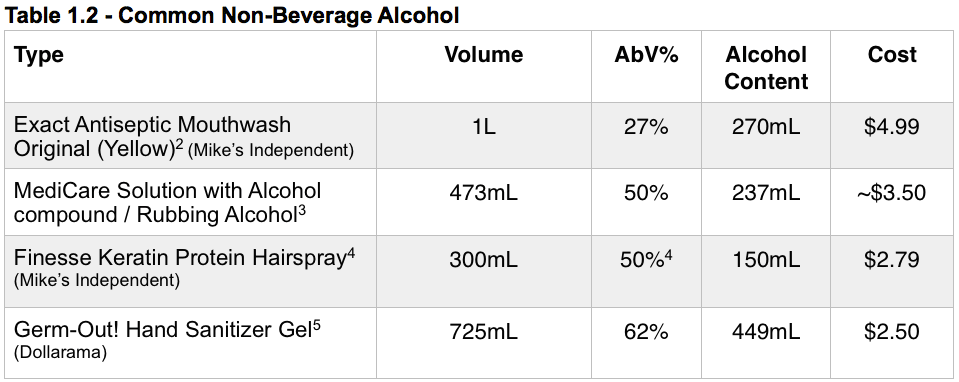
    Table1.2
    (costs listed based on retail prices at given locations)
    (approximate calculations were done at http://www.cleavebooks.co.uk/scol/ccalcoh4.htm and should not be used as a substitute for medical advice)
    2 Medicinal Ingredients: Eucalyptol (Eucalyptus Clobulus-Leaf) 0.092%W/V, Menthol 0.042%W/V, Methyl Calicylate 0.060%W/V, Thymol 0,064%W/V
    Notice: If more than used for rinsing is accidentally swallowed, get medical help or contact a poison control centre right away.
    3 Ingredients: Aqua, Ethyl Alcohol, Denatonium Benzoate, Camphor
    Notice: For External Use Only, Poison, Inflammable. If swallowed, do not induce vomiting. Call a physician immediately. If patient is unconscious, give them air. Danger: Harmful or fatal if swallowed.
    4 Ingredients: Alcohol denat, water (aqua), acrylates copolymer, aminomenthyl propanol, fragrance, octylacrylamide/acrylates/butylaminoethyl methacrylate copolymer, PEG-12 dimethicone, tritely citrate, hydrolyzed silk, hydrolyzed keratin. Alcohol content TBD but could be between 50-70%.
    5 Medicinal Ingredient: 62% Ethyl Alcohol. Non-Medicinal Ingredients: Aqua, polysorbate 20, carbomer, aminomethyl propanol, glycerin, tocopheryl acetate (vitamin E acetate), denatonium benzoate.
    Warnings: For external use only, do not ingest. In case of accidental ingestion contact your physician or a Poison Control Centre.

    Limiting availability of these products has proven to be an ineffective means of managing the consumption of the toxic forms of alcohol, as many or all of those accustomed to drinking non-beverage alcohol regularly travel to the suburban areas of the city to purchase from larger box stores and centres where they haven’t yet been banned. When individuals don’t have to spend their energy finding their next source of alcohol and managing their withdrawal symptoms, it allows them to begin to spend that energy on developing life skills, focusing on housing, setting goals, and working on improving their overall health.

    The only responsible, healthy, and compassionate way to support those who consistently consume non-beverage alcohol is to understand that in these cases abstinence is potentially a dangerous, unhealthy, and unrealistic treatment, and that reducing the harm they are causing to themselves means assisting them with the consumption of safe forms of alcohol. This can be done with Managed Alcohol Programs where individuals are given a regulated amount of alcohol at regular intervals during the day to help them deal with withdrawal symptoms and feel normal and well, Alcohol Swap Programs where individuals not necessarily receiving comprehensive housing supports can swap out certain quantities of non-beverage alcohol for beverage alcohol, a Beer Co-op where individuals are trained in proper and safe ways to brew their own alcohol for safe consumption, and Prescription Alcohol, which like a MAP, would regulate volumes and quantities based on medical assessments and administered in similar harm reduction models such as methadone. These programs, specifically MAPs, have been implemented across Canada and the US to reduce both the harms inflicted upon alcohol-dependent individuals, and the subsequent costs upon the health and justice systems.

    While other potential treatments for alcohol dependence include medications such as benzodiazepines, which include diazepam, or Valium, the lifestyle and the desires of the patient must be taken into account, and for many, discontinuing alcohol use is not desired and is not a possible solution. Using diazepam as a treatment for alcohol withdrawals does not respond to the fact that many individuals would rather not discontinue alcohol use, and even with regulated and prescribed diazepam treatment, many individuals will continue to drink different forms of alcohol when it is presented to them. This would lead to an increased risk of addiction to diazepam, and a “high risk of overdose, loss of consciousness, coma, and death.”(American Addiction Centers) Benzodiazepines are also used as a short term treatment option, with only 1-2 percent of adults continuing treatment for 12 months or longer, and carry substantially higher risks of dependence and misuse in populations with a history of substance abuse (Longo). When supporting an individual living in community, monitoring all the substances that enter the home is impossible, therefore it is best to prescribe that which reduces the most risk and harm to the individual.

    The harm reduction framework aims to support individuals to make healthy choices and this begins with offering assistance in managing quantities of beverage alcohol, and accessing beverage alcohol in a cost-effective manner, while at the same time being careful not to perpetuate the stigma of using non-beverage alcohols that is often present in community supports and medical services. Many populations are stigmatized even within social circles for drinking non-beverage alcohol, and this stigma is magnified in many professional health settings. Following the harm reduction framework means focusing on the needs and desires of the individual, not reducing addictions to a moral or ethical choice, and understanding the barriers that have led to less-safe alcohol consumption. It is important that harm reduction treatments are in place and practiced by health professionals, as professional knowledge is needed to create public health policy that can be safely and confidently administered by community entities.

    Understanding

    Each individual receiving alcohol harm reduction support will consume a different variety, style, and amount of beverage and non-beverage alcohol each day. It is important to understand what the approximate quantities of non-beverage alcohol are to ensure that the proper volume of beverage alcohol is supplied to each individual. Having a set schedule of beverage alcohol consumption would ensure that a moderated amount of alcohol is consumed, which, ideally could be lessened over time based on the desires of the individual. Clinical medical advisement through a MAP or prescription may be required to ensure that the individual is getting a safe dosage, and that an understanding of the individual’s history with addiction and their personal and traumatic history is taken into consideration. In an evaluation of a MAP in Vancouver, BC, alcohol consumption did not necessarily decline in six months for all of the participants, however the consumption of non-beverage alcohol did decline, and most participants reported improvements in mental health, social connectedness, and general well-being, and consumed alcohol in a safer setting with less harms that come from drinking large quantities at one time (Stockwell 6,7).

    Below are some comparisons of alcohol contents. Though it is clear that the ethanol present in beverage alcohol is different than the types of alcohol present in non-beverage alcohol (denatured alcohol/ethanol, isopropyl alcohol) and the “high” achieved through using non-beverage alcohol would therefore be different, the comparisons below are a guideline for quantities consumed knowing that the denatured alcohol and isopropyl alcohol have added chemicals that are toxic for human consumption.

    For example, as shown in Table 2.1, one litre (1L) of Antiseptic Mouthwash has an alcohol content of 270mL, which is equivalent to 12.5 cans (4.4L), of strong percentage beer, or nearly two bottles of a strong sherry wine. Similarly, as shown in Table 2.2, it takes nearly 10 times as much strong beer to equal the same alcohol content of 449mL that is obtained through 725mL of Hand Sanitzer Gel. While the point of alcohol harm reduction isn’t necessarily to meet the alcohol content that an individual would consume drinking non-beverage alcohol, it is important for service providers and community supports to understand just how much beverage alcohol it takes to help cope with withdrawal symptoms.


    Table2.1-2.2

    Conclusions

    It is clear both to the uneducated outsider and to the affected individual that the consumption of non-beverage alcohol is extremely damaging to one’s physical and mental health. By offering support to individuals in their addiction through alcohol harm reduction programs, the dignity of these individuals is upheld as they are receiving compassionate medical treatment that views them as a whole person. Through these programs, these individuals would be able to access supports that are often only accessible to less-stigmatized populations, including detoxification programs that in Regina are inaccessible to many with reduced mobility and high physical needs.

    Access to inexpensive, clinically regulated and adequately strong forms of beverage alcohol is key to the physical and mental health and well-being of the individual. Regulated quantities of alcohol must be customized to each individual based on their own personal symptoms and histories. While having professional medical advice involved is clearly the best practice, disallowing access to safe forms of alcohol because of lack of confirmed policy is irresponsible and lacks the compassion necessary in the human services sector and in a responsible community.

    Policy driven by the Regina Qu’Appelle Health Region, monitored and planned by medical professionals, delivered by community organizations, and tailored to the needs of the individual are imperative to the success of an alcohol harm reduction program, and the timely nature of its implementation is extremely important to ensure the safety, health, and survival of a large population of vulnerable people. A responsible community and health region would not allow the continued consumption of controlled poison when clear, simple, and practical alternatives exist.

    Sources
    International Harm Reduction Association, What is harm reduction?, http://www.ihra.net/what-is-harm-reduction
    CBC News, Hand sanitizer ingestion linked to 2 Ontario deaths, Oct 25, 2013, http://www.cbc.ca/news/canada/toronto/hand-sanitizer-ingestion-linked-to-2-ontario-deaths-1.2252046)
    CBC News, Hairspray abuse plagues northern town, Feb 16, 2001, http://www.cbc.ca/news/canada/hairspray-abuse-plagues-northern-town-1.293513
    Pauly, B., Stockwell, T., Chow, C., Gray, E., Krysowaty, B., Vallance, K., Zhao, J. & Perkin, K. (2013) Towards alcohol harm reduction: Preliminary results from an evaluation of a Canadian managed alcohol program. Victoria, BC: Centre for Addictions Research of British Columbia.
    Carnahan RM, Kutscher EC, Obritsch MD, Rasmussen LD. Acute ethanol
    intoxication after consumption of hairspray. Pharmacotherapy. 2005 Nov;25(11):1646-50. PubMed PMID: 16232026.
    http://www.ncbi.nlm.nih.gov/pubmed/16232026?report=docsum
    American Addiction Centers, Dangers in Mixing Valium and Alcohol or Drugs, http://americanaddictioncenters.org/valium-treatment/dangers/
    Longo LP, Johnson B., Addiction: Part I. Benzodiazepines–side effects, abuse risk and alternatives. Am Fam Physician. 2000 Apr 1;61(7):2121-8. Review.,
    http://www.aafp.org/afp/2000/0401/p2121.html
    Stockwell, T., Pauly, B., Chow, C., Vallance, K., Perkin, K. (2013). Evaluation of a managed alcohol program in Vancouver, BC: Early findings and reflections on alcohol harm reduction. CARBC Bulletin #9, Victoria, British Columbia: University of Victoria
    http://www.uvic.ca/research/centres/carbc/assets/docs/bulletin9-evaluation-managed-alcohol-program.pdf
  • Solitaire.

    Brandees is a four-and-a-half-block walk from my bachelor apartment. My building, an 88-year-old three-storey brick structure called The Kenora, is equipped with bathrooms that make phantom popping sounds like peculiar lip movements of a large-mouthed old man. Plop poppop plop pup pop. And pipes that sound like a monkey is hitting them with a hammer in the basement. And pigeons that flutter and coo, waking me like the cocks of the city.

    Brandees is a convenience store with a post office open until 11pm. A convenience store that at one time sold bannock in a brown paper bag. But most importantly, a convenience store that rents DVDs for $3, or two for $4.

    My laptop died several weeks ago in the first month of death. My new laptop, replacing the creator of two books and countless jeering essays, is thinner than a pancake and has fewer orifices than a three-eyed human, excluding the hardware that reads any media that can be rented at Brandees.

    My friend Mike once said that the only honest place left in Regina is Country Corner Donuts on the corner of Dewdney and Broad St. A sandwich as tall as a five-dollar-bill only costs four. Stan has his own corner called Stan’s Corner. It says it is open 24-hours but you get kicked out at 11pm. (Though that seems dishonest, it isn’t.) Brandees is one of those few honest places left in the city (except the one time they fined me $25 for not returning a movie that I did indeed return, but again, honesty is subjective). Brandees is a dry oasis in a city soaked in booze.

    So now I count down the days until I can no longer watch Brandees DVDs on my work laptop because I will soon be fired for doing my job too well and by then I will have absolutely no way of watching movies rented from Brandees and I will probably die from irony and desperation and chest pain from losing at solitaire too many times because I can’t just double click on every card until something happens because I have to flip the cards by hand and look at a rubbermaid coffeetable instead of a screen.

    Because without Brandees movies and without the internet and without the motivation to go to the library to steal the internet I have no distraction and with no distraction I have to remember that all my friends at work are dying because good people are scared at the backlash of ignorant people when those ignorant people find out that all people are actually being treated like ‘people’ and not like the ‘ideas’ that they see them to be.

    I walk to Brandees instead of biking or driving or jogging. Because the four-block journey there and back, stepping over the same dead bird four times in a week, walking past the pub and through the Safeway parking lot is guaranteeably more enjoyable than the destination, especially when the destination is in the apartment listening to popploppupploping and accidentally watching a Woody Allen movie.

    I guess there’s always the arcade.


  • Lyrics of the Month: March 2016 – Bikini Kill

    I can’t say everything about it
    In just one single song
    I can’t put how I feel in a package
    And sell it back to everyone

    But wait
    There’s another boy genius who’s fucking gone
    I hope the food tastes better in heaven
    I know there’s lots of rad queer boys up there
    I hope every time they talk to you
    They know they’re lucky to be yr friend

    Cuz look
    There’s another boy genius who’s fucking gone
    And I wouldn’t be so fucking mad so fucking
    Pissed off if it wasn’t so fucking wrong
    It’s all fucking wrong
    It’s not fair, it’s not fair, it’s not fair

    But no one said life was easy
    Yeah, but no one said, no one said
    Nothing’s supposed to happen right?
    No, no one told me anything
    To prepare me for fucking this

    There’s another boy genius who’s fucking gone
    Don’t tell me it don’t matter
    Don’t tell me I’ve had three days to get over it
    It won’t go away
    It just won’t go away

    -Bikini Kill, Reject All American, R.I.P.

  • Politics

    IMG_6881 - Version 2

    I drag my sorry ass outside in a desperation trip to the grocer. I don’t want to get groceries but I never want to get groceries, and I know that my one remaining pear won’t be enough to last me until Friday, even if I have no appetite. I forget my bike helmet in the apartment, so I risk permanent debilitation because I cannot look past the seven steps to my bedroom even though I know I may never walk again because of it. Politics.

    One of those days where starting smoking sounds like a good idea because of how it reflects inner thought.

    The grocer is sad. Only one jar of peanut butter on the shelf, wrinkled limes in the fridge, no deodorant left. But it has good intentions. I still manage to spend $60. Get home, eat a few crackers and a homemade hummus that tastes like tunafish, get back on the bike to go to the hockey rink.

    The ice is soft like our discussion of impotence. Existential non-boners. We play hockey on the ice anyway. Rather destroy what is left of the rink in the name of a good time than preserve it for someone who would enjoy it less.

    Somehow my Spam folder knows what I dreamt about the night before.
    HotH00kup Alert
    H0rny Sextmatch

    Couchsurfers from Quebec politely put up with my sad-man room and speak excitedly about their impending trips to brighter lands. The arcade is closed, the only sober thing to do in the city, so we go for a beer. We only get one beer, so it is good. Bed by ten. Not bad.

    Trying to to distract myself because good people die when bureaucrats want successful track records for their resumes and political futures. Because the real world and the citizenry run in never-overlapping circles and we make decisions for the citizenry. We make decisions for the taxpayers who pay the wages. Politics.

  • Season of the Badlands

    IMG_5565

    The following was originally published with photos in Of Land & Living Skies: A Community Journal on Place, Land, and Learning. For more interesting content and events, consider becoming a Sask Outdoors member at SaskOutdoors.orgDigital magazine available here.

    Just west of the yard in a field of summer fallow is a rock. Its existence alone isn’t remarkable; there are a multitude of rocks in the dirt around Horse Creek. All over the prairies there are rock piles, decades or centuries of rounded stones the size of softballs or buffalo skulls or lawnmowers, stacked as monuments to the neighbouring broken earth. But the rock west of the yard, picked out of the ground to clear the way for tilling, ended up being the size of a small car. Forty paces from the road it looks substantial but unremarkable; flat and several feet high, grey brown, leaning back with a salute to the sky, the remaining clover hissing at its base. But the illusion disappears when it is approached. It juts out significantly, looking like the missing nose of the Sphinx. A nearly immovable object, even with all the trucks and tractors around, because of its size and the damage it would do to the road and the ditch. It would look good in the garden but the force needed to move it is a force we do not have. So there it sits.

    My grandma was born in Horse Creek. I never knew this until a week before I headed there myself. Horse Creek is located on Treaty 4 Territory, seventeen miles south of McCord, 110 miles southwest of Swift Current and just sixteen miles as the crow flies from the American border. If you look for it on a map or even the internet, you may not find it. In a time of unions and co-operatives, grandma’s father was a carpenter in Horse Creek for her first year of life. Last November, I was in Horse Creek holding tape measures and nailing boards and starting my own imaginary union to provoke my anti-union, farming friends.

    Much of that summer was spent exploring the badlands of southern Saskatchewan. The first weekend of spring meant camping with three friends at Grasslands National Park, which shares the same hill ranges as Horse Creek. In 4x4s we were guided through pastures and down ravines to Storey Lowell’s, the local folklore touting it as an early hideout for horse rustlers, when it is more modestly two adobe shacks that made the home of an old homesteader. Later we hiked in at McGowan’s Visitor Centre and camped in a coulee just steps from the moon-like landscape of dirt and cliff. Before darkness settled we walked to the highest point in sight, overlooking the crumbling badlands, with heavy clouds and bursting light advancing from the south sky. Walking back in the heavy showers we purposefully searched out the storied quicksand piles by tossing rocks on odd looking pieces of dirt, then toeing them, then stepping on them, then stomping on them, tempting our fate for a movie-like reaction from the earth. We never found any quicksand.

    Later in summer we visited Castle Butte, a massive ice-age-created structure of sandstone and clay reaching to the sky of the Big Muddy. A few miles from there we navigated to Buffalo Effigy, the flat outline of rocks which shape a buffalo on the highest hill around——a sacred site now part of a pasture, luckily fenced off and somewhat preserved. A few weeks later we camped at St. Victor Petroglyph Park, timeworn carvings on horizontal rock on the top of another highest hill in the area. These three sites of identity and significance to the First Peoples, all purposefully placed on top of the highest of hills, existed long before my maternal grandparents settled in the area——around Harptree, Brooking, Radville——and began creating their own monuments in picked rock piles and homesteads.

    IMG_5447

    In the snow-covered shortgrass prairie of Horse Creek, I attempted to experience the ranching and farming life in which my family was once rooted. I picked bales and fixed fence and tried to be useful. When on break, to bolster my writing craft, I urinated poems into the snow in cursive.

    When heading south to move lumber or check on cows it looked as though the clouds that rested on the hills that enclose the badlands were the end of the world, which in my own way, is the truth. The badlands are dead land and past them is a barbed wire pasture fence that is patrolled with drones and satellites of the American border guard. Other border-adjacent land is sold off to multinational companies scavenging for oil whose only identity in the land they own is corporate identity. The end of the world and the end of identity exists in deserts and robots and contracts.

    I have a vested interest in preserving this land from such ominous ends because I feel connected to it in some vague, flaky kind of way. My friend who has lived here his whole life and whose family has farmed it for a century offers the same. Giving up his land would be the last thing he would do, and because of his connection to the land he acknowledges that he knows to some extent what it might have felt like when the settlers came. I identify with the land that sits atop the badlands because of personal history, but this land does not identify with me any more than it identifies with the farmers or ranchers or indigenous peoples or the Queen who leases it out or that rock west of the yard.

    The connection felt from being on the land, from spending time caring for it and working it, is universal and real. I am not entitled to this land, nor is any one person or group of people. Instead the land has an entitlement to be inhabited by people who identify with it, because those who identify with the land are more apt to treat it as it ought to be treated.

    To be an asset to the land, to be the type of person that the land is entitled to, I learn as much as I can about how it works and how to live well on it. About all its intricacies of connectedness, which offer lessons of how to exist and how to relate. Like the rock west of the yard, I am not out of place standing alone on the prairie, I only look that way when I am dug up from the city and thrown naked in a field. Like the rock, my ancestral composition lies in the soil, just as everyone else.

    Each time I visit the badlands and hills adjacent I seek out the highest geographical point possible——to feel the wind’s unmitigated power or to fully realize the thunderstorm that approaches. Monuments that mark time, the carvings and effigies and buttes of the area, are locations of height for a reason. They are standing points that we revisit to watch the thunderstorm of the future steadily move in. The easiest place to keep your feet grounded for change and resistance is in community and identity. Strengthening our connection with these highest places is the only way to ensure the thunderstorm doesn’t come in and drown us all out and to ensure that when we are walking home, we see the pits of quicksand that would otherwise swallow us up.

    I drove out of the yard and left the farm behind with a year of vagrancy and foreign experiences on the horizon. The rock west of the yard sat silent with the ice fog painted low in the background. The rock will quite likely be there when I get back.

    To look just on the surface, and think that what you see from horizon to horizon is all that is needed to survive, is to misunderstand your place on the ground which you stand. To scale its heights-to learn its lessons—one must be alive to the underlying structures that support the visible and not-so-visible world around you.

    -John Borrows (Kegedonce), Drawing Out Law: A Spirit’s Guide (University of Toronto Press, 2010, p72)