Category: Writing

  • The Deadlifts of Success

    My person has been threatened. By another person that is greater, more successful, wittier than I. I mean, a clever writer that also enjoys spending time on the floor? Goddamn. Talk about identity theft, man. If only I had been lucky enough to get a useless arts degree and have to move home to my parents’ farm, where hilarious, pathetic, obstacle-surpassing events could have occurred. I got dealt a shit hand in the world of semi-original writers of essays.

    My roommate Bryce, the one who spends his days doing ‘dead-lifts’ (whatever the hell those are), weighing his turkey bacon, the household vegetable, down to the gram, and bench-pressing pizza pops, a very motivated and determined man, told me that the best thing we can all do is to give up. Several times in a day, even. If this is what a soon-to-be provincial record-holder says, then what on earth would an unmotivated wiener like me do? He would agree, of course.

    Once we hit seven billion, I knew it was over. The chances of being an original, one-of-a-kind individual when there are that many people in the world are slim. Not-worth-putting-a-dollar-on-it slim. There is someone out there that looks a lot like you, only with smaller ears and a nicer gum line. There is someone out there with your exact mannerisms, only far easier to tolerate and definitely more charming. There is someone out there that wrote what you wrote only with bigger words, less swears and more marketable jokes. So you might as well give up. So says Bryce, my personal trainer in the game of life.

    My dad gave me a copy of The Globe and Mail, “a newspaper with decent writing”, he said as he looked at the copy of the Leader Post in our mailbox. Compared to our local publications I would tend to agree with him. However, compared to real, actual, impartial, worthwhile writing, I would disagree. Regardless, there was a section on CanLit, he told me, and being a potential part of the CanLit scene, albeit an unestablished, unimportant, mostly inutile one, I figured I’d look it over. One of the ‘up-and-comers’ (a term I loathe) that the article mentioned, Iain Reid, author of ‘One Bird’s Choice‘, seemed like that one-or-two-out-of-seven-billion successful versions of myself. Published as opposed to self-published. Writing a second book in the shadow of success and already under contract, instead of writing a second book already planning on how much money I will lose in self-publishing again. Looking good with short hair instead of like a fresh-out-of-juvie gang member. And I guess I’m jealous. Of his accolades. Of his ability. Of his newspaper-worthiness.

    But I don’t want to give up. I write because I enjoy it, at least that is I tell myself when I am editing/staring at the wall trying to distinguish between the off-putting odours arising from my body. I do it because, although I cannot make everything happen that I want to happen in life, despite what real life-coaches and the successful tell you, I can make it happen on paper. (Only the successful tell you that you can do anything you put your mind to, when I bet most of them just got really fucking lucky.) The day I discovered that writing can be absolutely anything, that it doesn’t have to be done to please a teacher, that it doesn’t have to be real, logical, simple, or formatted, was maybe the day that instead of giving up on writing, I gave up on writing for others.

    And I’ve finally learned exactly what my life-teacher meant. That I should give up so much, that I give up on giving up. I’ve given up on mostly everything I’ve started, so why not try giving up on that. Goddamn Bryce, you genius.
  • Nobody reads.

    Nobody reads anymore.

    My book, in my mind, is written for the ultimate casual reader. Short chapters. Easy topics. Non-fiction. Penis jokes. Swears. I may start counting the number of people that have told me that they haven’t finished my book. It is large. I’m guessing half of those I sold. And I don’t blame the readers as much as I blame the writer, I can think of thirty-thousand things I’d rather read and I’d suggest you read instead, however the inability to finish a book written by a child who pretends to be adult, strikes me. Makes me sad in both the ‘yeah, I can’t write‘ kind of way, and also the ‘yeah, people can’t read‘ kind of way.

    I am in a current struggle editing stories. The phase I dread more than anything. The one that reminds me of why I hated English in school, and why I quit. One person who would think they could see the goddamn rings of Jupiter, a person that I asked to help, and is helping greatly. Stories are difficult enough, and when I write them in hopes that they are suitable for people that don’t like to read, I must do something even greater. Appeal to those that don’t care while making it interesting for those that do. A daunting task even for a practiced wordsmith. I’m hooped. But it was Vonnegut who told me to write for one person.

    “If you open a window and make love to the world, so to speak, your story will get pneumonia.”

    Vonnegut said, “Nobody reads anymore” when describing a book I’ve never read. I don’t have the balls to say that phrase with authority. I’m not well-read enough. Later on in his introduction he says that a short story, “because of its physiological and psychological effects on a human being, is more closely related to Buddhist styles of meditation than it is to any other form of narrative entertainment.” Nobody reads because nobody has to. Entertainment has technologically surpassed it. Digitally we are limited to reading infinitesimal posts and our attention span suffers for it. Nobody reads because nobody can bring themselves to sit down for a minute and meditate like a Buddhist.

    Vonnegut’s first rule of Creative Writing states that a story should be written so that the reader will not think their time had been wasted. I guess that is where my first book went wrong, and so far, every story I’ve ever written, or anything I’ve ever done. Wasting time in a creative manner is no better than wasting time in a destructive manner. I guess I’m searching out the place where wasting time becomes being productive. Wasting my time and yours. I guess I’m searching the person who decides that.

    I hope I’m not that person.

  • QC

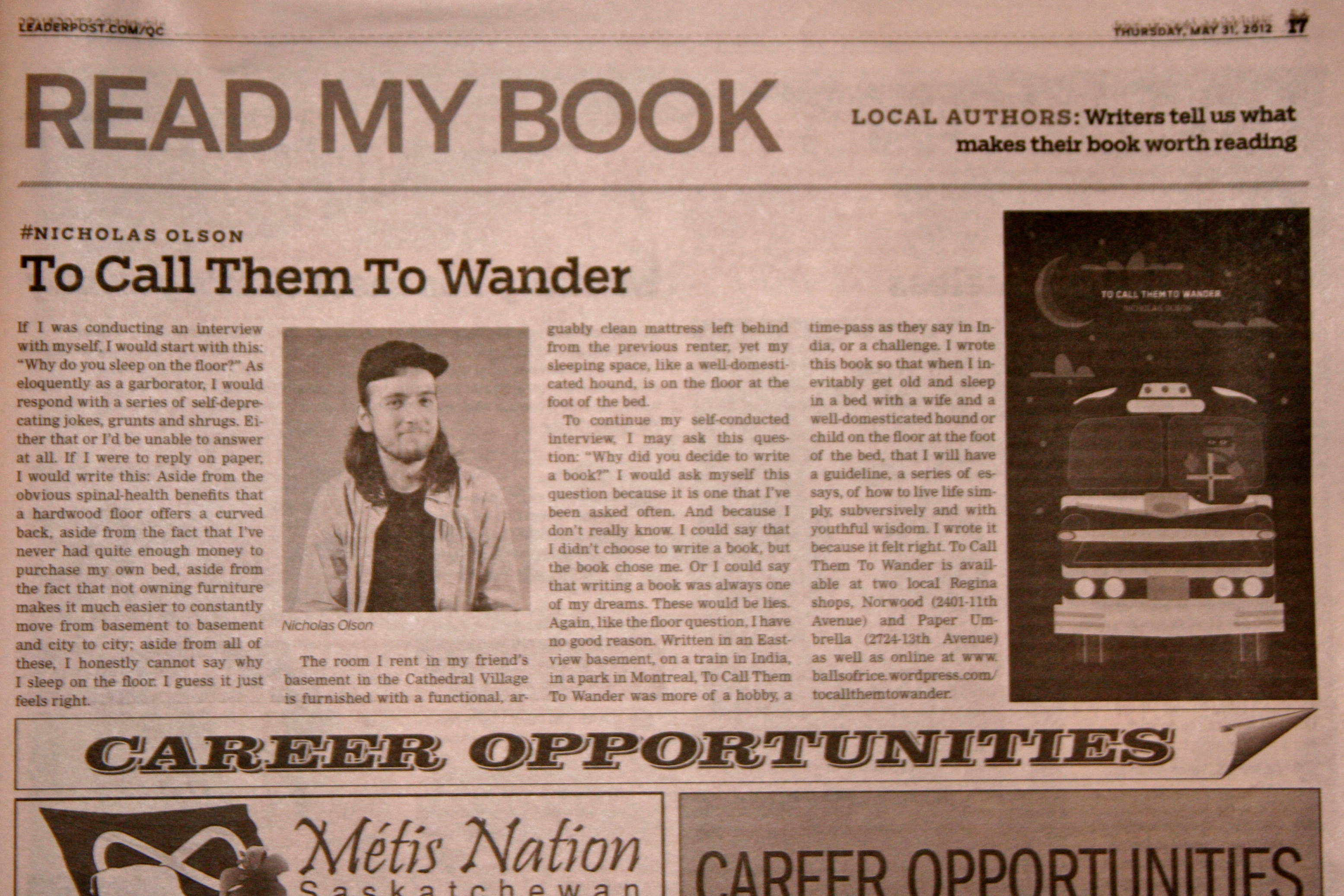
    This write-up recently appeared in QC newspaper’s Read My Book column, complete with glamour shot by Noel Wendt. 

    If I was conducting an interview with myself, I would start with this: “Why do you sleep on the floor?” As eloquently as a garborator I would respond with a series of self-deprecating jokes, grunts and shrugs. Either that or I’d be unable to answer at all. If I were to reply on paper, I would write this: Aside from the obvious spinal-health benefits that a hardwood floor offers a curved back, aside from the fact that I’ve never had quite enough money to purchase my own bed, aside from the fact that not owning furniture makes it much easier to constantly move from basement to basement and city to city; aside from all of these, I honestly cannot say why I sleep on the floor. I guess it just feels right. The room I rent in my friend’s basement in the Cathedral Village is furnished with a functional, arguably clean mattress left behind from the previous renter, yet my sleeping space, like a well-domesticated hound, is on the floor at the foot of the bed.

    To continue my self-conducted interview, I may ask this question: “Why did you decide to write a book?” I would ask myself this question because it is one that I’ve been asked often. And because I don’t really know. I could say that I didn’t choose to write a book, but the book chose me. Or I could say that writing a book was always one of my dreams. These would be lies. Again, like the floor question, I have no good reason. Written in an Eastview basement, on a train in India, in a park in Montreal, To Call Them To Wander was more of a hobby, a time-pass as they say in India, or a challenge. I wrote this book so that when I inevitably get old and sleep in a bed with a wife and a well-domesticated hound or child on the floor at the foot of the bed, that I will have a guideline, a series of essays, of how to live life simply, subversively and with youthful wisdom. I wrote it because it felt right.

    To Call Them To Wander is available at Norwood (2401-11th Avenue) as well as online at http://www.ballsofrice.wordpress.com/tocallthemtowander.

  • Growing up into a regular douchebag.

    I was recently told to ‘grow the fuck up.’ It was an internet voice that suggested this to me, however the tone of the phrase, lacking capitalization and proper grammar, was quite scathing. Along with personal attacks on the low readership and comment tally on my blog, I was truly taken aback and offended. The internet, after all, is where anyone can write whatever they want about anything, and then be forced to write a formal apology via Twitter. God bless it.

    Since writing a chapter about growing up for ‘To Call Them To Wander‘ several years ago, I have discovered nothing new. Still I do not see the appeal or necessity of such an action, nor do I believe that having more people ‘grown up’ in our world will be what pulls us from the muck. I have a hard time thinking otherwise; the people who tell you to grow up must just be the ones who hold contempt for those that enjoy life. Growing up to them, I can only guess, means being able to accept a governmental shit storm in stride, to amass incredible debt with the accumulation of objects, and to not speak about something you believe in.

    Reprimands aside, I am statistically part of that age group where people are expected to begin their ascent into maturity and adulthood. That quarter-century mark, which I have yet to reach, hits people as if it were the tender hand of Mother Nature slowly ushering them towards erectile dysfunction or menopause. And it strikes fear. It incites comparisons with our parents based on calendars. It triggers worry about priorities and education and careers. And all because we have been told since we were old enough to be in school, that growing up is good, inevitable, and essential, but we weren’t told what it meant to grow up, nor what the point would even be. Every culture has indicators of adulthood. Rites of passage. Ours must be internet related. Either that or the loss of passion and the acceptance of apathy.

    Responsibility is inevitable with age, and is an admirable thing to take on. Homeownership, marriage, planting a garden, buying a dog, or painting interior walls can be considered commendable things (with the exception of painting walls, in my opinion) that symbolize adulthood. The not-so-admirable parts of growing up—the close-mindedness, the sloth, the justification, however, seem to root deeper by the birthday. And it is these that I plan to leave aside, that is, if I could ever be considered a ‘grown up.’

    I was also recently called a ‘douchebag,’ a word commonly reserved for males that seemingly lack brains. Again, internet name-calling that I likely deserved for encouraging people to put dog shit in newspaper bins and being another opinionated ass-clown with a blog. Based on recent internet advice, I best grow up into a man that is comfortable calling strangers names through the guise of the internet. It’s the only thing I can think to do. Nay, it is the only thing a true adult would do.

    I am twenty-three and three-quarter years old.

  • To Call Them To Wander Book Review

    Thanks to Global Regina and Devin Pacholik, To Call Them To Wander was reviewed on the morning news. Check the links below for a flattering video and separate written review.

    To Call Them To Wander Review Video

    To Call Them To Wander Pages and Patches Book Review

  • Fail Blog

    I received my first rejection letter last week. And the second just a few days later. No, not the kind of rejection letter you get from a lady (although I will not be surprised if/when one of those ends up in my mailbox), but the kind of rejection letter you get from a literary magazine after you send them a piece of literature. I submitted to this particular magazine because the process was extremely simple, required no extra effort, and was a fancy publication from the cultural mecca of Brooklyn, New York. I expected nothing less than a rejection letter, however I expected it a few months down the road, when I would have been more prepared to receive it, would have forgotten of my childish dreams to be published in the self-proclaimed greatest city in the world. Failure is seeming to become a more and more relevant piece of my current life.

    Humans enjoy watching the failure of others, it is what most entertainment is based on, and is entirely what internet entertainment is based on. It is entirely what the cultural pinnacle of America’s Funniest Home Videos is based on. And although I think it is natural for us to want to gawk at such spectacles, I think it is sometimes good for the human mind to avoid doing what seems pleasurable. A good exercise in restraint.

    Failure wasn’t a common thing in my younger days, whether I was too naive to notice it or it happened less often, I cannot say for sure. For whatever reason, this moment of failure resurfaced in my mind last night: In grade six I asked Jillian Frick if she would date me, and she said no. She said that I was more like a brother to her. My crush since first grade—the smartest, nicest, blondest girl at school—and I was destined to fail as the friend she considered as her brother. I wanted to grade-six-date her so badly, which consisted of MSN chatting, an arm around her while watching a movie, and status. When I ended up dating Ashlyn Cooke in grade six and seven, she always got on my case for not holding her hand when we walked to buy five cent candies. The thought of touching my girlfriend never even crossed my mind. Simpler times. I am still simple.

    Rejection isn’t something I’ve had to put up with a great deal in my life. A middle-class English-speaking white male in Canada. It is likely for this reason that being a middle-class English-speaking white male in Canada is something I desperately want to fail at. When I think about any of my statuses, I regret my life. Not that this regret will make up for the fact that I’ve had one of the easiest lives of anyone that ever existed, nor will it change the world in anyway, but it might at least encourage myself to change from being a waste of skin, to being a waste of skin that knows he is a waste of skin.

    I sent the same two stories to two other magazines, ones in which I actually believed I may have a chance at, at least that is what I’m telling myself now. When the inevitable day comes that those stories are returned to me with a letter that includes a quiet thank you and an encouraging keep trying, I will breathe in the rejection as if I thought it was my fate in the first place. My life of failure and rejection starts now. And if I accept it as such, then it isn’t as tragic as it may seem. Rejection and failure are good for the soul, good for humility, good for what ails you. Nothing cures the disease of middle-class English-speaking white males better than rejection. To be healed, I will keep submitting to magazines far out of my league.