


Tag: Carmichael Outreach
-
Living on the Street Hockey
Gretzky, Wendel Clark, Jazzy Darren shine at Carmichael World Cup of Hockey
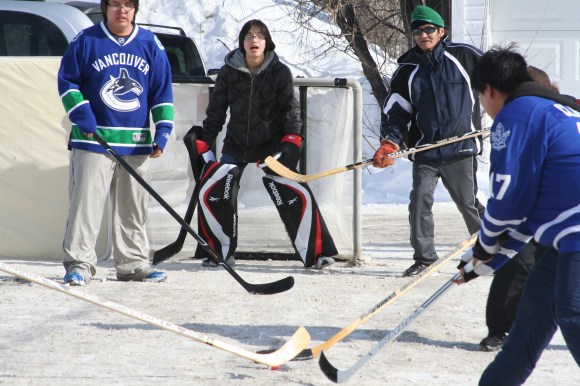
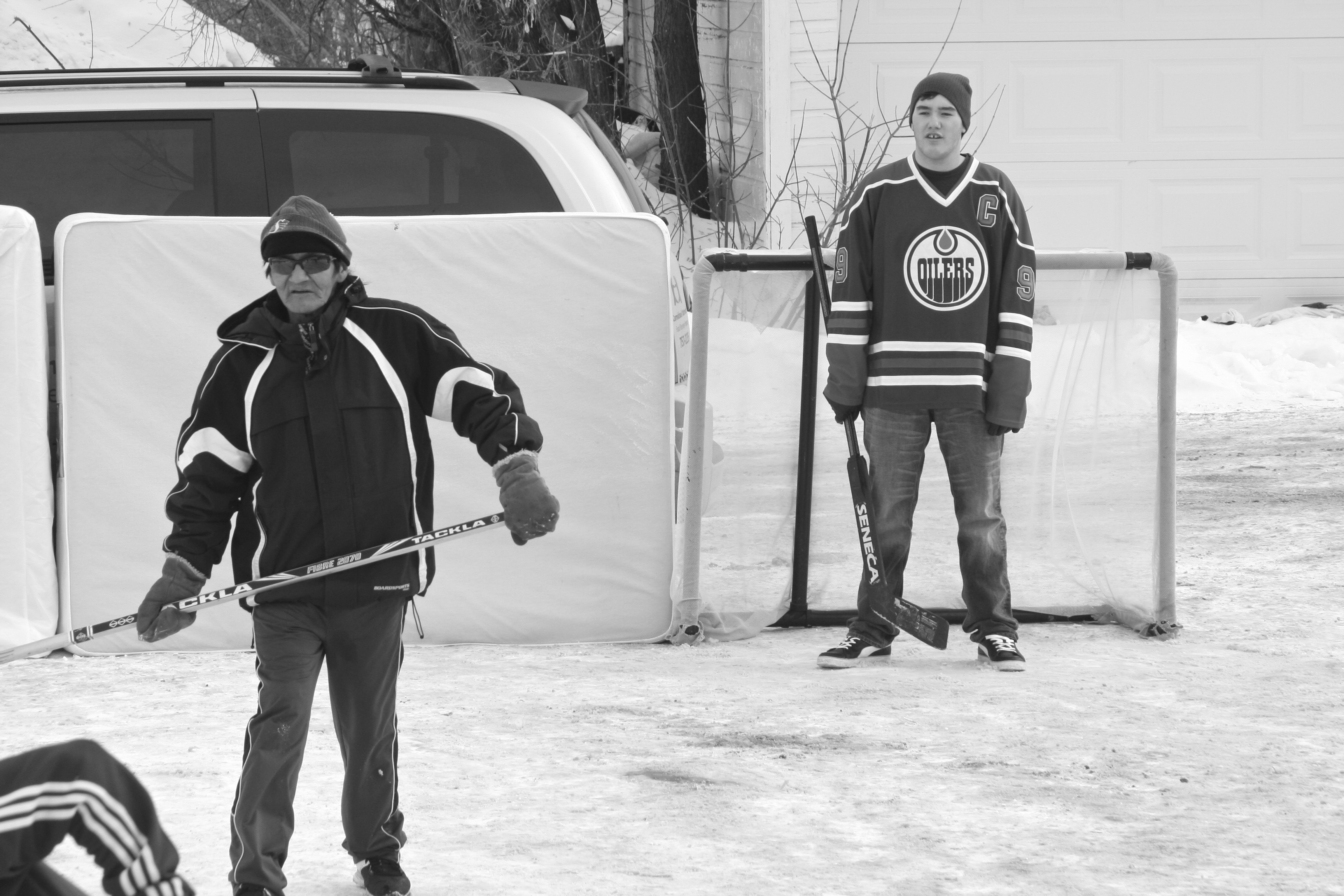
On Saturday, February 23rd, 2013 we had a shinny game in the back parking lot of Carmichael Outreach. Twenty people showed up, the game was heated, the old men beat the young kids 10-8. The One-Block-Off-Broad-Street Bullies warmed the Penalty Box when they were tired. Ken Dryden passed out after the first period. I haven’t had so much fun at work or otherwise in a very long time.


-
Jazzy Darren
 A slightly shorter piece on Darren Sanguais can be found at the Carmichael Outreach blog.
“I’m no fan of Justin Bieber, but–uh, haha!” If there is anyone I know that could be described as jazzy, it would be Darren Sanguais.
Darren is a shortish man of forty-eight years, but looking at him you would think he may be ten years younger than that. This is likely due to his laugh, his work ethic, and his hair. His hair is jet black and always well-groomed—short and styled on top with a long strip that rolls down his back—usually loose, occasionally in a braid. His sharp hairstyle is undoubtedly inspired from his days studying at Richard’s Beauty College in Regina, where he learned dyeing, cutting, and all other men’s and women’s esthetics. When it isn’t too cold, Darren will wear his hand-beaded leather jacket with tassels. When the temperature dips, he wears his fur coat and fur hat. Darren is a sharp-dressed man.
Two months ago, Darren was living in the back of a truck. From January to September he curled up in what he called ‘Hotel Darren’, the cab of an old pickup, heated only by two tea-light candles, with only a few old blankets and the clothes on his body. The first time I met Darren was one of my first days at Carmichael, and was one of his first days out of Detox. He and I were commissioned to clean out the Carmichael Community Garden. It was late September and frost had already set in, but the red fruits were covered up by the bowed stalks and the fallen leaves, thus untouched by the cold. We took a few boxes of tomatoes back to the office, pulled several bundles of hand-painted garden signs and closed up the garden for the year, which Darren had helped tend throughout the growing season. From the first time we talked, walking down the alley from the garden next to Souls Harbour on Halifax to Carmichael on Osler, he told me that the hardest part about changing, about sobering up, was the people around trying to bring you down. Friends, family, acquaintances drinking everything, everywhere. Giving him shit for thinking he is better than them. Wanting to fight if he doesn’t join in with their drinking. And even two months down the road while we sat down for a burger and fries he said:
“I’m like a kettle, man. I just throw it in the back, throw it in the back, but it’s gonna boil sometime. It hurts, man. The people, talking shit. It’s hard.”
“But in the back of my mind I keep thinking, I’m a survivor, man. I’m a survivor.”
When he says things like this, I cannot offer any advice—he is twice my age. He has seen more than I ever will. He is tougher than I will ever know how to be. When he tells me about people giving him shit, I can only tell him what I know for certain: that I am always around to hang out, and that even if the doors are closed for the day, there is always someone to talk to from Carmichael. And that Carmichael always has work to keep him busy. He is twice my age but has seen far more than twice the things I have, and is twice as wise as I expect to be at forty-eight. I asked him if it was ok if I wrote a bit about him for the Carmichael site. He often uses the word ‘jazzy,’ and he might’ve in this case.
“Really? For sure, for sure, that’s cool. I’m not ashamed of where I come from. I’m not. I want people to know where I come from. I’ve got lots of stories.” And he told me a few thereafter.
Darren was born in Grenfell, Saskatchewan. Most of his family was born on the reserve in Sakimay First Nation, but being maybe his mother’s eighth child they went to town for his birth. One winter night on the reserve as a child, his step-father kicked him out of the house for being a nuisance. He wandered outside during a blizzard and nearly froze to death until a pair of dogs found him, he told me. A few of his fingers still show the damage from the relentless bite of a Saskatchewan winter.
He has lived in and around Regina most of his life, spent five years in Edmonton, part of that time incarcerated. He figures he has had over one-hundred convictions on his record, one of attempted murder—he was jumped one night when he was drunk, fought back, stabbed a guy, all while he was blacked out. This got him three and a half years in federal prison—the last sentence of a fifteen-year stretch where he wasn’t out of jail for more than three months at a time. If they picked him up for anything now, he’d have no chance because of his previous record, he says.
After listening to a half-dozen of his stories, I felt like I needed to create a balance and tell him something of myself. So I told him of my recent legal battles, childish and non-serious, but a story nonetheless.
“That’s stupid. Don’t they have bigger fish to fry? I mean, come on. They’ve got bigger fish to fry here, and they’re frying me, haha.”
Instead of walking the streets or hanging out at home alone, Darren comes to Carmichael. He makes sandwiches. He shovels the seemingly endless Carmichael parking lot. We bond over the breaking down of cardboard boxes. (Whenever I go out back to start on cardboard, he joins in without hesitation. I always make sure to say “thanks,” and he says, “Shit yeah, man.”) He can often be found at the back food-window, taking orders for burgers and fries when we are serving macaroni, singing choruses of old rock ballads. And he is almost always laughing. He now has casual employment with a local construction company, and when he is not there, he is at Carmichael. He has an apartment of his own, a bank account for the first time in a decade. He gets to see his grandkids. He has a support group of peers and staff at Carmichael.
Darren is the reason that Carmichael exists—friendship and accountability, food security and assistance with daily necessities, housing help and employment opportunities—an open door with available programs and services to help, no matter a person’s living arrangements, family situations, financial circumstances, health issues, or addiction battles. Darren is also why Carmichael is a joy to go to on a daily basis. His commitment and determination is inspiring. His joy of life is contagious. The reason that Darren seems like the fountain of youth, is because his heart is young. And because he is a self-proclaimed jazzy man.
-
Always Support the Bottom
Always support the bottom. -Aluminum Baking Tray
I’ll get all poetic later.
I was washing dishes at Carmichael in Regina. If you don’t know about this place and you live in Regina, then you best become aware. Oh, how noble of you, Nic—helping the poor and publicizing it on your blog like a self-righteous asshole. That’s right, I am.
When I was washing dishes I came across multiple clever coffee mugs in the Coffee Mug Graveyard that is the Carmichael Outreach. Here are the greatest of the great:- Don’t borrow off Peter to pay Paul on your birthday, Because no one likes a sore Peter.
- The Older I Get, The Better I Get
- Merry Christmas MOM, You’re Special
- Neighbours by Chance, Friends by Choice
- Pepe Tours, South American Travel Agency
- Age-appropriate Dora ceramic coffee mugs
- #1 Hair Stylist
- I’m no sex addict, but we haven’t had bunnies in days.
These all seem to date back to a similar time period when giving coffee mugs was as common as texting. A warm era of camaraderie where you would give a mug for absolutely any occasion, even if the mug made no sense, and especially if it had heavy sexual undertones. Like a reusable, practical, breakable gift card.
Several weeks ago while at Carmichael, two local television celebrities came by to volunteer their time. I was greasy, wearing a ponytail and my trademark stained hoodie, slanging leftovers from juvenile delinquent centres into old yogurt containers. They were wearing classy female-tailored suits. They helped package and deliver food. Being television extroverts, asking questions seemed natural to them, and since I am always able to answer the questions of beautiful, young successful local women, we had a nice conversation about the city, about their early morning television schedules, and about Montreal. They asked me why I came to Carmichael on a regular basis, and I was unable to give a decent answer. I have spare time, I said. I like what they do here.
This week, I slapped together likely fifty or more double burgers on white bakery buns with a splash of mustard and an explosion of ketchup. When I reached the bottom of the tray, through a layer of greyish-yellow fatty beef juice, I came up with the reason why I do my best to volunteer on regularly. On the aluminum tray, one that was once filled with frozen burger patties, oven-cooked to perfection, I read the above quote and title of this post. And although this one was staring at me in the face, and although lately I have been going really far, shitty-preacher far, to make connections between regular life crap and philosophical nonsense, this one I just couldn’t pass up.
I do not use the term ‘the bottom’ as if those financially unlucky are somehow lower than those of us who can live comfortably in our wealth. I use the term ‘the bottom’ as in, those who are neglected by the rest, including government funding and policy. Supporting ‘the bottom’ means more than using a thrift store as a garage sale for our conscience, it means more than parting ways with our novelty ceramic mugs, it means more than a financial gift that we will be refunded 15% by the compassionate Canadian government. It means changing the the system in a way so that the bottom is supported by the top, and the top is supported by the bottom. A system where they are both on the same level. Where ‘the bottom’ doesn’t exist. This is possible starting with a change in mindset, change in priorities, change in spending. But if you’ve got any hilarious ceramic mugs for me to wash, we can always just start there.
If you have an excess of food items, large plastic yogurt containers, plastic bags, clothes, money, or time please consider donating it to the Carmichael Outreach on 1925 Osler Street.
-
The Wounds of Home
The following will be released in the first edition of Rise Up, a free street newspaper available in Regina, Saskatchewan in January 2012.
Of the past five years that I have been free from the confines of high school education, I have spent approximately two-thirds of my time away from my hometown of Regina, Saskatchewan, the motherly city that always welcomes me back. I have been fortunate enough to be one of the few people in the world that has the means to save money to travel. To see the street food stands of Korea, to ride the blue trains of India, to watch soccer games in Mexico. I have also been lucky enough to have a home and a family to which I can return after such adventures, and friends that give me employment and rooms to rent so that I can save up more money to further travel and again leave the tender arms of my fair home.
As is inevitable with any sort of travel, third-world or not, one sees the absolute contrast between the excessiveness of wealth and the inadequacies of poverty. The gap between the wealthy and the poor classes in India is obvious on any city street, but not openly discussed or even talked about as something that has the potential to change. Living in a poorer area of Montreal for a year and a half, one can see the difficulty for small immigrant families and local residents to function in a large city setting. Travelling throughout America by bus, one sees the neighbourhoods that house Greyhound bus stations in giant cities, places falling apart because of several years of recession. Staying in homes and hostels in Mexico, the country is obviously exhausted of a system that allows the rest of North America to take advantage of it for its natural beauty and drug-trafficking, leaving a tourist-pillaged people and nation. After two years away, I never expected to return to Regina, my place of privilege and opportunity, to see a housing situation equally as grave as any of the metropolises in North America. A vacancy rate of below zero that is not improving, and the lack of vision for affordable housing are crises deemed less urgent in comparison to other places, possibly due to a lower population of the city and province, but are no less serious. In one of the few places in the world that was not seriously damaged by the past several years of economic decline, we see misplaced development into more shopping complexes and chain restaurants with little development of necessary infrastructure. The present wealth of our province should eradicate homelessness, just as the wealth of our nation and other Western nations should guarantee fair and equal food and wealth distribution worldwide. The key word being should. Because of a flawed system of bureaucracy, and insatiable, power-hungry leaders, suburban centres pop up overnight while city centres further dilapidate.
Supporting organizations such as the Carmichael Outreach and Souls Harbour, and by talking with City Council members, MLAs and MPs, the privileged public can communicate that these are not just issues of the poor in certain neighbourhoods, but that they are issues that involve any member of Regina, a city that is in essence one large community. It is not enough to say that we disagree with poverty, any person with the semblance of a soul would say this, but it is necessary to communicate that we aren’t content to sit around as a resource-rich government ignores the immense need for affordable housing, improved schools and better family and child care.
If I were ever to designate a place to call home, Regina would likely be it. And although I haven’t been directly hit by the housing crisis in Regina, as I couchsurf and rent out basements of friends who have grown tired of a saturated rental market and overpriced shack-like apartments, it still feels like a member of my family is being abused and neglected. Like my grandpa is the Plains Hotel being kicked out of his downtown home so that Brad Wall and Pat Fiacco can continue the gentrification of Regina by selling the land to oil-rich Calgary investors, building condominiums for a large unknown population of upperclass businessmen that want to inhabit the modest capital city. Then, when my grandfather begins to look for a new place to live, he finds that even though the government has enough of a surplus to kick him out and build a $100-million condo/hotel, they don’t have enough surplus to give him an affordable, or even available, apartment to rent to rest his ‘Plains’ aging bones. This place that I would designate as ‘home’ is fighting through a housing crisis, and although it may not seem as severe as the one facing the inhabitants of India, or as widespread as the decay of cities across America, it cannot be overlooked. And as my motherly home of Regina aches for help, she can at least take solace in the fact that although her serious wounds are generally still untreated, they are starting to be talked about.
Please contact your city councillor, MLA and MP at the links below to tell them of your concern with the current system.


 Balls of Rice