I also recently became a board member for Briarpatch, so I strongly encourage you to check out their reporting and consider signing up for a subscription.
In my final class studying international human rights law, I shared my paper analyzing Ukraine’s law on Indigenous people which, while imperfect, protects the territorial and language rights of Crimean Tatars, Karaites and Krymchaks. In the class discussion, a friend and self-proclaimed Marxist wearing a keffiyeh asked if I knew that the Russian language was broadly oppressed in Ukraine. Despite their rightful support for Palestine and correct criticism of colonial governments, they tended to be sympathetic to a different colonial, imperial power by repeating one of Russia’s falsified justifications for engaging in an unprovoked war of aggression.
Expanding our critiques beyond western colonial empire is important as we struggle to find alternatives to any form of oppressive, centralized power. As fascism balloons in our own backyard, we can learn from Ukrainian people actively resisting a fascist authoritarian state. And as we try to comprehend how to dismantle an empire here, we can well be reminded that the problem isn’t one empire or another; rather, the problem is empire itself. As one empire coerces Ukraine into a minerals deal, another empire is currently shooting ballistic missiles at shopping centres in Ukraine.
The following resources have helped me understand Ukrainian resistance as removing itself from under the foot of centuries of a colonial power.
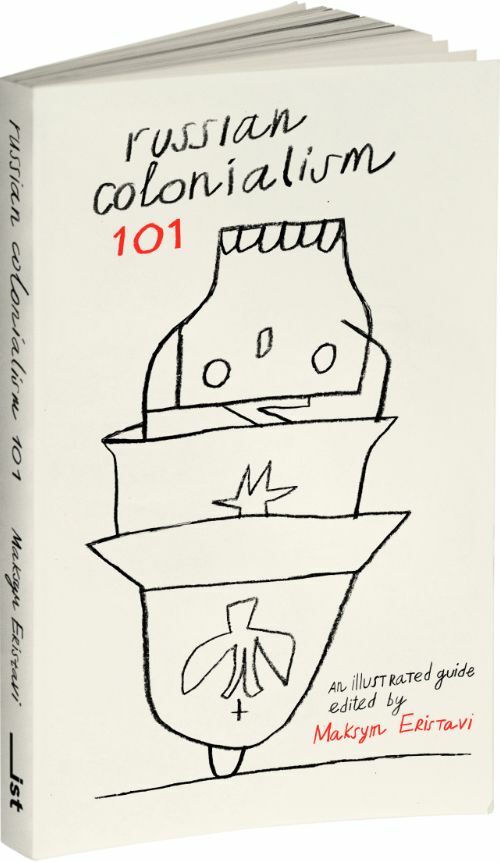
Until I found the illustrated book, Russian Colonialism 101, by Ukrainian journalist Maksym Eristavi, I hadn’t heard of Russian history explained as colonial power. In the Western anti-colonial, anti-capitalist circles in which I found myself, the Soviet Union was generally either tolerated or praised, with Joseph Stalin’s violent purges considered one of the only dark spots marring this alternative to capitalism. I knew little about its predecessor, the Russian Tsarist Empire, or the current Russian Federation. This guidebook (basically a reading list of its own) explains that the past three iterations of Russian rule – from the Tsars to the Bolsheviks to the Vladimir Putin regime – have employed the same colonial tactics to control and oppress Indigenous nations neighbouring and within Russia’s borders. When Russian prisoners of war are released they are often photographed holding flags for Tsarist Russia, the Union of Soviet Socialist Republics (USSR), and the Russian Federation all at once. The book demonstrates that the current war on Ukraine is far from a singular project of a power-hungry dictator, but an unfortunate feature of Russian colonial statehood.
The Matryoshka of Lies podcast, hosted by Maksym Eristavi and Ukrainska Pravda news outlet dives into lesser-known histories of Russian colonialism. The season-one finale, Ending Empire, touches on Russia’s expansion into Alaska in the late 1700s, where they extended the same policies of coercion and enslavement they used on Indigenous nations of Northern Asia. (Tlingit resistance to this Russian colonialism is best captured by Gord Hill in The 500 Years of Indigenous Resistance Comic Book: Revised and Expanded.) In part, the purpose of the episode and the podcast as a whole is to allow a western audience to better understand Russian colonialism as akin to the genocidal horrors of European colonialism that many North Americans are just starting to grapple with. Similar to many radicals in North America calling for an end to U.S. hegemony and violence through an end of the American Empire, this episode suggests that a “total reset in what is now the Russian Federation” is the only way to end these continuing colonial expansionary tactics.
Policies of food control and forced starvation have long been a genocidal policy of colonial governments, from Canada’s purposeful extermination of Indigenous food sources, to Israel’s current explicit weaponization of food in Gaza. The Holodomor (meaning ‘death by starvation’) occurred in 1932-33 in Ukraine and led to the deaths of upwards of a fifth of all Ukrainians. Soviet policies forced the collectivization of farms, imprisoned or killed people for hiding or ‘stealing’ grain, and instituted restricted travel so Ukrainians could not access other food sources.
Whereas most narratives of the war start in 2022, or maybe 2014, Mariam Naiem’s graphic novel puts Russia’s war on Ukraine into perspective from the very beginning of Ukrainian nationhood. It unravels the long history of policies meant to extinguish Ukrainian sovereignty movements that threatened Russian control over valuable Ukrainian natural resources: from the Holodomor to policies meant to marginalize the Ukrainian language, to Russia’s invasion once Ukraine shifted into the European sphere of influence. This introduction to the history of the region helps give context to the war by explaining the centuries of Russian empire and Ukrainian resistance.
While the Western left has generally expressed support for Ukraine, in some anti-imperialist circles, dialogue is often immobilized when someone associates Ukraine with NATO, Nazis, or nukes. In this interview, Hanna Perekhoda, a Ukrainian socialist and historian, succinctly addresses some of the most controversial among these stumbling blocks. She explains supposed Russian-language oppression and Russophobia is akin to the anti-white racism rhetoric rising in the West. Perekhoda speaks to Putin’s claim that Ukraine is overrun by Nazis, a propagandist justification for the war hearkening back to Second World War mythology. She acknowledges Ukraine’s far right, noting they have repeatedly proven to be a fringe movement. Given that problems with the far right exist everywhere, she questions whether this justifies a full-scale invasion or a withholding of military support or other aid. She notes that what really risks a rise in fascism is a long-standing war waged by a fascist Russian regime where common Ukrainians are radicalized by years of military occupation and systematic oppression. As Perekhoda makes clear, what is needed is support for Ukrainian lives, autonomy, and resistance.
Ukrainian author Artem Chapeye gives a contemporary account of what it is like to be on the receiving end of a colonial war of expansion. As a self-proclaimed pacifist, leftist, and feminist, Chapeye joined Ukraine’s military in 2022. After politely admonishing Western anti-imperial leftists for their lack of critique of other powers as compared to their rigorous critique of the American Empire, Chapeye addresses the privilege of pacifism that judges Ukrainian (and other) resistance; anarchist traditions of Ukraine’s historical resistance to empire; navigating the tension of being against the authoritarian dangers of nationalism while fighting for a civic – rather than ethnic – community currently under a nation-state; and the impossible psychological toll of war. Speaking to himself as much as to Western audiences, Chapeye explains Ukrainian resistance as follows: “We can either fight back now, with the losses that necessarily accompany this, or remain the colony of an empire for another hundred years.” His book explains his decision to fight against Russian invasion is not because of a guaranteed win, but because of the moral imperative to fight fascism in all its forms.
Pasha, on break from installing new rain gutters, looked down at me as I sweat, shovel in hand, knee-deep in Ukraine’s famous black earth. “Crazy Nic” he said. I didn’t expect him to say something in English so I didn’t catch it. He repeated in his own language: «Шалений Нік» (shaleney Nic). Then I understood.
Olia and I went for a walk to the forest just to see what the sun and wind felt like from from different angles. Upon return, the neighbour, bent ninety-degrees at the waist hoeing potatoes, couldn’t really understand that we came back without foraged mushrooms. A friend has said that she finds it sad that her parents don’t know how to have fun, that every spare moment is spent processing apples, feeding chickens, digging potatoes, canning tomatoes. They would never go to a movie or concert. This weekend, her and I will go to a bar on Friday, a concert on Saturday, and another concert on Sunday. We are of the generation that must always constantly forever be entertained. There’s not much entertainment in the village since the discobar closed.
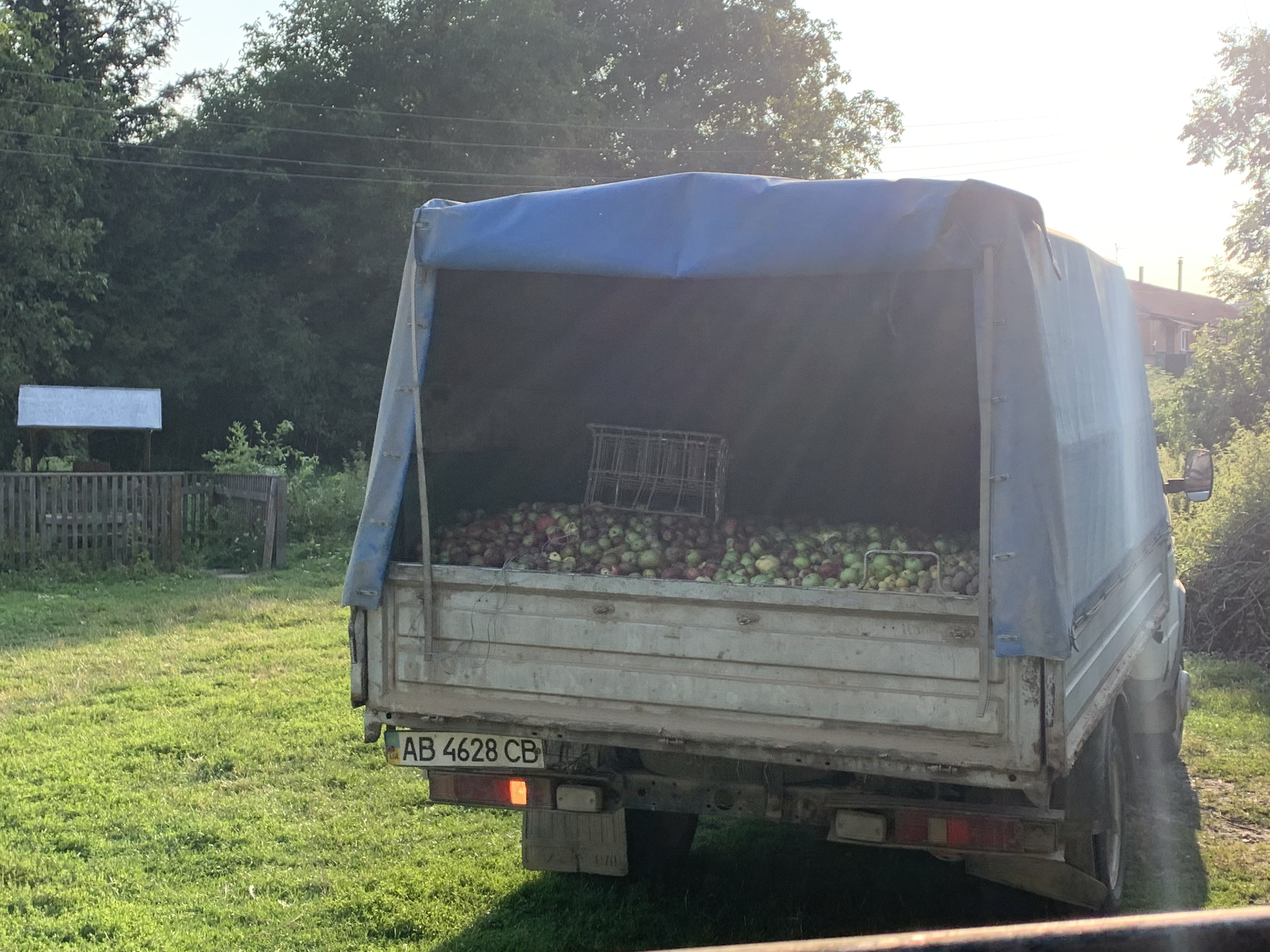
Maybe I should get a job. Selling bread-flavoured sodapop (kvas), selling honey, bike courier, taxi driver, bus driver, teaching english. My anti-capitalist brain tells me that my desire to get a job is just me being insecure about my worth in a society that values you solely based on your salary. My bank account tells me otherwise. And seeing old people sit on the concrete selling wilted plums makes me feel guilty for being previously paid an hourly wage equal to their monthly pension, as though I had something to do with global wealth inequality and amassing of colonial wealth. So I find solace in incorrectly sewing and then seam-ripping adaptive underwear for veterans with prosthetics. Or carrying a long stick with a hook at the end of it, letting gravity pummel me with apples as I shake branches of 100-year-old trees to collect fruit to sell to the juice man for 10₴/kg (25¢/kg). Each metric tonne we collect eases my insecurities, each apple welt brings me closer to the village god of labour — the permanently bent-over бабуся (babusia).
It wasn’t clear to me why Pasha thought I was crazy. For digging a 60metre long trench from the well to the garden to provide water to the vegetables in increasingly dry summers? Or for moving to Ukraine, spending time in the village when he was just a few years from conscription-age and wanted nothing more than to leave a place he was not legally allowed to leave, being told by his mom that he had to help out his uncle, the only carpenter in town? His uncle is now in jail, having paid a bribe to avoid military service. Now there’s no one to finish the eavestroughs.
As I Support The Arts by gently bobbing my head to synthesizers pumping through clouds of haze at a festival in Kyiv (a task I convince myself is more important than ever when a culture is under attack), village labour takes on a different tone in occupied and nearly occupied territory. Demining. Reselling pieces of exploded enemy drones as a fundraiser for new defense drones. Trying not to be killed. There’s an absurdity to art in times of war, says author and soldier Artem Chekh. But also that art is the only thing that allows for a “tolerable existence”. Make art not war, sure, but what do you do if someone makes war on you? (Village) God (of Labour) knows that this blog post or a John Lennon song won’t prevent a train car from exploding. But neither will picking metric tonnes of apples.
As always, if you’re able, please consider donating below, or reach out if you are interested in donating somewhere else.
The following was originally posted on Poverty Kills 2020’s blog, and was written with help from Joshua at Poverty Kills. It outlines the ongoing pandemic shower saga and the City’s inadequate response.
Since the first COVID-19 restrictions were implemented in ‘victoria’ in March 2020, one survival service (of many) that has been restricted for those forced to shelter outside is basic hygiene access in the form of showers. While there have been several organizations that have been offering limited access to showers throughout the pandemic, overall these services have been reduced, restricted, and largely inaccessible to those sheltering in parks away from the downtown core. With ongoing changes to bylaws and enforcement, an order from the provincial government restricting sheltering in two locations, and increasing hostility from housed people, campers have been continually and increasingly displaced from the core of the city where most shower services are located.
On November 21, 2020, in massive numbers, bylaw enforcement officers and VicPD tore down community-built crowdfunded showers and a community care tent at MEEGAN. Shortly after this heavy-handed display of colonial power, the City announced a one-time Emergency Social Services Provision Grant to respond to immediate hygiene and survival needs until March 31, 2021 when the City is insisting everyone living outside will be housed (despite no apparent plan to achieve that). While more funding for resources and infrastructure is useful, the City is also the cause of many of the problems and this grant has political motivations and implications.
From the start the City has prioritized money for increased bylaw enforcement and policing, including a recent allocation of nearly $600,000 additional funding to hire five more Bylaw officers (which is intended to be permanent, at $491,000/year) and to pay police more overtime for increased policing near larger encampments. The City has repeatedly changed rules about sheltering, forcing people to move multiple times, and arbitrarily deciding on permissible locations with no thought to liveability of those locations — as was horribly witnessed a week ago when heavy rains flooded many people’s tents, destroying their belongings — and even spent money on a legal injunction to displace campers from one location. And the City has also repeatedly refused to communicate and work constructively with groups providing support and services on the ground.
Despite many misgivings about all of this, given the huge need for more shower access Nic, a community volunteer involved in shower advocacy, spent many hours sleuthing shower options and bringing groups together to support a collaborative, peer-centred mobile shower project. But the way the City set up the grant meant this was doomed to fail.
We are sharing Nic’s work for two reasons. As part of broader understanding about how colonial systems work, we want to illustrate how the one-time Emergency Social Services Provision Grant was inaccessible, problematic, and perpetuates colonial control, and how the City continues to interfere with unhoused people’s autonomy to decide what they need and who they trust and want to work with. We also wanted to share info on mobile shower logistics in case it helps people in other regions who are considering mobile showers to have a realistic sense of what is involved.
FUNDING AMOUNT
The City’s grant was limited to $100,000 one-time funding. To explore what could be done with that funding, as a starting point Nic consulted with LavaMaeX, a highly reputable and experienced mobile shower and hygiene provider who offers support and consultation to organizations looking to develop mobile shower programs across the world. For some items he also did additional research on costs.
Although the mayor posted on her blog a picture of a three-stall mobile shower trailer from another region as an example of what the grant was supposedly making possible, the reality is that even a smaller mobile shower project can’t properly be done for $100,000. That amount is not enough to buy a shower trailer and cover the costs offreight and duty for the import of the trailer, a vehicle to tow the trailer, wages, vehicle insurance, liability insurance, ICBC coverage, materials (propane to heat the water, gas for truck and generator, towels, sanitizing products, etc.), laundry services, unit parking costs, and vehicle/trailer maintenance. Below we break down the expenses. All estimates are in ‘canadian’ dollars.
Shower trailer: We believe it is unethical to consider infrastructure that is inaccessible to people with mobility disabilities. However, for a more solid understanding of costs Nic looked at a full range of options, consulting both with LavaMaeX for a general sense of cost range and five commercial shower trailer suppliers for more specific estimates. A 3-stall trailer with stairs (which would have required ramping and other accessibility customization) or a 2-stall wheelchair-accessible trailer would have cost over $60,000, and a 2-stall non-accessible trailer (which would have required ramping and other accessibility customization) would cost over $40,000. Obviously, having only two stalls would significantly reduce the number of people who could use the shower on a daily basis. LavaMaeX estimated that a 3-stall trailer could provide 35 showers per day, already not enough for the 200+ people at all 11 different sites across the city to shower even once weekly.
Vehicle with towing capacity: LavaMaeX estimated over $50,000 to purchase a new truck with sufficient towing capacity. It’s a huge outlay especially for just a four-month project, but there aren’t other good options. Shopping on the used market means the vehicle risks being unreliable with high maintenance costs, leasing a vehicle is generally not possible or cost-effective if the lease is less than a two-year contract, most car rental companies will void their insurance if the vehicle is found towing a trailer, and U-Haul vehicles that are capable of towing a trailer weighing 9,000 lbs are not rentable by the month.
Wages: To run a three-stall mobile shower service operating 4 days a week with one day for deep cleaning and maintenance, LavaMaeXestimated a budget of over $28,000 per month for wages alone. This far exceeded the City budget so Nic tried to take it down to a bare bones level of what he felt was possible in local conditions and given the size of the City grant. In the peer-oriented staffing model Nic came up with, the labour costs alone to operate a mobile two-stall shower at a bare minimum of 4 days a week, with two positions (split between multiple people to support peer payments) at 8 hours a day plus 3 hours weekly for trailer maintenance, at $25/hour, would cost $7,875 per month in wages. This doesn’t include the extensive amount of time that would have to go into weekly coordination, or the coordination with the City around sites, safety protocols, and their required reporting (LavaMaeX estimated coordination as one full-time position). A two-position staffing model, even just for February and March and excluding prep training on operating the trailer, overdose response, etc., would total over $15,000.
Other costs: To run a three-stall mobile shower service operating 4 days a week, LavaMaeX estimated a core budget of $1,356 per month for cleaning products, laundering towels, propane, and water; they couldn’t provide any estimate for ICBC insurance, liability insurance, maintenance of the trailer and towing vehicle, gas, or parking as these are highly geographically specific. Nic didn’t do any in-depth investigation of these costs as it was clear by this point that there was no way to make this work within the terms of the City’s grant.
The bottom line: While $100,000 seems at first glance like a significant sum of money that should be more than enough to run a mobile program for four months, the reality is that acquiring mobile shower infrastructure is very expensive. The City either did no diligence around actual costs of purchasing or operating a mobile shower unit, or deliberately set up a funding competition that was hyped as being open to grassroots teams and organizations already on the ground, but in reality was viable only for large organizations able to augment the City’s funding with other funding sources.
Realistically, it’s the big poverty industry agencies that corner a large portion of funding streams because of their official organizational status (many funding streams are only open to registered charities) and existing infrastructure (positions and wages that can be shifted to new projects, existing vehicles, ongoing funding from donations, work space, secure parking, liability insurance, administrative and fundraising infrastructure, etc). And indeed, in the end the only organization that submitted a mobile shower proposal was the Salvation Army, a mega-agency that, globally, has a long history of anti-queer and anti-trans discriminationand as a proselytizing Christian organization is not felt to be safe by many people who have experienced harm by Christian churches and missionaries. This is not an organization that prioritizes accountability to people who are unhoused; the local branch came under scrutiny in 2015 for having substandard living conditions in its shelter, and in 2020 was in conflict with outreach groups and people living outside about the way it handled its publicly-funded food distribution to people living in parks (which was abruptly discontinued by the Salvation Army after a few months of changing locations and times with minimal notice, choosing to leave their donated specialized food truck sitting idle rather than offering it to the outreach groups that were left scrambling to put together food distribution systems).
Photo of a shower trailer included in the Salvation Army’s funded proposal. The Salvation Army committed to providing $55,000 top-up funding as part of its proposal, as the City’s funding was not enough.
Grassroots groups and mutual aid organizing have the ability and willingness to collaborate with people sheltering outside in the design and implementation of infrastructure and programs, and are often centred around economic justice principles that mean recognizing the expertise and skill of people who are unhoused, prioritizing money for peer positions, and paying peers fair wages. But grassroots groups and mutual aid networks don’t have the same kind of financial leverage as poverty industry agencies. Even if no matching funding is required as a prerequisite for applying (as is often the case), functionally requiring matching funding means that large organizations who don’t work collaboratively with those sheltering outside are likely to be the only ones who can run a project.
TIMELINES
Beyond the financial restrictions involved, the timeline restrictions involved in a project of this nature were also substantial.
Hurry up and wait: People living outside and the groups providing on-the-ground support have been calling for mobile showers since the COVID public health emergency reduced options in March. When the City finally responded eight months later, the amount of time between the grant announcement and deadline was 10 days. While several city councillors successfully got the deadline extended by one week at the last minute, it still proved, for most people and organizations on the ground who were already stretched thin and functioning at over-capacity, too quick and therefore unworkable to figure out a solid plan for something as complex as creating a collaborative, peer-based mobile shower program from scratch. LavaMaeX has suggested that most organizations take several months to do what the City required to happen in 10 days.
While the City expects organizations already working flat-out to hustle to meet the City’s timeframe, that’s not an expectation they hold for their own staff. Two of the three successful applicants funded through this program have not been able to begin their project one month later due to city restrictions and bureaucracy, making one question how much the City actually deems this an “Emergency”.
Unrealistic implementation timeframe & lost time due to City inaction: In its grant program description the City said grants would support programs running from December 1, 2020 until March 31, 2021. But in the process of calling mobile shower programs in ‘canada’ and all of the shower trailer production and sales companies Nic could find online, it quickly became evident that the earliest a shower trailer could make it onto ‘vancouver island’ would be mid-February 2021. This is largely because of the high demand of mobile shower trailers due to the COVID-19 pandemic, because other municipalities and organizations across the continent had been months ahead of ‘victoria’ in their decisions to pursue mobile shower trailers. Again, the City either did no diligence in creating its granting program or didn’t care that their timeline was unrealistic. Receiving a mobile shower trailer in February 2021 means 2+ months dead time until people are able to access basic hygiene services, with no interim solutions (and already-torn-down mutual aid shower stalls). There was a proposal for fixed-site showers — already constructed — that the City could also have opted to support, that could have been installed much more quickly as an interim measure.
The two community-built shower stalls that the City removed from MEEGAN after people having hot showers for four days. These were supported through volunteer labor and crowdfunding, and cost $5,883 to build, transport, and install. Photo by Emily Fagan from Tyee article.
Additionally, the grant only funds projects until the end of March 2021, which meant that for any team exploring the feasibility of a project there was only a vague guarantee of showers for, at most, 1.5 months unless organizations could come up with additional funding beyond that time. Some groups didn’t apply out of a feeling that $100,000 for 6 weeks of showers is not the best use of emergency funds.
While a mobile shower unit is something that will be needed ongoing as long as there are people living outside (even if fixed-site shower services return to pre-COVID service structures), many individuals and organizations are unable to take a project on with such uncertain funding for ongoing operation. The infrastructure is only a good investment if it comes with realistic operating timeframes and full accountability to people living outside in how it is operated.
SCOPING
The City pitched this project as taking care of people’s shower needs. But when you don’t ask people living in parks how they need things to be set up, it’s impossible to accurately scope an issue. Throwing out a random budget number with no sense of how well it meets needs is not a responsible approach.
As mentioned earlier, LavaMaeX estimated that a 3-stall trailer could provide 35 showers per day. The Salvation Army was funded for a 3-stall mobile shower operating five days per week — at that rate the 200+ people at all 11 different sites across the city can’t shower even once per week. If housed people were rationed down to one shower per week, even outside of a respiratory pandemic, there would be outrage.
Instead of providing an amount insufficient for even one mobile shower unit, the City could have considered offering both a mobile shower unit (which might be the most feasible approach for smaller parks) and also fixed-site showers at the larger sites where there is significant volume of people needing to shower. The community shower-builders did submit an (unsuccessful) application that could have made showers immediately available near the largest park where people are sheltering, with an option for more fixed-site showers at other locations as part of the roll-out. Fixed-site showers definitely don’t meet everyone’s needs but the immediacy of their implementation at least would have meant that people in one site had access to hot showers near where they’re living during the coldest months of the year. And it would also have relieved demand on the mobile unit, making it more feasible for people at other sites to benefit from it.
While a mobile shower unit is great in its portability, if you happen to be at the wrong site on the wrong day, or have a schedule that doesn’t align with that of the shower trailer operators, then you are still out of luck. Fixed-site showers proximate to where people are sheltering can be peer-operated during hours that are flexible and based on what people living in the park need, without the environmental and financial costs of moving the showers around the city. But colonial systems don’t consider diverse needs and have little creativity around how to meet those needs.
ETHICS
Witnessing first hand the ways that people sheltering outside have been treated by bylaw officers and police through the pandemic (and well before), and watching the same forces do everything in their power to restrict access to showers at MEEGAN (including turning off a water hookup and digging it out of the ground, tearing down several shower stalls, and arresting one person), it did not feel right to even consider applying for funding from the City. A City grant released in the midst of City staff aggressively dismantling a mutual-aid shower project and community care tent is insincere and largely performative. Tearing down an already functional mutual-aid shower project to create a City-controlled shower option is a paternalistic, colonial, bureaucratic power move. The City’s PR person claimed to media that the community showers were shut down because grassroots people were unwilling to work with them, but after nine months of the City being obstructive to grassroots groups working on the ground, it becomes apparent that in the City’s eyes, “working with the City” actually means doing what the City tells you to do.
Additionally, while framing this grant as open to everyone, the reality is that the City’s funding processes are completely inaccessible to people living outside who do health and social service provision all the time with little recognition or compensation. One hopeful applicant sheltering in a park only heard about the grant three hours in advance of the deadline, as the City relied heavily on email to organizations and advertising on its website — impossible for people living outside to access when the City has refused to provide electricity so people living in parks can keep mobile devices reliably charged, and drop-ins are largely closed due to COVID. Council’s discussion of applications during a webcast meeting included a decision to remove the name of the individual who was the most heavily involved in the community care tent, and who had already demonstrated an ability to successfully do a community care tent (till the City tore it down), saying that instead the money should go to the church that was the organization listed as the co-sponsor (in compliance with the City’s requirement that an organization with insurance be identified as the co-sponsor for any informal team). The City’s processes speak to the inaccessibility of funding and the ways that involvement of people who are currently unhoused or have recent experience in the street community is largely tokenized. A peer-based project submitted by an unhoused person and a housed ally was submitted but it wasn’t funded.
Seeing the ways that this grant has been administered, the ways the funding has been distributed, and the ways that the implementation of its projects has been delayed and stretched because of bureaucratic process, demonstrates the ways that this grant — while partly well-intentioned and undoubtedly meaning to support good work in community — was also inadequate, insincere, and a public-relations tactic meant to sweep the City’s misdeeds and inaction under the rug.
A MONTH AFTER THE SO-CALLED “EMERGENCY”…
After a short extension to the grant deadline, the City decided to fund three projects: $6,500 to set up a new community care tent near (but not in) the park at MEEGAN (making it functionally inaccessible to people living in the park who can’t leave their belongings to access the tent), $22,400 to the Umbrella Society for morning “wellness checks” as part of delivering 120 breakfasts to the 200-250 people living outside (the food provider making the breakfast, who also submitted an application, was not funded by the City), and $86,520 to the Salvation Army Addictions and Rehabilitation Centre to provide a mobile 3-stall shower trailer in parks five days per week until the end of March. The total comes to $115,420 but the City is asking the CRD to reimburse the $15,420 overage from its original $100,000 commitment.
A month after the grant deadline, there are still no showers in or near parks, and restricted showers elsewhere. There is still no city-built infrastructure in order to allow the City’s approved version of the community care tent. While the city tears down mutual aid projects and turns off water sources for people sheltering outside, while they drag their feet in forcing support projects through the “proper” colonial bureaucracy, hundreds of people are forced to live outside in heavy rain, winds, cold, and largely flooded fields. They continue to live without heat, without knowing if they’ll be displaced unnecessarily, without access to basic hygiene, without their human rights being respected by the City. And while it will be truly great to have a mobile shower trailer in the city in February and ongoing, it would’ve also been great if the City had worked with people living outside, and had listened and acted on a solution to the shower crisis a year ago, last March, when the struggle for showers initially began.
I used to think selfishness was the basic flaw in most of humankind. That all problems in the world could be cured with a cure for selfishness (see How to Cure a Man, in this award-winning piece of horseshit). This hypothesis is perhaps too flattering to the human species. Selfishness takes the presence of mind to know what a person wants, whether it destroys another human being or not in the process is irrelevant. Selfishness is bold. It is daring enough to step over an injured child on the side of the road to catch a fluttering $5 bill in the tempestuous prairie wind.
Obedience, a compliance or submission to some form of authority, real or imagined, takes nothing. It takes cowardice and brainlessness. It takes cowering in a corner and an inability to think for one’s self. It takes the physical ability to nod.
When I consider the ghastly orders obeyed by underlings of Columbus, or of Aztec priests supervising human sacrifices, or of senile Chinese bureaucrats wishing to silence unarmed, peaceful protesters in Tiananmen Square only three years ago as I write, I have to wonder if obedience isn’t the basic flaw in most of humankind.
-Kurt Vonnegut, Sucker’s Portfolio, Episode Seven – The Last Tasmanian, p132
As young mushroom-hair-cutted brats of 1998 (photographed above) we were taught to be compliant. Schools are dens of obedience. Being conditioned to work well with others, to finish projects without accessing the portion of your brain that requires questions that make the teacher do more work. Being conditioned to keep quiet and not to ask stupid questions. Conditioned to see the virtues of obedience as opposed to those of knowledge. To avoid sounding too conspiratorial, I will avoid using the term ‘the system’, but the molding of impressionable sock-footed suburban kids is done intentionally to make a smoother transition into the system of obedience. (Dammit, I said ‘system’.) When we come out as full-fledged adults, procreating in healthy uteri or test-tubes, spending money and buying dinnerware, we are well-prepared to nod our heads when told what to do by the prevailing order.
We are taught to obey politicians, those brave and intellectual souls who do what is best for their country without even a thought about themselves or their friends’ corporate interests. We are taught to obey societal and relational norms and end up reclusive, in debt, and lonely. We are taught to obey the market, the ultimate form of democracy, the system that leaves no one behind. We are taught to obey the status quo.
Without rebellion from the opinion of corporate powers (even as minor as voting yes), souls will continue to be crushed by the forces that originally indoctrinate children with obedience. Without disobedience, creative thought would cease to exist. Without disobedience, those in power will continue to rape the land without end. Without disobedience, the population, you, will be complicit in everything you hate.
In works such as On Power and Ideology and Manufacturing Consent, Chomsky has, more than any other American intellectual, charted the downward spiral of the American political and economic system. He reminds us that genuine intellectual inquiry is always subversive. It challenges cultural and political assumptions. It critiques structures. It is relentlessly self-critical. It implodes the self-indulgent myths and stereotypes we use to aggrandize ourselves and ignore our complicity in acts of violence and oppression.
-Chris Hedges, Death of the Liberal Class, Chapter 2, p35
Obedience is death.
Deciding which is a worse human abomination, selfishness or obedience, is maybe an impossible task (like Oprah vs Dr. Phil, or politicians vs lawyers) and wouldn’t accomplish much. We are naturally selfish, and this is something that we will never grow out of. We are taught to be obedient, however. It is easier to unlearn something learned than to override a natural instinct.
Blind obedience is foolish. Selfishness is barbaric.
The fool is cowardly, while the barbarian doesn’t know better.
It doesn’t really matter which is worse, it matters that we can acknowledge both in our own person. Let us unlearn, then let us defy natural instinct. Our children’s haircuts will be all the better for it.
The Red Indians. That is how I remember friends from India refer to Aboriginal peoples in North America. Please excuse the politically incorrect nature of the title of this essay.
As Cook and Food Recovery Program Coordinator (the more words you have in the title, the more important you are on a global scale) one of the duties is to run a nutrition program. If my roommates are a typical sample selection, I can guarantee that I eat healthier than most single men my age, but in no way does this qualify me to pretend I know more than mothers-of-five or middle-aged men. I stumble through repetitive weekly sessions about budgeting and Canada’s Food Guide for First Nations, Inuit and Metis populations trying not to brainwash them into vegetarianism that could realistically jeopardize their culture. Currently, the program consists of several Aboriginal mothers and fathers and one Punjabi woman with no children.
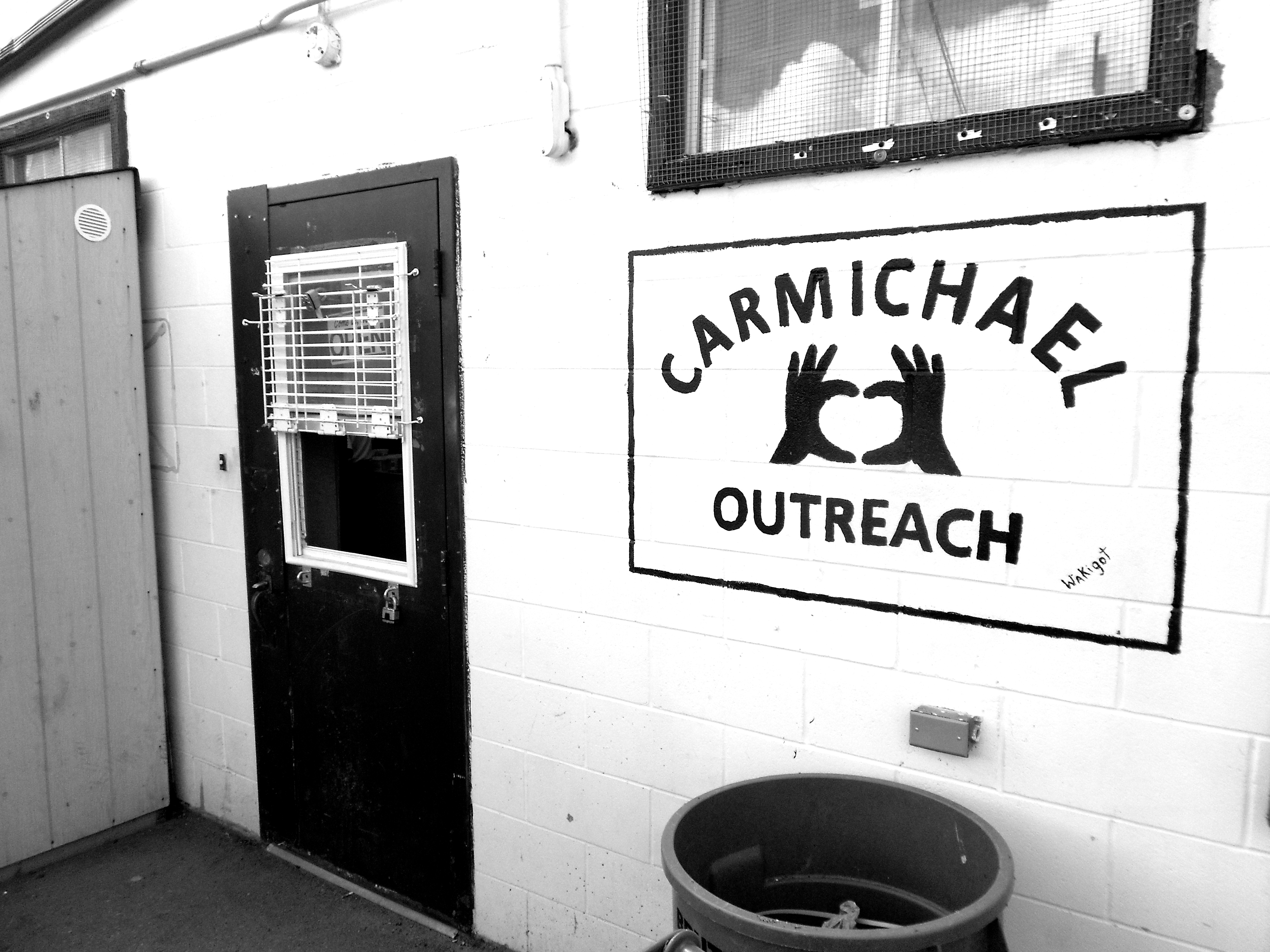
Daily I feed hundreds of people who lack a regular source of healthy food. I attempt to do this with absolutely no ability or knowledge in serving them food that respects their culture, let alone their dietary preference. I serve westernized semi-processed foods out a back window to people verging on physical malnutrition and cultural assimilation. Carmichael Casserole or Spaghetto and Meatsauce sustains their bodies for a while longer and at times it doesn’t even achieve that. I am overwhelmed with how little I know.
Then I read such articles. Things which are 100% relevant to my current position and I begin to reel. If the government or people are not willing to properly reconcile, then I become immaturely overwhelmed as to how to do so out of a 6′ x 6′ kitchen. Leanne Simpson, Indigenous author, writes:
“I wonder how we can reconcile when the majority of Canadians do not understand the historic or contemporary injustice of dispossession and occupation, particularly when the state has expressed its unwillingness to make any adjustments to the unjust relationship….
It reminds me of an abusive relationship where one person is being abused physically, emotionally, spiritually and mentally. She wants out of the relationship, but instead of supporting her, we are all gathered around the abuser, because he wants to ‘reconcile.’ But he doesn’t want to take responsibility. He doesn’t want to change. In fact, all through the process he continues to physically, emotionally, spiritually and mentally abuse his partner. He just wants to say sorry so he can feel less guilty about his behaviour. He just wants to adjust the ways he is abusing; he doesn’t want to stop the abuse.”
I cannot host reconciliation out of a kitchen. And this is because, according to the synopsis of Simpson’s book (see the above link), “reconciliation must be grounded in political resurgence and must support the regeneration of Indigenous languages, oral cultures, and traditions of governance.” I cannot catalyze reconciliation because I do not really understand the historic or contemporary injustice of occupation. And that is what gets me. Reconciliation is not done solo out of a grimy kitchen. It is done through processes which may have nothing to do with me and steps which I cannot control, but processes and steps in which I can participate in some way. Processes which I can learn about to potentially approach a climate that is fair for future reconciliation.
The fact that I cannot adequately express my intentions with the word Indian demonstrates my obvious inability to help promote and preserve a culture that is not mine through an ill-prepared nutrition program and sloppy meals. The infinite nature of my naiveté and glaring inability is burning me out. They make me want to run away to the land of the Not-Red Indian in a fit of hedonistic, selfish admission of my lack of knowledge. My lack of commitment. My lack of connection to the issue, which is maybe the worst part—that I could get on a plane and forget about hundreds of years of colonialism and assimilation, because I can.
I am here to stick around for as long as I can before my brain explodes and I find myself crying in some colonially-cultivated blossoming organic flax field, because I do not want to “adjust the ways” we have been abusing, rather I want to stop the abuse. One of the only ways to do this is participation, knowledge, and handing out egg salad sandwiches to two-hundred people a day.
Or at least that’s what I’m going to tell myself so I don’t drown in egg salad.








 Balls of Rice