Author: Nic Olson

  • How to Succeed in Business

    I was born a businessman, and I will die a rich businessman. The quality of the product is of no consequence, a good businessman sells anything. He sells everything. He must exude self-esteem and confidence in astronomical quantities, as I do, and he must know, deep in his loins, that Sales is where he was born to be.

    In marketing school called Life, they teach you that the purpose of any human being, whether it is a businessman, a writer, a male trying to copulate with a female at the bar, a musician, an engineer applying for a new job, a child at their first day of school, a vacuum salesman, or a female call girl trying to turn a trick, is to sell themselves. If a human being is unable to sell themselves, they will have no success in selling a product, even if it is free food to a starving man.

    It is always the fault of the businessman if his client prefers the product that is free or cheaper. If he can be swindled out of his product through lack of initiative or timidity or shame, even if the product is a book that he wrote himself and purchased himself, then he will inevitably fail. It is the duty of the businessman to convince the public that the product they want is great, simply because they want it, and simply because of its name and its heritage. And for this, they will pay top dollar.

    Any good businessman is not in business for the money or perks or fame. They are in it to promote products and lifestyles that they fully indorse, but even more importantly, they are in it to promote the art of Sales, the truly fine, integrity-filled and honest art that it is. They are in it to enrich the lives of their clients.

    I am a businessman. I am currently in the business of selling literature, written by me. I am trying to sell myself, because I’ve been giving away the product in equal ratio to selling it, which as we all know from the short six-step process listed below, is the key to success in business.

    A simple guide of how to be a successful businessman.

    1. Create a product.

    2. Be ashamed of the product.

    3. Don’t feel comfortable selling the product.

    4. Give the product away.

    5. Pay your credit card off several weeks later with your own money you earned working your part-time job.

    6. Repeat.

    Following this procedure will ensure Apple-like profits.

    This businessman now posts the following job opportunities:
    Literary Agent. Duties include selling my book and convincing me not to quit writing, unless you actually think that I should. Wage is 10% of sales.
    Full-Time Editor. Duties include screening my writing and telling me what is a dud and what is less of a dud. Wage is first position on my ‘Thank You List’ for book number two.

    I take resumes by email and spontaneous interviews if you broach the subject.

    Please consider your involvement with the future of business with some of the greatest business minds in the world: the Balls of Rice Team.

    Thank you.

  • Lyric of the Month: February 2012

    Why do I daydream?
    Oh why do I get my hopes up at all?
    I’ve been living this Walter Mitty life for too long
    Somebody save me
    I’m a prisoner of my own fears

    Sometimes fantasy is the only problem I bear
    My mind is a dream filled balloon
    Dripping dreams into my shoes
    And I’m too afraid to move
    To face the real world
    And when I fall, I fall down hard
    When will I ever learn?
    Don’t take your dreams to heart
    You’ll only wind up getting burned

    Well maybe I’m lazy
    But circumstances always knock me down
    So I’ll just lie here
    Never get up, off the ground
    Well maybe it’s crazy
    To sit and think of all the things I want to do
    What’s the use of dreaming
    When dreams never come true?

    And when I fall I fall down hard
    When will I ever learn?
    Don’t take your dreams to heart
    You’ll only wind up getting burned

    Why do I daydream?
    Why do I daydream?
    Why do I bother?
    WHY?

    Why do I daydream? (Time to get up off your ass)
    Why do I daydream? (Pull your head up take a chance)
    Why do I bother? (Grab whatever you can grab)
    WHY? (There’s no such thing)

    It’s time to get up off your ass
    Pull your head up take a chance
    Grab whatever you can grab
    There’s no such thing

    It’s time to get up off your ass
    Pull your head up take a chance
    Grab whatever you can grab
    There’s no such thing

    It’s time to get up off your ass
    Pull your head up take a chance
    Grab whatever you can grab
    There’s no such thing
    No such thing

    -Descendents, Dreams

  • The Problem with My Character(s)

    I’ve been writing a story. Supposedly a short story, it has taken me nearly seven months to form, from the first conception of the idea, to the actual act of sitting down and forming a plot, to the position I am in as of late of considering destroying it and starting from scratch, to the hopeful eventual position of fine-tuning and completing the roughest draft of all. There were three or four times when I thought I had it. I thought I had come up with a clever end to a strong plot with a well-rounded character, but after a week-long break from the 4,000 words, I decided it was actually a flop. A flop that I am not willing to abandon because it has taken me seven months to create. I still had faith in the idea, something I thought was unlike anything ever told, but my ability to form this with a style or even an air of storytelling was about as impossible as the plot of the story itself.

    So, like the good writer I am, and like the good-cripple-with-hundreds-of-hours-at-my-disposal that I am, instead of working on the story, I am here, working on a very early excuse for why the story didn’t work.

    In watching well crafted television or movies, or especially reading books by classic authors such as Vonnegut or Tolstoy or Camus or anyone else reputable, I wonder at how some people can design characters so intelligently that they seem more real than myself. A way of describing a mind, an organized mind or otherwise, so that the reader becomes part of it to the point of it affecting their thoughts throughout the rest of the day is an uncanny attention to detail and contemplation that I can only dream of having. The way to create a character in a script so that you remember that certain characters only say certain things, and that dialogue is important in that there are two or more characters with two or more completely different personalities, is, as I’ve discovered as the ultimate rookie of fiction, impossibly difficult.

    In Forewords and Afterwords of the short list Tolstoy books I’ve read, the translator gives insight into Tolstoy’s journals and thoughts during and after his writings. They are decidedly negative in all aspects, and seem to mirror those of my own. An inability for contentedness with a piece, or a very fast turnover rate between satisfaction and disappointment. The fact that he thought the same things brings me hope. The fact that I know I will never write anything anywhere near the level of even B-authors, let alone the classic minds of literature, takes away most of that same hope.

    My works always branch out of a single phrase or idea, never of a plot that jumps or a character that erupts. I am an idea man, pretending to write stories. The only thing easier to see through than my one-dimensional stories are my one-dimensional blogs about those stories.

    And as a character is simply a reincarnation of the author that created him, I have discovered the reason for my inability to create a character with a soul, a character with a personality, or interesting thoughts, or dialogue that is in any way captivating. It is because I lack these things. That my life isn’t interesting enough to create interesting characters, and because of this, they are all flat, emotionless robots. That even though I can get attacked in foreign countries, and break my legs in skateboarding, and tackle shoplifters while in a cast on my first day back at work, I can’t use the semi-interesting events of my uninteresting life to write a story or create anything of worth. Because I am always lost in bigger ideas that aren’t worth much. I am lost in a pixelized, boxed-up version of the world where I disallow the truly interesting.

    The problem with my characters is my character. The problem with my ideas is my brain.

  • PostPostSecondary: 3

    Assignment 3: Choose an object. Use the object to develop a character. Use the character to develop a story. The object must change hands in the story.

    Snooz

    The items were spread across a sheet of plywood that balanced on two wooden sawhorses. Other items were beside this makeshift table in cardboard boxes and on end tables and TV trays. Some of the larger items were just placed along the edge of the driveway, the taller items standing in the trimmed green grass, the shorter heavier items like dumbbells and car parts rested on the concrete slab itself. Rick sat on a lawn chair near the opened garage, dutifully writing numbers on tiny circular yellow stickers that he was placing on each and every object on his driveway and in his garage. The most expensive item, a Honda GL 400 motorcycle was going for $1800, it needed some work. Rick had placed a yellow sticker on its leather seat. The least expensive items included a spool of brake cable for pedal bikes, pink and green wicker baskets used for Easter egg hunts and decorations, a black plastic cassette tape rack, and other objects that the regular observer, including Rick, couldn’t be sure what they were for. These items were in a box labelled, “Free” on which Rick did not put any yellow stickers, to avoid confusion with the garage-sailers, the dumb load of cheapskates, he thought.

    On the plywood table were other artifacts that at one time had been the most useful items in Rick’s home but with renovations and time, had rendered them pointless, at least to Rick and his wife. Doorknobs, light switches, toothbrush holders, steel-toe work boots. Rick had priced all these fairly, he thought, with numbers that screamed, “Get rid of me but at least leave my former owner with something to remember me by.” Rick came upon his alarm clock radio, the size of a large box of chocolates, and considered its prospective price. For nearly twenty years that alarm clock woke Rick up at 6:15am every morning even if the power went out, thanks to the nine-volt battery inserted in the bottom. This clock electrified Rick to to start his routine, which was unchanged for almost as long as he owned the clock. He would eat breakfast—Corn Flakes, an apple and a cup of black coffee—flip through the Obits section of the newspaper, listen to talk radio for weather reports and then head to the city garage where he would pick up a city bus and drive his route, Route 18-Greenwood Village, until 4pm when he headed home again. Now, in his first two weeks of retirement, the alarm clock seemed nonessential since he had formed the habit of waking up every morning at 6:14 in anticipation of the breathy squeals of the alarm. He could buy a new one if he ever had a reason to wake up before then, he thought. Canadian Tire was bound to have one on sale. Ever since Canadian Tire introduced their own form of paper currency, Rick had never shopped anywhere else. His XL plaid shirts and size 36 blue jeans came from Canadian Tire, as did his socks and underwear, his toilet paper, toiletries and cleaning supplies, his car care and household items, and when Canadian Tire offered, modest food items and condiments.

    Also in the garage sale were some of Rick’s wife’s items. There was a box of folded tea towels with prints of smiling ducks and pioneer children on them, fifty-cents each. There was a wire magazine rack, wrapped completely by thin plastic cord, which was fraying and unravelling, for one dollar. She also had a stack of books, each for twenty-five cents, which included quite a selection of James Patterson paperbacks, a few assorted romance novels, one or two by Steinbeck and one by Vonnegut. The Vonnegut was a gift from her daughter, already read and scored, but unread by Rick or his wife. The Vonnegut novel sat at the bottom of the pile of books which sat on top of one of two octagonal particle board end-tables, the set on sale for ten dollars. Inside, on a dog-eared page, these words, which Rick or his wife would never read since they would sell the book to a young lady later that day, were underlined with red pen:

    “In time, almost all men and women will become worthless as producers of goods, food, services, and more machines, as sources of practical ideas in the areas of economics, engineering, and probably medicine, too. So—if we can’t find reasons and methods for treasuring human beings because they are human beings, then we might as well, as has so often been suggested, rub them out. Poverty is a relatively mild disease for even a very flimsy American soul, but uselessness will kill strong and weak souls alike, and kill every time. We must find a cure.”

    At fifty-eight, Rick was bald and likely weighed about thirty pounds more than he had throughout most of his life. In his last few months before retirement he had noticed this increase in weight and attributed it to his wife baking more often to accommodate the increased amount of time that Rick spent at home. The more time he spent at home, the more jam-jams and snickerdoodles he ate, the more he felt like a burden. Rick was structured and reliable. Routine looked to Rick to see if it was running properly. Now without work to attend to, without his regular regimen, Rick was beginning to suffocate in his uselessness. He sat on the couch in the mornings, from 7:15 to 9:00, looking out the front window while his wife baked more than the two of them could eat in a year, and he cursed time. He had asked his wife how she had passed the last forty years as a housewife without going insane. She asked how he knew she hadn’t gone insane. By the first Monday afternoon of his retirement he had run out of things to do. His yard was pristine, his house had no real issues. He spent six hours fixing the air conditioner, something that he had never attempted before but committed to the project since he was now retired. The eavestroughs were clean, the compost was stirred, the gutters were swept, the garden was weeded. So, to pass some time, he decided to host a garage sale.

    He priced the alarm clock at four dollars, and next to the cost he placed another yellow sticker that read, “Still works!”

    #

    Sam stepped out of her Pontiac Sunfire, placed her foot on a steel sewer grate that was clogged with leaves and paper coffee cups. She saw to the bottom of the sewer, brown water and sludge and shiny garbage was swallowed by the sewer, something that she never really noticed, but was thankful for, otherwise she would be standing in a puddle of muck. She headed towards the driveway that had the small red sign posted at the end, accented with a bunch of balloons that clumsily bumped each other in the wind. It was a garage sale, and she was a garage sailer, perusing the open seas of peoples’ once useful junk, looking for cheap alternatives to bringing new plastic and cardboard into the world. She had just got a job, the first job that she’d ever had, she realized, where she had to wake up before twelve noon. Almost ten years of bars and bistros and restaurants and clubs and lounges and dives and she had finally decided to somewhat grow up and get an office job. To put her party days to a rest and to settle, save, and become what her father would tell her was ‘a valued member of society.’ Sam was twenty-eight, had shoulder-length envelope-coloured brown hair, a face which resembled that of a chinchilla, and was pudgy but not fat. She was hoping that her new lifestyle, a 9-to-5, would allow her to join a gym and get in shape, make her body a tool or weapon instead of a soft inanimate object.

    It was Sunday and at a party the night before, her last party before starting her data-entry job on Monday, she lost her phone. Her phone had the internet, and Sam had gone the two hours since she woke up without it. She was going through withdrawal. She needed an update from the party last night. She had come to rely heavily on the internet and her phone but never noticed her reliance until she had lost them both. All in one, she had lost her contact list, including the phone number for her new job, her camera, her day planner, her computer, her calculator and her alarm clock. It was the last of these that had caused her to stop at several garage sales on her drive from the mall to pick up new business appropriate clothing. Even if she still had her phone, she needed an alarm clock to wake her up since it had become a subconscious and sometimes even unconscious reaction to touch the phone’s off button anytime it made a sound, either that or every fifteen seconds.

    The man working the garage sale sat against the brick house near the open garage door, writing on stickers and surveying to find items without prices. Sam took inventory. A miniature bag of plastic tooth-flossing picks, hopefully unused she thought, for a quarter. A box of unopened Gillette Mach3 replacement razorblades for a toonie. She was in the bathroom section, an unusual one for a garage sale, but essential items nonetheless. She came upon the plywood table with dishes and plates and household appliances. In the centre was an alarm clock radio priced at four dollars, emphatically announcing that it still functioned.

    “Excuse me, may I plug this in to see if it still works?”

    “Of course you can. Just bring it on over here.”

    Sam grabbed the clock, which was about the size of an encyclopedia. It had a faux-wood finish, sleek angular buttons, brown tuning wheel that protruded off the side. The man plugged it in to the exterior outlet and the clock flashed ’12:00′ in sharp red digits, blinking every second. He flipped the switch from ‘Alarm’ to ‘Radio’ and the crackle of an AM station of talk radio blasted through its mono-speaker. She affirmed that she would take it, browsed the tables again, found a Vonnegut book and a pink porcelain toothbrush holder and gave the man six dollars in change, the total for her three items. Sam thanked the man and walked back to her car.

    Sam knew how difficult it was going to be to transition between jobs and between lifestyles. She stopped her bar tending job on Friday and was slated to wake up at seven in the morning on Monday. Her new alarm clock was her insurance that she make the transition, even if it was guaranteed to be ugly. Without it, she would surely wake up late and continue to be ineffective. She opened the driver-side door and threw her items on the passenger seat of her car. The alarm clock bounced to the floor of the car, landing upside down with the cord caught under the seat. She reached down to grab it, felt something small and plastic under the seat just beside it, and pulled out her cellphone. She breathed in relief, left the alarm clock upside down on the floor, checked her messages and drove away.

  • I am RoboCop

    Just when I thought I couldn’t reach any new levels of pathetic, I went ahead and broke my ankle.
    And just when I thought I couldn’t reach any lower level of hygiene, I went ahead and broke my ankle.

    I thought a lot of things about myself, and many of these changed with a simple pop and an ensuing crack, followed by a blaring use of the word ‘fuck’ and a foot-dangling ride to the hospital. With a lot of morphine, a bit of Senokot-S, some serious moping, and some quality on-my-ass time, I learned that you never know how pathetic you can get, because there is always a place that is even more pathetic than where you are. If that is not positivity, then I obviously don’t know what is. I can’t wait to find out what is next.

    Now I sport a leg akin to that of RoboCop and I still complain, mostly to myself in my head, but sometimes to others via my sour demeanour and disdain for my situation. Trying to think of things to be productive, I remembered an article my dad sent to me a while back, likely hoping for another father-titled blog post, or maybe just to make me feel better about my poverty. But it highlights another human fault, besides weak ankles and negative attitudes. Greed and discontentedness. People in their wealth often don’t appreciate what they’ve got because they aren’t smart enough to notice it. Wealth is a state of mind, it says. I am the example of the opposite—that people in their most lamentable, embarrassing, useless and detestable state, still can’t appreciate what they’ve got. Because I’ve been stowed up in my off-smelling bedroom for a week and I am still sitting here feeling sorry for myself like a child. Pathetic is a state of mind, I say.

    The subtitle to this defect and to this post: The pains of being spoiled.

  • Lyric of the Month: January 2012 – If you’re gonna be dumb, you gotta be tough.

    The day before I broke my ankle at the Heritage Building at Regina’s Exhibition Grounds, I wrote a testimonial as to why I believed the indoor park should receive extra funding.

    Six days before I broke my ankle at the Heritage Building at Regina’s Exhibition Grounds, I broke my skateboard deck. Because I still can’t ollie properly, with my feet on both trucks as I land, the centre of the deck broke like so many of Jeremy’s growing up. Liam went in the back room and pulled out an old skateboard. He didn’t know from where it came. I was fairly confident I had seen the board before: Enjoi deck, orange Tensor trucks with blue wheels. I believed it to be my brother’s. Kris later confirmed. He also confirmed that it was the same board on which he broke his ankle when he was about 23 years old.

    If coincidence existed, this would be a rather wild instance of it. But I prefer to see things as signs. That either I am not supposed to skateboard ever again, or that I was living life a bit too fast, or that I am not supposed to drink for another month, or that this particular deck was cursed by the skateboard gods, or that I need to finish writing a book that is actually good. I have yet to decide which of these I feel is correct.

    They hailed me for taking it well, as if I had broken my leg before, or as if they expected me to be crying and screaming as if I was giving birth to the artificially inseminated child of Dr. Danny Devito (I plan to watch Junior in the next few days). Maybe it was nothing more than a sign of my absolute manliness. We’ll take it as that.

    If your gonna be dumb, you gotta be tough

    When you get knocked down you gotta get back up,
    I ain’t the sharpest knife in the drawer but I know enough, to know,
    If your gonna be dumb, you gotta be tough

    I lit my brain with Rot-Gut whiskey
    ‘Till all my pain was chicken fried
    And I had dudes with badges frisk me
    Teach me how to swallow pride

    I took advice no fool would take
    I got some habits I can’t shake
    I ain’t the sharpest knife in the drawer, but I know enough to know
    If you’re gonna be dumb, you gotta be tough

    If you’re gonna be dumb, you gotta be tough
    When you get knocked down, you gotta get back up
    That’s the way it is in life and love
    If you’re gonna be dumb, you gotta be tough

    I’ve been up and down and down and out
    I’ve been left and right and wrong
    Well I’ve walked the walk and I’ve run my mouth
    I’ve been on the short end for too long

    But if they gave medals for honky tonk wars
    Hell, I’d keep mine in my chest of drawers
    With my IRS bills and divorce papers and all that stuff
    If you’re gonna be dumb, you gotta be tough

    If you’re gonna be dumb, you gotta be tough
    When you get knocked down, you gotta get back up
    I ain’t the sharpest knife in the drawer, but I know enough to know
    If you’re gonna be dumb, you gotta be tough

    If you’re gonna be dumb you gotta be tough

    -Roger Alan Wade, If You’re Gonna Be Dumb

  • PostPostSecondary: 2

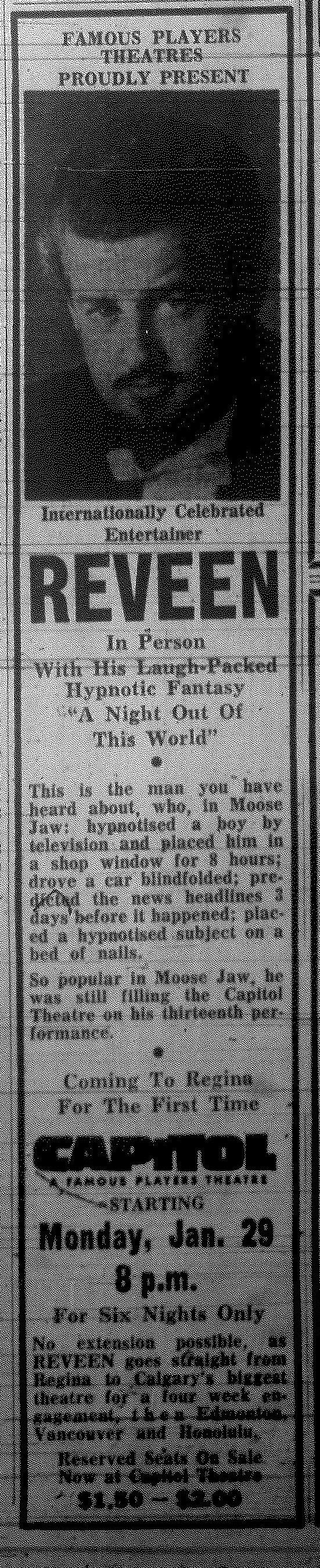
    Assignment 2: take an article, advertisement, or event from a newspaper 50 years ago and develop a short story, telling it subjectively as if it were a family story. 

    Also see the slightly edited version of PostPostSecondary: 1

    Blondy

    “How did what? Birds? What’re you rambling about? You’ve only been here four hours and I’m already tired of your questions. What’d you want to hear? You mean, you want to know why your mother is afraid of birds? How the hell should I know?

    Well, if it’ll keep you quiet, I could come up with something… I suppose it musta been about forty years ago, the way she’d tell the story. I remember that act. Christ be damned, that old hypnotist, I can’t remember his name for the life of me. Anyhow, he was an oaf. No better than a sideshow. Shoulda been caged up next to a gorilla or bearded lady. The folks there believed what they wanted to believe, and hypnotized themselves. You don’t need another man to do it for you, if you sit quietly long enough, you’ll convince yourself that you want to lay on a bed of nails or bark like a cotton-pickin’ dog.

    What’s that? Oh, right, the story. Well, your mother musta been your age, about ten-years old, when that two-bit gypsy rolled on through. Reveen, his name mighta been, come to think of it. She saw the write-up in the Post and saw the bills all over lamp posts in town. His grubby moustache and goddamn bow-tie—he was dressed like a snake-oil salesman, and I guess it makes sense, ‘cause that is exactly what he was. Her brother, your uncle Ernest, was courting some dame at the time, and they both decided that they wanted to go see this quack too. Your grandmother got it in her head that it might be a nice family function for us to attend, as long as the ladies from the church didn’t hear that we were going, but I still opposed. I held off as long as I could—the show was in Regina for only six days, said the write-up, although it was in Moose Jaw for nearly two weeks. Supposed to be heading off to Honolulu or some damn thing. I eventually gave in when your mother told me that she heard that the man had made an 8-year-old drive a car blindfolded in Moose Jaw, which somewhat sparked my interest. Thought he might get arrested at least. So I went and took $7.50 out of the tin tea box in the compartment beneath the floor boards, to take them all to this crock-show in downtown Regina. We took the old Crestliner to the theatre, which, if I remember correctly, was on 12th and Scarth. Well, no, maybe it was Hamilton. Helen, where was that old Capitol Theatre, back when we lived on Coventry there? Scarth? Yes, it was Scarth wasn’t it.

    Well, we got there and your mother was so excited that her eyes were big like the moon. She had never been in Capitol Theatre before, and I hadn’t been there since I was courting your grandmother. We took our seats, high up in the back where one could barely make out the moustache on that rat-face swindler.

    So this fellow got ahold of some of the audience. They were planted there by the theatre boosters, no doubt. They got on stage and acted like chickens or sang songs like that shameless Elvis Presley. Eventually it got to a point where he was picking from the audience in the back of the theatre. His eyes kept creeping closer to our corner, and your mother was standing on my knee, waving her hand in the air like the damn thing was on fire. Then he had these assistants, in these flashy tight dresses… I mean, this man claimed to be a man of science, that he wasn’t a magician, that he was a genius of the mind, but he had these ladies running around in cocktail dresses, goddammit… Anywhow, they chose your mother, and she went up on stage, ready to believe anything this man told her. Ready to jump off a bridge, or at least pretend to. He put his hands on her temples, rubbed them softly, told her to close her eyes, chanted some voodoo, and he told her that she would wake up and there would be a thousand pigeons flying around the theatre. She opened her eyes and they were blank as a brick wall, staring straight forward. She pointed out towards the back of the audience, where me and your grandmother and uncle were sitting, and her finger led her arm around like it was following a single bird flying in the theatre. The invisible pigeon eventually reached the stage, and she ducked and swatted and screamed and swung her chair around her head. It was the most enjoyed part of the night by most of the crowd, but your grandmother didn’t much like it.

    The show ended up staying in Regina for ten more nights, goddammit. People flocked to the theatre as if he were the second coming of Christ Almighty.

    That is how your mother would tell you the story, anyway. She still thinks that this caused her fear of birds, that it somehow planted a real fear in her head, or some foolishness. I don’t believe in that sort of nonsense, myself, but I do believe that she convinced herself that it was happening. This Reveen fellow was merely an idol that took away from what the audience really believed in, which was the power of their own damned brains.

    I believe that your mother became afraid of birds when she was six. Her cat had caught a robin in the backyard, broken its wing and left it to die. Your mother went up to it, convinced that she could nurse it back to health, then keep it as a pet. When she bent down in front of it, the cotton pickin’ thing started flapping around as if it were demon-possessed, and scared your mother half to death. She fell right on her backside and cried for a few hours. Right on her ass!”

    Calvin coughed out a laugh and his granddaughter Megan dropped a crumb of bread in the cage of the white cockatoo stationed on a card-table in the corner of the living room. Megan kept repeating the bird’s name, Blondy, with her nose close to the cage, in hopes that it would someday be able to say its own name. She was sure that it was possible if she really believed.

  • Outing Myself

    I fell asleep in the library yesterday. Head down. Computer on, sipping away at its battery. Grease-stained construction hoodie on my back. Ripped up winter mitts on the table. A sleeping cliche.

    I am slowly embracing the life of a writer. Either that or the life of someone homeless, and let us be honest, if I pursue this path much further, I will inevitably end up homeless and friendless, sleeping in the library or in a McDonalds on a daily basis. I mean, I haven’t felt like I’ve really had a home for a few years, and I am thinking that this is something I like. If owning things makes a home, then I hope to never have what would be considered an extravagant or even decent home. I have felt like I was at home in any of the past thirty stops I’ve made in the past eight months, save for the two times I got attacked in Mexico. Feeling at home is a large part of having a home.

    I am trying to treat writing as a second job, committing to several hours in a week locked in one of two basements that lack internet connection or outside sound. If, at this point, I treated it as a hobby (which it is), it would be about as successful as my hobby of sewing, or yoga, or tennis, or showering. I would basically consider it as something I once did but have become to busy to continue. That is what a hobby is.

    It has taken me to the point of writing a book, albeit a rather clumsy one, to be able to admit that I write. I mean, it is embarrassing. If you are a musician you play shows and your success and progress is tangible, it resonates with people far greater than any piece of writing, regardless of quality. If you are a writer, you sit at your computer alone for hours at a time, and when you are promoting it, you are quietly plugging your blog on social networking sites, counting until your hits reach triple digits and you can celebrate by drinking a single bottle of beer. In the past, I would often defer to telling people that I spent my Saturday night reading a book, as if I felt I needed an excuse to stay home on a weekend and the excuse of reading was any less embarrassing than writing. It at least seemed more acceptable. It has taken me the five year process of writing and self-publishing a book to finally be comfortable enough to (attempt to) join a creative writing class. To share new works with longtime friends, or to even tell longtime friends that I do write. It has taken me to write a book (of which I am proud of but not satisfied) to freely admit my joy in writing. My shame level is high. Sleeping in the library seems to somehow lower it.

    And I feel free that I can finally admit that I do it, and that I enjoy it. That it is a hobby, if not a passion, and that although it is one of the most difficult things I’ve ever done and that every word is exhausting to spew out, and every story frustrates me to the point of never writing another sentence again, that it is one of the more enjoyable things I can think of doing.

    To Call Them To Wander is the doorknob to my writer’s-shame closet.

  • PostPostSecondary: 1 (Edited)

    Although fate/the admissions department did not permit me to enrol in English 252 at the University of Regina, I haven’t lost all hope. I still have the desire to practice writing, to try new methods and styles, and to walk through the same exercises as those students who are lucky enough to pay $700. Since I no longer have a group of peers to ‘workshop’ my writing, I thought that I would use this forum to present my works and encourage readers to workshop with me through comments, criticisms, and suggestions, while I try my best to keep up with university due dates. Preceding each post I may explain the exercise to clarify what exactly I am doing. But I may not. Thank you for bearing with me and my childish dream to become decent at something.

    Assignment 1 put simply: describe the photo below in a prose-paragraph. A mini-plot is permitted. Use imagery.

    Please take a seat. He sits square to the stool, causing his shoulders to push up like a wooden frame. His neck ducks under his dusty wool jacket, drawing in to hide from the blade of punishment. Under a swelled coat he hides his his long-known theft. It professes extravagance with a wide lapel and heavy fur collar, but mirrors destitution—too large, with dust and holes. He has seen, stolen his share and his face shows that his mind hasn’t let him forget it. His body, however, still holds, unwavering. Hands higher, please. In reverence, his hands are clasped. Wrists shackled like his ankles, yet the chains are concealed by the coat’s deep cuffs. It wasn’t I who imprisoned him. It was those hands. Still limber. Unfocused. Chin down. Through the viewfinder his chin and lips seem to become bald and the sides of his face become bushier, scruffier—the winter coat of a wolf. A glance at the frame suggests anger and hatred, as his tough/tucked upper lip represses appeals to my human goodness. A longer look. His right eye pleads, although content. His left eye loathes in the shadow of his angled eyebrows that pray to God. There is a modesty there, a humility, but I cannot tell if it is natural or inflicted. There is wisdom when one reaches the depths. Now look at the camera. 3, 2, 1. Flash. Snap. Next.

    Photograph of John Roman. Photographer unknown.
    Collection: Tyne and Wear Archives and Museums, “Prisoners 1871-1873”

  • The Wounds of Home

    The following will be released in the first edition of Rise Up, a free street newspaper available in Regina, Saskatchewan in January 2012.

    Of the past five years that I have been free from the confines of high school education, I have spent approximately two-thirds of my time away from my hometown of Regina, Saskatchewan, the motherly city that always welcomes me back. I have been fortunate enough to be one of the few people in the world that has the means to save money to travel. To see the street food stands of Korea, to ride the blue trains of India, to watch soccer games in Mexico. I have also been lucky enough to have a home and a family to which I can return after such adventures, and friends that give me employment and rooms to rent so that I can save up more money to further travel and again leave the tender arms of my fair home.

    As is inevitable with any sort of travel, third-world or not, one sees the absolute contrast between the excessiveness of wealth and the inadequacies of poverty. The gap between the wealthy and the poor classes in India is obvious on any city street, but not openly discussed or even talked about as something that has the potential to change. Living in a poorer area of Montreal for a year and a half, one can see the difficulty for small immigrant families and local residents to function in a large city setting. Travelling throughout America by bus, one sees the neighbourhoods that house Greyhound bus stations in giant cities, places falling apart because of several years of recession. Staying in homes and hostels in Mexico, the country is obviously exhausted of a system that allows the rest of North America to take advantage of it for its natural beauty and drug-trafficking, leaving a tourist-pillaged people and nation. After two years away, I never expected to return to Regina, my place of privilege and opportunity, to see a housing situation equally as grave as any of the metropolises in North America. A vacancy rate of below zero that is not improving, and the lack of vision for affordable housing are crises deemed less urgent in comparison to other places, possibly due to a lower population of the city and province, but are no less serious. In one of the few places in the world that was not seriously damaged by the past several years of economic decline, we see misplaced development into more shopping complexes and chain restaurants with little development of necessary infrastructure. The present wealth of our province should eradicate homelessness, just as the wealth of our nation and other Western nations should guarantee fair and equal food and wealth distribution worldwide. The key word being should. Because of a flawed system of bureaucracy, and insatiable, power-hungry leaders, suburban centres pop up overnight while city centres further dilapidate.

    Supporting organizations such as the Carmichael Outreach and Souls Harbour, and by talking with City Council members, MLAs and MPs, the privileged public can communicate that these are not just issues of the poor in certain neighbourhoods, but that they are issues that involve any member of Regina, a city that is in essence one large community. It is not enough to say that we disagree with poverty, any person with the semblance of a soul would say this, but it is necessary to communicate that we aren’t content to sit around as a resource-rich government ignores the immense need for affordable housing, improved schools and better family and child care.

    If I were ever to designate a place to call home, Regina would likely be it. And although I haven’t been directly hit by the housing crisis in Regina, as I couchsurf and rent out basements of friends who have grown tired of a saturated rental market and overpriced shack-like apartments, it still feels like a member of my family is being abused and neglected. Like my grandpa is the Plains Hotel being kicked out of his downtown home so that Brad Wall and Pat Fiacco can continue the gentrification of Regina by selling the land to oil-rich Calgary investors, building condominiums for a large unknown population of upperclass businessmen that want to inhabit the modest capital city. Then, when my grandfather begins to look for a new place to live, he finds that even though the government has enough of a surplus to kick him out and build a $100-million condo/hotel, they don’t have enough surplus to give him an affordable, or even available, apartment to rent to rest his ‘Plains’ aging bones. This place that I would designate as ‘home’ is fighting through a housing crisis, and although it may not seem as severe as the one facing the inhabitants of India, or as widespread as the decay of cities across America, it cannot be overlooked. And as my motherly home of Regina aches for help, she can at least take solace in the fact that although her serious wounds are generally still untreated, they are starting to be talked about.

    Please contact your city councillor, MLA and MP at the links below to tell them of your concern with the current system.

    City of Regina

    Province of Saskatchewan

    Federal Government of Canada