Category: Books

  • Ukrainian Resistance to Russian Colonialism – Briarpatch Reading List (Extended)

    In the September/October 2025 edition of Briarpatch Magazine, I was able to publish a reading list about Ukrainian Resistance to Russian Colonialism. It is reproduced below with additional works I had to cut for length.

    I also recently became a board member for Briarpatch, so I strongly encourage you to check out their reporting and consider signing up for a subscription.

    In my final class studying international human rights law, I shared my paper analyzing Ukraine’s law on Indigenous people which, while imperfect, protects the territorial and language rights of Crimean Tatars, Karaites and Krymchaks. In the class discussion, a friend and self-proclaimed Marxist wearing a keffiyeh asked if I knew that the Russian language was broadly oppressed in Ukraine. Despite their rightful support for Palestine and correct criticism of colonial governments, they tended to be sympathetic to a different colonial, imperial power by repeating one of Russia’s falsified justifications for engaging in an unprovoked war of aggression.

    Expanding our critiques beyond western colonial empire is important as we struggle to find alternatives to any form of oppressive, centralized power. As fascism balloons in our own backyard, we can learn from Ukrainian people actively resisting a fascist authoritarian state. And as we try to comprehend how to dismantle an empire here, we can well be reminded that the problem isn’t one empire or another; rather, the problem is empire itself. As one empire coerces Ukraine into a minerals deal, another empire is currently shooting ballistic missiles at shopping centres in Ukraine. 

    The following resources have helped me understand Ukrainian resistance as removing itself from under the foot of centuries of a colonial power.

    Russian Colonialism 101 (2023)
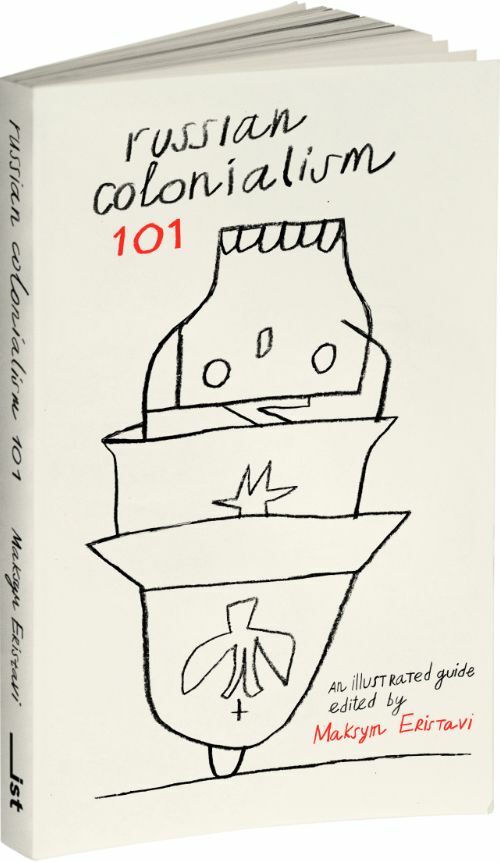
    Until I found the illustrated book, Russian Colonialism 101, by Ukrainian journalist Maksym Eristavi, I hadn’t heard of Russian history explained as colonial power. In the Western anti-colonial, anti-capitalist circles in which I found myself, the Soviet Union was generally either tolerated or praised, with Joseph Stalin’s violent purges considered one of the only dark spots marring this alternative to capitalism. I knew little about its predecessor, the Russian Tsarist Empire, or the current Russian Federation. This guidebook (basically a reading list of its own) explains that the past three iterations of Russian rule – from the Tsars to the Bolsheviks to the Vladimir Putin regime – have employed the same colonial tactics to control and oppress Indigenous nations neighbouring and within Russia’s borders. When Russian prisoners of war are released they are often photographed holding flags for Tsarist Russia, the Union of Soviet Socialist Republics (USSR), and the Russian Federation all at once. The book demonstrates that the current war on Ukraine is far from a singular project of a power-hungry dictator, but an unfortunate feature of Russian colonial statehood.

    Matryoshka of Lies: Ending Empire (2024)

    The Matryoshka of Lies podcast, hosted by Maksym Eristavi and Ukrainska Pravda news outlet dives into lesser-known histories of Russian colonialism. The season-one finale, Ending Empire, touches on Russia’s expansion into Alaska in the late 1700s, where they extended the same policies of coercion and enslavement they used on Indigenous nations of Northern Asia. (Tlingit resistance to this Russian colonialism is best captured by Gord Hill in The 500 Years of Indigenous Resistance Comic Book: Revised and Expanded.) 
    In part, the purpose of the episode and the podcast as a whole is to allow a western audience to better understand Russian colonialism as akin to the genocidal horrors of European colonialism that many North Americans are just starting to grapple with. Similar to many radicals in North America calling for an end to U.S. hegemony and violence through an end of the American Empire, this episode suggests that a “total reset in what is now the Russian Federation” is the only way to end these continuing colonial expansionary tactics.

    A Brief History of a Long War: Ukraine’s Fight Against Russian Domination (2025)

    Policies of food control and forced starvation have long been a genocidal policy of colonial governments, from Canada’s purposeful extermination of Indigenous food sources, to Israel’s current explicit weaponization of food in Gaza. The Holodomor (meaning ‘death by starvation’) occurred in 1932-33 in Ukraine and led to the deaths of upwards of a fifth of all Ukrainians. Soviet policies forced the collectivization of farms, imprisoned or killed people for hiding or ‘stealing’ grain, and instituted restricted travel so Ukrainians could not access other food sources.

    Whereas most narratives of the war start in 2022, or maybe 2014, Mariam Naiem’s graphic novel puts Russia’s war on Ukraine into perspective from the very beginning of Ukrainian nationhood. It unravels the long history of policies meant to extinguish Ukrainian sovereignty movements that threatened Russian control over valuable Ukrainian natural resources: from the Holodomor to policies meant to marginalize the Ukrainian language, to Russia’s invasion once Ukraine shifted into the European sphere of influence. This introduction to the history of the region helps give context to the war by explaining the centuries of Russian empire and Ukrainian resistance.

    Hanna Perekhoda: “The fight for freedom in Ukraine is intimately linked to the global struggle against fascist forces” (2025)

    While the Western left has generally expressed support for Ukraine, in some anti-imperialist circles, dialogue is often immobilized when someone associates Ukraine with NATO, Nazis, or nukes. In this interview, Hanna Perekhoda, a Ukrainian socialist and historian, succinctly addresses some of the most controversial among these stumbling blocks. She explains supposed Russian-language oppression and Russophobia is akin to the anti-white racism rhetoric rising in the West. Perekhoda speaks to Putin’s claim that Ukraine is overrun by Nazis, a propagandist justification for the war hearkening back to Second World War mythology. She acknowledges Ukraine’s far right, noting they have repeatedly proven to be a fringe movement. Given that problems with the far right exist everywhere, she questions whether this justifies a full-scale invasion or a withholding of military support or other aid. She notes that what really risks a rise in fascism is a long-standing war waged by a fascist Russian regime where common Ukrainians are radicalized by years of military occupation and systematic oppression. As Perekhoda makes clear, what is needed is support for Ukrainian lives, autonomy, and resistance.

    Ordinary People Don’t Carry Machine Guns: Thoughts on War (2025)

    Ukrainian author Artem Chapeye gives a contemporary account of what it is like to be on the receiving end of a colonial war of expansion. As a self-proclaimed pacifist, leftist, and feminist, Chapeye joined Ukraine’s military in 2022. After politely admonishing Western anti-imperial leftists for their lack of critique of other powers as compared to their rigorous critique of the American Empire, Chapeye addresses the privilege of pacifism that judges Ukrainian (and other) resistance; anarchist traditions of Ukraine’s historical resistance to empire; navigating the tension of being against the authoritarian dangers of nationalism while fighting for a civic – rather than ethnic – community currently under a nation-state; and the impossible psychological toll of war. Speaking to himself as much as to Western audiences, Chapeye explains Ukrainian resistance as follows: “We can either fight back now, with the losses that necessarily accompany this, or remain the colony of an empire for another hundred years.” His book explains his decision to fight against Russian invasion is not because of a guaranteed win, but because of the moral imperative to fight fascism in all its forms.

    ADDITIONAL WORKS

    Where Russia Ends (film) (2024)

    Makhno: Ukrainian Freedom Fighter (graphic novel) (2022)

    Hey Waitress! – Helen Potrobenko

    Putin’s Trolls – Jessikka Aro (2022)

    Without the State – Emily Channell-Justice

    Five Stalks of Grain (graphic novel) (2022)

  • White Van Privilege

    White Van Privilege

    White Van Privilege follows the life of one white passenger van from conception to death: first roadtrip to final sale.

    White Van Privilege is a collection of poems that considers the views from the front driver’s seat of a 2008 Chevy Express 15-Passenger van, and from standing next to a tent in a homelessness and drug-toxicity crisis made worse by a global pandemic. Turns out, the views are pretty similar.

    All proceeds go towards my law school education with which I will use to rapidly dismantle the drug war and systemic racism, law by law, regulation by regulation. And/or authenticate your last will and testament. Either way.

    Order today and there’s chance you’ll get it before December 25, but I doubt it.

    ballsofrice.bandcamp.com/merch

  • “Lester’s Book” Release Party


    I haven’t written through the Balls of Rice channel very much in the past two years as I’ve been working on other writing projects. These projects have included some of those listed under the Books and Audiobooks tabs of BallsofRice.com, smaller articles and book reviews, and more. If you’re able or interested, please come out to the “Lester’s Book” Release Party on June 4, or order a book from ballsofrice.bandcamp.com to see what I’ve been up to. I feel confident that this is some of my best work to date.

    Thanks for checking in.

    Facebook event here.

    [Art by Alex Murray (atmmurray[at]gmail.com)]

  • Fighting For Space

    The following book review of Travis Lupick‘s book Fighting For Space first appeared in Briarpatch Magazine‘s Prairie Edition, and online.

    In 2002, a group of residents and advocates met at the intersection of Main and Hastings in Vancouver holding a 100-foot-long hypodermic needle made out of a giant cardboard tube, stopping traffic. They were protesting the forced closing of a needle exchange on the corner of Main and Hastings in the Downtown Eastside. Earlier, in 2001, front-line workers had distributed clean needles in a trailer outfitted with washrooms, and ensured those using in bathroom stalls didn’t overdose. Affectionately known as “the Thunder Box,” the trailer became one of North America’s first unsanctioned supervised injection sites.

    These stories are among countless actions detailed in Travis Lupick’s Fighting for Space, which tells of the struggle that led to the implementation of Canada’s first official safe-injection site in Vancouver in 2003. The history of the harm reduction movement is one of direct action and protest – an “act first, ask second” attitude that was the only reasonable response to an outbreak of preventable disease and a crisis of premature deaths. Lupick focuses on the Portland Hotel Society (PHS), the groundbreaking housing non-profit that offered low-barrier housing to the city’s most vulnerable, and the Vancouver Area Network of Drug Users (VANDU), the advocacy group that pushed for accessible health care and decriminalization of drug use. The two worked in tandem, with VANDU often willingly taking the heat for direct actions to protect the more diplomatic and funding-restricted Portland Hotel Society.

    The history of the harm reduction movement is one of direct action and protest – an “act first, ask second” attitude.

    The 1990s saw a dramatic spike in overdose deaths and high rates of HIV diagnoses in Vancouver – not unlike the current fentanyl crisis playing out across Canada. But this time the human cost is much higher, with 2017 being the deadliest year on record for overdose deaths in B.C. The strategies used by advocates on the West Coast, honed over decades of persistent work, can provide guidance for similar struggles being newly waged in neighbouring Prairie provinces like Saskatchewan, where fentanyl has killed over 40 people since 2015.

    While revealing the staggering numbers of diagnoses and deaths is key to understanding the scope of the problem, it is the stories of the people who’ve lived through the harm reduction movement that makes this history real. By telling the accounts of people struggling for dignity against politicians and a public determined to dehumanize them, Lupick reinforces two basic claims of the harm reduction movement: people who use drugs are human, and all people deserve safety and health.

    In one of their first organized meetings, members of the newly formed VANDU agreed that they wanted somewhere safe and healthy to spend time, a space that was free of police harassment. The Portland Hotel Society’s first residence was known as the “Hotel of Last Resort.” Simplifying their message to one of “health and safety” – one that politicians and the public couldn’t reasonably reject – has grounded all of their actions and successes in the harm reduction movement. Lupick concludes the book with an epilogue about a family — Mary, Molly, and Mikel — in a quietly triumphant story of three generations living in the Portland Hotel Society, all experiencing stability in their health and housing.

    Lupick reinforces two basic claims of the harm reduction movement: people who use drugs are human, and all people deserve safety and health.

    Lupick does not deify Vancouver’s advocates or their process – rather, he shows them to be people offering the simple necessities of safety and support, while working toward inclusive public health policy. He demonstrates a proven way to effectively build low-barrier health care and housing systems: through persistent action coupled with advocacy, and building partnerships with sympathetic policy-makers. Without this infrastructure, the number of overdose deaths in B.C. last year would have been much higher.

    The current situation on the Prairies is nearly as dire as the one Vancouver faced in the 1990s. Saskatchewan’s HIVAIDS rates are the highest in the country, and with 79 per cent of the people newly diagnosed as HIV-positive self-identifying as Indigenous, programming must prioritize consultation with Indigenous communities. Meanwhile, harm reduction programs have been heavily stigmatized by a predominantly conservative public and openly scrutinized by political leaders. In 2009, former premier Brad Wall said his government would limit the number of clean needles handed out, despite a Saskatchewan Ministry of Health report proving the success of needle exchange programs. In 2017, The Sask. Party threatened community based organizations with a 10 per cent funding cut that would hit operations deemed not to be “core services,” like needle exchanges. Though the party eventually opted against the funding cut, when harm reduction programs are routinely among the first to be threatened, the work being done by those of the front lines is delegitimized and destabilized.

    When harm reduction programs are routinely among the first to be threatened, the work being done by those of the front lines is delegitimized and destabilized.

    For years, doctors, front-line workers, and advocates in Saskatchewan have been pushing for the province to declare a state of emergency regarding rising HIV rates. But if we continue to wait for a provincial government to take necessary action – especially as two newly elected party leaders wade in slowly, in a province where the health of First Nations people is systematically neglected — it may never happen. Prairie activists and front-line workers struggling through those bureaucracies must instead act upon their values and conscience to build systems of equitable health care and human services, regardless of whether they have been granted permission by the state.

    Nicholas Olson is the author of A Love Hat Relationship, a photobook of collectable prairie hats; and a series of illustrated zines with accompanying audiobook narrations. More can be found at ballsofrice.com. He lives in Treaty 4 Territory.


  • Books of the Year: 2017

    If Beale Street Could Talk – James Baldwin

    “Perhaps, as we say in America, I wanted to find myself. This is an interesting phrase, not current as far as I know in the language of any other people, which certainly does not mean what it says but betrays a nagging suspicion that something has been misplaced. I think now that if I had any intimation that the self I was going to find would turn out to be only the same self from which I had spent so much time in flight, I would have stayed at home.”

    -James Baldwin, Giovanni’s Room

    Postcards from the End of America – Linh Dinh

    Simply put, many Americans have become redundant in an economy rigged to serve the biggest banks and corporations. With no one hiring us and our small businesses bankrupted by the behemoths, many of us are forced to beg, peddle, push or steal, though on a scale that’s minuscule compared to what’s practiced by our ruling thugs. As we shove dented cans of irradiated sardines into our Dollar Store underwear, they rob us of our past, present and future.

    -Linh Dinh, Postcards from the End of America, Lower-Class Upper Manhattan, p180

    All Quiet On The Western Front – Erich Maria Remarque

    The Wind Up Bird Chronicle – Haruki Murakami

    Angels – Denis Johnson

    This Accident of Being Lost – Leanne Simpson

    Requiem for the American Dream – Noam Chomsky

    The Lathe of Heaven – Ursula K. Le Guin

    Going to Meet the Man – James Baldwin

    Other Works of Note
    A Love Hat Relationship
    Book One
    Tour Book

  • Books for People Without Homes

    “You in that house yet?”

    “Which one?”

    “The one they were gonna work on.”

    “Oh yeah, I’m in there. They’re not working on it yet.”

    Click the computer a few times. Library worker stocks books. The Dewey Decimal System leaves no book without a home. They don’t lose books. Have you ever heard of a library losing a book? The man behind me mumbles, “Fuck sakes.”

    “Yeah, I was gonna look into that Phoenix Group.”

    “Oh, yeah.”

    “Yeah, but I’d be 80th on the wait list.”

    “You been to SWAP? I had a few buddies who went through Souls who went there. They didn’t even have to go to Social. SWAP did it all for them.”

    “No where’s it? Albert? Like by the McDonalds? Ok. No, Detox told me that Phoenix would do all the Social Assistance stuff for you, you wouldn’t even have to talk to them, which is good, since Social is so useless nowadays. But then you’re 80th on the waitlist.” 

    Spend fifteen hours in two days clicking the mouse around white farmer caps, calling people on farms asking if they are willing to be in a book about hats. Write short blurbs about hats and how they relate to institutional racism and amoral government. Brainstorm where you can donate the theoretical money from selling unsellable hat books to help alleviate the housing crisis. Remember that making books doesn’t house people and raising awareness is masturbation.

    “Fuck sakes,” the man behind me mumbles. Can’t find a house. Housing with obstacles. Maybe there’s a book about that. Filed under the Dewey Decimal System:

    How To Find an Apartment When The World Hates You and Denies Your Existence.
    821.2219 HARPAUER

    A Complete Guide to Budgeting for People Whose Rent is $400 More Than Their Cheque.
    821.2218 FOUGERE

    LOVE YOURSELF: Family Self-Esteem When The State Doesn’t Think Your Uncle Deserves A Funeral
    821.2217 BEAUDRY-MILLER


  • Up-and-Coming

    Three blocks from the venue, down an industrial street in Denver like that in any North American city that boomed in the 1950s, was a small store inside of repurposed shipping containers that sold US-made backpacks, outerwear, and slacks. The store was clean and simple and catered to the young outdoorsy types who live inside but are able to sleep in tents in exotic locations outside.

    “We were one of the first businesses in this part of town,” said the shopkeeper sitting bored behind a handmade counter, hair messily gathered in a bun on the top of her head like she had just crawled out of a tent in the Rockies that surrounded her city. “Since then all sorts of businesses have opened here, which is too bad, it used to be a cheap part of town. Now there’s a luxury hotel going up just up Larimer.” The woman expresses her displeasure just as I would. I agreed as I tried on a pair of outerwear pants behind the changing curtain. Their shop and brand are participating in making the neighbourhood more expensive by selling $150USD pants, but they are at least trying to create a manufacturing industry by making their products in the USA. I left without buying pants, wondering where the nearest goodwill was.

    The next day, the venue was plopped in the same part of town, only in a city that was 500 miles away, a state and a half to the east. After load-in and soundcheck, the soundman asked “Where’d you go for food? The burrito place? How was it? I heard it wasn’t that good. Yeah, this was the part of town no one would come, until my boss opened this bar and the other one, we started booking shows here, and then other businesses started coming too. It was kinda the bad part of town, now it’s the up-and-coming part of town.” At the expensive coffee joint across from the bar arcade, next to the burrito place, they were giving out a free, one-page newspaper/zine/leaflet. In it read,

    “Most American cities are run by real estate interests… In Omaha, the tactic for encouraging gentrification is Tax Increment Financing or TIF. TIF is a way for cities to return tax money to developers as an incentive to put up projects that the city wants (and the public makes up the difference). Unfortunately, no provision is made for the people who used to live in the cheap housing turned into gentrified apartments. The former residents are simply scattered to the four winds. Surprised by ‘shots fired’ near 108th and Maple? This is your City gentrification policy in action.”

    A similar but more developed street newspaper in Seattle uses the G-word, gentrification, describing places like Africatown in Seattle being dismembered, breaking up the “home and haven for Seattle’s Black families and businesses”, and highlighting stories of people failing to maintain housing in a rapid-rehousing program because of the recent inflation in costs of rent. Large newspapers will only use the G-word when describing vandals in Montreal or Vancouver who are terrorizing business owners, as business is the uncriticizable holy grail of progress.

    I am fortunate to be able to tour with world-class musicians, but each time I’m on the road I wonder how long such jobs will exist. How long will I be paid to burn fuel and watch music in ‘up-and-coming’ parts of American cities, while around the block, that neighbourhood’s previous inhabitants are clamouring to find shelter under a bridge or in a condemned building. I do it because there’s something in music and creation that is able to be unpolluted by corporate greed, though most times it has already been bought and sold.

    When people ask what I got to see this trip, Linh Dinh answers for me in his book, Postcards from the End of America, in which he visits communities across the United States left with little or no economy:

    You can’t really see a city or town from a motorized anything, so if you claim to have driven through Los Angeles, for example, you haven’t seen it. The speed and protection of a car prevents you from being anywhere except inside your car, with what’s outside rushing by so fast that each face, tree, and building is rudely dismissed by the next, next and next…Like television, the private automobile was invented to wean us off our own humanity. From each, we’ve learned how to amp up our impatience and indifference towards everything, and with life itself.


    After tour ends I fly home to an ailing Saskatchewan. I’d heard of the government cuts while in San Francisco, when a friend texted saying WHAT. THE. FUCK. with a link to an article about the shutting down of the province-owned small town transportation and parcel shipping company. Now home, walking through the downtown, worried citizens are passing colourful clipboards around, asking passers-by to sign one of the multitudes of petitions that are circulating to Save Our Libraries, Save our Bus System, Save our Schools. I sign them all, knowing full well that no petition will be worth the millions of dollars that the government squandered on stadiums and tax cuts on resource extraction companies. The angry protests and province-wide campaigns might get them to preserve something, but the effectiveness of these actions will only go so far if we continue to work within the system that props up corporate interest over that of the public. Though it plays into the hands of the fearmongering government and high income class, one can see why smashing windows in Montreal seems more effective.

    Government MLAs show their responsibility, boasting their 3.5% paycuts, which to them means 3.5% less income to spend on boats and cottages and home renos and filet mignon. The paycuts they make to those on social assistance, the paycuts they make to those once employed by the rural transportation system, the cuts they make to the libraries, all mean that thousands of low income individuals won’t have food, shelter, a way to travel for medical treatment, books, and significantly more.

    Several years ago, after seeing Chris Hedges speak at the University, I worried that Saskatchewan was the next sacrifice zone—the places that are abandoned by industry, left in disrepair and a humiliating culture of dependency after being used and left behind because of their lack of monetary worth. This could be the beginning of that reality.

    It starts with the desperate government selling its struggling assets to the highest bidder, then selling its most profitable assets. They begin begging oil companies to relocate to the province to help the crumbling economy, start giving public land to large corporate bidders. At this point, entire cities and provinces will be bloated with corporate-controlled land and buildings, and towns end up, in a way, like the middle-class urban centres of post-manufacturing North American cities, where no one can afford to pay rent. Eventually, when the government isn’t coddling big business enough, they’ll pack up and move to find a different government who will subsidize their existence. Thirty years later, when our industries have died and all that’s left is cheap bars and empty buildings, businesses that pander to middle class tastes will further move into parts of town with abandoned buildings and cheap rent and begin the process of displacement of those marginalized by the loss of industry, struggling to survive in the older neighbourhoods. We are no better than the economic destruction seen in the United States, we are just a generation behind.

    All that will help in the midst of a breakdown of free, communal places of existence and of the breakdown of social programs, is the creation and maintaining of communities that support one another and support the other, the different communities who are similarly affected. I am the middle class that is being pandered to, and while being in these places, eating their burritos, buying their pants, is not inherently bad, it makes it all the more imperative to support and participate in the communities that are contrary to austerity. These communities—social groups, churches, activist collectives, sports teams, artist groups, musicians—must band together to build movements that support the racialized, marginalized, the poor, Indigenous, immigrant communities, who are most harshly affected by public cuts and an economy sucked dry.

    Linh Dinh, states the obvious:

    For any community to be healthy, local initiatives must be encouraged, nurtured and protected, so let’s reclaim our home turf, reestablish the common, and, in the process, regain our collective sanity and dignity.

  • Books of the Year: 2016

    img_8469

    Between the World and Me – Ta-Nehisi Coates

    It does not matter that the “intentions” of individual educators were noble. Forget about intentions. What any institution, or its agents, “intend” for you is secondary. Our world is physical. Learn to play defense—ignore the head and keep your eyes on the body. Very few Americans will directly proclaim that they are in favor of black people being left to the streets. But a very large number of Americans will do all they can to preserve the Dream. No one directly proclaimed that schools were designed to sanctify failure and destruction. But a great number of educators spoke of “personal responsibility” in a country authored and sustained by a criminal irresponsibility. The point of this language of “intention” and “personal responsibility” is broad exoneration. Mistakes were made. Bodies were broken. People were enslaved. We meant well. We tried our best. “Good intention” is a hall pass through history, a sleeping pill that ensures the Dream.

    -Ta-Nehisi Coates, Between the World and Me, p33

    Racialized Policing – Elizabeth Comack

    Cities of the Plain – Cormac McCarthy

    Antarctica – Kim Stanley Robinson

    Waiting for the Barbarians – JM Coetzee

    Bullet Park – John Cheever

    Last Supper – Aaron Cometbus

    Cathedral – Raymond Carver

    A Propaganda System – Yves Engler

  • Ten Years

    IMG_3007

    It is ten years to the day that I started writing Balls of Rice.

    If you read from the painfully embarassing first post, to the lost and meandering most recent post, you’d see how I went from proud flag-loving Canadian to dissident anarchist-in-training. You can see a public journal of mental health. Ten years later I still don’t know why I write, still don’t know what I’m doing with my life, still eating peanut butter and banana sandwiches for supper. All I know is that Balls of Rice has both saved my life and ruined it.

    Naturally, the only posts worth reading were written in the last four years. The six years before that was trial and error, with more error than anything. These days there is less trial and about the same amount of error. The list below is not a list of the best writings, because reading over every single post could only end in crushing depression. But these ones are alright, I think.

    Thanks to whoever has read this in the past decade for the encouragement. If it weren’t for you, I’d probably be a successful engineer by now. Instead I’m a squatter in the back of a pizzeria.

    Thanks for still reading, mom and dad. Oh you stopped reading it in 2012?

    Yeah. Me too.


    Notable Posts:

    Realistic Ideas – August 30, 2012

    Losing Faith – December 2, 2012

    Cheap Attempts at Warping History – April 2, 2013

    Dear Mouse, – September 17, 2014

    I wasn’t shot dead in the CN Railyard – December 29, 2015

    Still don’t know – July 26, 2016

  • Books of the Year: 2015

    Wages of Rebellion – Chris Hedges

    I do not know if we can build a better society. I do not even know if we will survive as a species. But I do know that these corporate forces have us by the throat. And they have my children by the throat. I do not fight fascists because I will win. I fight fascists because they are fascists (Sartre). And this is a fight that in the face of the overwhelming forces against us requires that we follow those possessed by sublime madness, that we become stone catchers and find in acts of rebellion the sparks of life, an intrinsic meaning that lies outside the possibility of success. We must grasp the harshness of reality at the same time as we refuse to allow this reality to paralyze us. People of all creeds and people of no creeds must make an absurd leap of faith to believe, despite all the empirical evidence around us, that the good draws it to the good. The fight for life goes somewhere—the Buddhists call it karma—and in these acts we make possible a better world, even if we cannot see one emerging around us.

    -Hedges, Wages of Rebellion, Sublime Madness, p226

    If I Fall, If I Die – Michael Christie

    Player Piano – Vonnegut

    I Wish There Was Something That I Could Quit – Aaron Cometbus

    What happened to me? How am I supposed to know? Ask someone else. That woman, she used to be so serious, so purposeful, so outgoing. Now look at her, she’s in pieces. Sleeps all day, then at night she gets drunk and throws herself at trains. Quite a life.

    Well, I’ll tell you what happened. Nothing, that’s what. Still the same. Just that now there’s no more reassuring feeling that everything will work out with time and get better. No more faith that if we yell loud enough, someone will listen. No more security even that if we just stay quiet and try to live our little lives, they’ll even let us. Not on our own terms, at least. As if these were even close to my own terms. Taking money from the government, that pretty much admits their claim that I’m crazy. And makes everything I have to say worthless, because who’s paying my rent? Right. But what am I gonna do, get a job at the donut shop instead? Well, maybe. Let’s not rule out anything at this point.

    -Aaron Cometbus, I Wish There Was Something That I Could Quit, Ch 12, p31-1

    All the Pretty Horses – Cormac McCarthy

    Catch-22 – Joseph Heller

    The Dispossessed – Ursula K. LeGuin

    It is of the nature of idea to be communicated: written, spoken, done. The idea is like grass. It craves light, likes crowds, thrives on crossbreeding, grows better for being stepped on.

    -Ursula K. LeGuin, The Dispossessed, Chapter3, p 172

    Crash Landing On Iduna – Arthur Tofte

    Oryx and Crake – Margaret Atwood

    Jesus’ Son – Denis Johnson