Category: Non-University

  • The Adirondack Haystack Still Tours

    The Adirondack Haystack Still Tours Mini Book Tour/Camping Trip

    July 12 – Kokopelli Salon w/ Son Howler, 2052 Commercial Dr, Vancouver BC, 8pm
    July 16 – Oaklands Sunset Market, 1-2827 Belmont Ave, Victoria BC, 4pm
    July 18 – Pages Books, 1135 Kensington Road NW, Calgary AB, 7:30pm

    See posters below. Click below for PDF versions.

     The Adirondack Haystack Still Tours The Adirondack Haystack Still Tours Poster

    Market July-page-001

    July 16 – Victoria

  • Act Like You Know

    I planned a successful yet wildly overbudget kitchen renovation. Successful in the fact that the new space looks like a kitchen, and it looks like a nicer kitchen than it did before. It has yet to be used, so its functionality is still highly in question. My experience working in a commercial kitchen for one week washing dishes under the feet of thousands of Habs fans, scrubbing pots with my tears of jealousy, along with working six months in a kitchen the size of my closet, gave me obvious authority to run a commercial kitchen renovation.

    I wrote a second book. The first one received wild acclaim from my aunt in small town Saskatchewan, so I figured I owed it to the world to write a second, to be released in a matter of days. In the process of repeatedly underlining one paragraph of the 300 copies of my book with a red ball-point pen stolen from a private Christian high school, I tried to come up with an explanation for one of my stories for when Peter Mansbridge inevitably asks me about it on The National. Well Peter, this story represents the inevitable Marxist revolution coming within our generation. Peter will share the book with an aging baby-booming generation of liberals and will send it to the swoopy-haired tiger-beat of Jian who will publicize it to the slightly more liberal but slightly less informed generation of thumb communicators.

    I recently began as the Housing Coordinator at work. This position, usually held for academics with experience, was given to the best candidate, an anti-academic with zero experience. I am to guide people on the margins of society through an Orwellian world of bureaucracy and gently nudge them towards the racist, classist, stigma-soaked free enterprise rental market so that they survive another month. My experience living in suburbia and going to private school, as well as that three months of volunteering at the food bank in Montreal was all they needed. I was a shoe-in.

    Before you begin to congratulate me on how wide my knowledge base is, how successful I have become, and how multi-talented I am, please know that my recent successes have been entirely based on this:

    If you don’t know, act like you know.

    Disclaimer: If you abide by this creed but you are a visible minority, we cannot guarantee positive outcomes like those listed above. We suggest you bank on your contacts, that is, “It’s not what you know, it’s who you know” to bring you out of the muck.

    In daily dealings of all three of the above projects I get asked about my background. Each time I instinctively want to respond “Swedish and Irish,” but then realize I’m not at a settlers reunion. Actually, people want to know why they should give me the time of day. My publishing history. My construction experience. My participation and perseverance in systems of institutionalized education. Justify yourself in two short phrases. And while I find the request foolish, I can’t blame them, since I am the first to admit that people have zero reason to take my word for anything. I am the hack of all hacks. I do, however, I appreciate the chance to make myself look foolish.

    You didn’t get lucky, some might say, you worked hard. As true as this may be, my luck cannot be downplayed and my privilege cannot be ignored. Hard work pays off is a sentiment that attempts to justify the oppressive systems of capitalism and neocolonialism. In the cases that it is used to congratulate someone for a job well done, it often ignores the contextual advantages that actually contributed to the finished project, and fails to recognize the reasons that hard work doesn’t pay off for the majority of folks, besides the fact that they “just didn’t work hard enough, I guess.”

    After three days of a new position, clients have actually said to colleagues, “I met Nic. I like him because he really knows what he’s doing.” The illusion stands. I’ve tricked my boss, I’ve tricked clients, and now the goal is to trick you. And by the time the illusion falls I hope to be in a tropical country indulging in coconut-flavoured depressants. That is something that I am undeniably versed in. No acting necessary.

  • The Adirondack Haystack Still Floats

    THE ADIRONDACK HAYSTACK STILL FLOATS

    Click on cover art for more information.

  • The Five-Dot Eagle

    The new year has already had me clean up several kinds of faeces, including human, off of the snow-covered ground. It has had me see the reproductive organs of two single, middle-aged, grey-haired males, both dropping their pants in places that would not be deemed appropriate by a court of law. The new year has seen me drag a half-conscious man from a snowbank into a building to escape from a -40 degree Celsius Saskatchewan windchill. Two thousand fifteen can’t come soon enough.

    Seeing penises does not make me a better person. I have a rewarding job, people often tell me. If this is the reward, then you must have an odd sense of payoffs. Nice to be able to make a difference, others claim. If the difference is that I get paid to ensure people don’t freeze to death on the street, then I claim that every citizen should somehow participate in this difference.

    Later in the same day that I dragged Leon into the coffee room, I was walking to the library in the early evening darkness. A plastic bag was fluttering in the wind, but caught under the packed snow of the street. I bent down to grab the bag to put it in the proper receptacle, and had a flash of my action earlier in the day; dragging a man, foaming from the mouth, into his proper receptacle, that being Carmichael, and shortly after that, a police cruiser. I fleetingly feel shame in comparing Leon to a plastic bag stuck under road snow, but then again, this is how the man is treated. His proper receptacle is one of three locations with a span of three blocks, Carmichael, detox, or cells. The system has made his proper receptacle sanitized State-run facilities of oppression. An extermination hidden behind poor State-run social programs. I despise dragging a man, normally on crutches, grabbing him from under his armpits, as though I am hauling a piece of meat in a slaughterhouse (I couldn’t decide if this or leaving him lay in a snowbank was more dehumanizing). I despise calling the the undertaker, his hearse a police cruiser, but it is, through much experience, the only thing I can do in the current system of care to make sure Leon doesn’t freeze to death in the outdoor cooler. Passed around from under the armpit until he eventually dies and the program of cultural genocide continues.

    Heartbreaking. Tragic. After calling in on a single person fifteen times, after two penises, after several species of shit, it isn’t heartbreaking or tragic. It ensues rage. It ensues rage for the reason that those who dictate these people’s lives through policy, through programming the state and public mentalities, are uninformed. Those of them who are informed are often purposefully-distant, economically- and socially-conservative tools of the State. Leon, they see as an inevitability, a ‘well-we’ve-come-this-far’ colonial stepping-stone, as a financial burden. And only when Leon can be seen as less of a financial burden, by proving to them that their system of oppressive police systems, court systems, correctional systems costs more than treating Leon as if he weren’t a bag caught in a snowbank, but as a human, only then will they listen. Only then will they consider his humanity. And when he becomes a taxpayer and not a leech off of the system, then will he be truly rehabilitated, and the program of forced assimilation continues.

    Those are the two outcomes, deliberate and purposeful.

    But Leon will never rehabilitate. He will likely never sober up. He will likely die in a snowbank, as he told me he wanted to, while he laid in a snowbank. And at his funeral, if the State were to attend, they would eulogize him by absolving their responsibility to help such a person and say that they offered him supports but he just couldn’t sober up. Because his addiction was the reason he was homeless and unable to rehabilitate—not the fact that he was the victim of a multi-generational genocide planned and carried out by several levels of government, and assisted in the apathy of the general populace. No, he was always fond of drink, they’d say.

    Conservatives are not heartless, and progressives aren’t flawless. But conservative politics are heartless, based on and committed to a market-driven capitalist system that leaves people who cannot help themselves out in the snow, whether their supporters know it or not. If they do know it, and feel that it is neither the role of government, nor their role as citizens is to bring justice to the marginalized, then, well, they are as selfish as their politics. An ideology where an accountability to the market trumps an accountability to a human being is frightening when one looks into the already dimming future. And progressive politics are utopian, equally as damaging when they are bred in a bleeding-heart ignorance. Selfishness and ignorance, we are bound by thee.

    I’m tired of penises and I’m tired of calling the police on people whose only crime is nearly dying outside. I’m tired of participating in a system of oppression. I’m also tired of my ignorance that leaves me helpless in offering change to a system so badly flawed. And if I got an education, I would be tired of dealing with politicians with track-blinders on, and a Social Services system designed for the likeable, sober, employable, white homeless man you saw as a kid in the PeeWee Herman movie—designed for the eradication of a culture that represents the opposite of a consumption-based existence. And if I got an education and participated in the reform of the system, I’d likely be tired of something else. Probably tired of living in the dregs of socialism.

    The next day, over a bowl of chilli, Leon and I compared tattoos. He stuck his hand up my t-shirt sleeve to get a better look at mine, then he pulled up his leather jacket sleeve to show me his—four of five dots on his forearm that he did himself before the tattoo gun broke and he couldn’t continue. It was an eagle, he said, flying free in the sky. He gave a toothless grin, took his chilli and crutched his way to the north coffee room of his community-run receptacle.

  • Books of the Year: 2013

    When you finish reading a book and you know that it was one of the three greatest you’ve ever read, it is what I would, in my perpetually-single state, relate to the meeting of a soulmate. Likely better, because though the belief in soulmates is silly bit of fatalism, that book will remain in the library for at least a decade until libraries are shut down after the potash, oil, and uranium resources dry up and revenues can no longer sustain the economy and public services begin to close like Blockbuster movie rental stores after the plague of the internet. That’s love. Very rarely will a book make me cry, not out of despair or an emotional plot, but out of basic human discovery presented perfectly through dialogue. For me, this was East of Eden.

    I don’t know how it will be in the years to come. There are monstrous changes taking place in the world, forces shaping a future whose face we do not know. Some of these forces seem evil to us, perhaps not in themselves but because their tendency is to eliminate other things we hold good. It is true that two men can lift a bigger stone than one man. A group can build automobiles quicker and better than one man, and bread from a huge factory is cheaper and more uniform. When our food and clothing and housing all are born in the complication of mass production, mass method is bound to get into our thinking and to eliminate all other thinking. In our time mass or collective production has entered our economics, our politics, and even our religion, so that some nations have substituted the idea collective for the idea God. This in my time is the danger. There is a great tension in the world, tension toward a breaking point, and men are unhappy and confused.
    At such a time it seems natural and good to me to ask myself these questions. What do I believe in? What must I fight for and what must I fight against?
    Our species is the only creative species, and it has only one creative instrument, the individual mind and spirit of a man. Nothing was ever created by two men. There are no good collaborations, whether in music, in art, in poetry, in mathematics, in philosophy. Once the miracle of creation has taken place, the group can build and extend it, but the group never invents anything. The preciousness lies in the lonely mind of a man.
    And now the forces marshalled around the concept of the group have declared a war of extermination on that preciousness, the mind of man. By disparagement, by starvation, by repressions, forced direction, and the stunning hammerblows of conditioning, the free, roving mind is being pursued, roped, blunted, drugged. It is a sad suicidal course our species seems to have taken.
    And this I believe: that the free, exploring mind of the individual human is the most valuable thing in the world. And this I would fight for: the freedom of the mind to take any direction it wishes, undirected. And This I must fight against: any idea, religion, or government which limits or destroys the individual. This is what I am and what I am about. I can understand why a system built on a pattern must try to destroy the free mind, for that is one thing which can by inspection destroy such a system. Surely I can understand this, and I hate it and I will fight against it to preserve the one thing that separates us from the uncreative beasts. If the glory can be killed, we are lost.

    -Steinbeck, East of Eden, Chapter 13.1, p130-1

    My discovery of Leanne Simpson has also begun a personal interest in Indigenous thought and storytelling. Her aptitude in both fiction and non-fiction is stimulating, and a genre-blurring project that presents the tone of a piece of work unlike I have ever experienced, specifically through the songs of Islands of Decolonial Love, is a remarkably refreshing experience.

    “Reconciliation” is being promoted by the federal government as a “new” way for Canada to relate to Indigenous Peoples, and it isn’t just government officials that are promoting the idea. I have heard heads of universities talk about reconciliation; I have read journalists’ op-ed pieces; I have heard mayors talk about reconciliation as they open local Aboriginal events. But the idea of reconciliation is not new. Indigenous Peoples attempted to reconcile our differences in countless treaty negotiations, which categorically have not produced the kinds of relationships Indigenous Peoples intended. I wonder how we can reconcile when the majority of Canadians do not understand the historic or contemporary injustice of dispossession and occupation, particularly when the state has expressed its unwillingness to make any adjustments to the unjust relationship. Haudenosanee scholar and orator Dan Longboat recently reminded me of this, when he said that treaties are not just for governments, they are for the citizens as well. The people also have to act in a manner that is consistent with the relationships set out in the treaty negotiation process. If Canadians do not fully understand and embody the idea of reconciliation, is this a step forward? It reminds me of an abusive relationship where one person is being abused physically, emotionally, spiritually and mentally. She wants out of the relationship, but instead of supporting her, we are all gathered around the abuser, because he wants to “reconcile.” But he doesn’t want to take responsibility. He doesn’t want to change. In fact, all through the process he continues to physically, emotionally, spiritually and mentally abuse his partner. He just wants to say sorry so he can feel less guilty about his behaviour. He just wants to adjust the ways he is abusing; he doesn’t want to stop the abuse. Collectively, what are the implications of participating in reconciliation processes when there is an overwhelming body of evidence that in action, the Canadian state does not want to take responsibility and stop the abuse? What are the consequences for Indigenous Peoples of participating in a process that attempts to absolve Canada of past wrong doings, while they continue to engage with our nations in a less than honourable way?

    Leanne Simpson, Dancing On Our Turtle’s Back, chapter 1, p21

  • November 6th, 2013

    In response to November 5th, 2013:

    I am the romanticizer, the unenviable fool. I am a manipulator of words. I turn several years of running away from my problems and write a book about it, glorifying it into an admirable form of ‘roaming’ and ‘wandering.’ I romanticize my gloomy, smug, withdrawn nature as intellectualism and progress. I idealize my lifestyle of work and creation; a prideful and pretentious idolatry. I am likely the only one that strains to see through it all.

    What all who serve an idol fear is death, what Paul calls, “the last enemy.” It is fear of eventual obliteration. It is the fear that death, like life, means nothing. It is a fear we rarely name but which hovers over us. The compulsiveness that drives us to consume too much, drink too much, take drugs or work too hard are bred from this fear of death, the fear that we will no longer exist, the fear that no matter what we do or say or accomplish our life will be meaningless, an insignificant blip on the screen.

    -Hedges, Losing Moses on the Freeway, Chapter 2, p51

  • November 5th, 2013

    There is a crokinole board as a permanent fixture in front of a free hide-a-bed couch. Next to the couch is a stack of books from the library, easily ingested thanks to the lack of distractions of the internet or the television. Next to the stack of books is a bedroll laid on the hardwood with several blankets rumpled up on top. On the windowsill is a bottle of whiskey, two plants, a kerosene lamp, all gifts from friends and family. Next to the windowsill is a rickety card-table/desk with a few more books, a laptop computer. Opposite the desk next to the door is a bicycle which sits upside-down, dripping dirty melting snow and ice onto a tarp below.

    This is my bachelor apartment. I have never been surrounded by such solitude and peace in my life. Nothing I despise exists inside this setting of personality. Only distractions that I wish to have, only smells I create myself, only one light on at a time. No human interference except for when I wish to have human interference. I have abandoned formal education, thus informal, personally motivated knowledge is all I have. If I’m not working, I’m wasting. Accepting the truths of others is irresponsible. Truths must be discovered individually. And truths can’t be discovered when you are living in someone else’s filth. Before this attempt at personal solitude I believed I would miss the unplanned visitors and roommate experiences of living in a home, but now I know that comfort in the presence of people and distraction in happenings kept me unable to progress. Albeit I have only lived here a week, and I will undoubtedly become wretchedly lonely when this couch eventually gives me bed sores.

    Introversion doesn’t necessarily have to mean loneliness, or even solitude. But daily I find myself more inclined to stay home, to be quiet, to read. And while I crave human interaction, I only crave it to the point of surrounding myself with the people I like, and only for short amounts of time. This, also, is largely because the humans I wish to surround myself with have their own adult lives that don’t welcome a third-wheel for extended periods of time. But I do wish I’d have visitors every now and then. I do wish someone would ring my doorbell without telling me via text beforehand that they are going to do so. But my antiquated ways of communication likely won’t be shared anytime soon.

    People often say they hate people, and people usually laugh. But real misanthropy is more than a frustration with the foibles of humankind. Where annoyance becomes misanthropy is the point where one finds himself talking to his plants and never leaving his couch. I can’t imagine a sociable misanthropist, though they may well exist. A person that requires the company of people to relieve their stress, all the while cursing every person for their inanities and selfishness. Either confused, or just diabolical.

    I don’t hate people, but I do talk to my plants. And I do like my own company more than that of most others. The real love of a select few instead of the pretend love of a wide variety is how I survive. When drinking with a group of friends recently, one of the females convinced us to participate in the ‘what we are thankful for’ game while waiting for a cab. And although the cab interrupted my answer, I was thankful for a small group of friends and family that I know would look after me if life ever got too real. I can sit alone for hours comfortably knowing that fact.

  • Compliance or Complaints

    The CarpetI used to think selfishness was the basic flaw in most of humankind. That all problems in the world could be cured with a cure for selfishness (see How to Cure a Man, in this award-winning piece of horseshit). This hypothesis is perhaps too flattering to the human species. Selfishness takes the presence of mind to know what a person wants, whether it destroys another human being or not in the process is irrelevant. Selfishness is bold. It is daring enough to step over an injured child on the side of the road to catch a fluttering $5 bill in the tempestuous prairie wind.

    Obedience, a compliance or submission to some form of authority, real or imagined, takes nothing. It takes cowardice and brainlessness. It takes cowering in a corner and an inability to think for one’s self. It takes the physical ability to nod.

    When I consider the ghastly orders obeyed by underlings of Columbus, or of Aztec priests supervising human sacrifices, or of senile Chinese bureaucrats wishing to silence unarmed, peaceful protesters in Tiananmen Square only three years ago as I write, I have to wonder if obedience isn’t the basic flaw in most of humankind.

    -Kurt Vonnegut, Sucker’s Portfolio, Episode Seven – The Last Tasmanian, p132

    As young mushroom-hair-cutted brats of 1998 (photographed above) we were taught to be compliant. Schools are dens of obedience. Being conditioned to work well with others, to finish projects without accessing the portion of your brain that requires questions that make the teacher do more work. Being conditioned to keep quiet and not to ask stupid questions. Conditioned to see the virtues of obedience as opposed to those of knowledge. To avoid sounding too conspiratorial, I will avoid using the term ‘the system’, but the molding of impressionable sock-footed suburban kids is done intentionally to make a smoother transition into the system of obedience. (Dammit, I said ‘system’.) When we come out as full-fledged adults, procreating in healthy uteri or test-tubes, spending money and buying dinnerware, we are well-prepared to nod our heads when told what to do by the prevailing order.

    We are taught to obey politicians, those brave and intellectual souls who do what is best for their country without even a thought about themselves or their friends’ corporate interests. We are taught to obey societal and relational norms and end up reclusive, in debt, and lonely. We are taught to obey the market, the ultimate form of democracy, the system that leaves no one behind. We are taught to obey the status quo.

    Without rebellion from the opinion of corporate powers (even as minor as voting yes), souls will continue to be crushed by the forces that originally indoctrinate children with obedience. Without disobedience, creative thought would cease to exist. Without disobedience, those in power will continue to rape the land without end. Without disobedience, the population, you, will be complicit in everything you hate.

    In works such as On Power and Ideology and Manufacturing Consent, Chomsky has, more than any other American intellectual, charted the downward spiral of the American political and economic system. He reminds us that genuine intellectual inquiry is always subversive. It challenges cultural and political assumptions. It critiques structures. It is relentlessly self-critical. It implodes the self-indulgent myths and stereotypes we use to aggrandize ourselves and ignore our complicity in acts of violence and oppression.

    -Chris Hedges, Death of the Liberal Class, Chapter 2, p35

    Obedience is death.

    Deciding which is a worse human abomination, selfishness or obedience, is maybe an impossible task (like Oprah vs Dr. Phil, or politicians vs lawyers) and wouldn’t accomplish much. We are naturally selfish, and this is something that we will never grow out of. We are taught to be obedient, however. It is easier to unlearn something learned than to override a natural instinct.

    Blind obedience is foolish. Selfishness is barbaric.
    The fool is cowardly, while the barbarian doesn’t know better.

    It doesn’t really matter which is worse, it matters that we can acknowledge both in our own person. Let us unlearn, then let us defy natural instinct. Our children’s haircuts will be all the better for it.

  • Indians and Indians

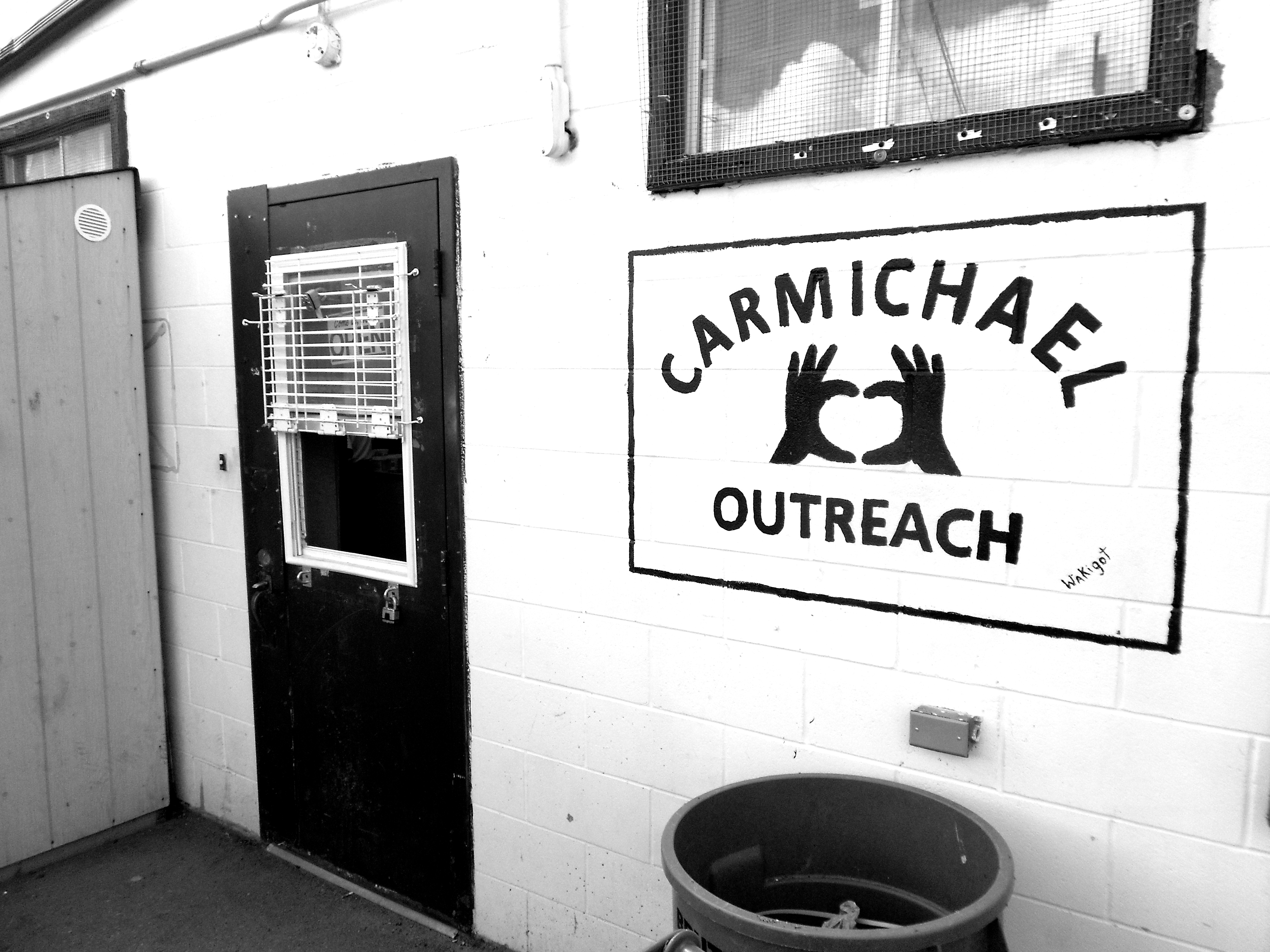
    Carmichael WindowThe Red Indians. That is how I remember friends from India refer to Aboriginal peoples in North America. Please excuse the politically incorrect nature of the title of this essay.

    As Cook and Food Recovery Program Coordinator (the more words you have in the title, the more important you are on a global scale) one of the duties is to run a nutrition program. If my roommates are a typical sample selection, I can guarantee that I eat healthier than most single men my age, but in no way does this qualify me to pretend I know more than mothers-of-five or middle-aged men. I stumble through repetitive weekly sessions about budgeting and Canada’s Food Guide for First Nations, Inuit and Metis populations trying not to brainwash them into vegetarianism that could realistically jeopardize their culture. Currently, the program consists of several Aboriginal mothers and fathers and one Punjabi woman with no children.

    Daily I feed hundreds of people who lack a regular source of healthy food. I attempt to do this with absolutely no ability or knowledge in serving them food that respects their culture, let alone their dietary preference. I serve westernized semi-processed foods out a back window to people verging on physical malnutrition and cultural assimilation. Carmichael Casserole or Spaghetto and Meatsauce sustains their bodies for a while longer and at times it doesn’t even achieve that. I am overwhelmed with how little I know.

    Then I read such articles. Things which are 100% relevant to my current position and I begin to reel. If the government or people are not willing to properly reconcile, then I become immaturely overwhelmed as to how to do so out of a 6′ x 6′ kitchen. Leanne Simpson, Indigenous author, writes:

    “I wonder how we can reconcile when the majority of Canadians do not understand the historic or contemporary injustice of dispossession and occupation, particularly when the state has expressed its unwillingness to make any adjustments to the unjust relationship….

    It reminds me of an abusive relationship where one person is being abused physically, emotionally, spiritually and mentally. She wants out of the relationship, but instead of supporting her, we are all gathered around the abuser, because he wants to ‘reconcile.’ But he doesn’t want to take responsibility. He doesn’t want to change. In fact, all through the process he continues to physically, emotionally, spiritually and mentally abuse his partner. He just wants to say sorry so he can feel less guilty about his behaviour. He just wants to adjust the ways he is abusing; he doesn’t want to stop the abuse.”

    -Leanne Simpson, Dancing On Our Turtle’s Back

    I cannot host reconciliation out of a kitchen. And this is because, according to the synopsis of Simpson’s book (see the above link), “reconciliation must be grounded in political resurgence and must support the regeneration of Indigenous languages, oral cultures, and traditions of governance.” I cannot catalyze reconciliation because I do not really understand the historic or contemporary injustice of occupation. And that is what gets me. Reconciliation is not done solo out of a grimy kitchen. It is done through processes which may have nothing to do with me and steps which I cannot control, but processes and steps in which I can participate in some way. Processes which I can learn about to potentially approach a climate that is fair for future reconciliation.

    The fact that I cannot adequately express my intentions with the word Indian demonstrates my obvious inability to help promote and preserve a culture that is not mine through an ill-prepared nutrition program and sloppy meals. The infinite nature of my naiveté and glaring inability is burning me out. They make me want to run away to the land of the Not-Red Indian in a fit of hedonistic, selfish admission of my lack of knowledge. My lack of commitment. My lack of connection to the issue, which is maybe the worst part—that I could get on a plane and forget about hundreds of years of colonialism and assimilation, because I can.

    I am here to stick around for as long as I can before my brain explodes and I find myself crying in some colonially-cultivated blossoming organic flax field, because I do not want to “adjust the ways” we have been abusing, rather I want to stop the abuse. One of the only ways to do this is participation, knowledge, and handing out egg salad sandwiches to two-hundred people a day.

    Or at least that’s what I’m going to tell myself so I don’t drown in egg salad.

  • The Paint Debate

    NYC Painting

    I have never owned a home, though I am in an age where my peers are all deciding that such an investment would benefit them. I find this admirable. Home ownership is something I aspire to greatly, but something which I know with certainty that my immaturity and late-bloomingness make me currently wholly unprepared. So instead I rent. There was a moment in time where I said I would rent comfortably for the rest of my life. I have since revoked this idea, as living in a home with zero roomates and no landlord (except for the bank) sounds somehow pleasant. My views of the following are likely to change in the same way.

    A married couple and I have been having a long-standing debate. This is a debate, to be sure, because both parties are so stubbornly rooted in their belief that no one will change sides, that is, until ten years down the road when I get married and see the lightly-tinted Kokopelli Teal and finally understand how a colour seems to understand my innermost being. I believe that painting the walls of a home or apartment is a painful waste of time and money, and though the debate will remain insignificant forever, the internet is rampant in even less stimulating debate, which therefore legitimizes The Paint Debate. Somehow.

    To state that the flat colour of the wall of a home can even begin to express the personality of a human soul is a degrading to the complexity of personality, which with every individual person would require more than the several thousand shades offered on the Benjamin Moore paint chip section. It would require millions of ever-changing colours; colours that don’t yet exist. The architecture and interior design of a house (if considered art), like the composition of a painting, has thousands of colours and strokes and accents and features that can hint at the surface of a personality, but in no way fully capture the intricacies and oddities of a person. You are not what you own, as Fugazi put it. You are not the colour of paint in your home.

    To state that colour has the ability to change a person’s mood may be a good enough reason to surround yourself in Baby Chick Yellow or the dignified Gibralter Cliffs Grey, though this may hold true only for classes of people who have nothing else to worry about besides superficial interior decorating decisions or choose to paint walls repeatedly to help them forget of their mounting debt. There has undoubtedly been some conclusive research conducted by an authority in psychology stating that certain colours release endorphines and thus, painting a room of a home will guarantee happiness. Similar psychology has been taken up by colonialist governments to bring joy and happiness to the groups of people that they previously assimilated and murdered, and hey, that seemed to work well.

    To claim ownership by way of paint on a wall is an illusional attempt at false ownership. It is evident that a human being purchasing a home will instinctively paint the walls regardless if the colour is something they would like in another context, and this is the Dog Piss Complex. Dogs will urinate on things even when they do not have to urinate, dribbling drops onto a fence or hydrant in a primal game of grafitti, simply to make more things their own. Humans have civilized ways of pissing on property, and thousands of colours of piss to choose from. Besides all this, simply put, ownership is a false dream. Possession is nine-tenths of the law, they say. But to have ownership over something, besides some twentieth century discipline system, is nothing. Ownership is a form of entitlement. A person’s home is no more theirs than it is mine, besides a magical thirty-year digital transaction or physical currency swap. Besides the fact that I would get arrested for attemping to enter it on my own will, and besides the fact that I might be sent to the hospital, mental or otherwise, for painting it myself. Claiming ownership of four walls and a roof is as misguided as claiming ownership over the air that resides within those walls. Painting those walls to mark territory, then, is ineffective.

    To protest living in apartments of drab white walls, to make a statement by painting walls elaborate colours, is something I can support. Change for the sake of change is something I can support. But when change is done in the name of personality, of ownership, of permanent mood-boosters, then I lose interest. Because then reason is out the window, and some bizarre cultural rite of passage comes into play. Adulthood or something.

    All this to say that I have yet to find a reason that I myself would take the time and financial discourse to paint the walls of my dwelling, and that I have a difficult time understanding those that do. There are indeed colours that I prefer over others, this is normal. But to base decisions or pocketbook numbers on these colours, even if they invoke the warmest of positive feeling, is not worth a person’s time. I’d rather sit here for three hours and write a piss-poor essay than waste my time rinsing out brushes and taping floorboard with green tape. The theorized, marginally-improved mood brought by the finished product would not offset the 100% worsened mood caused by mere seconds of the painting process.

    I do not consider it wrong, dumb, superficial, or negatively adult, I just find it as another case of myself not understanding human habit or what has grown to be the norm.

    I think I’m afraid of committment.

    And everyone sits patiently as they wait around for me to grow up.

    NYC Painting 2