Please check out my new project, a series of untitled short books with accompanying audiobooks.
Books can be found here: ballsofrice.bandcamp.com/merch
Audiobooks can be found here: ballsofrice.bandcamp.com
Please check out my new project, a series of untitled short books with accompanying audiobooks.
Books can be found here: ballsofrice.bandcamp.com/merch
Audiobooks can be found here: ballsofrice.bandcamp.com
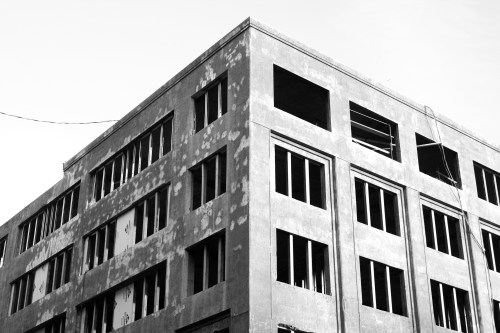
Three blocks from the venue, down an industrial street in Denver like that in any North American city that boomed in the 1950s, was a small store inside of repurposed shipping containers that sold US-made backpacks, outerwear, and slacks. The store was clean and simple and catered to the young outdoorsy types who live inside but are able to sleep in tents in exotic locations outside.
“We were one of the first businesses in this part of town,” said the shopkeeper sitting bored behind a handmade counter, hair messily gathered in a bun on the top of her head like she had just crawled out of a tent in the Rockies that surrounded her city. “Since then all sorts of businesses have opened here, which is too bad, it used to be a cheap part of town. Now there’s a luxury hotel going up just up Larimer.” The woman expresses her displeasure just as I would. I agreed as I tried on a pair of outerwear pants behind the changing curtain. Their shop and brand are participating in making the neighbourhood more expensive by selling $150USD pants, but they are at least trying to create a manufacturing industry by making their products in the USA. I left without buying pants, wondering where the nearest goodwill was.
The next day, the venue was plopped in the same part of town, only in a city that was 500 miles away, a state and a half to the east. After load-in and soundcheck, the soundman asked “Where’d you go for food? The burrito place? How was it? I heard it wasn’t that good. Yeah, this was the part of town no one would come, until my boss opened this bar and the other one, we started booking shows here, and then other businesses started coming too. It was kinda the bad part of town, now it’s the up-and-coming part of town.” At the expensive coffee joint across from the bar arcade, next to the burrito place, they were giving out a free, one-page newspaper/zine/leaflet. In it read,
“Most American cities are run by real estate interests… In Omaha, the tactic for encouraging gentrification is Tax Increment Financing or TIF. TIF is a way for cities to return tax money to developers as an incentive to put up projects that the city wants (and the public makes up the difference). Unfortunately, no provision is made for the people who used to live in the cheap housing turned into gentrified apartments. The former residents are simply scattered to the four winds. Surprised by ‘shots fired’ near 108th and Maple? This is your City gentrification policy in action.”
A similar but more developed street newspaper in Seattle uses the G-word, gentrification, describing places like Africatown in Seattle being dismembered, breaking up the “home and haven for Seattle’s Black families and businesses”, and highlighting stories of people failing to maintain housing in a rapid-rehousing program because of the recent inflation in costs of rent. Large newspapers will only use the G-word when describing vandals in Montreal or Vancouver who are terrorizing business owners, as business is the uncriticizable holy grail of progress.
I am fortunate to be able to tour with world-class musicians, but each time I’m on the road I wonder how long such jobs will exist. How long will I be paid to burn fuel and watch music in ‘up-and-coming’ parts of American cities, while around the block, that neighbourhood’s previous inhabitants are clamouring to find shelter under a bridge or in a condemned building. I do it because there’s something in music and creation that is able to be unpolluted by corporate greed, though most times it has already been bought and sold.
When people ask what I got to see this trip, Linh Dinh answers for me in his book, Postcards from the End of America, in which he visits communities across the United States left with little or no economy:
You can’t really see a city or town from a motorized anything, so if you claim to have driven through Los Angeles, for example, you haven’t seen it. The speed and protection of a car prevents you from being anywhere except inside your car, with what’s outside rushing by so fast that each face, tree, and building is rudely dismissed by the next, next and next…Like television, the private automobile was invented to wean us off our own humanity. From each, we’ve learned how to amp up our impatience and indifference towards everything, and with life itself.
After tour ends I fly home to an ailing Saskatchewan. I’d heard of the government cuts while in San Francisco, when a friend texted saying WHAT. THE. FUCK. with a link to an article about the shutting down of the province-owned small town transportation and parcel shipping company. Now home, walking through the downtown, worried citizens are passing colourful clipboards around, asking passers-by to sign one of the multitudes of petitions that are circulating to Save Our Libraries, Save our Bus System, Save our Schools. I sign them all, knowing full well that no petition will be worth the millions of dollars that the government squandered on stadiums and tax cuts on resource extraction companies. The angry protests and province-wide campaigns might get them to preserve something, but the effectiveness of these actions will only go so far if we continue to work within the system that props up corporate interest over that of the public. Though it plays into the hands of the fearmongering government and high income class, one can see why smashing windows in Montreal seems more effective.
Government MLAs show their responsibility, boasting their 3.5% paycuts, which to them means 3.5% less income to spend on boats and cottages and home renos and filet mignon. The paycuts they make to those on social assistance, the paycuts they make to those once employed by the rural transportation system, the cuts they make to the libraries, all mean that thousands of low income individuals won’t have food, shelter, a way to travel for medical treatment, books, and significantly more.
Several years ago, after seeing Chris Hedges speak at the University, I worried that Saskatchewan was the next sacrifice zone—the places that are abandoned by industry, left in disrepair and a humiliating culture of dependency after being used and left behind because of their lack of monetary worth. This could be the beginning of that reality.
It starts with the desperate government selling its struggling assets to the highest bidder, then selling its most profitable assets. They begin begging oil companies to relocate to the province to help the crumbling economy, start giving public land to large corporate bidders. At this point, entire cities and provinces will be bloated with corporate-controlled land and buildings, and towns end up, in a way, like the middle-class urban centres of post-manufacturing North American cities, where no one can afford to pay rent. Eventually, when the government isn’t coddling big business enough, they’ll pack up and move to find a different government who will subsidize their existence. Thirty years later, when our industries have died and all that’s left is cheap bars and empty buildings, businesses that pander to middle class tastes will further move into parts of town with abandoned buildings and cheap rent and begin the process of displacement of those marginalized by the loss of industry, struggling to survive in the older neighbourhoods. We are no better than the economic destruction seen in the United States, we are just a generation behind.
All that will help in the midst of a breakdown of free, communal places of existence and of the breakdown of social programs, is the creation and maintaining of communities that support one another and support the other, the different communities who are similarly affected. I am the middle class that is being pandered to, and while being in these places, eating their burritos, buying their pants, is not inherently bad, it makes it all the more imperative to support and participate in the communities that are contrary to austerity. These communities—social groups, churches, activist collectives, sports teams, artist groups, musicians—must band together to build movements that support the racialized, marginalized, the poor, Indigenous, immigrant communities, who are most harshly affected by public cuts and an economy sucked dry.
Linh Dinh, states the obvious:
For any community to be healthy, local initiatives must be encouraged, nurtured and protected, so let’s reclaim our home turf, reestablish the common, and, in the process, regain our collective sanity and dignity.
The following was first released online by Briarpatch Magazine, selected as Best of Regina entry in the 2017 Writing in the Margins contest.
“Hey, come over Saturday and we’ll watch the Canadiens play the Leafs. That’s my team! The Leafs,” Ivan tells me.
“Do they play each other this week?” I ask.
“They play every Saturday.”
I arrive at Ivan’s the following Saturday, ready to microwave each of us a bag of popcorn.
I turn on his tube television which sits at the foot of his single bed in the living room. Ivan lives on the main floor of an aging building across from the casino – one of those apartments where the landlord slaps on cheap laminate floors like bandaids to justify a 30 per cent rent increase. Next to the bed and in front of the TV is a recliner that I always encourage him to relax in instead of slouching on the sagging edge of his bare mattress. I’ve never once seen him sit in it. Next to the recliner is Ivan’s walker. One of the brakes doesn’t work.
Maybe when Ivan was younger Toronto played Montreal every Saturday, when there were only six teams. But it turns out they don’t play this Saturday. Instead, country music videos prattle on in the background while Ivan drinks from a bottle of port wine and I wheel back and forth on the seat of his walker.
“Oh yeah I used to play. In White Bear. We’d play in Carlyle sometimes. Home of the Cougars. White Bear versus them white kids in Carlyle, haha. You know, we weren’t half bad.” He winces at some painful on-ice memory tied to growing up in a province that is unforgivingly racist. He jokes about being a bit fat in those days, now he weighs half.
“I’ll pick you up on December 31st for Hockey Day at Carmichael,” I tell him as I leave.
“Sounds good, bro,” Ivan says. “See you then.”
“Sounds good.”
“Love you brother. Lock up behind you.”
Sheldon stands at centre ice, eyes closed, visualizing his upcoming slapshot. Noel, the goalie, affectionately known as Ken Dryden, waits with knees bent as much as his battered femur allows. The crowd heckles from the side boards.
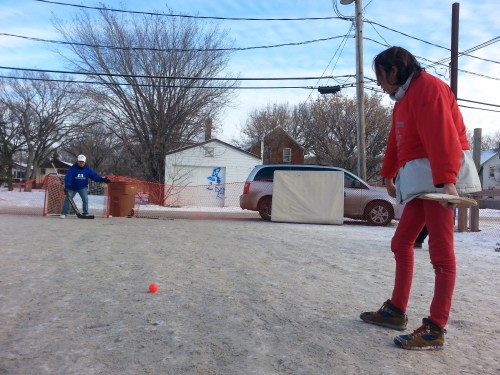
Hockey Day at Carmichael is a pick-up street hockey game played on the uneven, certainly dangerous parking lot of Carmichael Outreach, a crumbling drop-in centre in downtown Regina. On Hockey Day, members of the Carmichael family of hundreds, many of whom happen to be without homes, come to play shinny and eat a hamburger.
“Hey, Lenny! Keep your stick down, and stop saying ‘fuck.’ There’s kids around!”
Hockey Day is the only sporting event I’ve heard of where the inebriated and unskilled are encouraged to play. Where new renters can come and settle scores on-ice with their cousins who won’t stop trashing their apartment. Where those still healing from the abuses suffered in the residential school system can come and grind through their aggression. Where people who get ticketed in the mall under the city’s “unwanted guest” initiative come to forget the mall exists. Everyone is welcome to play.
Deano chases the puck into the corner, hits a patch of ice and lands on his face. He is escorted to the spectators’ bench for having one too many and is given a coffee, a smoke and a cheer from his teammates. Thirty people show up to play, another thirty to watch. The Lemieuxs and Leaches chase the ball with donated jerseys pulled tight over the five layers of jackets that are obligatory when one lives outside and sleeps at Sally Ann or Detox.
Ivan doesn’t make it as a spectator this time. He just got out of the hospital and being a spectator means sitting outside in the winter on a hard chair for three hours until burgers are ready.
“I knooow, I know. I still can’t figure out how I got pneumonia.” The week before while Ivan slept, some guests unhooked the smoke detector at his apartment and left the window open all night so they could smoke. “I never even left my bed!” Home care from the health region was supposed to start coming a month before but when he didn’t answer the door once, they permanently discharged him. When so many pieces of the health care, social assistance, and justice systems function in the same defective way, it points to the fact that these are purposeful features, rather than flaws, in the process of colonialism, designed to betray urban Indigenous people.
“I’m making breakfast. Come over!” Ivan says over the phone on New Year’s morning.
Ivan wheels himself into the kitchen, fries a pound of bacon, butters two slices of white toast and brings back our feast spread on two decorative plates on the stool of his walker.
“That’s my team!” Ivan says as the Canadiens walk from the dressing room at the NHL’s outdoor Winter Classic. We’d made a plan to watch the game, this time one that we knew was actually happening.
Ivan squints hard at the TV, at times mistaking the white and blue vintage sweaters of the Habs for the black and yellow of the Bruins. He needs glasses, he’s asked for them several times himself, but whenever he has an appointment to see any medical professional he refuses to go.
Montreal dominates Boston in a game of shinny not unlike Hockey Day at Carmichael, except the 80,000 spectators are drunk in some apparently socially acceptable way. He remarks on Carey Price, the world’s greatest goalie, who sits on the bench with a bum knee. Ivan knew the feeling. He recently had a broken upper tibia and a full-leg cast for eleven weeks, half of which he slept at Party Tree, an empty lot furnished with a plank of wood and two broken office chairs.
“You should see my grandpa’s rink in North Weyburn. Best ice in Saskatchewan,” I tell him. “Sometimes I go there to skate just to get rid of stress.”
“Oh, for sure. Weyburn, hey? The Red Wings!” he says, referencing the junior hockey club. “They’re a good team. But the Bruins, now that’s my team! Estevan. I lived there eight years. You’re my Estevan Man. I bet I know your family down there.”
He lists distinctly white surnames. I don’t have any family left in Estevan but since he found out I was born there we never stop talking about the place.
“I’d walk around with a wagon picking up empties. Ho boy, I’d make a lot, haha. No one down there doing it then. I wasn’t drinking then, could make $60 a day. Could see Boundary Dam from my place.” Ivan sits on his bed, arms crossed, blinking at the TV, wearing an Estevan 1985 Heritage hat I found him for Christmas. The coffee table next to him is littered with insulin pens, empties hiding under his bed. He’s lived in this apartment for three months. Before that he lived nowhere.
“No guests at all,” Ivan responds in agreement to my suggestion of having no guests after 11 p.m. Too many guests means noise complaints and an empty fridge. He just got out of Medical ICU.
“Whatever you want,” I say. “And the other part of the agreement is our part. We, as your support workers and friends, agree to respect your privacy, help you get groceries, do laundry, y’know, the stuff we already try to do. And we agree to take you out for coffee once a week. Get you outta your place.”
“Oh right on. That’s great, man.”
“I was thinking of getting us tickets to a Pats game. Maybe against Brandon,” I suggest. Ivan spoke of Brandon, Manitoba, another former home, on a daily basis. It was where he and his mind went when he tired of Regina.
“Ohhh hey, yeah. Alright! Maybe in that agreement put, ‘Take Ivan to a skin show.’ Haha. Jeez, I’m joking!”
It takes us a week to print the agreement — an attempt to keep his place safe and quiet and keep him housed. It takes another week to laminate it. By then he’d had guests and was in and out of the hospital again. He never did sign it.
There’s an ambulance outside his apartment as I drive past, so I stop and let myself in with my keys. A paramedic is holding an intravenous bag that runs into Ivan’s arm while Ivan sits eating his first meal in three days, microwaved by the paramedic himself.
“Heyyyy brother!” Ivan shakes my hand.
“And who’s this now?” asks the paramedic.
“That’s my counsellor.”
“Oh good,” he says to me. “He needs to make sure that he takes his insulin for sure the next day and a half, or he won’t make it. But he can’t take his insulin without eating.”
He speaks as if Ivan can’t hear. “I’m surprised he’s still kicking. Last time we saw him we were taking bets as to how long he’d last. Glad he’s got some help. If not, these kinds of guys would plug up the system.”
The health professionals place bets on his existence and call him one of ‘these guys’. Six months later the health region that employs them releases a job posting with blatantly racist language, then rescinds it and claims that racism is not an inherent issue within their institution. I begin to understand why Ivan skips every possible interaction with medical professionals.
The paramedics get him to sign a release stating that he is not willing to come with them to the hospital to get checked out.
“Ivan, do you have any other health concerns we should know about?” they ask.
“Yeah. I’ve got rabies.” Ivan says with a pause, his face earnest. The paramedics look at one another, unsure of what to say. Ivan laughs at them and they leave. Ivan finishes up his microwaved fettuccini alfredo.
“Hey bro, should we have some tea?” I say yes and go to the kitchen to find the coffeemaker topped up with teabags and the coffeepot already filled with warm tea. I grab the last mandarin orange from the counter, and he and I sit and watch the news and hockey highlights. We drink day-old tea, eat a few orange segments, and as I leave, we exchange our pleasantries one last time.
“Lock up behind you.”
I go home and grab my skates and head to the outdoor rink. I skate until my lungs burn, my legs noodle. My head still feels like there’s a bench brawl going on inside, so I skate laps until my head feels nothing. And then I skate more.
Stumbling drunk off a bus downtown
You’ve got it bad for the system
‘Cause you know it let you down
You see the marks on the whores
And the dimes they lent you
And your paranoia soars
On the wings of your dementia
Without a system that compels
The growth of human compassion
Its a face that will never change
Nobody’s well when even one soul suffers
We’re bound by circumstances
We can’t dissarrange
Does shame prevent you
From engaging in the indigents struggle
Just filling up a vacancy
With nothing new to live for
When I was young and naive
I believed I could be so much more
Out of touch with a world
That never cared or knew me
More dead than alive
when you stare right through me
Its a face that will never, never change
never change
You could be the one
With your hand held out
–Good Riddance, Bound By Ties of Blood and Affection, Shame, Rights & Privilege
Sometimes in the morning I am petrified and can’t move
Awake but cannot open my eyes
And the weight is crushing down on my lungs I know I can’t breathe
And hope someone will save me this time
And your mother’s still calling you insane and high
Swearing it’s different this time
And you tell her to give in to the demons that possess her
And that God never blessed her insides
Then you hang up the phone and feel badly for upsetting things
And crawl back into bed to dream of a time
When your heart was open wide and you loved things just because
Like the sick and the dying
And sometimes when you’re on, you’re really fucking on
And your friends they sing along and they love you
But the lows are so extreme that the good seems fucking cheap
And it teases you for weeks in it’s absence
But you’ll fight and you’ll make it through
You’ll fake it if you have to
And you’ll show up for work with a smile
You’ll be better you’ll be smarter
And more grown up and a better daughter
Or son and a real good friend
You’ll be awake and you’ll be alert
You’ll be positive though it hurts
And you’ll laugh and embrace all your friends
You’ll be a real good listener
You’ll be honest, you’ll be brave
You’ll be handsome, you’ll be beautiful
You’ll be happy
Your ship may be coming in
You’re weak but not giving in
To the cries and the wails of the valley below
Your ship may be coming in
You’re weak but not giving in
And you’ll fight it you’ll go out fighting all of them…
-Rilo Kiley, A Better Son / Daughter, The Execution of All Things
Brandees is a four-and-a-half-block walk from my bachelor apartment. My building, an 88-year-old three-storey brick structure called The Kenora, is equipped with bathrooms that make phantom popping sounds like peculiar lip movements of a large-mouthed old man. Plop poppop plop pup pop. And pipes that sound like a monkey is hitting them with a hammer in the basement. And pigeons that flutter and coo, waking me like the cocks of the city.
Brandees is a convenience store with a post office open until 11pm. A convenience store that at one time sold bannock in a brown paper bag. But most importantly, a convenience store that rents DVDs for $3, or two for $4.
My laptop died several weeks ago in the first month of death. My new laptop, replacing the creator of two books and countless jeering essays, is thinner than a pancake and has fewer orifices than a three-eyed human, excluding the hardware that reads any media that can be rented at Brandees.
My friend Mike once said that the only honest place left in Regina is Country Corner Donuts on the corner of Dewdney and Broad St. A sandwich as tall as a five-dollar-bill only costs four. Stan has his own corner called Stan’s Corner. It says it is open 24-hours but you get kicked out at 11pm. (Though that seems dishonest, it isn’t.) Brandees is one of those few honest places left in the city (except the one time they fined me $25 for not returning a movie that I did indeed return, but again, honesty is subjective). Brandees is a dry oasis in a city soaked in booze.
So now I count down the days until I can no longer watch Brandees DVDs on my work laptop because I will soon be fired for doing my job too well and by then I will have absolutely no way of watching movies rented from Brandees and I will probably die from irony and desperation and chest pain from losing at solitaire too many times because I can’t just double click on every card until something happens because I have to flip the cards by hand and look at a rubbermaid coffeetable instead of a screen.
Because without Brandees movies and without the internet and without the motivation to go to the library to steal the internet I have no distraction and with no distraction I have to remember that all my friends at work are dying because good people are scared at the backlash of ignorant people when those ignorant people find out that all people are actually being treated like ‘people’ and not like the ‘ideas’ that they see them to be.
I walk to Brandees instead of biking or driving or jogging. Because the four-block journey there and back, stepping over the same dead bird four times in a week, walking past the pub and through the Safeway parking lot is guaranteeably more enjoyable than the destination, especially when the destination is in the apartment listening to popploppupploping and accidentally watching a Woody Allen movie.
I guess there’s always the arcade.
The funeral procession passed by here today. Confusion and questions left strewn in its wake. But I feel like I knew his pain-a mechanical failure while enduring the norm. Some of us fracture, others simply deform and lose their elasticity, never to return to the shape they were. I wonder which is worse? I try to keep my composure amidst the insanity, resigned to the truth that I will not live to see the dawn of a better day that might wash away the sadness of this age. I try to keep the voices calling me at bay, desperately clinging to any futile act of human decency. The voices love to remind me of my futility. Sitting on my hands hoping anyone else than me will do what should be done, it’s hard to not succumb as they call my name. You gotta keep on truckin’ anyways.
-Propangandhi, Supporting Caste, The Funeral Procession
I sat cross-legged in the cushioned armchair, scratching paint off my water bottle in the cozy, warmly coloured, obviously intentionally non-institutional office of my psychologist/psychotherapist/whatever.
Isn’t it enough to just be a good person and treat people well? she asked after a near hour-long discussion of how far one needs to go to make the world less of a festering shit hole, with me grinding myself into a hole trying to figure out how to do so.
I thought it over. I pictured the tax-paying, maybe church-going, home-owning, child-rearing city councillor who occasionally shovels his neighbour’s sidewalk and might even give a few bucks in December to one of the organizations that sent Christmas mail-outs. His kids are in hockey. He loves his spouse.
No, I said. That’s a cop out.
I wondered what she thought—-that I was attacking her personally—-or if she was clinically breaking down my obvious guilt that stems from years in conservative religion, my fear that comes from the insecurity issues of being the youngest child, my anger from decades of not expressing myself in healthy mediums, and my depression which is induced by the daily watching of my friends dying while my other friends are not even able to give a shit. She was likely doing neither, she is significantly smarter than I.
Because of constant deconstruction of social programs, the development of neighbourhoods that are exclusive in nature, and the importance financial-driven success, being a good person means keeping to one’s self. It means not being an evil person. Not being a murderer, rapist, tax-evader, alcoholic, street worker. Not beating your children or spouse. Not pouring toxic waste into a animal rescue facility. Not bothering your neighbour. Being a good person, by the standards of our colonial, patriarchal society, means staying in line. The fact that my day job exists entirely to remind people of their worth, that they aren’t bad people for needing a shot of morphine everyday by noon, that they aren’t bad people if they fall off the wagon, that they aren’t bad people for being on welfare, that they aren’t bad people for having a culture that precedes the current—-the fact that this day job even exists, shows that good people, in today’s standards, are those with privilege.
I drank a sip from my water bottle, an action steeped in anxiety, done to make me look more natural. After a near hour of discussing my rage, my mind became blurry. By the time we got around to ways I can improve upon myself, I didn’t have the energy to comprehend new ideas. I pretended to take another sip of water from the empty bottle and nodded along with my psychological professional.
Being a good person and treating people well wouldn’t be a cop out if it meant something else. If it means more than smiling in public and not using racial slurs, then it may be enough. Enough to make changes that matter, to staunch the wounds that pour blood into the alleys. But until it does, until the characteristics of being a ‘good person’ include understanding and standing up for those our system have methodically destroyed, being a good person is not enough.
It’s not the fault of the good people that they are good people under the current model of good. We have been gutted and replaced with slop from the machine of individualistic, selfish commercialism. Our jobs don’t allow us the time to give a shit. In order to stay sane, we bask in the glory of our beautiful families and don’t look out the window to the family being kicked to the curb by a police officer, because we legitimately don’t have time, because the Mayor has stricken that topic from discussion in council, because if we do, we’ll get depressed. Good people everywhere don’t know how to participate in a change they want to make, so they rely on posting on internet, or they don’t do anything. I am that kind of good person.
Tonight as I watched city council directly shut down citizen concerns, bully them by calling requests of accountability disrespectful, and promote gun violence as seen on their favourite television shows, I watched a room full of good people fighting for their definition of good. The uninformed relied on tokenism, touching stories, and fear tactics to justify their definition of good, that is, to justify the increase in funding for the organization that protects their privilege. The informed stood up and defended their idea of good, that is, they were willing to understand and stand up for the good people outside of the room who have been trampled by the uninformed, power-protecting policies of racial profiling and bad-person profiling. Everyone was working for their own idea of good. Some of them were just unfortunately, painfully, and dangerously uninformed. I left city hall with a renewed interest in changing our current definition of what makes a good person. How we go about doing that has never been my strength.
I left the psychologist’s office $160 poorer, one-hour later, one vague understanding of fear and guilt, with one empty water bottle. I’m going to have to book another appointment. Or two.
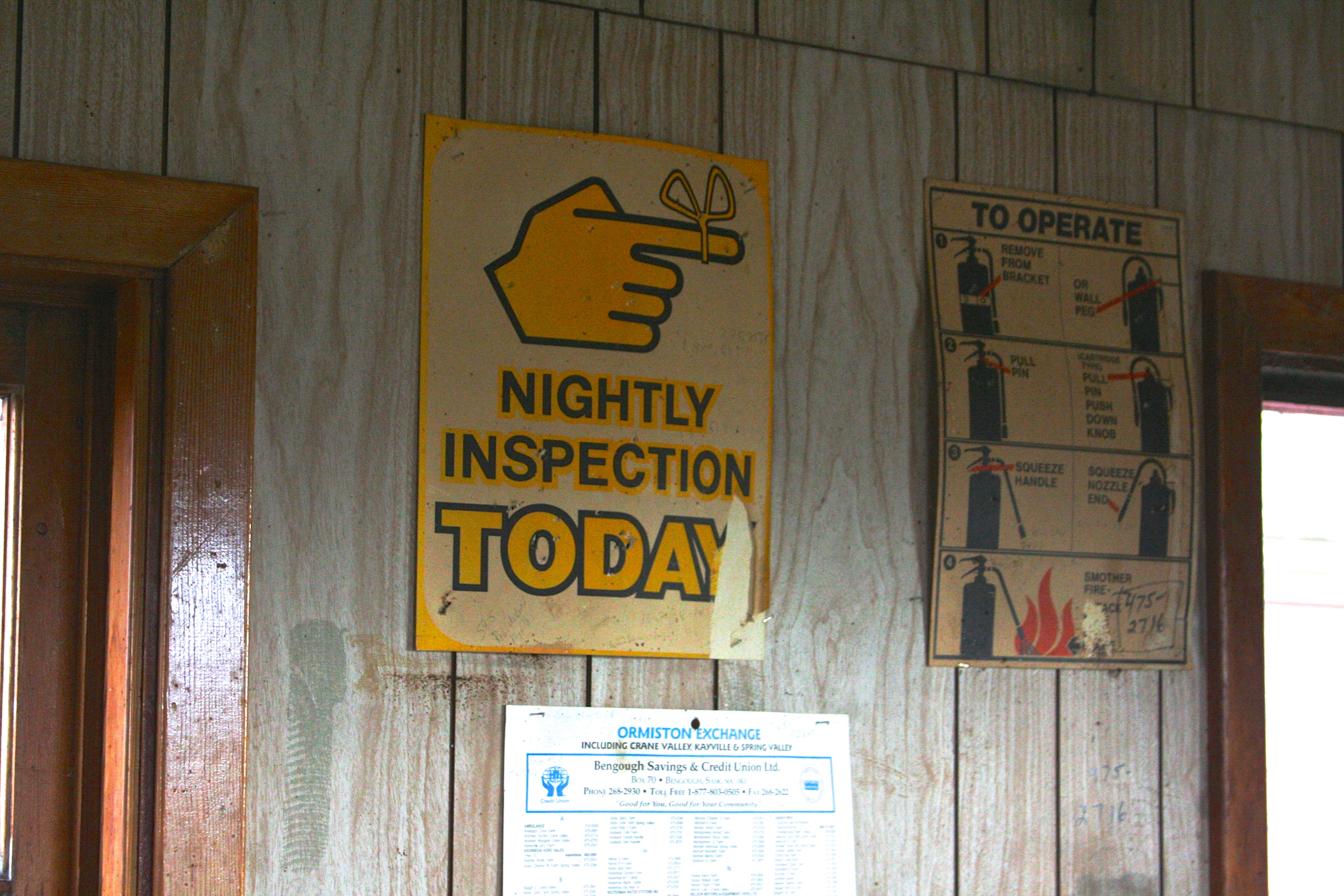
Tie a string around your finger so you don’t forget. Use different coloured string for different levels of forgetfulness. A ribbon on your pinky reminds you to make kale chips when you get home. A shoelace around your thumb reminds you to tune up your vehicle. A wayward greasy carpet string around your ring finger reminds you to keep in touch with that person you’ve had a crush on for a few years. A wire coiled around your index finger, gouging your knuckle each time you make a fist, reminds you, most important of all, to remember the other strings on your hand.
You need a string on your finger to remind you of leisure. Leisure that isn’t slovenly but leisure that is joyous, relaxing, not overthought. So you go for lunchbreak for the first time in years. You lounge next to a tree in the park with a friend, discussing light topics such as bicycles and ice cream and green grass and cats. You are succeeding at the leisure-string that you haven’t even tied on your finger. Maybe you don’t need to tie one on your finger at all.
Then a man, the same one you heard at the cenotaph gracefully preaching fire and brimstone to Friday Noon-Hour Lunchers, walks up to you and hands you a wallet-sized card, a fear-mongering reminder of your chronic problem with sin. He, a thirty-something-year-old touts ideas you thought were reserved for the fundamentalist old people, but doesn’t make you uncomfortable because your beliefs aren’t accidental but somewhat calculated and purposeful. He openly and strongly curses murderers and rapists and liars and thieves and those who use the Lord’s name in vain. He curses them to hell (the last three of which he asked if you do, to which you flatly respond, of course, daily) because he knows the grace of God better than you, and nearly, without so many words, accuses you of being a rape apologist, something like Norm on Bill Cosby fans. Because you don’t believe in the right kind of justice.
It’s difficult to have a conversation with a walking hate-filled preacher of love, a tape-recorder repeating language of heavenly bodies that is so far removed from the injustice of reality that a comprehension of human suffering is lost. His idea of justice is burning alive anyone who has ever farted and doesn’t share his belief system of how to get forgiveness for passing gas. Your idea of justice takes into account the victim, previous injustices, and human nature.
These are some big ideas, you tell him, we’ll give them some thought. He leaves to make the next group of people he talks to feel scared and angry, just like what his teacher told him to do, right?
A blue piece of floss around your outstretched middle finger. Remember that everyone has a right to a belief, but that right and wrong aren’t as clear as a heaven and hell.
“A story has got to have a beginning, a middle, and an end,” James told me over the phone from his care home in his small city in Arkansas. “That’s it. I don’t care if it’s a song, a novel, or just a story you’re telling your friend.” He coached me even though we’d essentially known each other for three minutes.
I met James E. Harper (a.k.a. Poet) nearly four years ago with a friend in downtown San Francisco. James was introducing himself to people on the street, selling his book of poems, three or four roughly photocopied pieces of gold-coloured paper, so he could afford to grab a meal or some hygiene products for his wife. He mentioned that more of his work was available if you searched his name on the internet. In doing so, I couldn’t find any writings, so I transcribed what he sold me and posted it here. He deserves credit for his work. His poems are powerful and real. Read them.
As simple as it sounds, this is the writing advice I’ve needed for months, years perhaps. James’ advice, to simplify and be natural, speaks to why I find his writing to be worth noting. Honesty. No bullshit. I spend hours at the Bernal Heights Library, staring into the eyes of Antonio Banderas encouraging me to read, while I try to sort out the several dozen metaphors I have choking every story. When really, all the story needs is a beginning, middle, and end. I am mid-read of Crash Landing on Iduna by Arthur Tofte, a sci-fi paperback I found in a Wyoming truckstop for $2.99 with incredible cover art. In contrast to my overcomplicated way of thinking, it is the perfect example of oversimplified writing. Now to find the middle.
Comments have been posted regularly to James’ poems on Balls of Rice over the past three years by people who also stopped to chat with James and searched his name upon arriving home. A comment arrived in February stating that James now lived in a care home, and included a contact number.
“When you write something, you want to strike the chord. There’s a tuning fork in all of us, and you want it to feel like you’ve hit that,” he said. “If you haven’t lived it, you can’t write it.”
I told him that I am a writer and that I was in San Francisco to finish a few stories, which were giving me some trouble. “It sounds like you are forcing it. You heard of that song, If It Don’t Fit, Don’t Force It? Well, that’s just it.”
I hadn’t heard of the song. Now it is in my head when I need it most.
Just waiting to hear the end of the story.
If it don’t fit, don’t force it
If it don’t fit, nah, don’t force it
If it don’t fit, don’t force it
Just relax and let it go
Just ’cause that’s how you want it
Doesn’t mean it will be soI’m givin’ up, I’m leavin’
Yes, I’m ready to be free
The thrill is gone, I’m movin on
‘Cause you’ve stopped pleasin’ meI can’t stand bein’ handled
I’ve exhausted each excuse
I’ve even stooped to fakin’ it
But tell me what’s the useYou’re tryin’ hard to shame me
‘Cause you wanna make me stay
But all it does is bring to mind
What Mama used to sayI know there’ll be no changin’
We’ve been through all that before
I’m all worn out from talkin’
And now I’m a-headin’ for the doorC’mon stop your complainin’
Someone else will come along
You can start your life all over
Sing her your brand new songYou’re tryin’ hard to shame me
‘Cause you wanna make me stay
But all it does is bring to mind
What Mama used to say
-Kellee Patterson, Turn On The Lights/Be Happy, If It Don’t Fit, Don’t Force It
 Balls of Rice