Category: Uncategorized

  • November 11, 2013

    “This is just a question, but do you consider yourself at fault in the accident?” This was what the apologetic SGI car insurance employee asked me over the phone as I sat in the Frontier Gas Station/Greyhound depot in Revelstoke, BC. I said no, although I should have been driving slower, I should have gotten more sleep the night before, I should have put it in four-wheel drive, I should not have tapped the brakes in panicky instinct. The totalled Nissan Titan, the Rider Pride Truck of 2007, lay on the back of a tow truck in the Classic Towing yard. It is worse crashing a truck when it isn’t yours. When I was certain that the passengers were not affected by the crash, I cleaned pieces of the plastic bumper off the middle of the highway, throwing them into the forest in a stewing rage. After the testosterone-sweating police officer took our information and the tow-truck drove us to town, I left my brother and his girlfriend sitting with a garbage bag of their belongings waiting for the 3pm bus while I stood on the side of the road and stuck my thumb out.

    The words of the pleasant German girl that I sat next to on the eleven-hour gauntlet Greyhound made sense in reflecting on the crash. “You experience more in life when you’re comfortable with being uncomfortable.” Inside of new experience is the place where one is able to improve.

    Near death, if you want to exaggerate the crash to that degree, has been heralded to change peoples’ lives. I’ll always wear a seatbelt from now on, one would potentially resolve. I’ll finally ask out this girl because life is too short, I thought. If life is lived properly, near death should not change anything. It may cause new thought or appreciation. A person should not be scared into living the life they’ve always wanted to.

    Individuals can be personally responsible for their faults. But are they at fault for the patch of ice that brought them spinning off a cliff? Our experiences can cause our faults, but dwelling on our faults, stewing in them, is regression. Once people realize their faults and wish to work on them, there must be proper supports in place; this is a responsible society. From an insurance standpoint, who was at fault is important to establish. But in working on the well-being of a human, who was at fault is unimportant. It is the asking for help that needs to be noticed.


  • November 6th, 2013

    In response to November 5th, 2013:

    I am the romanticizer, the unenviable fool. I am a manipulator of words. I turn several years of running away from my problems and write a book about it, glorifying it into an admirable form of ‘roaming’ and ‘wandering.’ I romanticize my gloomy, smug, withdrawn nature as intellectualism and progress. I idealize my lifestyle of work and creation; a prideful and pretentious idolatry. I am likely the only one that strains to see through it all.

    What all who serve an idol fear is death, what Paul calls, “the last enemy.” It is fear of eventual obliteration. It is the fear that death, like life, means nothing. It is a fear we rarely name but which hovers over us. The compulsiveness that drives us to consume too much, drink too much, take drugs or work too hard are bred from this fear of death, the fear that we will no longer exist, the fear that no matter what we do or say or accomplish our life will be meaningless, an insignificant blip on the screen.

    -Hedges, Losing Moses on the Freeway, Chapter 2, p51

  • Coffee is a human right.

    Coffee is a human right, we decided at work today. We have a coffee room so that the ultra-marginalized can have access to that steaming, aromatic, bold flavour to start each morning. As a non-coffee-drinker, coffee is far from something I would ever consider an important provision. Treating people as they ought to be treated, whether or not they can afford to purchase the right to be a customer of a Robin’s Donuts, is an important necessity, however. And if some foreign, non-fair trade caffeinated liquid does that, if coffee does that, then I guess I can support it. Treating people as humans even if they cannot participate in a market economy is a human right, thus, coffee is a human right where I work.

    Water, actually, is a human right. At work, we have cancelled our water service from Nimbus, one of those brilliant companies that sells necessities to spoiled morons who don’t know that it is essentially free in half of the rooms of their home. We cancelled the Nimbus because of cost, but in my mind, because of the classism that comes with letting only staff drink filtered moron water. I drank tap. Water is a human right, but it can be classed.

    Housing is a human right, though most forms of government act as if it weren’t. They watch, coddling the testicles of ‘the market’ in one hand, creating sub-committees out of thin air with the other hand, and let the erect shaft of the market decide. The market, therefore, decides what is a human right. Water and coffee don’t stand a chance.

    The topic of this year’s Blog Action Day is human rights. A few hundred or thousand hack writers delusionally pretend that a cob-webbed corner of the internet constitutes a conversation. The internet is a tool of monitorship and distraction with the veil of community and connectivity. Blogging will not save the world. Forms of virtual kudos and sharing will not save the world. Change.org petitions will not save the world. Blog Action Day will not save the world. You will not save the world.

    Nor will negativity. But nor will the market. And if we continue, as a human species, to live on hope and the poor writing of laypersons on the internet, if we continue to rely on shit media campaigns to start conversations, then sweet fuck, things are going to take a while.

    Blogging for human rights could be equated to smiling to end racism, or clapping to apartheid, or patting yourself on the back to start a revolution.

    Coffee is ready. (This coffee was brewed with good intentions and paid for by the market.)

  • Compliance or Complaints

    The CarpetI used to think selfishness was the basic flaw in most of humankind. That all problems in the world could be cured with a cure for selfishness (see How to Cure a Man, in this award-winning piece of horseshit). This hypothesis is perhaps too flattering to the human species. Selfishness takes the presence of mind to know what a person wants, whether it destroys another human being or not in the process is irrelevant. Selfishness is bold. It is daring enough to step over an injured child on the side of the road to catch a fluttering $5 bill in the tempestuous prairie wind.

    Obedience, a compliance or submission to some form of authority, real or imagined, takes nothing. It takes cowardice and brainlessness. It takes cowering in a corner and an inability to think for one’s self. It takes the physical ability to nod.

    When I consider the ghastly orders obeyed by underlings of Columbus, or of Aztec priests supervising human sacrifices, or of senile Chinese bureaucrats wishing to silence unarmed, peaceful protesters in Tiananmen Square only three years ago as I write, I have to wonder if obedience isn’t the basic flaw in most of humankind.

    -Kurt Vonnegut, Sucker’s Portfolio, Episode Seven – The Last Tasmanian, p132

    As young mushroom-hair-cutted brats of 1998 (photographed above) we were taught to be compliant. Schools are dens of obedience. Being conditioned to work well with others, to finish projects without accessing the portion of your brain that requires questions that make the teacher do more work. Being conditioned to keep quiet and not to ask stupid questions. Conditioned to see the virtues of obedience as opposed to those of knowledge. To avoid sounding too conspiratorial, I will avoid using the term ‘the system’, but the molding of impressionable sock-footed suburban kids is done intentionally to make a smoother transition into the system of obedience. (Dammit, I said ‘system’.) When we come out as full-fledged adults, procreating in healthy uteri or test-tubes, spending money and buying dinnerware, we are well-prepared to nod our heads when told what to do by the prevailing order.

    We are taught to obey politicians, those brave and intellectual souls who do what is best for their country without even a thought about themselves or their friends’ corporate interests. We are taught to obey societal and relational norms and end up reclusive, in debt, and lonely. We are taught to obey the market, the ultimate form of democracy, the system that leaves no one behind. We are taught to obey the status quo.

    Without rebellion from the opinion of corporate powers (even as minor as voting yes), souls will continue to be crushed by the forces that originally indoctrinate children with obedience. Without disobedience, creative thought would cease to exist. Without disobedience, those in power will continue to rape the land without end. Without disobedience, the population, you, will be complicit in everything you hate.

    In works such as On Power and Ideology and Manufacturing Consent, Chomsky has, more than any other American intellectual, charted the downward spiral of the American political and economic system. He reminds us that genuine intellectual inquiry is always subversive. It challenges cultural and political assumptions. It critiques structures. It is relentlessly self-critical. It implodes the self-indulgent myths and stereotypes we use to aggrandize ourselves and ignore our complicity in acts of violence and oppression.

    -Chris Hedges, Death of the Liberal Class, Chapter 2, p35

    Obedience is death.

    Deciding which is a worse human abomination, selfishness or obedience, is maybe an impossible task (like Oprah vs Dr. Phil, or politicians vs lawyers) and wouldn’t accomplish much. We are naturally selfish, and this is something that we will never grow out of. We are taught to be obedient, however. It is easier to unlearn something learned than to override a natural instinct.

    Blind obedience is foolish. Selfishness is barbaric.
    The fool is cowardly, while the barbarian doesn’t know better.

    It doesn’t really matter which is worse, it matters that we can acknowledge both in our own person. Let us unlearn, then let us defy natural instinct. Our children’s haircuts will be all the better for it.

  • Children and Why I Hate Them

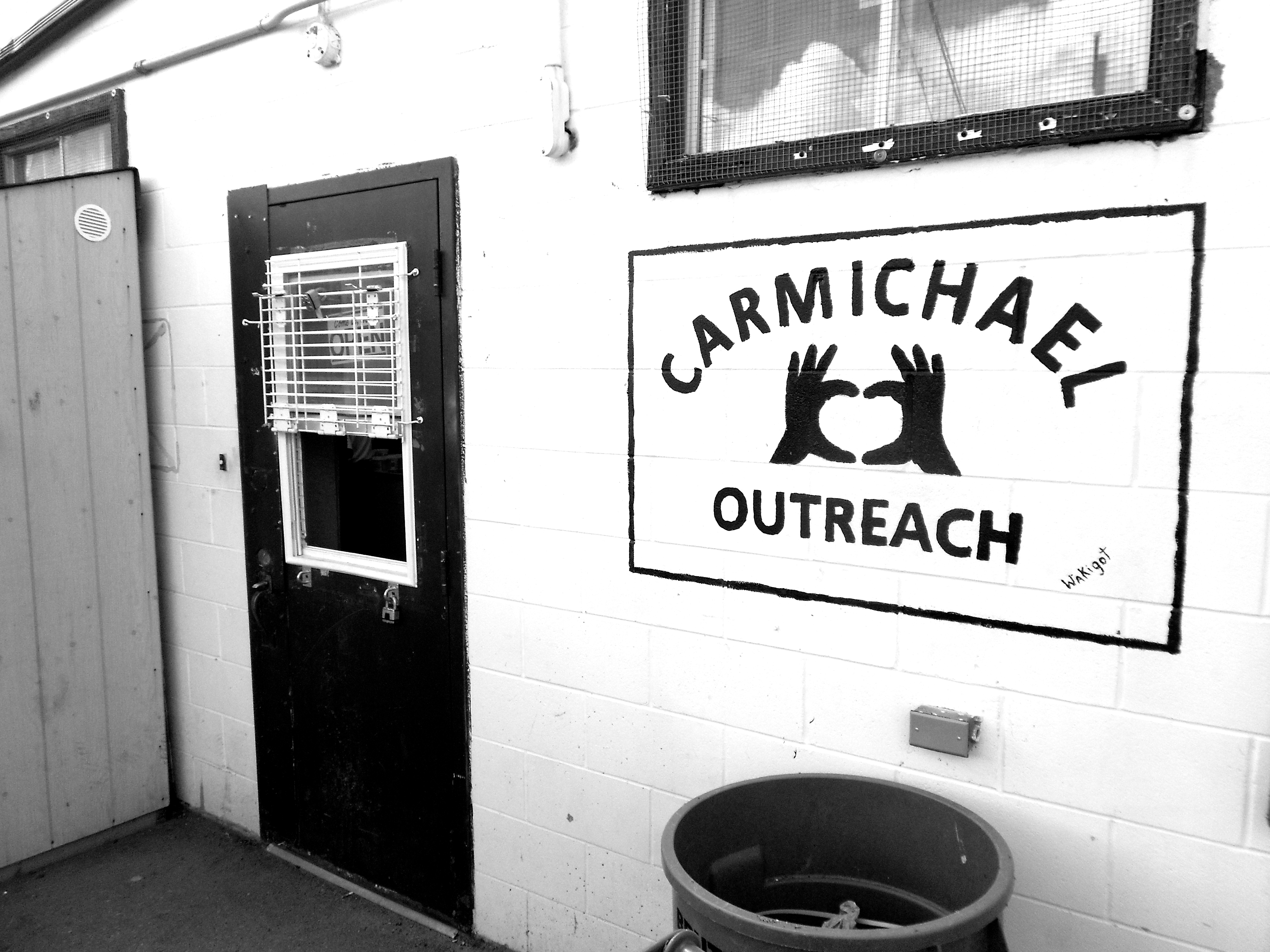
    Carmichael Kids' Camp

    I recently had a long, meaningful conversation with a former girlfriend when she said she had learned a lot about herself in the past several weeks. I asked her specifically what these were. Among more profound familial lessons was her new life decision that she was never going to have kids. She had expressed similar sentiments in the past, but it had since become definitive, and unless something changes significantly in her life in the next ten years, she said, that is how it is going to stay. As her former partner, when she would bring forth such ideas in the past, I would be selfishly disappointed of such a bold statement as if it were an avoidance of commitment (like this is something I should ever be sour about), but now, after a week of heading up a Kids’ Camp, I can understand her new realization. And though I would never plainly state what she has, I am currently examining the possibility that I hate kids.

    Thirty-six community children ran my ass ragged through their extreme energy and stubborn defiance to simple participation. Their guiltless tears and their visible joy of catching frogs disgusted me. I shouted more than I spoke. I swore at children in utter resignation. I wished for their demise under my breath, and sometimes over my breath. I could tell which children had structure and discipline in their lives, and tried to rationalize the multitude of the children’s flaws with the difficult lives of their parents. But mostly I blamed the children themselves.

    Nearing a quarter-decade of life, my peers are deciding that their libidos and personal energy can be well-spent on the magic of progeny. This is admirable. What has been called ‘our greatest resource’ is comprised sadly of miniature caracatures of the absolute worst of ourselves. The disorder-diagnosed, bed-wetting, pill-prescribed, blatantly selfish human beings that will one day be the drivers of our communities and councils of our cities. Tar sands seem almost preferable.

    People always say that it is different when it is your own kid, a truism that I cannot speak to. And I guess that is something I could look forward to; the chance to unimpededly warp the mind of a human unlike I have ever been able to do before because of previous parenting/brainwashing. My closest comparison is eating a rotten vegetable from my own garden; it somehow still tastes better than the neighbours’.

    The one kid at camp that wasn’t addicted to meat, sugar, video games, or attention, still managed to annoy me. He ate what I ate, he enjoyed reading rather than pestering other children, he was interested in science. But because his parents (with whom I likely have much in common, who likely eat the way they eat for presumably the same reasons as I) brainwashed him to a painful degree, it bothered me. If my child grew up with my exact ideals, I’d be disappointed; zero surprise, zero independent thought, zero digression. Zero evolution.

    But children, you may say, are impossible to hate. Their crooked teeth, their high pitched voices, their clear vulnerabilities. Their innocence and foibles and miniature features that formulate the broad term of ‘cute’.

    When I drove back into town, minivan exploding with bottles of old condiments and lost-and-found underpants, I waited at a red light next to the gaudy yellow lettering on forrest green back drop of the lamest chain store in the world, DOLLARAMA. I waited at the red light behind a massive SUV with stickers on the back window—stick-figures representing each member of the family including dogs and cats, but with the former father-figure sticker visibly scratched off. The truck next to me, the ultimate fan, had an upside-down novelty Roughrider license plate, showing off his true partisanship and devotion to ignorance. The light turned green and I grinded my teeth.

    Parallel to my former partner’s realization, I could say I have come to my own. I do not hate children. I hate who the children will inevitably end up being. That is, their parents. I hate their future selves and their parents for reasons that I just now understand. Because they are both selfish, ignorant morons. But this examination also reveals that I hate children because they make painfully evident the things that I loathe in myself. Over-controlling, short-tempered flakiness that I despise in others, and only see in myself when I am telling a child named Denzel that he is an idiot. Though I have been well aware of the fact for sometime, it was humbling to see how unprepared I am to be the guardian of offspring.

    I hate the children because the children are me.

  • Indians and Indians

    Carmichael WindowThe Red Indians. That is how I remember friends from India refer to Aboriginal peoples in North America. Please excuse the politically incorrect nature of the title of this essay.

    As Cook and Food Recovery Program Coordinator (the more words you have in the title, the more important you are on a global scale) one of the duties is to run a nutrition program. If my roommates are a typical sample selection, I can guarantee that I eat healthier than most single men my age, but in no way does this qualify me to pretend I know more than mothers-of-five or middle-aged men. I stumble through repetitive weekly sessions about budgeting and Canada’s Food Guide for First Nations, Inuit and Metis populations trying not to brainwash them into vegetarianism that could realistically jeopardize their culture. Currently, the program consists of several Aboriginal mothers and fathers and one Punjabi woman with no children.

    Daily I feed hundreds of people who lack a regular source of healthy food. I attempt to do this with absolutely no ability or knowledge in serving them food that respects their culture, let alone their dietary preference. I serve westernized semi-processed foods out a back window to people verging on physical malnutrition and cultural assimilation. Carmichael Casserole or Spaghetto and Meatsauce sustains their bodies for a while longer and at times it doesn’t even achieve that. I am overwhelmed with how little I know.

    Then I read such articles. Things which are 100% relevant to my current position and I begin to reel. If the government or people are not willing to properly reconcile, then I become immaturely overwhelmed as to how to do so out of a 6′ x 6′ kitchen. Leanne Simpson, Indigenous author, writes:

    “I wonder how we can reconcile when the majority of Canadians do not understand the historic or contemporary injustice of dispossession and occupation, particularly when the state has expressed its unwillingness to make any adjustments to the unjust relationship….

    It reminds me of an abusive relationship where one person is being abused physically, emotionally, spiritually and mentally. She wants out of the relationship, but instead of supporting her, we are all gathered around the abuser, because he wants to ‘reconcile.’ But he doesn’t want to take responsibility. He doesn’t want to change. In fact, all through the process he continues to physically, emotionally, spiritually and mentally abuse his partner. He just wants to say sorry so he can feel less guilty about his behaviour. He just wants to adjust the ways he is abusing; he doesn’t want to stop the abuse.”

    -Leanne Simpson, Dancing On Our Turtle’s Back

    I cannot host reconciliation out of a kitchen. And this is because, according to the synopsis of Simpson’s book (see the above link), “reconciliation must be grounded in political resurgence and must support the regeneration of Indigenous languages, oral cultures, and traditions of governance.” I cannot catalyze reconciliation because I do not really understand the historic or contemporary injustice of occupation. And that is what gets me. Reconciliation is not done solo out of a grimy kitchen. It is done through processes which may have nothing to do with me and steps which I cannot control, but processes and steps in which I can participate in some way. Processes which I can learn about to potentially approach a climate that is fair for future reconciliation.

    The fact that I cannot adequately express my intentions with the word Indian demonstrates my obvious inability to help promote and preserve a culture that is not mine through an ill-prepared nutrition program and sloppy meals. The infinite nature of my naiveté and glaring inability is burning me out. They make me want to run away to the land of the Not-Red Indian in a fit of hedonistic, selfish admission of my lack of knowledge. My lack of commitment. My lack of connection to the issue, which is maybe the worst part—that I could get on a plane and forget about hundreds of years of colonialism and assimilation, because I can.

    I am here to stick around for as long as I can before my brain explodes and I find myself crying in some colonially-cultivated blossoming organic flax field, because I do not want to “adjust the ways” we have been abusing, rather I want to stop the abuse. One of the only ways to do this is participation, knowledge, and handing out egg salad sandwiches to two-hundred people a day.

    Or at least that’s what I’m going to tell myself so I don’t drown in egg salad.

  • The Paint Debate

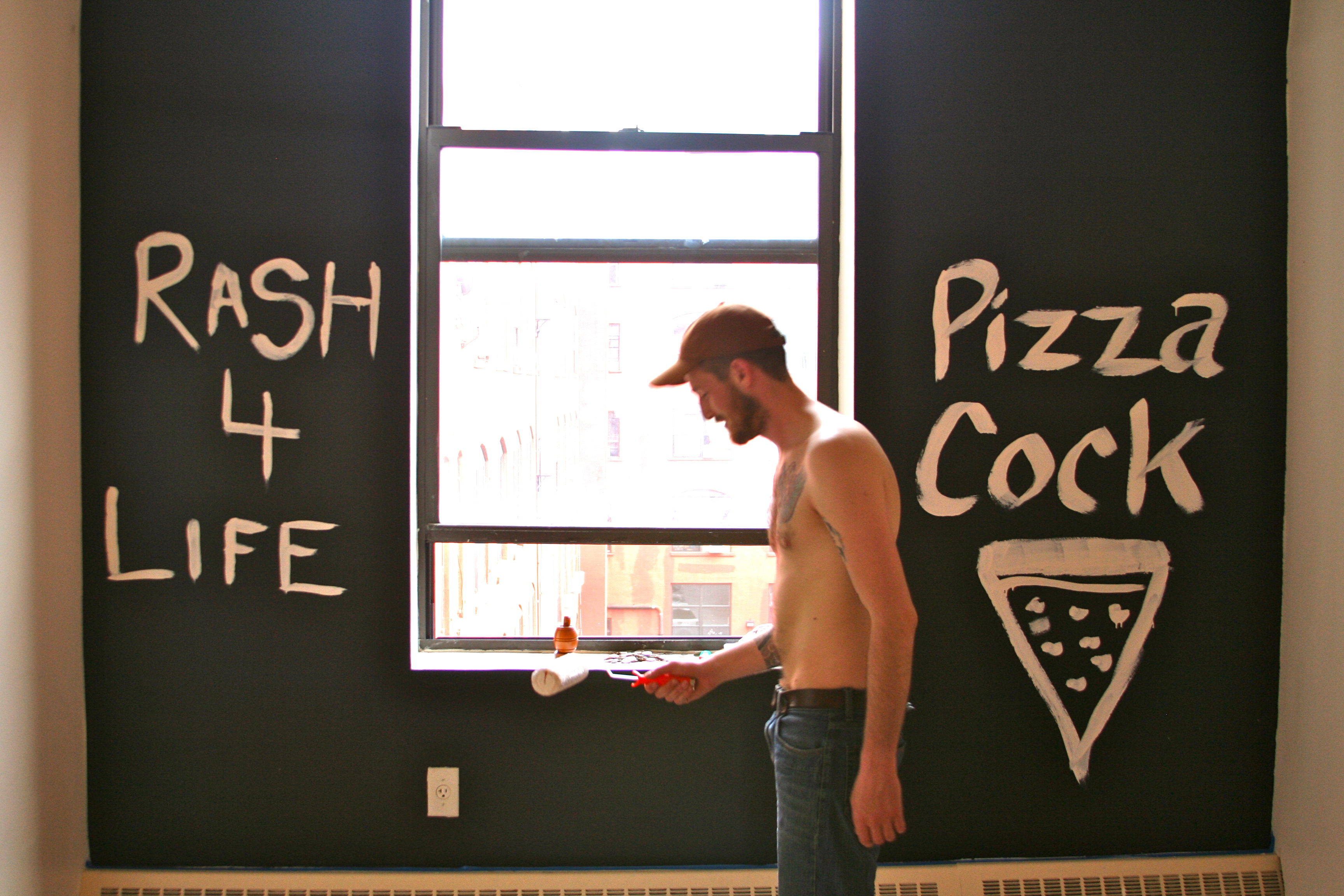
    NYC Painting

    I have never owned a home, though I am in an age where my peers are all deciding that such an investment would benefit them. I find this admirable. Home ownership is something I aspire to greatly, but something which I know with certainty that my immaturity and late-bloomingness make me currently wholly unprepared. So instead I rent. There was a moment in time where I said I would rent comfortably for the rest of my life. I have since revoked this idea, as living in a home with zero roomates and no landlord (except for the bank) sounds somehow pleasant. My views of the following are likely to change in the same way.

    A married couple and I have been having a long-standing debate. This is a debate, to be sure, because both parties are so stubbornly rooted in their belief that no one will change sides, that is, until ten years down the road when I get married and see the lightly-tinted Kokopelli Teal and finally understand how a colour seems to understand my innermost being. I believe that painting the walls of a home or apartment is a painful waste of time and money, and though the debate will remain insignificant forever, the internet is rampant in even less stimulating debate, which therefore legitimizes The Paint Debate. Somehow.

    To state that the flat colour of the wall of a home can even begin to express the personality of a human soul is a degrading to the complexity of personality, which with every individual person would require more than the several thousand shades offered on the Benjamin Moore paint chip section. It would require millions of ever-changing colours; colours that don’t yet exist. The architecture and interior design of a house (if considered art), like the composition of a painting, has thousands of colours and strokes and accents and features that can hint at the surface of a personality, but in no way fully capture the intricacies and oddities of a person. You are not what you own, as Fugazi put it. You are not the colour of paint in your home.

    To state that colour has the ability to change a person’s mood may be a good enough reason to surround yourself in Baby Chick Yellow or the dignified Gibralter Cliffs Grey, though this may hold true only for classes of people who have nothing else to worry about besides superficial interior decorating decisions or choose to paint walls repeatedly to help them forget of their mounting debt. There has undoubtedly been some conclusive research conducted by an authority in psychology stating that certain colours release endorphines and thus, painting a room of a home will guarantee happiness. Similar psychology has been taken up by colonialist governments to bring joy and happiness to the groups of people that they previously assimilated and murdered, and hey, that seemed to work well.

    To claim ownership by way of paint on a wall is an illusional attempt at false ownership. It is evident that a human being purchasing a home will instinctively paint the walls regardless if the colour is something they would like in another context, and this is the Dog Piss Complex. Dogs will urinate on things even when they do not have to urinate, dribbling drops onto a fence or hydrant in a primal game of grafitti, simply to make more things their own. Humans have civilized ways of pissing on property, and thousands of colours of piss to choose from. Besides all this, simply put, ownership is a false dream. Possession is nine-tenths of the law, they say. But to have ownership over something, besides some twentieth century discipline system, is nothing. Ownership is a form of entitlement. A person’s home is no more theirs than it is mine, besides a magical thirty-year digital transaction or physical currency swap. Besides the fact that I would get arrested for attemping to enter it on my own will, and besides the fact that I might be sent to the hospital, mental or otherwise, for painting it myself. Claiming ownership of four walls and a roof is as misguided as claiming ownership over the air that resides within those walls. Painting those walls to mark territory, then, is ineffective.

    To protest living in apartments of drab white walls, to make a statement by painting walls elaborate colours, is something I can support. Change for the sake of change is something I can support. But when change is done in the name of personality, of ownership, of permanent mood-boosters, then I lose interest. Because then reason is out the window, and some bizarre cultural rite of passage comes into play. Adulthood or something.

    All this to say that I have yet to find a reason that I myself would take the time and financial discourse to paint the walls of my dwelling, and that I have a difficult time understanding those that do. There are indeed colours that I prefer over others, this is normal. But to base decisions or pocketbook numbers on these colours, even if they invoke the warmest of positive feeling, is not worth a person’s time. I’d rather sit here for three hours and write a piss-poor essay than waste my time rinsing out brushes and taping floorboard with green tape. The theorized, marginally-improved mood brought by the finished product would not offset the 100% worsened mood caused by mere seconds of the painting process.

    I do not consider it wrong, dumb, superficial, or negatively adult, I just find it as another case of myself not understanding human habit or what has grown to be the norm.

    I think I’m afraid of committment.

    And everyone sits patiently as they wait around for me to grow up.

    NYC Painting 2

  • World Crokinole Championships – The Great Paternal Experiment

    The following piece was featured on Ominocity.com out of Saskatoon, Saskatchewan.

    Crokinole 4

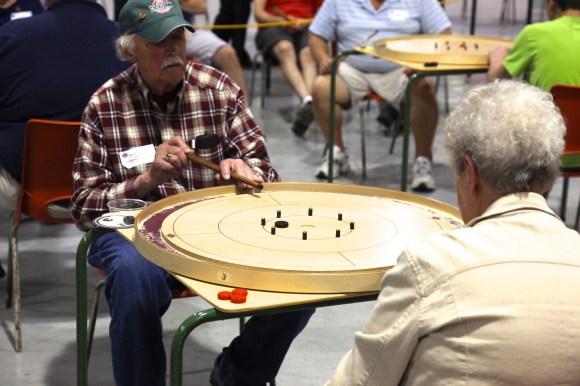
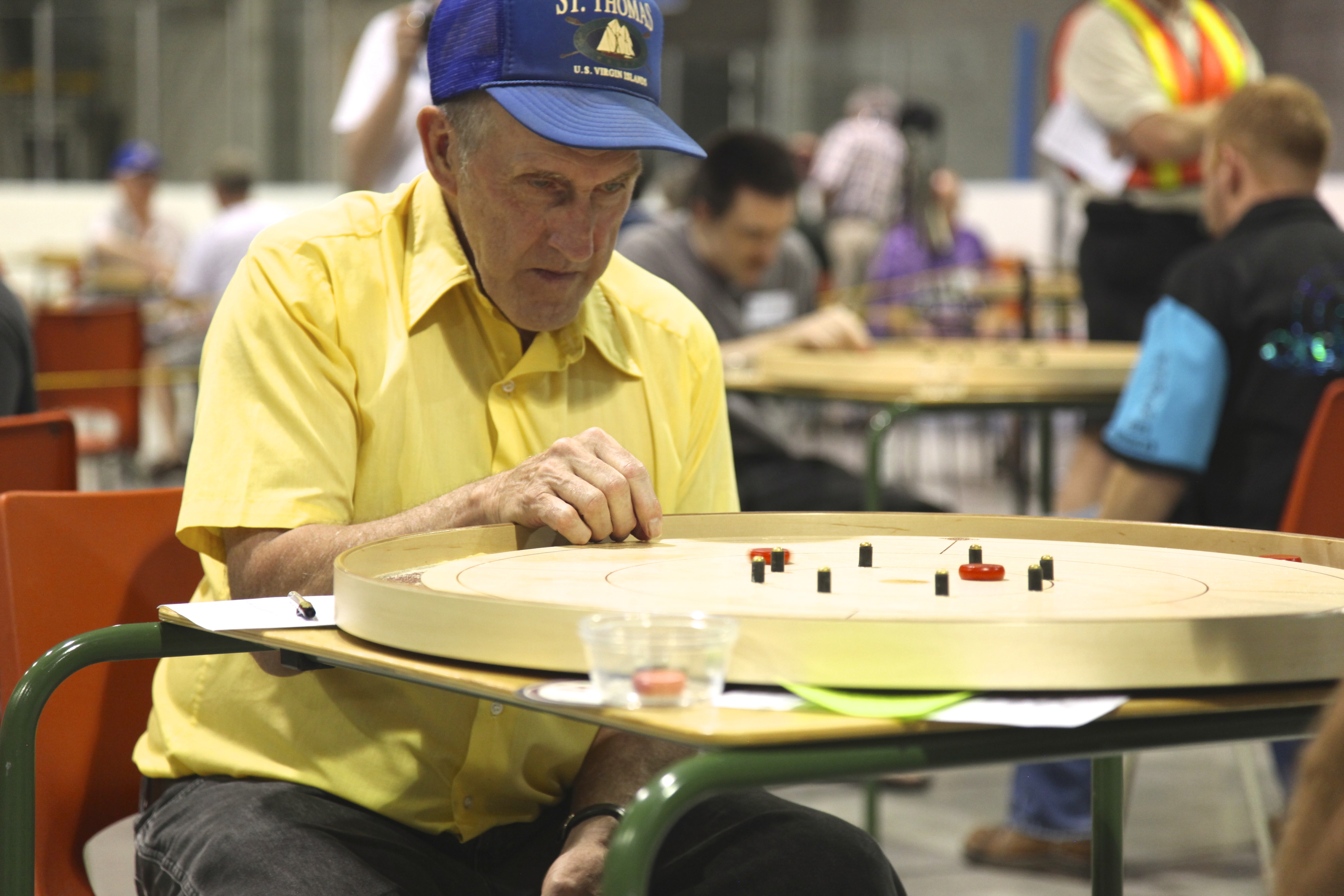
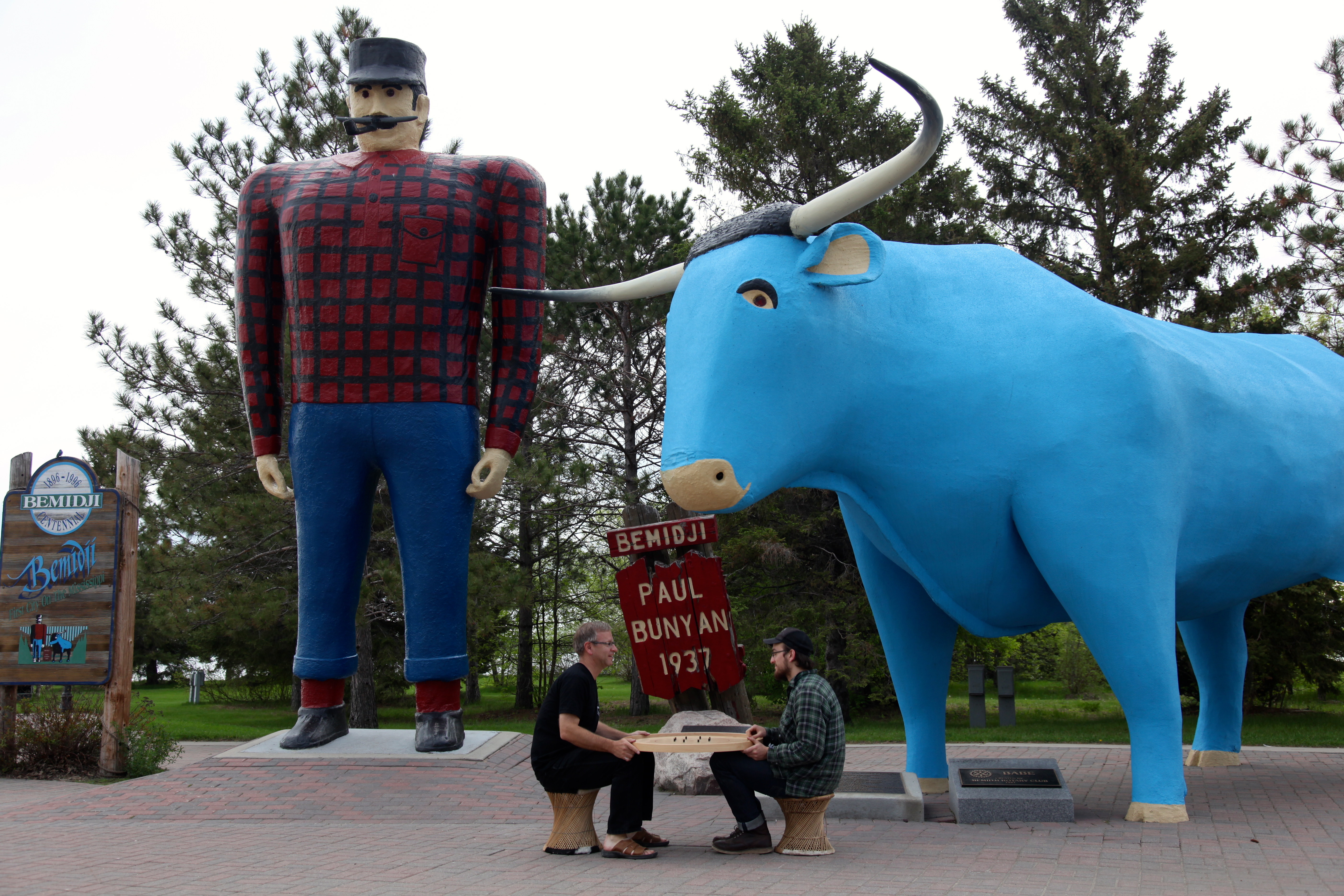
    If you’ve never heard of crokinole, you’re likely not a citizen of the disintegrating Canadian countryside. If you are from the North of 49 and you still haven’t heard of crokinole, you either a) are from a city, b) didn’t grow up in a church, c) grew up with a Nintendo, or d) had unloving parents. Crokinole is a two or four person game played on a 66cm-diameter circular board, in which each player has a determined number of discs made of lathed wood. Each player purposefully flicks these buttons with a finger or wooden cue towards a hole in the centre of the board a quarter-of-an-inch deep and only slightly larger than the button itself, attempting to avoid the eight stationary pegs that guard it like pawns on a chess board.

    It is a game you may have played with your loud uncle and your wrinkly aunt before Christmas dinner. A game in which your grandpa is likely indomitable in between heavy naps in a dusty cardigan on an itchy couch. It is a game you may have tinkered with not knowing the rules (of which there are perhaps three), or, as previously determined, a game you may not have ever even heard of. For myself and my father, it is the game in which we competed at the World Championship in Tavistock, Ontario on June 1, 2013. The World Crokinole Championship, widely revered as the Stanley Cup of crokinole tournaments, the Kentucky Derby of the forefinger stallions, centre stage of peculiar rural males aged 39-88, was obscurity and sportsmanship perfectly defined.

    Crokinole 3

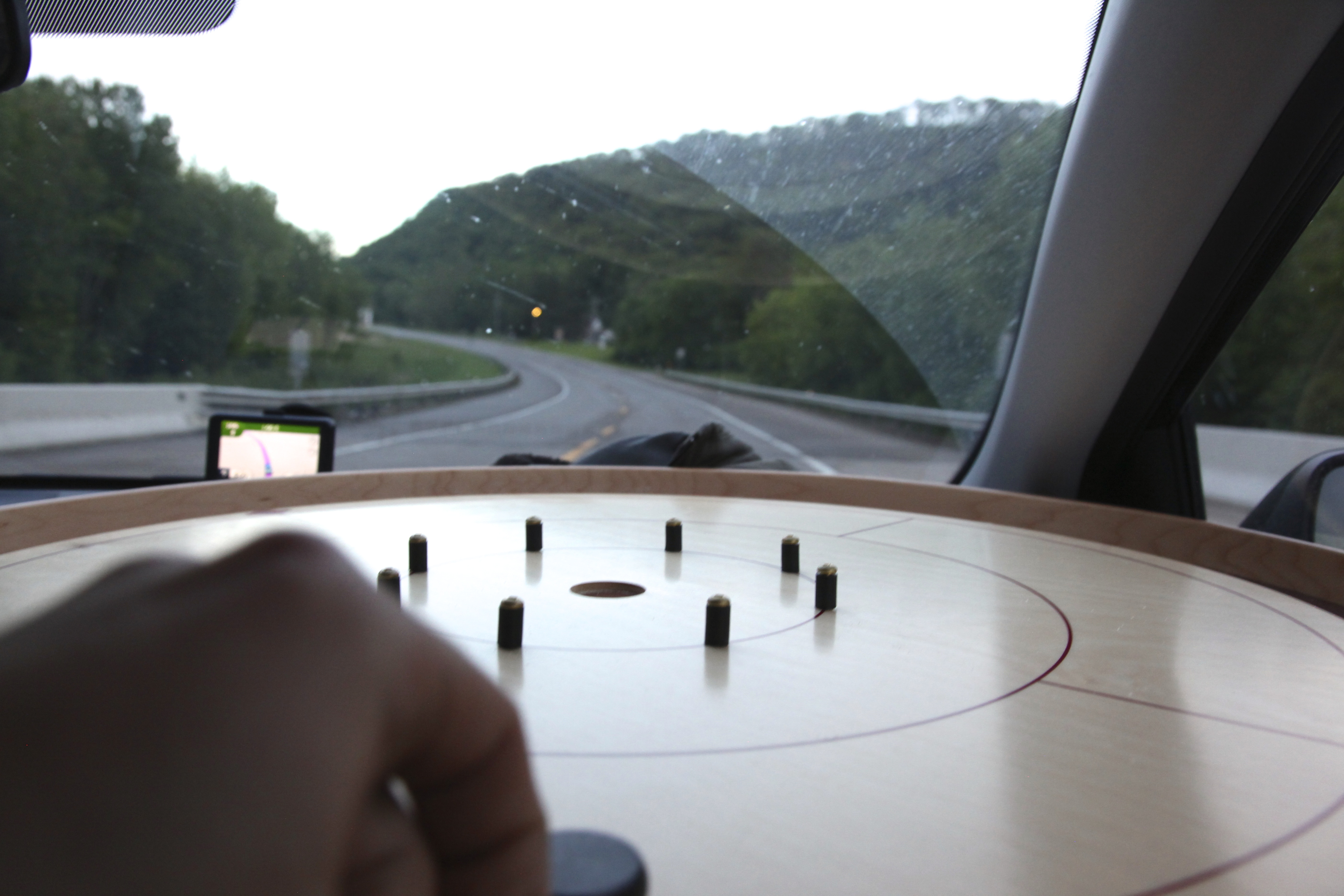
    After driving straight through six U.S. states and two Canadian provinces, we pulled into Tavistock, home of the oldest known crokinole board dating back to 1876. During the drive, when our periods of silence (often reaching four or five hours at a time) were broken, we discussed religion in many contexts; traditional theology, silage and dairy production in devout farming lives, and most importantly, righteousness through crokinole techniques. We made our ecclesiastical pilgrimage, fasting from sleep and whole foods in the goal of reuniting westerly disciples with the holy land of immaculate wooden conception. We were pilgrims for the board of life. The home of crokinole was like I had dreamed it would be as a kid of twenty-four years old. An established farming community of dairy producers with a Main Street that boasted a two-decade old Chinese Restaurant, local credit union, and butcher shop. As one might expect, side streets were dotted with various forms of seniors’ homes.

    Upon arrival, silence was broken by John Schultz, the bald, wiry, extremely pleasant chairman of the World Croknole Championship, asking, “Are you folks here for the crokinole tournament?” He woke us napping in the park—our first hours of horizontal sleep in two days—and it finally occurred to me what we’d done. We drove twenty-two hours for crokinole. In the same amount of time I could’ve driven to the flawless forests of northern California. I could’ve driven to Nunavut. “Holy shit,” I thought, “I could’ve just travelled an hour and played a game of crokinole with my grandpa.” But instead I drove twenty-two hours to play with all of the grandpas of southern Ontario. John Schultz continued to tell us that other folks drove in from Michigan, New York, Ohio, P.E.I.. We cleaned up, grabbed our board, and began our pre-tournament practice on a picnic table in the shade of Queens Park.

    Crokinole 2

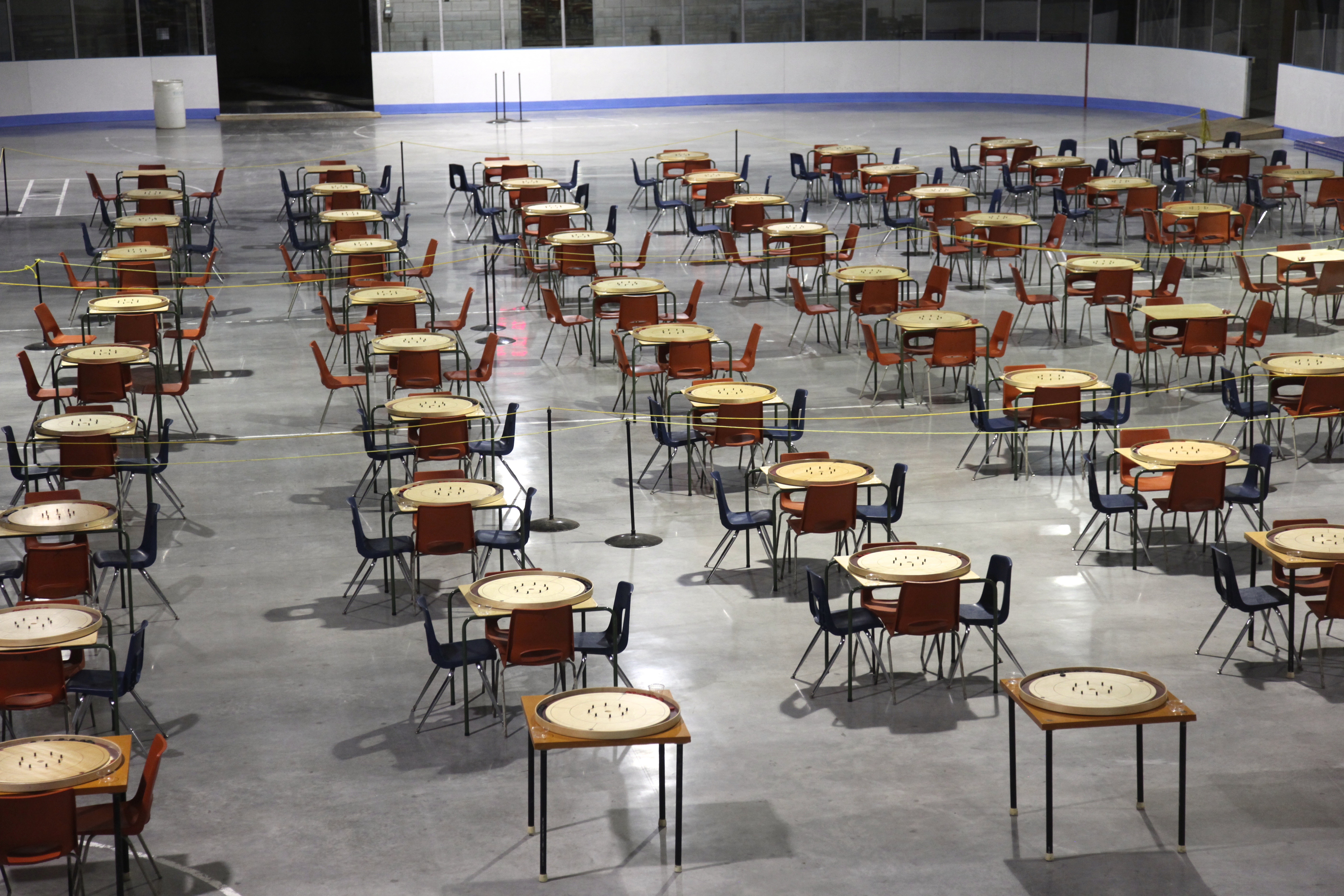
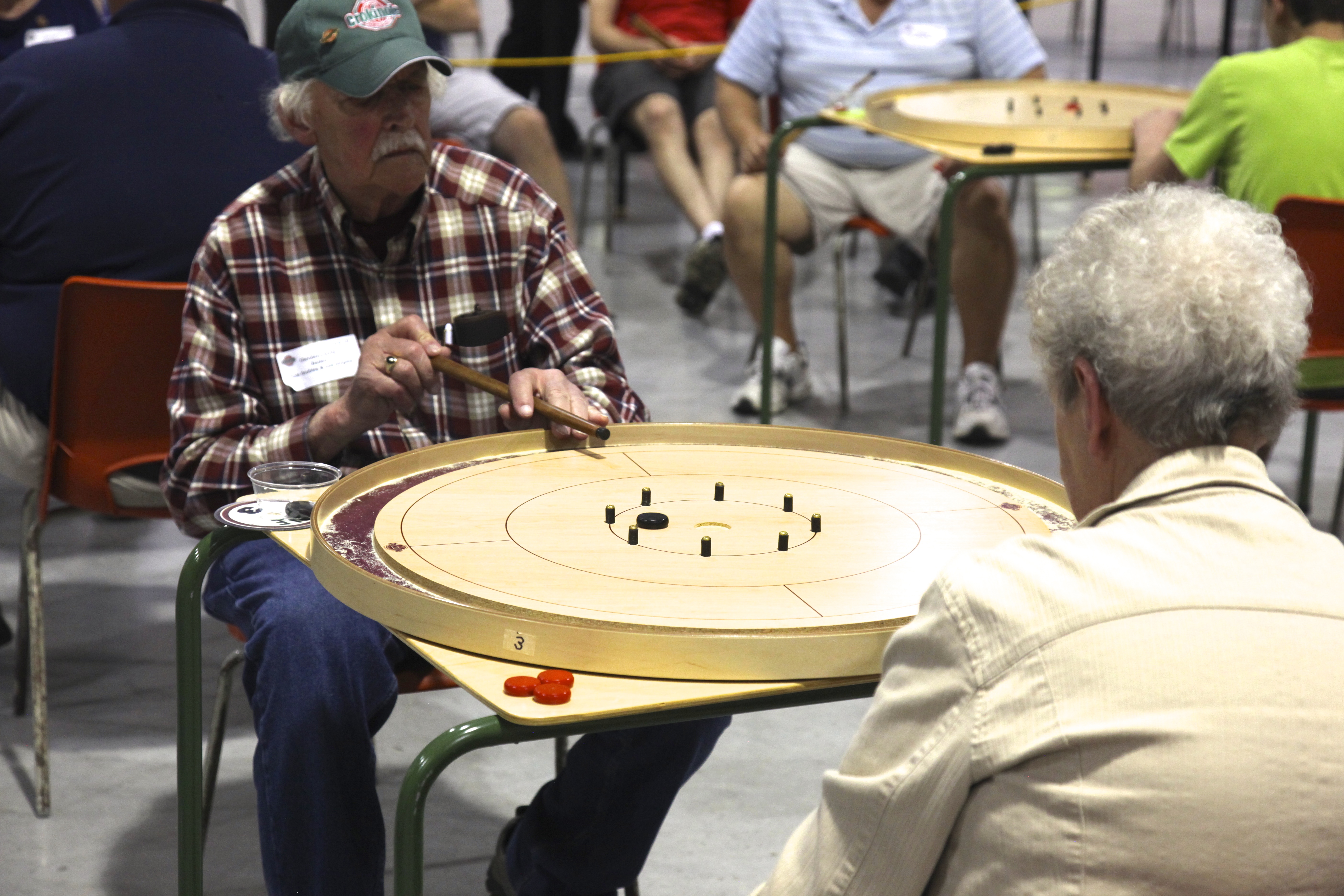
    On Saturday morning when I woke up at dawn to practice before competition began at 8:30, the Ontario air was thick. The humidity weighed down the crokinole buttons as if Mother Nature rubbed each one on her sweaty chest. After a breakfast fine-tuned for finger endurance I followed my father into the arena which housed over 64 freshly waxed, previously untouched boards set up in a grid on the concrete slab of the dried up hockey ice, all partitioned by yellow rope. Competitors and spectators in jean shorts and agriculturally branded caps floated around the merchandise on the perimeter of the rink. Those keen on capitalizing on the lucrative crokinole market sold World Championship t-shirts, ballcaps, boards and board accessories. People competed in the skill shot competition and captured photos of the trophies which were handmade for the event (it is difficult to find a golden plastic figurine of a man playing crokinole to fix to the top of a regular trophy). When tournament competition began, over 280 competitors showed their masterly applied-geometry skills and muscle memory. Each competitor sat down at a table with ten strangers for eight minutes at a time until the horn sounded, shaking hands and wishing luck to people they hoped to blank eight points to zero. Saturated in Canadian politeness, if crokinole isn’t a game of true sportsmanship, it isn’t anything at all.

    Crokinole

    As for the competition, unfortunately the prophesy from aged-competitor Dave Skipper that, “people with beards and moustaches shoot better on these boards,” didn’t prove true. I, one of the few participants with a gnarly beard, didn’t even place in the top half of the draw, and the eventual singles champion, John Conrad, had the hairless face of a teenager, although he was surely approaching his golden years. My father proved to be worthy competition, scaling the ranks of eleventh of 86 participants in the main draw, making the playoff round with the true elites. The final match drew crowds upwards of forty, those who had already sweat through their crokinole team jerseys and sweat bands, groaning and whispering with the final shots of the game. Hands become shaky with such pressure. For one of his final shots, Conrad made an incredible triple take-out. Someone in the crowd said in praise, “I think that was a statement.” In the finals, fathers sat behind the yellow rope, watching sons in competition, offering familial support. My father and I participated in the great paternal experiment that is crokinole.

    While discussing board consistency during the final round, a man who placed third in the doubles category, making no excuses, commented: “The heat, the humidity—we have been battling the elements all day long,” as though it were an Ironman competition, which, in a way it was. The oldest participant was 88-years old, and was celebrating his 50th wedding anniversary at the tournament. He had competed in all previous fifteen World Championships that had been held.

    If it were a televised event, and if the champions were interviewed and asked to describe their feelings, I imagine that like any other world final, they would stumble and mumble in speechlessness. There is no way to properly explain a world championship of any sport, and it only becomes more grueling when it is a celebration of nearly-perfected obscurity. We travelled knowing full-well that we were participating in an antiquated parlour game that itself was competing against screen-bright technologies for space in the family room. What we didn’t know was that our hands would shake and that we would miss shots from fried nerves in a game usually as relaxing as a free massage. We didn’t know that we’d have to practice for another year to make even a dent in the crokinole kingdom.

    Back to the grind. Back to the board.


    Crokinole 1

    Crokinole, The Finals

    Crokinole Boxes

    Crokinole Cues

  • The Melt

    I had a cup of coffee about twenty-one days ago. First time in a decade perhaps. Tasted fine. Any thing tastes good with three scoops of white sugar and some non-dairy powdered whitener. Put that shit on an old worn out boot and you could eat the damn thing. I had coffee because someone needed me to have coffee with them so badly that I didn’t say no. He waited until he had absolutely no choice but to call someone, on the brink of self-destruction sitting in the park.

    I drank beer and pissed in the bush about ten times and eight times respectively on Friday evening. The beer kept appearing in my koozie and I kept talking, more than I may have talked in a few months. The topics discussed included petroleum, Aboriginal rights, picky eaters, atheism, plastic bags (reusable vs. one-time use), housing, Harper, Meatless Mondays and veganism, which brought us back to petroleum and Aboriginal rights and Harper. We cycled into the same topics on purpose, hitting the same points eloquently and intelligently, but after piss number seven the cycles looked more like a child’s attempt a drawing a circle. I held the left wing, and he, the right, and pulled so hard that beers brought left and right so close that they nearly touched.

    Unless we are struck by bicycle-stopping winds that prevent me from delivering two donation receipts to my Alternative Measures Program this week, I am all but in the clear for my passionate stencil incident. “It wasn’t stupid, it was ill-advised,” said the mediator, “You’re not a stupid person.” This was my first mediator/participant that didn’t speak down to me like I was in grade school.

    These stories have a theme. The theme could be summed up by a phrase I heard this week in the alley by our garden.
    Just another goddamn bleeding heart. No perspective or guidance. With no fucking clue.

    And thus I’ve hit a new stage of life. The catatonic stage. The one where you get home from your day and you realize that having two jobs you love isn’t enough to keep you happy. Karma has struck you lonely because of selfishness. Booze, bonfires, television, hobbies cannot distract you like work can, nor can they make you feel like your days are well spent. You are tired but you aren’t too tired. Laying on the couch staring at the ceiling, standing in the kitchen staring out the window, sitting in the work van staring at the steering wheel in the complete city silence, with no thoughts except simultaneous self-pity and self-loathing based on things you can’t even remember. Getting home is no longer a mental relief because you are alone with your thoughts, trying to find where one balances passion and sanity, trying to see how long you can drown your emotional and relational issues in work tasks and busywork. And when those begin to sour then the rest begins to heat up. The coffee melts the mandatory donation receipts and mixes with the beer.

    The spring melt has ended, but the summer brain melt has just begun.

  • Witchcraft on Water

    It is perhaps ill advised to housesit for two different homes in one week when you are overwhelmingly busy and underwhelmingly bothered by relationships. I am here to keep the Communist-inspired dog from getting lonely, but when my only comfort of the weekend becomes playing with and speaking to a self-sufficient domesticated animal who is so deaf that an airhorn in the ear would not even make him lick his balls, then I wonder who is in need of help. Who really needs the doors opened for him here, Fidel?

    But it gave me the chance to witch for water. Grandma suggested I do so, saying that it is in the family’s blood. Water witching consists of walking around in a field with a y-shaped branch or several metal pieces to find underground water, minerals, pirate treasure, sweet sweet oil, underground chocolate rivers, or anything you fancy you are looking for. Many may consider this a form of quackery but I see it as a return to the roots of our ancestors. Ancestors: those people with stolid faces and dirty trousers who were able to plant a garden with seeds they sowed themselves with water they found themselves with a horse they broke themselves, all without the divine assistance of an international database of information, or even a single book, that is unless the Bible explains in detail the steps of dowsing. But as far as I can tell I found a few spots where the water table opened its top to the arms of witchcraft. I cut and bent two metal clothes hangers into L-shaped instruments, walked around in the several-acre long yard with the hangers balancing delicately parallel between my four fingers. Beforehand, to assist with the exhilaration, I downed three beers. I hit a point between two trees (fuck if I even know what kind of trees they were. My ancestors roll in their graves, and only partially because I said ‘fuck’). The arms of my instrument swung inwards and crossed at the point where water was supposedly resting underground. I smiled and maybe even thrust my hips in a south-easternly direction.

    You never know if water-witching is one of those things that you want to happen so bad, that you make it happen. Like seeing a ghost in your grandma’s basement, or feeling the hand of Jesus on your shoulder when singing at church. This system doesn’t work for anything that matters; I want most of Regina City Council to get a raging bout of herpes, but I cannot will my subconscious to tilt my water-witching tools so that those old troglodytes start growing sores on their genitals (I’d have to contract that kind of work out to someone with more hip-thrusting talent.) Positive energy can have a great affect on the outcome or the outlook of many things, I am learning this slowly. Sweet shit, I maybe now know why I have been consistently so miserable.

    I really wanted to find water. And though I don’t have the tools to dig a well to see if my witching was water-worthy, I have faith that it was. That my ancestors left me one useful, practical skill. It will come in handy when we in the lower class don’t have homes and don’t have running water so I can witch for water, potash, oil, an underground bakery, to survive.

    The only thing I can hear is Fidel licking clean his dinner dish on the tile floor, the rest of the neighbourhood is silent. He needs me to feed him, and that’s about it. He can piss in the basement, he can lounge his days away. I need more than to sit around and will for things to happen, lounging decades away with my hands down my pants. Positive energy isn’t that strong. Willing for water to exist, and getting up when I hear the door chime and let the dog outside to take a shit, have two entirely different outcomes.