Category: Writing

  • The Village God of Labour

    Pasha, on break from installing new rain gutters, looked down at me as I sweat, shovel in hand, knee-deep in Ukraine’s famous black earth. “Crazy Nic” he said. I didn’t expect him to say something in English so I didn’t catch it. He repeated in his own language: «Шалений Нік» (shaleney Nic). Then I understood.
    Olia and I went for a walk to the forest just to see what the sun and wind felt like from from different angles. Upon return, the neighbour, bent ninety-degrees at the waist hoeing potatoes, couldn’t really understand that we came back without foraged mushrooms. A friend has said that she finds it sad that her parents don’t know how to have fun, that every spare moment is spent processing apples, feeding chickens, digging potatoes, canning tomatoes. They would never go to a movie or concert. This weekend, her and I will go to a bar on Friday, a concert on Saturday, and another concert on Sunday. We are of the generation that must always constantly forever be entertained. There’s not much entertainment in the village since the discobar closed.

    Abandoned disco-bar.

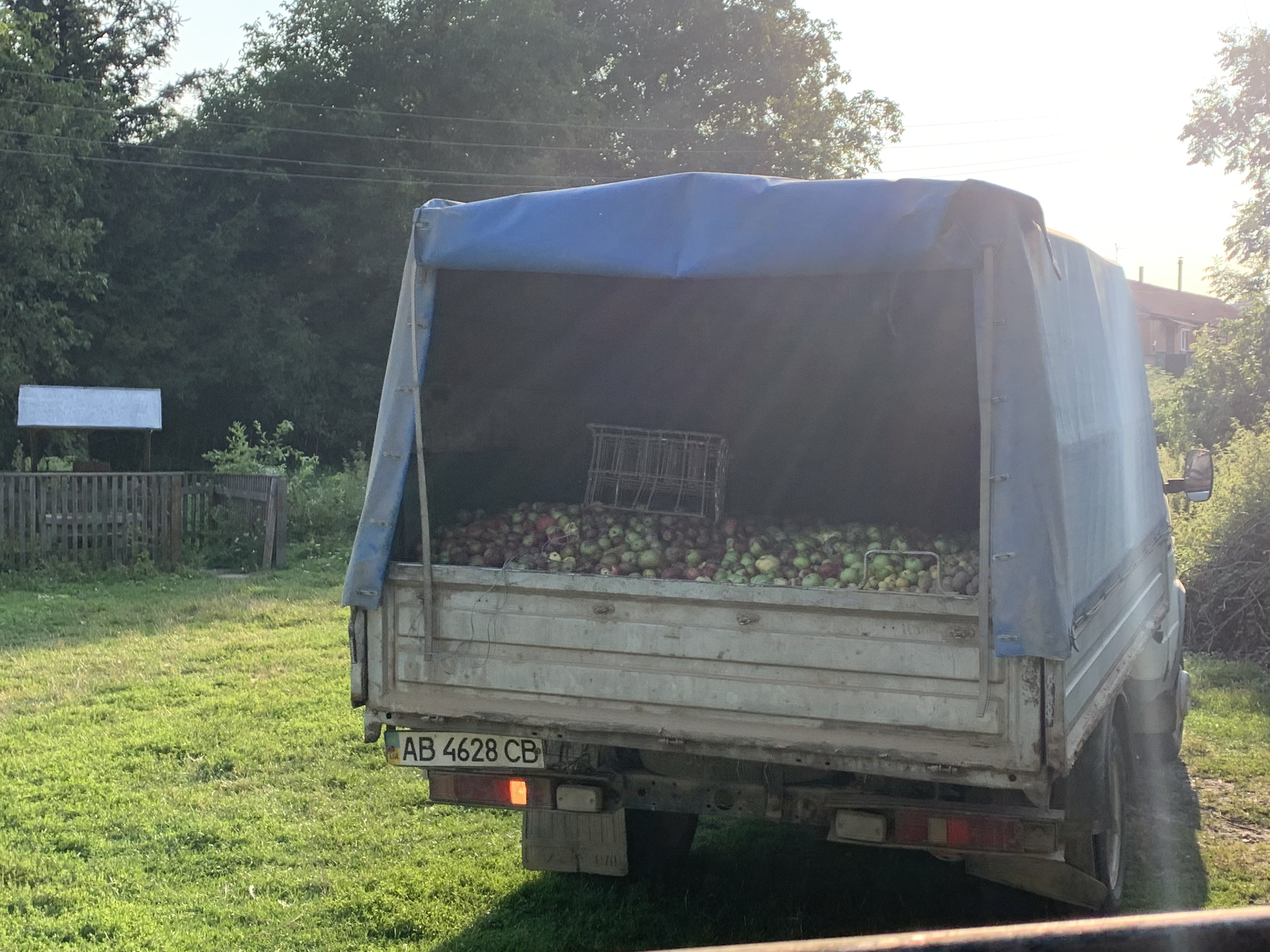
    Maybe I should get a job. Selling bread-flavoured sodapop (kvas), selling honey, bike courier, taxi driver, bus driver, teaching english. My anti-capitalist brain tells me that my desire to get a job is just me being insecure about my worth in a society that values you solely based on your salary. My bank account tells me otherwise. And seeing old people sit on the concrete selling wilted plums makes me feel guilty for being previously paid an hourly wage equal to their monthly pension, as though I had something to do with global wealth inequality and amassing of colonial wealth. So I find solace in incorrectly sewing and then seam-ripping adaptive underwear for veterans with prosthetics. Or carrying a long stick with a hook at the end of it, letting gravity pummel me with apples as I shake branches of 100-year-old trees to collect fruit to sell to the juice man for 10₴/kg (25¢/kg). Each metric tonne we collect eases my insecurities, each apple welt brings me closer to the village god of labour — the permanently bent-over бабуся (babusia).

    It wasn’t clear to me why Pasha thought I was crazy. For digging a 60metre long trench from the well to the garden to provide water to the vegetables in increasingly dry summers? Or for moving to Ukraine, spending time in the village when he was just a few years from conscription-age and wanted nothing more than to leave a place he was not legally allowed to leave, being told by his mom that he had to help out his uncle, the only carpenter in town? His uncle is now in jail, having paid a bribe to avoid military service. Now there’s no one to finish the eavestroughs.

    As I Support The Arts by gently bobbing my head to synthesizers pumping through clouds of haze at a festival in Kyiv (a task I convince myself is more important than ever when a culture is under attack), village labour takes on a different tone in occupied and nearly occupied territory. Demining. Reselling pieces of exploded enemy drones as a fundraiser for new defense drones. Trying not to be killed. There’s an absurdity to art in times of war, says author and soldier Artem Chekh. But also that art is the only thing that allows for a “tolerable existence”. Make art not war, sure, but what do you do if someone makes war on you? (Village) God (of Labour) knows that this blog post or a John Lennon song won’t prevent a train car from exploding. But neither will picking metric tonnes of apples.

    As always, if you’re able, please consider donating below, or reach out if you are interested in donating somewhere else.


    Musicians Defend Ukraine

  • A No Hope Guarantee

    Everyday, bylaw officers, police officers, and other city employees confiscate and destroy the sentimental and survival belongings of people who are forced to shelter outside across North America. In Canada, people’s internationally recognized human rights are generally enshrined in the Canadian Charter. Tens of thousands of (billable) hours and hundreds of millions of dollars have been spent by governments on lawyers trying to convince old (generally white) judges that their laws are compliant with the Charter, uphold people’s human rights, and are necessary to the functioning of a liveable society. Seemingly, the discussion of general decency is generally ignored and not a consideration in the legal profession.

    For my final paper in law school, I wanted to practice writing an argument that could be put in front of one of those judges that one law in one municipality that allows the confiscation and destruction of people’s belongings violates people’s Charter right to be free from cruel and unusual punishment. It was later published by the school’s student journal. If you’re super bored, you can read it here. Below is the summary of the paper:

    Since the inclusion of section 12 in the Canadian Charter of Rights and Freedoms (the “Charter”), much has been written about cruel and unusual punishment. However, relatively little attention has been paid to the issue of cruel and unusual treatment. As society becomes increasingly regulated and individuals interact with government through administrative bodies with broad discretion, clearer protections against cruel and unusual treatment are necessary to fully realize the intent of the Charter right. Over the past two decades, the City of Victoria has progressively restricted the use of public spaces by individuals experiencing homelessness. While these restrictions have been challenged under various Charter provisions, section 12 has rarely been considered. The 2023 amendments to the City of Victoria’s public space bylaws offer a timely opportunity to consider the application of section 12 in the context of non-punitive administrative decisions that amount to government treatment. Although the test for cruel and unusual treatment requires further clarification, Victoria’s bylaw scheme underscores the need for section 12 analyses to more explicitly address government treatment, or risk neglecting the Charter’s dignity-centred focus.

  • Multi-Millionaire Hockey Player Declines to Comment

    Ovechkin at 2005 World Juniors on the bench, injured

    thirteen lighting of the lamps

    until the Great Eight

    Vladmir’s number-one horse

    surpasses

    the Great One

    Donald’s number two, Governor

    Gretzky merlot to be served in Donald’s Riviera
    Ovi scores and Crimea gets a free PapaJohn’s

    greatest scorers of all time
    one-hundred-twenty empty net goals between them
    mom says they’re both

    cherry pickers

    podcast hosts don’t seem to talk about that


    Connor McJesus roofs

    one in OT
    heals the trade war

    tariffs explode
    supply chains re-weld
    the 49th etched deeper
    illegit sovereignty upheld

    Sid the Kid sings home and native land

    on key

    Fentanyl-czar can now eliminate the scourge

    of drugs over the deeper etch
    street hockey game
    puck rings off the
    iron law of prohibition

    who invented hockey again?


    Vladmir’s anti-propaganda law

    so Provorov boycotts

    Pride Night
    rainbow hockey tape

    two Staals secretly stick-tap

    for Donald executive-ordering
    two genders
    people X off the scoresheet

    Orthodox Pope supports

    the full-scale invasion:
    a conflict against sin
    and pride parades

    but remember it’s the

    Patriarchate
    who is oppressed

    hockey is for everyone

    but especially for
    people who look like
    the two highest scorers of all time

  • White Van Privilege

    White Van Privilege

    White Van Privilege follows the life of one white passenger van from conception to death: first roadtrip to final sale.

    White Van Privilege is a collection of poems that considers the views from the front driver’s seat of a 2008 Chevy Express 15-Passenger van, and from standing next to a tent in a homelessness and drug-toxicity crisis made worse by a global pandemic. Turns out, the views are pretty similar.

    All proceeds go towards my law school education with which I will use to rapidly dismantle the drug war and systemic racism, law by law, regulation by regulation. And/or authenticate your last will and testament. Either way.

    Order today and there’s chance you’ll get it before December 25, but I doubt it.

    ballsofrice.bandcamp.com/merch

  • Homeless Encampments: Connecting Human Rights and Public Health

    “The COVID-19 pandemic is exacerbating long-standing issues related to homelessness, including lack of affordable housing, unemployment, poverty, wealth inequality, and ongoing impacts of colonization. Homelessness is often accompanied by narratives rooted in individual blame, criminalization, and reinforcement of substance use and mental health related stigma. Visible homelessness, in the form of encampments, are manifestations of government policy failures that neglect to uphold the human right to housing, and demonstrate eroding investments in affordable housing, income and systemic supports. Encampments make visible that some in our community lack basic determinants of health such as food, water, sanitation, safety, and the right to self-determination. In order for public health to effectively and equitably promote health and enact commitments to social justice, we argue that public health must adopt a human right to housing and homeless encampments. Embracing a human rights perspective means public health would advocate first and foremost for adequate housing and other resources rooted in self-determination of encampment residents. In the absence of housing, public health would uphold human rights through the provision of public health resources and prohibition on evictions of encampments until adequate housing is available.”

    See the entire article as a PDF here.

  • Poem for the Camp

    Three flags whip and crack 

    over the Ledge like Canada Day celebrations 

    or hangfire warning shots


    It’s Deano’s 52nd 

    we go to McDonalds after an hour 

    deliberating where he wouldn’t get kicked out, if alone. We talk 

    about Willie Nelson. He eats a BigMac, 

    I finish his fries.


    I used to come to the Ledge to rev the engine at rabbits 

    padding along the asphalt

    at cyclists

    at things I didn’t really get


    Deano and I talk 

    about finding bikes in dumpsters. Later, alone, 

    I stop at a grocery store alley

    find an unopened pizza and wonder 

    which of these dumpsters he might’ve been sleeping in 

    the moment the trash was picked up

    and the compactor closed.


    One time with a girl

    through a crack in the stairs 

    I saw someone move in the Legislative basement 

    like a dungeon 

    keeper of secrets I had yet to learn

    bigger than a limestone building


    I sit in the cold, consider

    what it would feel like to have my body valued 

    like expired frozen pizza

    or my blood used 

    to restore the big copper dome. 


    Toes and head numb, I add more wood to the illegal sacred fire 

    and think about Willie Nelson.


    -Regina SK, March 16, 2018

    (Justice for Our Stolen Children Camp, Treaty 4)

    This poem was first published in Tour Book #2.


  • The Payphone

    The following excerpt is from the story The Payphone, first published online at Lunch Ticket, and now available as an audiobook and in print at BallsOfRice.Bandcamp.com. Artwork by Alex Murray.


    A man wearing a navy paisley bandana and wire-frame glasses pedaled his bike to the corner, stepped over his seat, and coasted on one foot to the bike rack at the side of the liquor store. He slotted his front wheel in the rack, strode four steps over to the unsheltered public payphone, lifted the handset, inserted a quarter, dialed the number to his daughter on the east end of town, and waited. He needed to call her Tuesday, today, to see if his cheque had arrived. His watch said 4:42 p.m.

    No dial tone started, nothing, until he heard an automated woman’s voice say in her cold, impersonal way, “Credit twenty-five cents. Please deposit twenty-five cents.”

    The man forgot that the phone company raised the price by one-hundred percent, to fifty cents. He patted his pants pockets, checked his jacket, checked the sidewalk, even checked the pouch attached to his bicycle, and couldn’t find a quarter. He couldn’t find two dimes and a nickel. He couldn’t find anything. There was no one around for several blocks to ask for change.

    “Fuck sakes!” the man cursed. He slammed the phone against the liquor store’s brick wall, breaking the earpiece off. He dropped the receiver and biked away.

    Finish the story at Lunch Ticket.

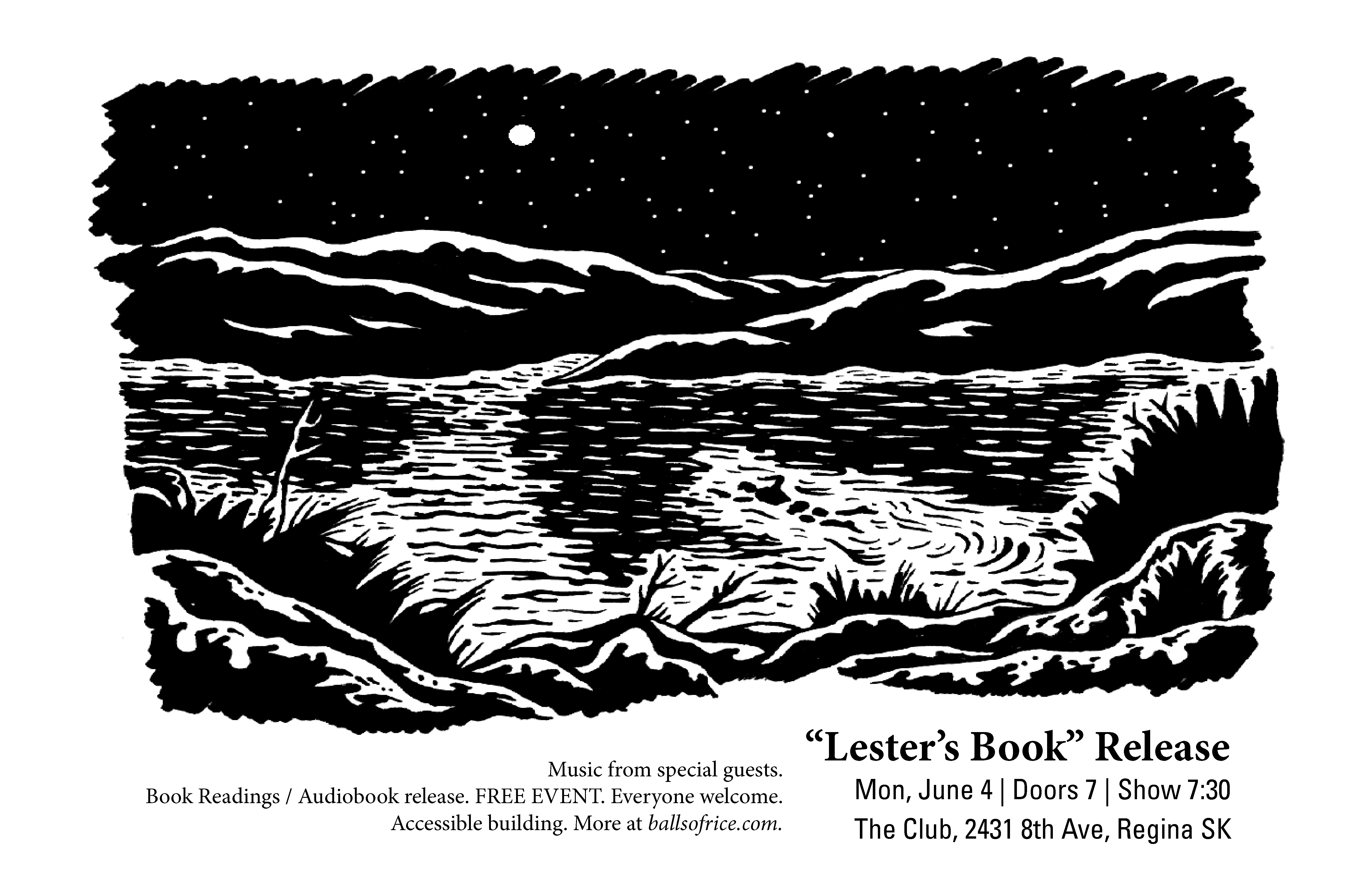
  • “Lester’s Book” Release Party


    I haven’t written through the Balls of Rice channel very much in the past two years as I’ve been working on other writing projects. These projects have included some of those listed under the Books and Audiobooks tabs of BallsofRice.com, smaller articles and book reviews, and more. If you’re able or interested, please come out to the “Lester’s Book” Release Party on June 4, or order a book from ballsofrice.bandcamp.com to see what I’ve been up to. I feel confident that this is some of my best work to date.

    Thanks for checking in.

    Facebook event here.

    [Art by Alex Murray (atmmurray[at]gmail.com)]

  • Fighting For Space

    The following book review of Travis Lupick‘s book Fighting For Space first appeared in Briarpatch Magazine‘s Prairie Edition, and online.

    In 2002, a group of residents and advocates met at the intersection of Main and Hastings in Vancouver holding a 100-foot-long hypodermic needle made out of a giant cardboard tube, stopping traffic. They were protesting the forced closing of a needle exchange on the corner of Main and Hastings in the Downtown Eastside. Earlier, in 2001, front-line workers had distributed clean needles in a trailer outfitted with washrooms, and ensured those using in bathroom stalls didn’t overdose. Affectionately known as “the Thunder Box,” the trailer became one of North America’s first unsanctioned supervised injection sites.

    These stories are among countless actions detailed in Travis Lupick’s Fighting for Space, which tells of the struggle that led to the implementation of Canada’s first official safe-injection site in Vancouver in 2003. The history of the harm reduction movement is one of direct action and protest – an “act first, ask second” attitude that was the only reasonable response to an outbreak of preventable disease and a crisis of premature deaths. Lupick focuses on the Portland Hotel Society (PHS), the groundbreaking housing non-profit that offered low-barrier housing to the city’s most vulnerable, and the Vancouver Area Network of Drug Users (VANDU), the advocacy group that pushed for accessible health care and decriminalization of drug use. The two worked in tandem, with VANDU often willingly taking the heat for direct actions to protect the more diplomatic and funding-restricted Portland Hotel Society.

    The history of the harm reduction movement is one of direct action and protest – an “act first, ask second” attitude.

    The 1990s saw a dramatic spike in overdose deaths and high rates of HIV diagnoses in Vancouver – not unlike the current fentanyl crisis playing out across Canada. But this time the human cost is much higher, with 2017 being the deadliest year on record for overdose deaths in B.C. The strategies used by advocates on the West Coast, honed over decades of persistent work, can provide guidance for similar struggles being newly waged in neighbouring Prairie provinces like Saskatchewan, where fentanyl has killed over 40 people since 2015.

    While revealing the staggering numbers of diagnoses and deaths is key to understanding the scope of the problem, it is the stories of the people who’ve lived through the harm reduction movement that makes this history real. By telling the accounts of people struggling for dignity against politicians and a public determined to dehumanize them, Lupick reinforces two basic claims of the harm reduction movement: people who use drugs are human, and all people deserve safety and health.

    In one of their first organized meetings, members of the newly formed VANDU agreed that they wanted somewhere safe and healthy to spend time, a space that was free of police harassment. The Portland Hotel Society’s first residence was known as the “Hotel of Last Resort.” Simplifying their message to one of “health and safety” – one that politicians and the public couldn’t reasonably reject – has grounded all of their actions and successes in the harm reduction movement. Lupick concludes the book with an epilogue about a family — Mary, Molly, and Mikel — in a quietly triumphant story of three generations living in the Portland Hotel Society, all experiencing stability in their health and housing.

    Lupick reinforces two basic claims of the harm reduction movement: people who use drugs are human, and all people deserve safety and health.

    Lupick does not deify Vancouver’s advocates or their process – rather, he shows them to be people offering the simple necessities of safety and support, while working toward inclusive public health policy. He demonstrates a proven way to effectively build low-barrier health care and housing systems: through persistent action coupled with advocacy, and building partnerships with sympathetic policy-makers. Without this infrastructure, the number of overdose deaths in B.C. last year would have been much higher.

    The current situation on the Prairies is nearly as dire as the one Vancouver faced in the 1990s. Saskatchewan’s HIVAIDS rates are the highest in the country, and with 79 per cent of the people newly diagnosed as HIV-positive self-identifying as Indigenous, programming must prioritize consultation with Indigenous communities. Meanwhile, harm reduction programs have been heavily stigmatized by a predominantly conservative public and openly scrutinized by political leaders. In 2009, former premier Brad Wall said his government would limit the number of clean needles handed out, despite a Saskatchewan Ministry of Health report proving the success of needle exchange programs. In 2017, The Sask. Party threatened community based organizations with a 10 per cent funding cut that would hit operations deemed not to be “core services,” like needle exchanges. Though the party eventually opted against the funding cut, when harm reduction programs are routinely among the first to be threatened, the work being done by those of the front lines is delegitimized and destabilized.

    When harm reduction programs are routinely among the first to be threatened, the work being done by those of the front lines is delegitimized and destabilized.

    For years, doctors, front-line workers, and advocates in Saskatchewan have been pushing for the province to declare a state of emergency regarding rising HIV rates. But if we continue to wait for a provincial government to take necessary action – especially as two newly elected party leaders wade in slowly, in a province where the health of First Nations people is systematically neglected — it may never happen. Prairie activists and front-line workers struggling through those bureaucracies must instead act upon their values and conscience to build systems of equitable health care and human services, regardless of whether they have been granted permission by the state.

    Nicholas Olson is the author of A Love Hat Relationship, a photobook of collectable prairie hats; and a series of illustrated zines with accompanying audiobook narrations. More can be found at ballsofrice.com. He lives in Treaty 4 Territory.


  • Books of the Year: 2017

    If Beale Street Could Talk – James Baldwin

    “Perhaps, as we say in America, I wanted to find myself. This is an interesting phrase, not current as far as I know in the language of any other people, which certainly does not mean what it says but betrays a nagging suspicion that something has been misplaced. I think now that if I had any intimation that the self I was going to find would turn out to be only the same self from which I had spent so much time in flight, I would have stayed at home.”

    -James Baldwin, Giovanni’s Room

    Postcards from the End of America – Linh Dinh

    Simply put, many Americans have become redundant in an economy rigged to serve the biggest banks and corporations. With no one hiring us and our small businesses bankrupted by the behemoths, many of us are forced to beg, peddle, push or steal, though on a scale that’s minuscule compared to what’s practiced by our ruling thugs. As we shove dented cans of irradiated sardines into our Dollar Store underwear, they rob us of our past, present and future.

    -Linh Dinh, Postcards from the End of America, Lower-Class Upper Manhattan, p180

    All Quiet On The Western Front – Erich Maria Remarque

    The Wind Up Bird Chronicle – Haruki Murakami

    Angels – Denis Johnson

    This Accident of Being Lost – Leanne Simpson

    Requiem for the American Dream – Noam Chomsky

    The Lathe of Heaven – Ursula K. Le Guin

    Going to Meet the Man – James Baldwin

    Other Works of Note
    A Love Hat Relationship
    Book One
    Tour Book