Category: Politics

  • Advocating for Alcohol Harm Reduction Policy in Regina, Saskatchewan

    Advocating for Alcohol Harm Reduction Policy in Regina Saskatchewan
    Understanding Chronic Addiction and Responsible Public Health Practices
    Nicholas Olson – Housing Support Worker – Carmichael Outreach

    Background

    Severe alcohol dependence is common in individuals experiencing or at risk of homelessness in Regina, Saskatchewan. For individuals who have experienced violent or psychological trauma, alcohol is often used as a way to cope with the mental and physical pain that comes when this trauma is left untreated. Aboriginal populations overrepresent those experiencing homelessness in Saskatchewan and Canada, and many of the traumas they have experienced are directly related to unstable family settings caused by the lasting effects of residential and public schools and other programs created under colonial policy. Homeless populations have a high rate of alcohol dependence and for this reason face significant barriers to stable and safe housing, and are often unable to access shelter systems. In Regina, the few housing support programs that are willing to work with individuals with severe alcohol dependence are finding that the Housing First model is not always enough to keep individuals housed, healthy, and stable. Alcohol harm reduction is the next clear step to support Regina’s most vulnerable.

    What is Alcohol Harm Reduction?

    Alcohol Harm Reduction aims to reduce the harms associated with the use of alcoholic substances in people that are unable or do not desire to stop (International Harm Reduction Association). Harm reduction functions under the idea that all individuals deserve the dignity and respect to be treated in a manner that best supports them as a whole person, not just as an addict, and to be treated medically in a way that is understanding, empowering, and compassionate to their specific needs as a person experiencing an alcohol addiction. For many, the traditional abstinence model is unrealistic and does not take into account the desires of the individual who may not want, or be able, to discontinue use. Alcohol Harm Reduction aims to support the individual to live a healthy life regardless of whether they intend to become abstinent. This may be done by assisting them to consume healthy forms and volumes of alcohol through different programs tailored to the individual, supporting them to be safe during and after consumption, and working with them to maintain good health and, if desired by the individual, to reduce their alcohol consumption overall.

    Alcohol Treatment

    The development of Alcohol Harm Reduction through a Managed Alcohol Program (MAP), Alcohol Swap Program, Beer Co-op, and/or Prescription Alcohol is the best practice in supporting the addictions of a marginalized population in Regina primarily between the ages of 30-55. Since individuals experiencing or at risk of homelessness often have fixed or no incomes, beverage alcohol is unaffordable due to the high cost of controlled substances in Saskatchewan. This, coupled with the marginalization of individuals experiencing poverty, addiction, and mental health, has made beverage alcohol even more inaccessible because these individuals are often not permitted to enter establishments that sell beverage alcohol, and in many cases are unable to even access basic health and emergency services. Non-beverage alcohol (NBA) purchased in grocery stores, convenience stores, and pharmacies including mouthwash, hand sanitizer, hairspray, and rubbing alcohol is being consumed in large quantities because of its potency and availability.

    Non-beverage alcohol can be any form of alcohol that is not fit for human consumption. Ethanol, or ethyl alcohol, is found in beverage alcohol and is safe to consume in moderate amounts. Denatured ethanol, or alcohol denat, found in products such as mouthwash, hairspray, and some hand sanitizers, is ethanol with chemical product added to make the alcohol unfit for human consumption. The chemical additives also allow the producer to avoid the product being designated as a controlled substance. Methanol, or methyl alcohol is toxic and has caused death when consumed through hand sanitizer (CBC). Isopropyl alcohol, found in rubbing alcohol and some hand sanitizers, is toxic if ingested as well. While it is often stated that the extremely high alcohol content in non-beverage alcohol is the most toxic ingredient, with sustained use and high dosage, serious risks are present from the other toxic ingredients in each solution. Hairspray, for example, can have long term effects such as internal bleeding, kidney and liver damage, respiratory problems and death (CBC). Each receptacle of non-beverage alcohol clearly warns of the risks of consumption and strongly advises to contact poison control if consumed in any volume (Pauly 10).

    Alcohol Contents and Types
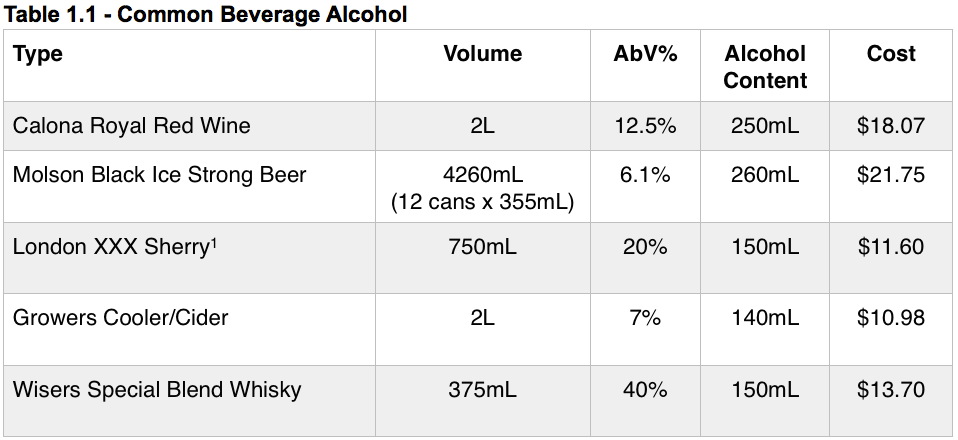
    Table1.1
    (costs listed are based on saskliquor.com)
    (approximate calculations were done at http://www.cleavebooks.co.uk/scol/ccalcoh4.htm and should not be used as a substitute for medical advice)
    1 The LCBO is recalling four brands of sherry (LONDON XXX SHERRY INCLUDED) that tested positive for a potential carcinogen. “This is not like E. coli or botulism where you’re acutely affected. To be affected by something like this, you would have to consume it for a long time for many years, so there is no risk at all,” he said. “It’s very, extremely difficult for anyone to get cancer from this type of chemical, unless you’re consuming it on [a] daily basis and you’re drinking large amounts of it.” (http://www.cbc.ca/news/lcbo-recalls-sherry-for-carcinogen-risk-1.619474)
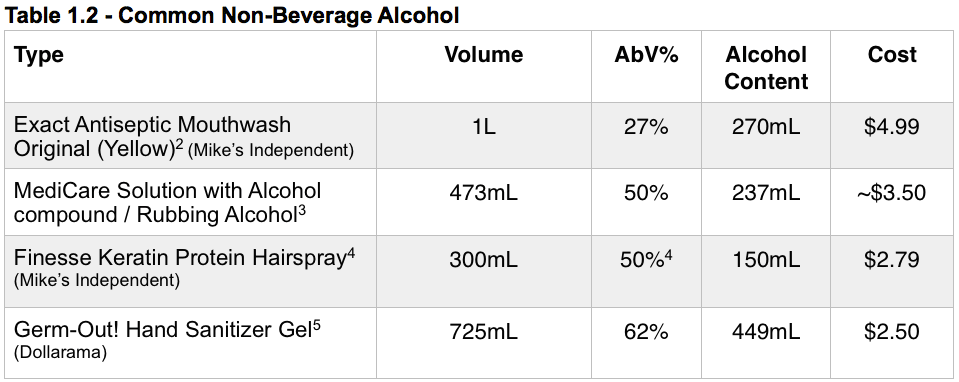
    Table1.2
    (costs listed based on retail prices at given locations)
    (approximate calculations were done at http://www.cleavebooks.co.uk/scol/ccalcoh4.htm and should not be used as a substitute for medical advice)
    2 Medicinal Ingredients: Eucalyptol (Eucalyptus Clobulus-Leaf) 0.092%W/V, Menthol 0.042%W/V, Methyl Calicylate 0.060%W/V, Thymol 0,064%W/V
    Notice: If more than used for rinsing is accidentally swallowed, get medical help or contact a poison control centre right away.
    3 Ingredients: Aqua, Ethyl Alcohol, Denatonium Benzoate, Camphor
    Notice: For External Use Only, Poison, Inflammable. If swallowed, do not induce vomiting. Call a physician immediately. If patient is unconscious, give them air. Danger: Harmful or fatal if swallowed.
    4 Ingredients: Alcohol denat, water (aqua), acrylates copolymer, aminomenthyl propanol, fragrance, octylacrylamide/acrylates/butylaminoethyl methacrylate copolymer, PEG-12 dimethicone, tritely citrate, hydrolyzed silk, hydrolyzed keratin. Alcohol content TBD but could be between 50-70%.
    5 Medicinal Ingredient: 62% Ethyl Alcohol. Non-Medicinal Ingredients: Aqua, polysorbate 20, carbomer, aminomethyl propanol, glycerin, tocopheryl acetate (vitamin E acetate), denatonium benzoate.
    Warnings: For external use only, do not ingest. In case of accidental ingestion contact your physician or a Poison Control Centre.

    Limiting availability of these products has proven to be an ineffective means of managing the consumption of the toxic forms of alcohol, as many or all of those accustomed to drinking non-beverage alcohol regularly travel to the suburban areas of the city to purchase from larger box stores and centres where they haven’t yet been banned. When individuals don’t have to spend their energy finding their next source of alcohol and managing their withdrawal symptoms, it allows them to begin to spend that energy on developing life skills, focusing on housing, setting goals, and working on improving their overall health.

    The only responsible, healthy, and compassionate way to support those who consistently consume non-beverage alcohol is to understand that in these cases abstinence is potentially a dangerous, unhealthy, and unrealistic treatment, and that reducing the harm they are causing to themselves means assisting them with the consumption of safe forms of alcohol. This can be done with Managed Alcohol Programs where individuals are given a regulated amount of alcohol at regular intervals during the day to help them deal with withdrawal symptoms and feel normal and well, Alcohol Swap Programs where individuals not necessarily receiving comprehensive housing supports can swap out certain quantities of non-beverage alcohol for beverage alcohol, a Beer Co-op where individuals are trained in proper and safe ways to brew their own alcohol for safe consumption, and Prescription Alcohol, which like a MAP, would regulate volumes and quantities based on medical assessments and administered in similar harm reduction models such as methadone. These programs, specifically MAPs, have been implemented across Canada and the US to reduce both the harms inflicted upon alcohol-dependent individuals, and the subsequent costs upon the health and justice systems.

    While other potential treatments for alcohol dependence include medications such as benzodiazepines, which include diazepam, or Valium, the lifestyle and the desires of the patient must be taken into account, and for many, discontinuing alcohol use is not desired and is not a possible solution. Using diazepam as a treatment for alcohol withdrawals does not respond to the fact that many individuals would rather not discontinue alcohol use, and even with regulated and prescribed diazepam treatment, many individuals will continue to drink different forms of alcohol when it is presented to them. This would lead to an increased risk of addiction to diazepam, and a “high risk of overdose, loss of consciousness, coma, and death.”(American Addiction Centers) Benzodiazepines are also used as a short term treatment option, with only 1-2 percent of adults continuing treatment for 12 months or longer, and carry substantially higher risks of dependence and misuse in populations with a history of substance abuse (Longo). When supporting an individual living in community, monitoring all the substances that enter the home is impossible, therefore it is best to prescribe that which reduces the most risk and harm to the individual.

    The harm reduction framework aims to support individuals to make healthy choices and this begins with offering assistance in managing quantities of beverage alcohol, and accessing beverage alcohol in a cost-effective manner, while at the same time being careful not to perpetuate the stigma of using non-beverage alcohols that is often present in community supports and medical services. Many populations are stigmatized even within social circles for drinking non-beverage alcohol, and this stigma is magnified in many professional health settings. Following the harm reduction framework means focusing on the needs and desires of the individual, not reducing addictions to a moral or ethical choice, and understanding the barriers that have led to less-safe alcohol consumption. It is important that harm reduction treatments are in place and practiced by health professionals, as professional knowledge is needed to create public health policy that can be safely and confidently administered by community entities.

    Understanding

    Each individual receiving alcohol harm reduction support will consume a different variety, style, and amount of beverage and non-beverage alcohol each day. It is important to understand what the approximate quantities of non-beverage alcohol are to ensure that the proper volume of beverage alcohol is supplied to each individual. Having a set schedule of beverage alcohol consumption would ensure that a moderated amount of alcohol is consumed, which, ideally could be lessened over time based on the desires of the individual. Clinical medical advisement through a MAP or prescription may be required to ensure that the individual is getting a safe dosage, and that an understanding of the individual’s history with addiction and their personal and traumatic history is taken into consideration. In an evaluation of a MAP in Vancouver, BC, alcohol consumption did not necessarily decline in six months for all of the participants, however the consumption of non-beverage alcohol did decline, and most participants reported improvements in mental health, social connectedness, and general well-being, and consumed alcohol in a safer setting with less harms that come from drinking large quantities at one time (Stockwell 6,7).

    Below are some comparisons of alcohol contents. Though it is clear that the ethanol present in beverage alcohol is different than the types of alcohol present in non-beverage alcohol (denatured alcohol/ethanol, isopropyl alcohol) and the “high” achieved through using non-beverage alcohol would therefore be different, the comparisons below are a guideline for quantities consumed knowing that the denatured alcohol and isopropyl alcohol have added chemicals that are toxic for human consumption.

    For example, as shown in Table 2.1, one litre (1L) of Antiseptic Mouthwash has an alcohol content of 270mL, which is equivalent to 12.5 cans (4.4L), of strong percentage beer, or nearly two bottles of a strong sherry wine. Similarly, as shown in Table 2.2, it takes nearly 10 times as much strong beer to equal the same alcohol content of 449mL that is obtained through 725mL of Hand Sanitzer Gel. While the point of alcohol harm reduction isn’t necessarily to meet the alcohol content that an individual would consume drinking non-beverage alcohol, it is important for service providers and community supports to understand just how much beverage alcohol it takes to help cope with withdrawal symptoms.


    Table2.1-2.2

    Conclusions

    It is clear both to the uneducated outsider and to the affected individual that the consumption of non-beverage alcohol is extremely damaging to one’s physical and mental health. By offering support to individuals in their addiction through alcohol harm reduction programs, the dignity of these individuals is upheld as they are receiving compassionate medical treatment that views them as a whole person. Through these programs, these individuals would be able to access supports that are often only accessible to less-stigmatized populations, including detoxification programs that in Regina are inaccessible to many with reduced mobility and high physical needs.

    Access to inexpensive, clinically regulated and adequately strong forms of beverage alcohol is key to the physical and mental health and well-being of the individual. Regulated quantities of alcohol must be customized to each individual based on their own personal symptoms and histories. While having professional medical advice involved is clearly the best practice, disallowing access to safe forms of alcohol because of lack of confirmed policy is irresponsible and lacks the compassion necessary in the human services sector and in a responsible community.

    Policy driven by the Regina Qu’Appelle Health Region, monitored and planned by medical professionals, delivered by community organizations, and tailored to the needs of the individual are imperative to the success of an alcohol harm reduction program, and the timely nature of its implementation is extremely important to ensure the safety, health, and survival of a large population of vulnerable people. A responsible community and health region would not allow the continued consumption of controlled poison when clear, simple, and practical alternatives exist.

    Sources
    International Harm Reduction Association, What is harm reduction?, http://www.ihra.net/what-is-harm-reduction
    CBC News, Hand sanitizer ingestion linked to 2 Ontario deaths, Oct 25, 2013, http://www.cbc.ca/news/canada/toronto/hand-sanitizer-ingestion-linked-to-2-ontario-deaths-1.2252046)
    CBC News, Hairspray abuse plagues northern town, Feb 16, 2001, http://www.cbc.ca/news/canada/hairspray-abuse-plagues-northern-town-1.293513
    Pauly, B., Stockwell, T., Chow, C., Gray, E., Krysowaty, B., Vallance, K., Zhao, J. & Perkin, K. (2013) Towards alcohol harm reduction: Preliminary results from an evaluation of a Canadian managed alcohol program. Victoria, BC: Centre for Addictions Research of British Columbia.
    Carnahan RM, Kutscher EC, Obritsch MD, Rasmussen LD. Acute ethanol
    intoxication after consumption of hairspray. Pharmacotherapy. 2005 Nov;25(11):1646-50. PubMed PMID: 16232026.
    http://www.ncbi.nlm.nih.gov/pubmed/16232026?report=docsum
    American Addiction Centers, Dangers in Mixing Valium and Alcohol or Drugs, http://americanaddictioncenters.org/valium-treatment/dangers/
    Longo LP, Johnson B., Addiction: Part I. Benzodiazepines–side effects, abuse risk and alternatives. Am Fam Physician. 2000 Apr 1;61(7):2121-8. Review.,
    http://www.aafp.org/afp/2000/0401/p2121.html
    Stockwell, T., Pauly, B., Chow, C., Vallance, K., Perkin, K. (2013). Evaluation of a managed alcohol program in Vancouver, BC: Early findings and reflections on alcohol harm reduction. CARBC Bulletin #9, Victoria, British Columbia: University of Victoria
    http://www.uvic.ca/research/centres/carbc/assets/docs/bulletin9-evaluation-managed-alcohol-program.pdf
  • Politics

    IMG_6881 - Version 2

    I drag my sorry ass outside in a desperation trip to the grocer. I don’t want to get groceries but I never want to get groceries, and I know that my one remaining pear won’t be enough to last me until Friday, even if I have no appetite. I forget my bike helmet in the apartment, so I risk permanent debilitation because I cannot look past the seven steps to my bedroom even though I know I may never walk again because of it. Politics.

    One of those days where starting smoking sounds like a good idea because of how it reflects inner thought.

    The grocer is sad. Only one jar of peanut butter on the shelf, wrinkled limes in the fridge, no deodorant left. But it has good intentions. I still manage to spend $60. Get home, eat a few crackers and a homemade hummus that tastes like tunafish, get back on the bike to go to the hockey rink.

    The ice is soft like our discussion of impotence. Existential non-boners. We play hockey on the ice anyway. Rather destroy what is left of the rink in the name of a good time than preserve it for someone who would enjoy it less.

    Somehow my Spam folder knows what I dreamt about the night before.
    HotH00kup Alert
    H0rny Sextmatch

    Couchsurfers from Quebec politely put up with my sad-man room and speak excitedly about their impending trips to brighter lands. The arcade is closed, the only sober thing to do in the city, so we go for a beer. We only get one beer, so it is good. Bed by ten. Not bad.

    Trying to to distract myself because good people die when bureaucrats want successful track records for their resumes and political futures. Because the real world and the citizenry run in never-overlapping circles and we make decisions for the citizenry. We make decisions for the taxpayers who pay the wages. Politics.

  • Good People

    I sat cross-legged in the cushioned armchair, scratching paint off my water bottle in the cozy, warmly coloured, obviously intentionally non-institutional office of my psychologist/psychotherapist/whatever.

    Isn’t it enough to just be a good person and treat people well? she asked after a near hour-long discussion of how far one needs to go to make the world less of a festering shit hole, with me grinding myself into a hole trying to figure out how to do so.

    I thought it over. I pictured the tax-paying, maybe church-going, home-owning, child-rearing city councillor who occasionally shovels his neighbour’s sidewalk and might even give a few bucks in December to one of the organizations that sent Christmas mail-outs. His kids are in hockey. He loves his spouse.

    No, I said. That’s a cop out. 

    I wondered what she thought—-that I was attacking her personally—-or if she was clinically breaking down my obvious guilt that stems from years in conservative religion, my fear that comes from the insecurity issues of being the youngest child, my anger from decades of not expressing myself in healthy mediums, and my depression which is induced by the daily watching of my friends dying while my other friends are not even able to give a shit. She was likely doing neither, she is significantly smarter than I.

    Because of constant deconstruction of social programs, the development of neighbourhoods that are exclusive in nature, and the importance financial-driven success, being a good person means keeping to one’s self. It means not being an evil person. Not being a murderer, rapist, tax-evader, alcoholic, street worker. Not beating your children or spouse. Not pouring toxic waste into a animal rescue facility. Not bothering your neighbour. Being a good person, by the standards of our colonial, patriarchal society, means staying in line. The fact that my day job exists entirely to remind people of their worth, that they aren’t bad people for needing a shot of morphine everyday by noon, that they aren’t bad people if they fall off the wagon, that they aren’t bad people for being on welfare, that they aren’t bad people for having a culture that precedes the current—-the fact that this day job even exists, shows that good people, in today’s standards, are those with privilege.

    I drank a sip from my water bottle, an action steeped in anxiety, done to make me look more natural. After a near hour of discussing my rage, my mind became blurry. By the time we got around to ways I can improve upon myself, I didn’t have the energy to comprehend new ideas. I pretended to take another sip of water from the empty bottle and nodded along with my psychological professional.

    Being a good person and treating people well wouldn’t be a cop out if it meant something else. If it means more than smiling in public and not using racial slurs, then it may be enough. Enough to make changes that matter, to staunch the wounds that pour blood into the alleys. But until it does, until the characteristics of being a ‘good person’ include understanding and standing up for those our system have methodically destroyed, being a good person is not enough.

    It’s not the fault of the good people that they are good people under the current model of good. We have been gutted and replaced with slop from the machine of individualistic, selfish commercialism. Our jobs don’t allow us the time to give a shit. In order to stay sane, we bask in the glory of our beautiful families and don’t look out the window to the family being kicked to the curb by a police officer, because we legitimately don’t have time, because the Mayor has stricken that topic from discussion in council, because if we do, we’ll get depressed. Good people everywhere don’t know how to participate in a change they want to make, so they rely on posting on internet, or they don’t do anything. I am that kind of good person.

    Tonight as I watched city council directly shut down citizen concerns, bully them by calling requests of accountability disrespectful, and promote gun violence as seen on their favourite television shows, I watched a room full of good people fighting for their definition of good. The uninformed relied on tokenism, touching stories, and fear tactics to justify their definition of good, that is, to justify the increase in funding for the organization that protects their privilege. The informed stood up and defended their idea of good, that is, they were willing to understand and stand up for the good people outside of the room who have been trampled by the uninformed, power-protecting policies of racial profiling and bad-person profiling. Everyone was working for their own idea of good. Some of them were just unfortunately, painfully, and dangerously uninformed. I left city hall with a renewed interest in changing our current definition of what makes a good person. How we go about doing that has never been my strength.

    I left the psychologist’s office $160 poorer, one-hour later, one vague understanding of fear and guilt, with one empty water bottle. I’m going to have to book another appointment. Or two.


  • Lyrics of the Month: November 2015 – Geoff Berner

    My city has been in a housing crisis
    For fifteen years or more,
    Middle class families can’t afford to live here,
    And there’s a ten thousand dollar fine
    For being poor.
    They said if we let them build all these condo towers,
    The market would pull down the rent,
    Now we’ve got the most expensive city
    On the whole damn continent.
    Our Mayor says he wants Eco Density,
    And of course it’s a sin not to be Green,
    But when Mayor Happy Planet says Eco Density
    What does he really mean?

    He means
    Sunday, condos
    Monday, condos
    Tuesday and Wednesday
    Condos,
    Thursday, Friday,
    A few more condos,
    Saturday, for a change,
    Condos.

    What happened to a thousand culture buildings and counting?
    They knocked them down to build some condos.
    And the social housing on Little Mountain?
    Get rid of it!
    (We need more condos.)
    The Ridge, Richards, the Capital,
    That’s a special kind of condos—
    The kind of condos that you call
    After the thing that you knocked down to make the

    Sunday, condos
    Monday, condos
    Tuesday and Wednesday,
    Condos,
    Thursday, Friday,
    A few more condos Saturday, for a change,
    Townhouse condominiums.

    What’s the plan for the Georgia Viaduct?
    Well, they’re gonna knock it down and build some condos,
    And why’s the city four hundred million dollars on the hook? —–They’re fucked!
    They paid some guys to build Olympic condos.

    And what about the sacred burial site?
    Not as sacred as condos,
    Till the Musqueam Nation actually put up a fight,
    And that’s how you stop the condos.

    So what’s going to happen now, for God’s sake?
    Are we just going to let them build more condos?
    Or could there be a time when we finally put the brakes
    On Vancouver’s mad sickness for

    Sunday, condos
    Monday, condos
    Tuesday and Wednesday Condos,
    Thursday, Friday,
    A few more condos,
    Saturday, for a change,
    Market artist live/work studios.

    Geoff Berner, We Are Going To Bremen To Be Musicians, Condos

  • Blogging will save the world..

    White Butte

    I was accidentally put on a ‘panel of experts’ discussing homelessness at a recent documentary release. Politicians mingled with professors and service providers in an eatery that neighbours the dry men’s shelter. Concerned citizens arrived early to bounce pleasantries off one another, nibbling on fine sausage and kalamata olives. I showed up late, downed a whiskey to calm the nerves, and shook with anxious rage throughout the entire documentary.

    The panel discussion concluded past its allotted time, and the moderator hurriedly spilt the plan, funding model, and hopes for the upcoming year in the industry of homelessness, with no one really understanding what it all meant. The crowd left restless and confused as to how to help, and the panelists left more disgruntled than before, and a month later, mid-October, there are still people sleeping in the alley in Regina.

    As a white male, when I speak, people generally listen. They listen for two or three sentences until they realize that I don’t know what I’m saying, then they rightfully daydream about food and sports and sex. On this year’s Blog Action Day, a day where organizers attempt to unite writers under one socially-driven topic (a day that I use the prompt to get off my ass and write something off-topic), people were asked to consider the title Raise Your Voice. Writers, artists, and journalists have the responsibility to tell the stories of those who are unable to do so. But an important part of this is to give people the platform to tell their own stories. Those whose voices need to be heard—the marginalized, the people of colour, the refugees, the LGBTQ2, the Indigenous, the working class—are denounced because a wealth-driven patriarchal society determines whose voices have worth. For completely unjust reasons, I have a voice. Instead of only ever using my voice to amplify the voices of others, I attempt to use my voice and my actions to create a place where others can be heard without need for amplification. When you create a place where people have inherent value, their voices will inevitably be heard.

    To Raise Your Voice in the digital era by blogging, sharing, liking, or ranting is as effective as leaving scraps of paper with motivational slogans blowing in the gutters. Divisive and irritating, the internet only further entrenches beliefs and perpetuates ignorance. While speaking on the panel I kept repeating this idea that we can pressure and lobby government until our heads explode, but that this is only one, arguably ineffective, means to creating change. That the only way homelessness and class-divide will end is through a system-wide change, altering how we treat and relate to one another, and changing the wealth and social inequalities that oppress minorities. I left the event feeling empty and sick, for I sounded like a politician—pushing for an idea while offering no tangible examples of how it might work and while participating in no organizing that may lead realization of the idea.

    Appealing to the judicial, legislative, or executive branches of government in the hope of reform is as realistic as accepting the offer made by the March Hare during the Mad Tea-Party in Lewis Carroll’s Alice in Wonderland:
    “Have some wine,” the March Hare said in an encouraging tone.
    Alice looked all round the table, but there was nothing on it but tea.
    “I don’t see any wine,” she remarked.
    “There isn’t any,” said the March Hare.

    -Hedges, Wages of Rebellion, The Post-Constitutional Era, p 61

    On Thanksgiving Monday I biked to the advanced polls to participate in the experiment of democracy. My hands numb in the wind, I waffled left and right each time I saw an election sign posted in a front lawn, truly not knowing who’d get my vote upon arrival. I’d rather waffle left. I voted in a way that reflects my values. I voted in a way that is considered a throwaway. This is because I do not believe in the ability for real reform under the current economic system in which the major parties function, but I simultaneously participate in this economic system and rarely make an effort in being a part of breaking it down. When I raise my voice but drink my sorrows, doing nothing to participate in making true change, I am complicit.

    Later on Thanksgiving Monday I lost a game of cribbage to a person who I’ve only known for a few months. It definitely wasn’t the first game of crib I’ve ever lost, and sure, I gave away several pairs of sevens to the crib. After he pegged out and we congratulated ourselves on a game well-played, I laid on the floor and watched him paint while we listened to new Northcote and RahRah. My new friend has been housed for three months, homeless for years before that, and still requires regular and extensive assistance to live a healthy life. I am extremely privileged to be employed by one of the few places that actively works to repair the damages caused by the wealth inequality synonymous to the capitalism, however, continually cleaning up the messes left by a system that purposefully destroys the lives of a particular cultural group is ineffective. Working within the current system is necessary to a point, but a total dismantling of this system is required to ensure real, lasting equality.

    There is no morality in words. Morals are behavioural, based in how a person acts. A person can raise their voice to the heavens while sitting in their recliner. If you raise your voice without breaking a few walls, no one outside your already-converted group will hear you. Breaking walls means breaking laws, breaking norms, supporting (verbally and physically) oppressed minorities, and thinking outside of the “cult of the self”* in which we find ourselves.

    And I can say with certainty that I’ve never broke down a wall in my life…

    *Hedges

  • Bigfoot

    Photo by Eric Goud

    Bigfoot is real. I saw him, his pecker in his hands, last week at Big Sur.

    I was eating a breakfast burrito on the coast, overlooking the mist-covered cliffs and crashing Pacific waves, when several kilometers in the distance, there he was, squatting on a rock with his back-end hanging over the ocean. The Pacific Ocean, Bigfoot’s toilet. I was far away, so it could have been a walrus, a sea lion, a humpback whale, a rogue sequoia tree, or beach trash. Or, as I prefer to believe, Bigfoot relieving himself.

    When I told a friend of my sighting, she scoffed and told me what I saw was just an amalgamation of seaweed and driftwood, propped up by high tide and made look real through morning haze. She proceeded to show me a very recent UFO video from Kazakhstan. Real, undeniable proof.

    Another friend told me to watch out. That the wormhole of bigfoot and UFO videos is a dangerous place for people already uncertain about reality, which is a common symptom of anxiety. She then proceeded to tell me about the peaceful tenets of Buddhism.

    Begrugingly I have recently come to admit that what I saw was not, in fact, Bigfoot taking a shit. But rather, simply, my desire to see Bigfoot exposing himself to the endless wonders of the bright blue ocean. But if someone sitting next to me, looking at the same cliff at the same time, believed that they saw him, truly believed that Bigfoot was there, I would support their belief. The reasons they believed with conviction could have something to do with their eyesight, their hunger levels, the animals they saw in the forest when they were children, the movie they watched the night previous, the TinTin yeti episode they saw as kids, or previous sightings of Bigfoot himself. Their previous life events made them more likely to believe, and since Bigfoot’s existence is still truly an unknown, this does not make them any less rational.

    Most people’s beliefs are based on secondhand accounts, old books, or internet video footage. Stories told by credible friends over a bonfire. A belief based on a feeling they have that they cannot explain. The same for belief in ghosts, or the resurrection, or of yoga, or in science, or in nothing.

    Some create elaborate hoaxes—a tall hairy figure with massive strides saunters towards a body of fresh water to wash his/her own personal holes—but their commitment to false evidence does not disprove the existence of a bipedal woodland creature. Some, presumably most, film what they believed to be the outright truth, an accidental stumbling across the unknown. Discussions of incredulity of people’s beliefs, denouncing what some hold true, break down any level of human connectedness. But people’s absolute conviction in the existence of Bigfoot, or their utter insistence on the excessive nature of his legend—people’s certainty and what they will do in its name—will forever impress, entice, and scare me.

    Their desire to be part of something, whether it is the glorious triumph when scientists find the first Bigfoot skeleton in northern B.C. or by pointing and laughing when it is proven to be an elaborate folktale, is the same unexplainable, at times unproductive desire that is a side effect of the destruction of real communities, the same desire that concretes people to a sports team, a country, a tax bracket, a t-shirt company, that is, the human desire—opposite of Bigfoot’s desire to be solitary, separate, unseen, anonymous—to be part of a greater whole.


    I visited the Temple Square in Salt Lake City, Utah. Wandering around, haggard and tour-worn, I noticed the disproportionate number of attractive women aged 20 to 25, the flags of their home nations pinned to their blouses, welcoming wayward, lonely travellers in dozens of languages into the many ornate buildings of Mormon history. I was drawn to the domed Tabernacle where an organ rehearsal boomed triumphantly, peacefully. There I sat, recent non-believer, truly thinking how lovely it would be to fall in love with a Mormon girl, accept the general tenets of her faith, and start a simple carefree life as a closet Mormon in some foothills town in Utah, the ‘Life Elevated’ state. Sometimes, like this time, I would be elated to hand in my anxieties, loneliness, my overthought, for the absolute certainty that some can hold, and the happiness and joy that comes with being part of the greater whole. But in order to do that, one must believe.

  • LANDRULE

    Phakdichumpon Cave

    The crimson tide of communism flows north from Indonesia into the remainder of the ASEAN countries, conquering and destroying numbers of tribals with a roll of the dice. Tens of thousands are displaced, thousands others are killed. Borders are bolstered when resources exist enough to do so, and infiltrations continue based on economics and weather.

    These are the ins and outs of LANDRULE, the rip-off, digital version of the classic marathon board game RISK, where joke apologies are given when cultures are decimated, and homogeneousness is the end goal. When you have 44hours of van time in three days, such games and distractions and mindless mind-stimulation is necessary. We watch Band of Brothers, a Hollywood ‘tribute’ to the allies in WWII, then we pass the massive Samsung Galactica S7 to the next unshowered goon, pretend to conquer the world, one podcast at a time.

    In contemporary, middle-class terms, we are conquering the land. We burn fossil fuels and eat Peanut Butter Salted Nut Rolls to show our progress and civility as humans. In five months from Regina to Vancouver to Horse Creek to Yellowknife to Winnipeg to Thailand to Regina to Seattle to New York spanning amounts of time in which only microbes can thrive. Such life is not natural for the relationship between a person and a person, a person and their brain, a person and their butthole.

    Thusly, my original doubts of malaria and parasites and any illness that exists until it breaks me down like a lego wall in an air strike, have begun to become real fears. My body aches for a home that I don’t have. In joking desperation and boredom WebMD tells me that I might have meningitis or hepatitis or West Nile shortly after it asked me if my symptoms included ‘low self esteem’ and ‘poor personal hygiene’. Do you have a craving to eat ice, dirt, or paper? If so, contact our emergency health insurance provider immediately.

    It’s not natural for a body to travel this far, this quickly, someone stated when the golden glow of New York City invaded the night sky from 50 miles out. Feels like I haven’t touched the ground in 4 days. I haven’t, really. The snaredrum whispered in my ears from atop the pile of guitars, amps, t-shirts, warning me that it was about to land on my neck with the next bump in the NJ Turnpike.

    Fox News headlines digested during free hotel breakfast:
    Rudy Guiliani thinks Obama doesn’t love America.
    North Korea claims that ebola was biological warfare sent by the US to destroy the world.

    I am here to bring it home.

    LANDRULE continues.

  • Pizza Scurvy

    Disclaimer: This is not pizza from Vera Pizzeria. This is scummy Montreal metro pizza, which also has it's place.
    Disclaimer: This is not pizza from Vera Pizzeria. This is scummy Montreal metro pizza, which also has it’s place.

    I have oft dreamed of a world free from the bondages of currency. The ‘bootstraps’ analogy that no longer makes analogical sense would neither make societal sense because people would all have the same strapless boots, the same homes, and the same neapolitan ingredients in the fridge. Where no matter how hard you work, you get a piece of the pie. The pizza pie.

    I have oft dreamed of a job that pays me in pizza and beer but until recently I believed it was an impossible, utopian dream. I have found said job. I wear an apron, I swing my hips liberally to the hook-heavy anthems of Jenny Lewis, I spray, scrub, soak, sort, and airdry the cheese-grimed pizza plates of Vera Pizzeria, home of the finest pizza your pedestrian tongue (and undoubtedly mine) will likely ever taste. Contrary to my communist, currency-free compulsions, on busy nights where my free labour has been deemed as moderately necessary, I work hardest and get paid the least, a perfect microcosm of capitalism. In the name of that covetous progress, the human-crushing runaway train that it is, they have sourced a commerical dishwasher. And with the simple stroke of a pen, with the lease of a stainless steel washer that sprays with the intensity of a pissed off geyser at 150degrees centigrade, I have become obsolete.

    So with my severance package in hand (a bout of scurvy in my organs from a pizza-only diet), and my travel backpack on my shoulder, I will slither towards an early retirement. Savings were significant in the height of the pizza game, and my investments were sound, so with the wealth of a nation, the tropics call my name. I have long desired, for three years or more, to leave my home to see the homes of others, and now, ticket for Thailand securely in hand, visa for India theoretically in transit, this retirement dream will soon come to pass.

    I pack my belongings, patch the holes on my backpack, google trip plans when flashbacks of swimming in the ocean, drinking five-cent chai, eating dogmeat bring excited memories of the learned parts of travel. Then flashbacks of sweaty, anxious, late walks on the beach, the embarassed purchase of tacos from women squatting in the alley across from the department store, feeling responsible and justified when I get attacked on several occasions strike my memory.

    Hold on a second. People’s dreams change? Without them even knowing it? Until it’s too late? Well that’s some merited bullshit. Some ironic piece of formaggio pizza, light and bubbly crust on the outside, black and tarry on the inside. I’ve already bought a one-way ticket, already dreamed of the exploits and adventures of the trip for three years. Like a soon-to-be-wife with cold feet, always dreaming of the day she’d get married, but when the vows are written and the dress is tailored and the family has flown into town she realizes that this dream was what she wanted when she was 19, not 29. But she goes through with it anyway because, she figures, it’s still what she wants.

    Much has changed in my brain in the three years since I last was in a territory that I was not welcome. For example, I have learned that I have always lived in a territory that I was not welcome; The Dominion of Canada. I have learned that as a person of privilege, I am ignorant and blind to my privilege unless someone calls me out on it, and even then I’m likely too stupid to comprehend it. I realize that abusing this privilege by flaunting it and spending its savings unwittingly, I disrespect those who have no privilege, even if I attempt to be ‘socially responsible’ while I do it.

    I am willingly throwing myself into a situation to inevitably become the type of person I never want to be. As if I decided to run in party politics, or get season tickets to the Toronto Maple Leafs.

    The tenets that I used to hold dear and romanticize about my lifestyle—the learning about culture, and seeing new things, and helping where I can—now come off as paternalistic blather. I am a product of loving parents that worked hard to give me everything I ever needed, which, along with the technologial and economic progression of the west, has turned me into a skilless rube whose only ability is to pick up and go. As a ‘writer’ I use this as ‘inspiration’ for ‘projects’ and ‘essays’.  Previously my impulse was to I enjoy flaking on the lifestyles and traditions of groups of people far from my home that have been adversely flaked on by colonial forces for hundreds of years. Now, I’d prefer to do so at home, by myself, in a rundown house in small-town Saskatchewan where I can negatively affect only the people nearest me.

    I look forward to coming out of early retirement to rejoin the workforce and finally stop perpetuating the types of relationships I have come to realize as unbalanced and unfair. I look forward to squatting in a moldy, infested apartment, dressing like a true dishwasher thus embracing the motto, “Dress how you want to be addressed” and forever scrubbing the cheese off of pizza-related tools, all for the simple reason that I am too unintelligent to understand how to truly live in balance with other people, so I’d rather just rot.

  • See you at the movies.

    Abstinence of joy in pursuit of character and knowledge is something I learned from reading Gandhi’s autobiography when I was 18. If I remember correctly he wouldn’t eat anything but fruit and nuts, he wouldn’t even consummate his marriage with his faithful wife. I use it in explaining why I don’t have television or the internet, or why I eat a particular diet, and even something I used as a reason not to sleep with someone in the past. I use it as a noble way to cover less attractive qualities in myself such as cheapness, cowardice. I should have known that reading even a positive influential piece of literature when in the developing years can do a person harm if it is not fully understood. And it wasn’t.

    Unlike Gandhi, the intellectual giant and human phenomenon, the abstinence of joys has produced in me an uneven pattern of mental health. For when people are watching Netflix or eating ice cream or having sex on a basement floor, that is, when people are engaging in normal human activities, I am sitting on my couch staring out the window, trying to hide the light from the digital billboard behind a planter pot in order to further abstain from screens. Instead I stare out the window, the sky an apocalyptic yellow, picturing a tornado tearing off the corner of my building and sucking me up two hundred feet in the air before dropping me to the road below and flitting away. Think about how I abstain from distractions and personal weaknesses so that I can spend my time ruminating on philosophical truths and creative outlets, when instead I end up overthinking relationships and decisions and contemplating toenail length and streetlight schedules. My attempts at character building, knowledge gaining, wisdom seeking develop into anxious, panicked sweats. Or I think about thought; admonishing myself for not thinking about the things that a person of intelligence should think about. For not further studying into the history of Palestine, or the teachings of Tagore, or civic policy and politics.

    Only when I lay to sleep do I understand that every thought is regurgitation, and therefore not productive. I hear the voices of peers, or my voice repeating things I need to do, or a replay of the things I read, or advertisements plopping out of my subconscious. When tired, the regurgitation of thoughts intensifies. They blow around in your globe and bounce out like the next bingo ball. Meditation; be it unconscious, accidental, or purposeful, is where newness arrives from. From the back shelves, where things have been sorted and stashed. Meditation is being immersed in the lack of thought, either while gardening or biking or baking or sitting in a yogi pose or sleeping or eating. Demanding original and creative thought after ten hours of being pre-consumed and used up is impossible, and the pressure to do this has given me a new relationship with what mental health really is. Abstinence hasn’t ruined me, personal pressure and not knowing the limits of human energy has. And I will be surprised if I truly understand it before I break.

    I am learning, despite my previous conditioning, that a proper distraction will do more for an eager mind than eagerness itself. See you at the movies.

    What do you think? he asked me again.
    How it feels to go crazy? I asked.
    Yeah.
    I don’t know, I said. Sad and easy, I guess, like losing a friend? You say a few wrong things, you ignore the obvious, you act stupid in an unfunny way. Travis told me that Kafka or someone like that had said insanity could be defined as the attempt to reconcile one’s overwhelming urge to write things down with one’s overwhelming conviction that silence is the most appropriate response. Oh, I said. Okay.

    -Miriam Toews, A Complicated Kindness, Chapter 18, p 149-150

  • Slow Code Colonialism

    The following essay was published in the Summer 2014 edition of Transition Magazine, a Canadian Mental Health Association publication. Digital copy available here.

    You are lying on the street in cardiac arrest. I am obliged to inform your unconscious, breathless body of my newly acquired First Aid training. This, for some reason, is supposed to reassure you, as if my knowledge to enter three digits on a phone grabbed out of a bystander’s pocket changes the fact that your heart has ceased. All I can do is Check, Call, Care, and call bystanders to action, but according to the brawny male firefighters who taught my First Aid course, this should be reassuring. The fewer bystanders, the better, they said. According to said firefighters, CPR and portable defibrillators are so effective that you—unconscious, vulnerable, responsibility of the provincial healthcare and social services systems—shouldn’t worry about what will happen if you don’t wake up, but rather, what will happen if you do.

    The day after I became First Aid certified, I heard a piece on public radio that spoke to the misconception of the effectiveness of CPR. When it comes to the point where a human is in cardiac arrest, known as a Code Blue, healthcare professionals are obligated to administer life-saving procedures. When doctors are confident that CPR will not save a life, or will greatly reduce the quality of life that remains, they will often fake it, for it “looks and feels like a really gruesome way to usher someone out of this world.”(1) They go through the motions of CPR without actually trying to save the life. They do it so the patient can die. Slow Code—they even have a name for it. When family and friends are watching a loved-one slip away, they cannot understand a doctor who would stand by idly and let their family member die. CPR, in this case, is a system for the conscience of the bystander, not for the person in emergency. The professionals do this because the system of resuscitation is flawed.

    A friend was recently in the hospital. He got into a fight with three men half his age, he told me. Others claim that while inebriated, he tripped, the side of his head the first part of his body that struck the ground. Skull fracture and brain swelling which led to brain damage and memory loss. I visited him regularly—I sat there as an idle bystander contributing to his deteriorating health by supplying him with cigarettes which he forgot he had, as he basked in the overwhelming nature of his life of abuse and addiction. We played cards as he mumbled through the imagined traumatic experience of being locked in a house with three family members who beat him until he bled from the ears.

    When my friend is discharged, he will leave the hospital to no home and to a family who can no longer give him the support he requires. The hospital can’t keep him forever. The rehabilitation centre says he is too high-functioning—a man who cannot remember where he put his paintbrush or the names of his brothers. The province cares not for the marginalized. An ethically responsible governing body cares for the vulnerable, but my friend will end up homeless in a week, one inevitable head injury away from complete debilitation. He has never met his social worker. The social worker in his ward blankly stated that it isn’t her problem once he is discharged. The workers search on their computers and make phone calls in vain, aiming to satisfy the bystanders, knowing that whatever they do, it won’t save his life, because, whether or not they know it, the system of resuscitation is flawed. To those within the social welfare system, this is the most receptive the state will ever be—just another case file in the colonial shell game that is the Canadian welfare state.

    Those who have not dealt with the system imagine that it works for all. They imagine that the cracks through which people slip are fairy tales told from faraway lands. They can’t imagine a circumstance where someone would be left out in the cold after a traumatic event, because, they think, this is Canada, land of universal healthcare and equal aid for all. This liberal notion of equality of opportunity fails to understand the systemic racism which is fundamental to the colonial state. The gaps exist on purpose. The system of resuscitation is intentionally flawed—it is designed to appease the conscience of the bystander. But unlike a medical Slow Code, it is flawed in its design to take resources and power out from the trained field workers through lack of programs that offer proper supports. Fifty-percent of the Saskatchewan provincial budget is devoted to healthcare and social services, totalling over $5.5 billion per year.(2) With such a significant portion of the provincial budget devoted to two departments of human services, the general populace can only assume that the dollars are sufficient and effective; however, gaps in the departments are purposeful and widespread.

    Aboriginal communities have been stunted by the implementation of provincial and federal social assistance programs, contributing “to the persistence of individual and community economic dependency.”(3) These programs run on outdated living allowances, low earning allowances making a transition to employment impossible, and lack of adequate supports for Aboriginal people living in urban centres or dealing with HIV/AIDS. These programs run on cycles of poverty and death. A growing number of Aboriginal people have been forced from reserves to urban centres, where it is exceedingly difficult to live as a traditional Aboriginal person. It is a direct extension of settler colonialism, originally performed under the mandate of pre-confederation’s Indian Affairs, whose policies to ‘civilize’ Aboriginal populations introduced the residential school system. Residential schools were decentralized into the provincially-run Ministry of Social Services, a ministry which continues to perpetuate the same exterminatory mandate. Slow Code Colonialism—neocolonial institutions created to emphasize the desires of the bystander and ignore the needs of the sick. Neocolonialism is already the disguise for cultural eradication and is further masked as the unavailability of programs due to lack of financial support. Where supports exist, resources do not. My friend qualifies for a bed in a home for those with Acquired Brain Injury, but only after sifting through a waiting list of several months, and not if he continues to battle his addiction. Fairytale cracks become real. The ministry that originally took responsibility for my friend as a young boy sent to a residential school, now waives this responsibility and deliberately leaves him to flop around on shore, their program near completion.

    I was taught to Check, Call, Care. As your consciousness flickers, as shock sets in, I brush your hair from your forehead and tell you it will be alright. I lean close to your face to check your respiration. You are not breathing. Since I do not have my recommended mouth-cover, I begin compression-only CPR. I tell a bystander to call for help. I break your ribs and bounce up and down on your sternum with my arms locked at the elbows. The paramedics arrive. They are trained in emergency and begin Slow Code CPR, feigning an attempt at revival because that is what bystanders expect of them. There’s nothing we could do, they say, but I am appeased because of their valiant attempts at resuscitation. What they don’t tell me is that they were thinking about football when they were supposed to be pumping blood through your chest. You somehow survive despite the Slow Code, but you wake up with broken ribs, brain damage and you are expected to survive when you have no place to live and no family to care for you. And the system of resuscitation wins in its purposeful defectiveness.

    “Sir John A. MacDonald’s policy of starving First Nations to death in order to make way for the western expansion of European settlers,” along with the residential school system, “meets the criteria of genocide…by omission, if not by deliberate commission,” says a letter to United Nations Rapporteur for Indigenous People.(4) The policy of nineteenth-century Canada differs from today’s policy of intentionally defective programs of social service only in thin veils of supposed goodwill. There is no greater place to hide genocidal policy than behind a department of human services. The only other difference between Canada’s previous policies of starvation and the policy of today is the time elapsed in which the extent of the genocide could be fully understood. And time will again pass.

    The only way to stop Slow Code Colonialism is through a remodel of the system of resuscitation. The Ministry of Social Services is just one of the administrative programs that force subjugation by stamping out hope and dignity through “a complex web of city agencies and institutions that [regard] the poor as vermin,” Chris Hedges explains.(5) These programs work together to perpetuate the accepted state ideology by operating under the guise of being a protective force. The police who mine for crime by making arrests in communities of lower economic status work as the frontline of the repressive arms of the state. The military who break up blockades of First Nations fighting for liberation form another wing of Slow Code Colonialism. These structures work to protect the status and wealth of white middle class Canada, while ensuring the poor Aboriginal populations live in abject poverty, utterly subordinate to those who control the state. These structures project an image, and behind this image is a bloated bureaucracy focused not on remedying social evils, but on keeping these injustices out of the field of vision of polite society.

    The system must be remodelled to one that does not look to appease the taxpayer, but rather to adequately serve the marginalized. This starts when bystanders become involved and demand that governments stop these hegemonic structures of administrative programs such as Social Assistance, the judicial system, the police and RCMP, and unregulated resource development that make up the branches of colonization. This will dismantle the less visible forms of  “a very active system of settler colonialism.”(6) It starts with education and partnership that leads to real reconciliation “grounded in political resurgence” that “support[s] the regeneration of Indigenous languages, oral cultures, and traditions of governance.”(7) The system will be reformed when the programs intended to assist people do just that, instead of control, institutionalize, and cripple. As with any cooperative and proactive social system or community network, a welfare system administered by those to whom it caters is a democratizing step to reconciliation and empowerment. Aboriginal participation in the development of such strategies and programs is necessary to eventually eliminate the economic gap.(8) These state apparatuses will require more than just reform to make them democratic, but will require revolutionary change encouraged by grassroots movements like protests at Elsipogtog and Idle No More.

    First Aid isn’t as futile as it may have seemed at first. Although I still tread in the overwhelming nature of ignorance of how to respond to an emergency more serious than hunger pangs, I at least know that the symptoms for stroke, diabetic shock, and extreme inebriation are identical. I now know that the systems they taught me are evolving and changing because their legitimacy is still highly in question. I am no longer a bystander, but a person of direct action. The fewer bystanders, the better, they told me. With fewer bystanders, Slow Code Colonialism can shift to a more balanced paradigm of moral care for all.


    1. Goldman, Dr. B, (writer). Goodes, Jeff, (producer). 2013. “Slow Code.” White Coat, Black Art. CBC Radio 1. (http://www.cbc.ca/whitecoat/2013/10/18/slow-code/)

    2.  Saskatchewan Provincial Budget Summary, Ken Krawetz Minister of Finance, Government of Saskatchewan, 2013-14 GRF Expense, p44. (http://www.finance.gov.sk.ca/budget2013-14/2013-14BudgetSummary.pdf)

    3. Report of the Royal Commission on Aboriginal People. 1996. Ottawa, Indian and Northern Affairs Canada. Volume 2, Part 1, Chapter 5, Section 2.9 (http://www.collectionscanada.gc.ca/webarchives/20071211061313/http://www.ainc-inac.gc.ca/ch/rcap/sg/sh88_e.html)

    4. Fontaine, Phil. Farber, Bernie. 2013. “What Canada committed against First Nations was genocide. The UN should recognize it.” The Globe and Mail. October 14. (http://www.theglobeandmail.com/globe-debate/what-canada-committed-against-first-nations-was-genocide-the-un-should-recognize-it/article14853747/)

    5. Hedges, Chris. 2005. Losing Moses on the Freeway. New York, NY: Free Press, Chapter 1, p17

    6. Simpson, Leanne. 2013. “Elsipogtog Everywhere.” October 20. Retrieved October 21, 2005 (leannesimpson.ca/2013/10/20/elsipogtog-everywhere/)

    7. Simpson, Leanne. 2011. Dancing On Our Turtles Back. Winnipeg, MB: Arbeiter Ring Publishing, Back cover

    8. Painter, Marv. Lendsey, Kelly. Howe, Eric. 2000. “Managing Saskatchewan’s Expanding Aboriginal Economic Gap.” The Journal of Aboriginal Economic Development. Volume 1, Number 2, p42