Category: Uncategorized

  • Things that are fake.

    Due to lack of readable material, not updating in almost a week, and reproducing and distributing copyrighted material/plagiarism, Balls of Rice has been shut down by the US government. Please tell your friends.

    It usually only takes me a single sentence to be inspired to write a paragraph, or entry, or poem, or book. This certain sentence will often spring from my subconscious when I’m walking to school alone and thinking but not really thinking about life and a witty or absurd phrase comes to my lips causing me to laugh out loud and hoot out an echoing noise under the overpass. I can go through a dry spell of not having a decent sentence to jot down and later expand on, but sometimes all it takes is a photo of three governmental cartoon-esque eagles.

    Upon first glance this graphic looks like it was created by a highschool student in his or her first computer design class, however it is apparently a government ‘document’ of sorts. Originally I saw it as a fake, then I read the paragraph and believed it to be real. I am beginning to return to the idea that it is indeed a fake and that my favourite website for streaming sports, ATDHE.net, is conspiring to change web domains to avoid being too popular. But my once favourite website for streaming tv shows, TVShack.cc, gives the same notice. I’m torn. Things that are real, when done poorly, seem fake.

    I no longer force production of anything. Supper, poetry, conversation. Real writers say that you should write everyday to improve your trade even when it hurts. But when inspiration lacks, when images aren’t flooding, when supper ideas are limited, when conversation does not flow, forcing it is worse than doing nothing at all. The forced, even when real, seems fake.

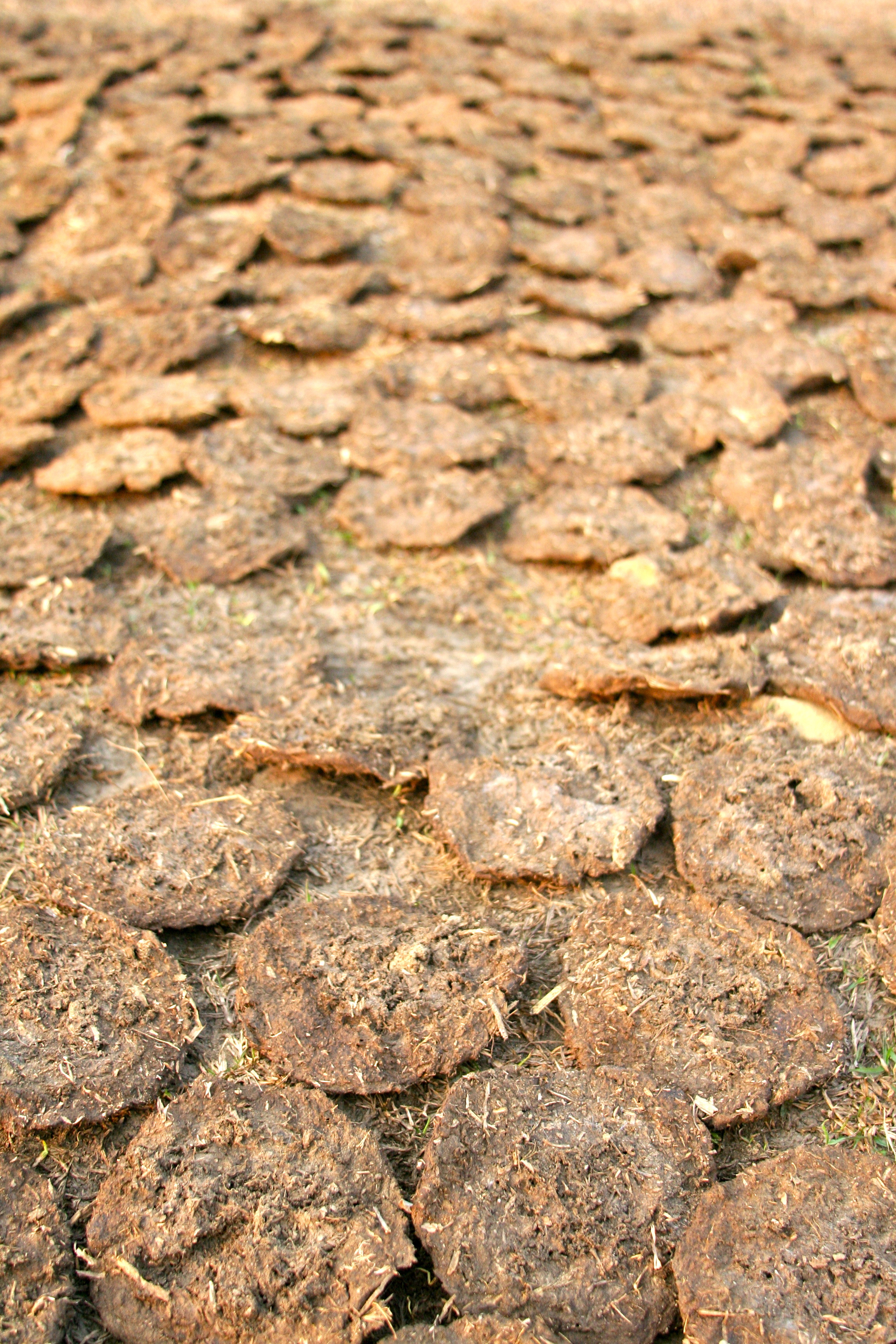
    So despite what the government says, Balls of Rice will still be producing its regularly scheduled spouting of complete, regurgitated crap, based on how often dig piss, dead birds or classic literature can inspire me. If readership numbers have anything to say about it, the government will probably leave me alone. I’m not even on the radar.
  • Translated Gold

    An author uses words deliberately to evoke images and thoughts in the mind of the audience. A poet does the same but even more deliberately, with the economy of words. I consider myself a man of ideas, in that I can use the English language to share concepts but my actual ability to manipulate the language is somewhat limited. A person’s self perception is often skewed, and that may be the case for myself. I likely don’t even have the idea ability on my side.

    I am reading pieces of work by literary heros Camus and Tagore, both authors likely capable in the English language but chose their own mother tongues to write the majority of their collection. I am nearly able to read Camus’ writings in the original language and plan to someday be able to do the same with Tagore’s, which is how I believe they were meant to be read. Reading the translated version is like reading a rough interpretation of the original language; there is a potential that the specific wording and imagery change, and a loss of certain phrases that only work in the original language. Lost in translation. Like an amateur painter who traces, follows and copies a world masterpiece. Just because a person is bilingual doesn’t mean he is qualified to translate a book from French to English. An atheist who understands ancient Greek and Hebrew maybe would translate the Bible more accurately than a Christian, but at the same time his ideals could get in the way. A French aristocrat could likely translate the works of Camus but would miss out on ideas aimed at a different audience. Authors such as Dostoyevsky, Camus, the authors of the Bible, or any other famous author worthy of translation use words purposefully and when translated, retranslated and untranslated, the original magic and authenticity can be lost. In the case of religion, mistranslation has likely caused more problems than the translations are worth. The translated version is a slightly less authentic although equally as important version of the original.

    Whenever I’m reading a book that I know has been translated from the original I have it in my mind, through every sentence, that the translator likely missed something huge. He or she didn’t catch the idea that the author meant to communicate and translated in his or her way, and I missed out on what was really meant. That I am not reading what the author wrote, but what the translator thinks the author wrote. It distracts me to the point of having to read each page twice. A solution to this would be to only read literature from your mother tongue, or at least a tongue you are fluent in, but that would reduce English speakers to Shakespeare and J.K. Rowling and not much else. Translations are legitimate, but they are not the original.

    When I become a world famous author I hope to be able to chose who translates my books into one of the eight remaining languages in the world, likely just before the apocalypse. I would choose someone that understands the my ideas and my mind, who may not end up being the greatest language student. As an idea man I would hope that although a word for word translation might not happen, and the images I paint may get changed (likely for the better), that the general idea that I am aiming for, the root of the piece, gets through. This may be easier for an idea writer, and not quite as easy for a real, image filled, wordsmith of a writer.

    Language is deliberate, and the manipulators of language are precise. Translation is loose, subjective and never precise. The two don’t go together very well. Therefore if you want to read Dostoyevsky, learn Russian. If you want to read the Bible, learn the languages it was written in. If you want to read Tolkien, become an elf. If you want to read properly, learn the language, don’t let some snobby university graduate tell you what you are reading. Don’t trust anyone.

  • Skates and Sleds


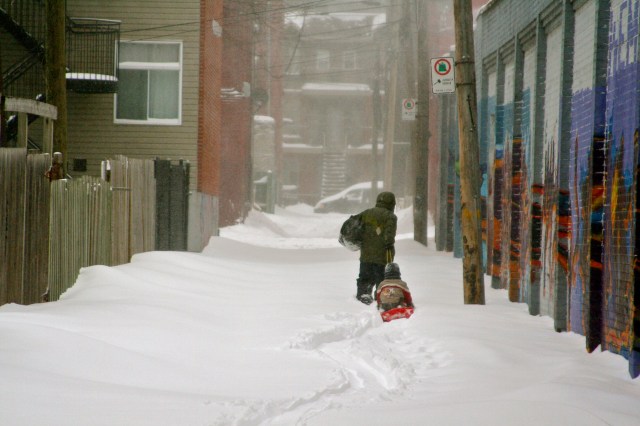
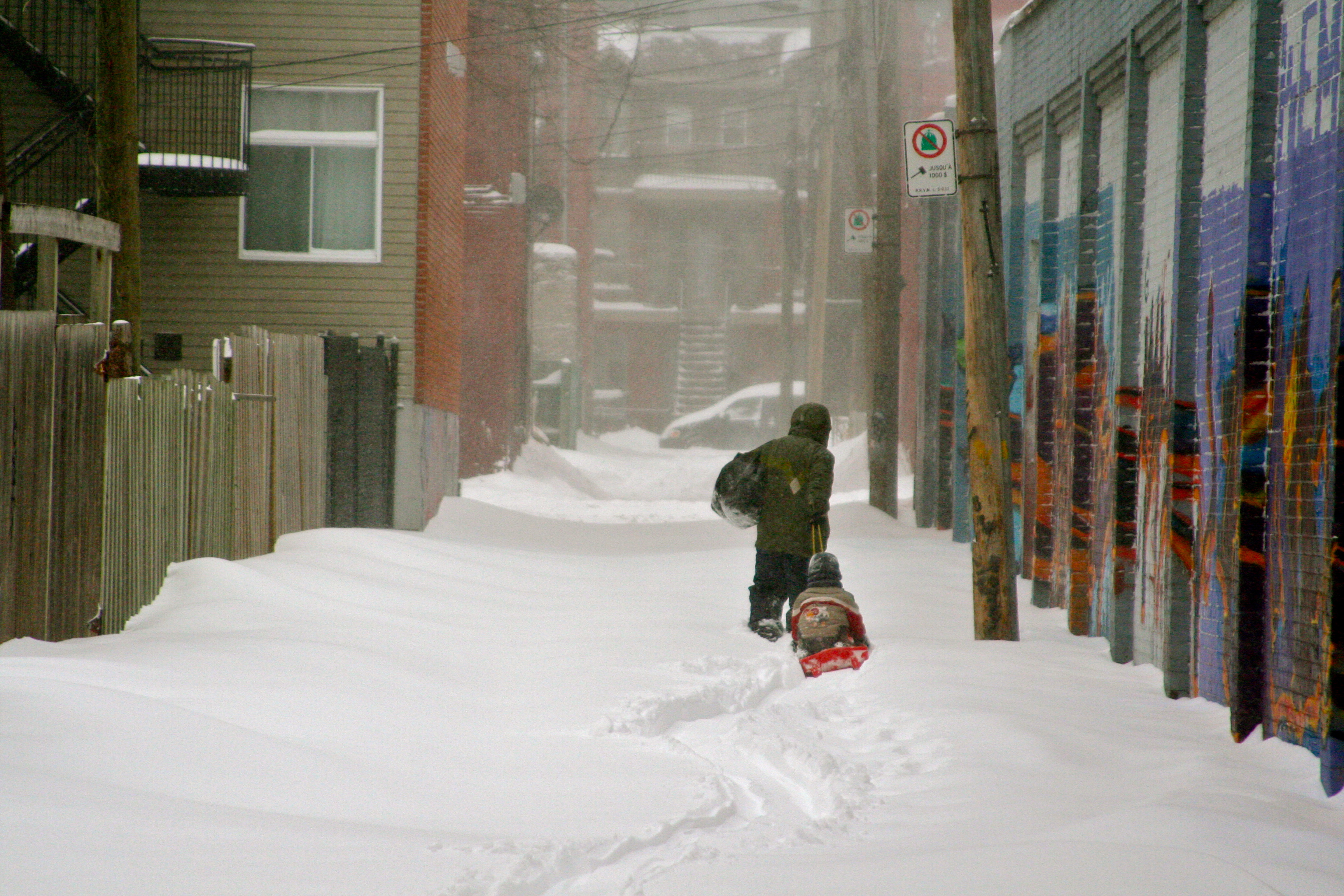
    Click on photos above to see a few more.

  • Il faut que je fasse…

    Nic’s French Lesson #1
    My first bilingual try at sorting out my thoughts. This oughta be good.

    Il faut… can be translated as It is necessary… or at least that is how I translate it in my mind. From the impersonal verb falloir.
    Il faut manger avant midi.
    Il faut faire des devoirs.
    Il faut bien lire les journaux.

    Il faut que je… can be roughly translated as, It is necessary that I… followed by subjunctive verb conjugation because it follows the indefinite pronoun que. It is possible to replace ‘je‘ with any other pronoun but the conjugation will change also. More crudely translated as, ‘I gotta…
    Il faut que je fasse un pain aux pommes aujourd’hui.
    Il faut que je sache comment de changer les pneus de ma voiture.
    Il faut que je regarde la route quand je conduis.

    We practice this phrase with subjunctive conjugation often, and while walking the soaked sidewalks of the city the phrase constantly rolls through my mind. Il faut que… Il faut que… Il faut que… Il faut que… Il faut que… Il faut que…

    My knowledge of both French and English is extremely limited, and my vocabulary is also fairly unexceptional, but I cannot recall an impersonal verb in English that is as effective as the verb falloir‘, and I appreciate the French language for finding such an efficient way of expressing the demands placed on us. The phrase repeats itself in my head because my mind is constantly trying to sort out all the new ideas and conjugations and translations, and just as I occasionally dream in French, I think ‘Il faut que…‘ instead of I gotta… I gotta… I gotta… I gotta… I gotta… I gotta…

    It is necessary that I finish my book soon.
    Il faut que je finisse mon livre bientôt.


    It is necessary to read every day.
    Il faut lire chaque jour.

    It is necessary that I cook dal.
    Il faut que je fasse du dal.

    Il faut que je trouve un bon emploi.
    Il faut que je reste ici pendant dix ans.
    Il faut que je paye le loyer.
    Il faut que j’aie des enfants.
    Il faut que je trouve Dieu, peu importe quel est son nom.

    Il faut…

    There is an awful lot of things that ‘Il faut faire‘ but not a lot of things that ‘Je veux faire‘. The responsibilities of life can be sorted out and listed with one impersonal French verb and it will make you realize that there are a lot of things that are deemed necessary to do, and although the efficiency of the verb is a sign of a well developed language, I am not convinced that having a verb that makes it so easy to demand things is good for most human beings. We can have the il-fauts roll constantly through our heads and sort out what we are required to do, but just as importantly we need to let the ideas of je fais, present tense, roll through our minds. Because what we are currently doing is equally if not more important to what we feel it is necessary to do eventually.
    Il ne faut pas que je fasse beaucoup, mais au contraire, il faut que je fasse les choses qui sont bonnes pour ma santé mentale.

    If needed, here’s the link to Google Translate for rough translations.

  • Salt on my wounds.

    Men used to fight and kill over supplies of salt, that is, if my knowledge of history is correct. But today my shoes are saturated, crystallized, firm and full of gravel because the city believes that salt and gravel in super-quantities increases sidewalk safety. The streets and walkways are painted and speckled white, salted like fastfood fries.  I have never bought salt, and maybe never will. I always steal salt from my roommate’s Windsor salt box to put on my rice and dal, and if I’m not careful he’ll probably kill me for it. Some things never change. Oil is the new salt, and someday we will find an alien planet to harvest all the oil we need to further destroy our own, and while killing the inhabitants of a foreign planet instead of a foreign country we will wonder how we ever paid $1.259 per litre and how we ever killed innocent people to get it. We could have just been killing aliens. If there were one ‘spice’ I could live without on a daily basis I think it would be salt, although I know it is used for far more than just sprinkling in soups. May the cumin keep coming and let the salt someday halt.

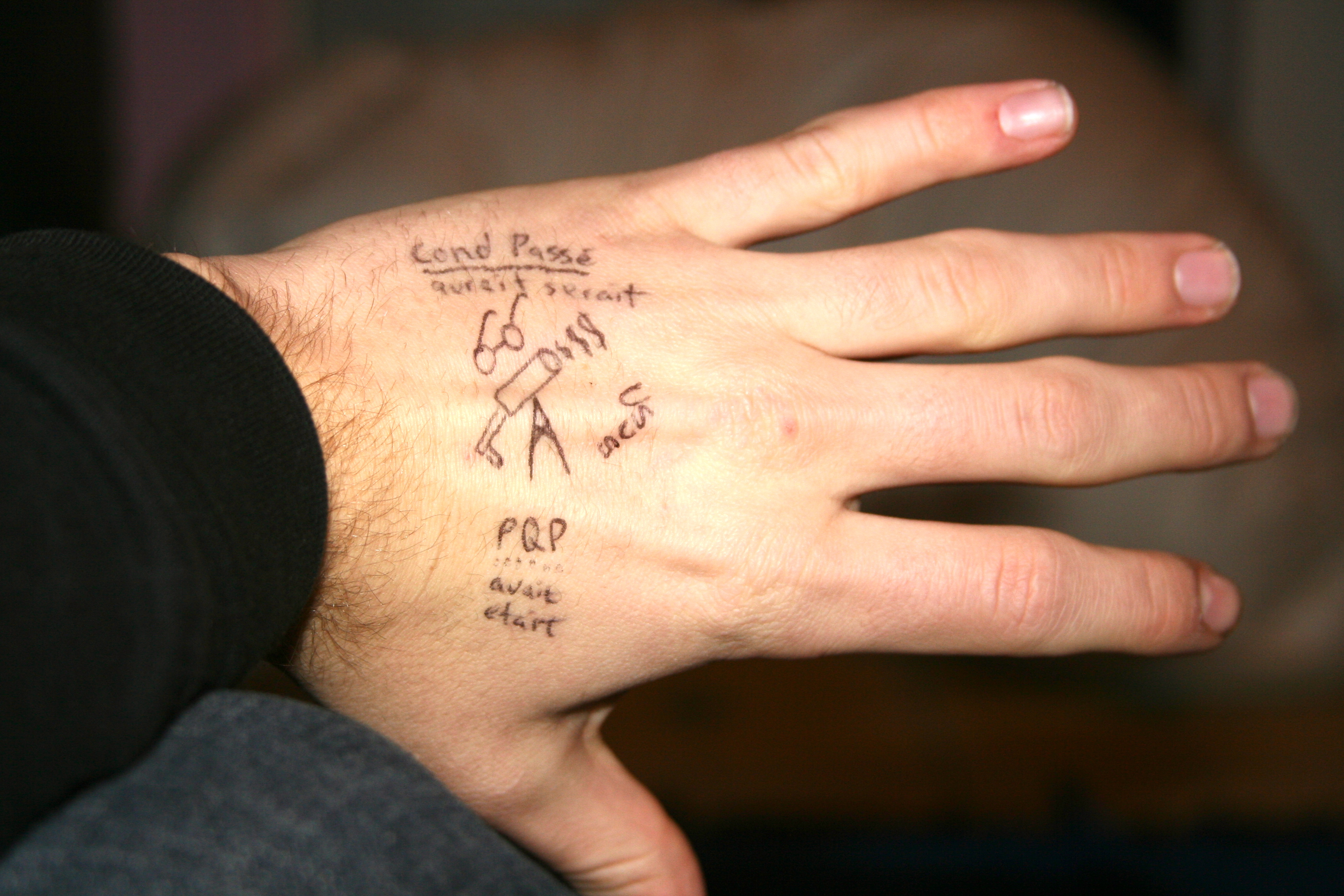
    There are so many ways to conjugate a verb, more ways than are even understood. Since July my French grammar has far surpassed my English grammar, so maybe I should be writing this in my second language because according to my engineer editor, my grammar needs work. I write things like this on my hand to remember the difference between conditionnel passé and plus-que-parfait. Drawings help too, they are the salt to flavour my hand. My hand looks like this at the end of most days.I have since added a book, the word ‘devoir’ and a hockey stick. I credit French to teaching me more English grammar than did my first 12 years of English school. The only thing I learned in university English is how to properly use its vs it’s. It’s easier than you think.

    After a weekend of high voltage hockey excitement, my life is back to its regular salt-free diet and routine. And as I read about the lives of friends and as my French class becomes more bland by the hour, I realize why people killed other people for salt. Because their dry, tasteless lives demanded it.

  • Sneeze Residue

    They say that your sneeze moisture travels as fast as Mario Lemieux’s slapshot. That is what they said when I was a kid anyway. Now Lemieux is a multi-millionaire owner of a successful sports franchise, and has great hair, and my sneeze residue is found on the sleeve of my sweater and the walls of rooms in southeast Montreal. Who wins? You be the judge.

    They’ve done sneeze studies: how far, how fast, if your eyes pop out of your head if you keep them open during the act, if your soul escapes until someone says, ‘Bless You’ or ‘À tes souhaits’ or ‘Gesundheit’, or if it is indeed 1/14th of an orgasm. No conclusive evidence has been found that your soul escapes when you sneeze. Or that you even have one. Conclusive evidence has shown that 14 sneezes in a row is not actually equal to 1Sneeze x 14. We tried in high school.

    These days they condition us to sneeze into our armpits or elbow-pits instead of into our hands, contrary to what we had been taught in youth. Evening news teaches us new techniques and NyQuil commercials condition it in us without us even noticing. New 21st century super diseases will inspire such innovations. The vampire sneeze is the new closed fist sneeze. What would a mime look like if he coughed? That joke may not last much longer. What would a vampire look like if he forgot to pull his cape over his face and held in a sneeze with his eyes open? Probably like a mime giving a blow job. I didn’t write the joke.

    My brothers used to sneeze directly in my face, spraying sneeze mist in my eyes and mouth. Scientifically it was like getting a vaccination, build up those antibodies against the diseases of the season. In the realm of manners and respect it is maybe the rudest thing one can do to you. I thank them all the same.

    As a common courtesy one day we will sneeze on pieces of toast and share them with friends. Immunity cheaper than no-name peanut butter. Hopefully someday our toasters will have speed radars on them so that we know for sure if our sneezes travel as fast as Mario Lemieux’s slap shot, and we will only use the vampire cover to avoid users of hand sanitizer and those with souls to recapture by scaring with blessings. The future relies heavily on our sneeze techniques. Our sneeze residue is the cure for everything. Spread it on toast.

  • Music

    Please see my Music Page to check out two albums I have been anticipating for a long time.