Category: Non-University

  • Ethical Life Under Crapitalism

    Data Collection:

    My coworker has been named the Woman of Distinction for Community Leadership and Enhancement in the City of Regina. She is brilliant.

    A 72 year old community member is a lonely man with failing kidneys who considers suicide but laughs a lot.

    There are three separate piles of change on the floor of my new, empty bachelor suite. I sleep in the closet.

    We make jokes about huffing lacquer because we don’t know how else to psychologically deal with it.

    I have a phone that is paid for, but am too stubborn to use it.

    I don’t know where my cutlery went, so I dump curry into my mouth using man’s ultimate tool: gravity.

    The end of each day, my chest is pulled taut and my brain is a piece of processed-cheese on top of a sun-soaked dumpster lid.

    I fell asleep with my thumb in a book, reading about work.

    My only piece of furniture is a crokinole board.

    The most traumatic event I experienced as a child was finding a marijuana pipe in the ditch next to the house.

    I get paid lower-middle-class salary and feel exceedingly guilty about it.

    Just finished reading one of the worst books I’ve ever read and now aspire to write exactly like the author.

    I bought backpack that encourages cycling and fair labour, but doesn’t fit my groceries.

    My values are clear but my knowledge is stunted, so I cling to the ideas of the knowledgeable people I know, and when challenged in them I shrivel like a wintery weiner.

    I desperately grab the first job I can that is based in community, because as a person with no education, finding a job that aligns with my values is like finding a bedbug on the pink mattress in the gang-monitored apartment. But we did find a bedbug.

    Findings:

    Do what you can/Don’t try so hard. Forget about religious guilt. Always ask others if they are comfortable with something. Don’t be selfish. Seek happiness in others. Eat well.

  • Books of the Year: 2014

  • Pizza Scurvy

    Disclaimer: This is not pizza from Vera Pizzeria. This is scummy Montreal metro pizza, which also has it's place.
    Disclaimer: This is not pizza from Vera Pizzeria. This is scummy Montreal metro pizza, which also has it’s place.

    I have oft dreamed of a world free from the bondages of currency. The ‘bootstraps’ analogy that no longer makes analogical sense would neither make societal sense because people would all have the same strapless boots, the same homes, and the same neapolitan ingredients in the fridge. Where no matter how hard you work, you get a piece of the pie. The pizza pie.

    I have oft dreamed of a job that pays me in pizza and beer but until recently I believed it was an impossible, utopian dream. I have found said job. I wear an apron, I swing my hips liberally to the hook-heavy anthems of Jenny Lewis, I spray, scrub, soak, sort, and airdry the cheese-grimed pizza plates of Vera Pizzeria, home of the finest pizza your pedestrian tongue (and undoubtedly mine) will likely ever taste. Contrary to my communist, currency-free compulsions, on busy nights where my free labour has been deemed as moderately necessary, I work hardest and get paid the least, a perfect microcosm of capitalism. In the name of that covetous progress, the human-crushing runaway train that it is, they have sourced a commerical dishwasher. And with the simple stroke of a pen, with the lease of a stainless steel washer that sprays with the intensity of a pissed off geyser at 150degrees centigrade, I have become obsolete.

    So with my severance package in hand (a bout of scurvy in my organs from a pizza-only diet), and my travel backpack on my shoulder, I will slither towards an early retirement. Savings were significant in the height of the pizza game, and my investments were sound, so with the wealth of a nation, the tropics call my name. I have long desired, for three years or more, to leave my home to see the homes of others, and now, ticket for Thailand securely in hand, visa for India theoretically in transit, this retirement dream will soon come to pass.

    I pack my belongings, patch the holes on my backpack, google trip plans when flashbacks of swimming in the ocean, drinking five-cent chai, eating dogmeat bring excited memories of the learned parts of travel. Then flashbacks of sweaty, anxious, late walks on the beach, the embarassed purchase of tacos from women squatting in the alley across from the department store, feeling responsible and justified when I get attacked on several occasions strike my memory.

    Hold on a second. People’s dreams change? Without them even knowing it? Until it’s too late? Well that’s some merited bullshit. Some ironic piece of formaggio pizza, light and bubbly crust on the outside, black and tarry on the inside. I’ve already bought a one-way ticket, already dreamed of the exploits and adventures of the trip for three years. Like a soon-to-be-wife with cold feet, always dreaming of the day she’d get married, but when the vows are written and the dress is tailored and the family has flown into town she realizes that this dream was what she wanted when she was 19, not 29. But she goes through with it anyway because, she figures, it’s still what she wants.

    Much has changed in my brain in the three years since I last was in a territory that I was not welcome. For example, I have learned that I have always lived in a territory that I was not welcome; The Dominion of Canada. I have learned that as a person of privilege, I am ignorant and blind to my privilege unless someone calls me out on it, and even then I’m likely too stupid to comprehend it. I realize that abusing this privilege by flaunting it and spending its savings unwittingly, I disrespect those who have no privilege, even if I attempt to be ‘socially responsible’ while I do it.

    I am willingly throwing myself into a situation to inevitably become the type of person I never want to be. As if I decided to run in party politics, or get season tickets to the Toronto Maple Leafs.

    The tenets that I used to hold dear and romanticize about my lifestyle—the learning about culture, and seeing new things, and helping where I can—now come off as paternalistic blather. I am a product of loving parents that worked hard to give me everything I ever needed, which, along with the technologial and economic progression of the west, has turned me into a skilless rube whose only ability is to pick up and go. As a ‘writer’ I use this as ‘inspiration’ for ‘projects’ and ‘essays’.  Previously my impulse was to I enjoy flaking on the lifestyles and traditions of groups of people far from my home that have been adversely flaked on by colonial forces for hundreds of years. Now, I’d prefer to do so at home, by myself, in a rundown house in small-town Saskatchewan where I can negatively affect only the people nearest me.

    I look forward to coming out of early retirement to rejoin the workforce and finally stop perpetuating the types of relationships I have come to realize as unbalanced and unfair. I look forward to squatting in a moldy, infested apartment, dressing like a true dishwasher thus embracing the motto, “Dress how you want to be addressed” and forever scrubbing the cheese off of pizza-related tools, all for the simple reason that I am too unintelligent to understand how to truly live in balance with other people, so I’d rather just rot.

  • Parasitism

    As a renewed cellphone-free man I drink the heavy nectar of wi-fi. I sense when it exists and where it exists and how to position my body and tilt my neck to best receive the finely-tuned wavelengths into my lungs and my soul and my device. I have given up on pride and ask even the least appropriate places for their security codes, their passwords to open the sesame of my personal communication. Restaurants, bars, party/costume shops, hotels, homes, parks, community centres, libraries.
    “Excuse me, what is your wi-fi password?” is like admitting your poverty and asking for change. People look at you, notice that your device is seven generations old and scoff. I sit in the corner and send messages to mom in India. Last night at midnight I stood in the cold outside of the local cafe and sent messages to travelling friends. The addiction is real. But I distance myself as best as possible which is why I am now a parasite.

    On my previous bout of unemployment I tagged it as the Freeloader trip, but I understood that this was an slightly more endearing term of what it really was: parasitism. Attaching to and sucking dry those connected to me that have vision and ambitions and talent and patience to see their goals through and somehow have room for a tapeworm in their process of progress. I “sold t-shirts” for Close Talker, coming up with a completely unnecessary job so that I could watch free music, travel, see friends, and drink too much. I will move to the farm to help a friend herd cattle and build a home on his century-old homestead, neither of which I know anything about. I will go to a new city to potentially participate in a friend’s grand project of opening a particular kind of pizza joint. I will latch on to progressive people of diligence and industriousness and hope that in my blood-sucking, what I admire in them will be transmitted to me.

    Then, when these months are said and done I will travel to countries that want nothing to do with another white man but will put up with it for the sake of an economy that is the tourism industry. And I will feed off of their land and their labour and their inexpensive living for my own personal benefit. I will inevitably further damage relationships because even responsible tourism is harmful. And with any luck I will come home six months later with a gnarly stomach worm, a parasite of deadly origins, and I will learn what it is like to be the host of someone who isn’t capable of envisioning their own future.


  • Letter to the Board


    IMG_4020

    Letter to the Board,

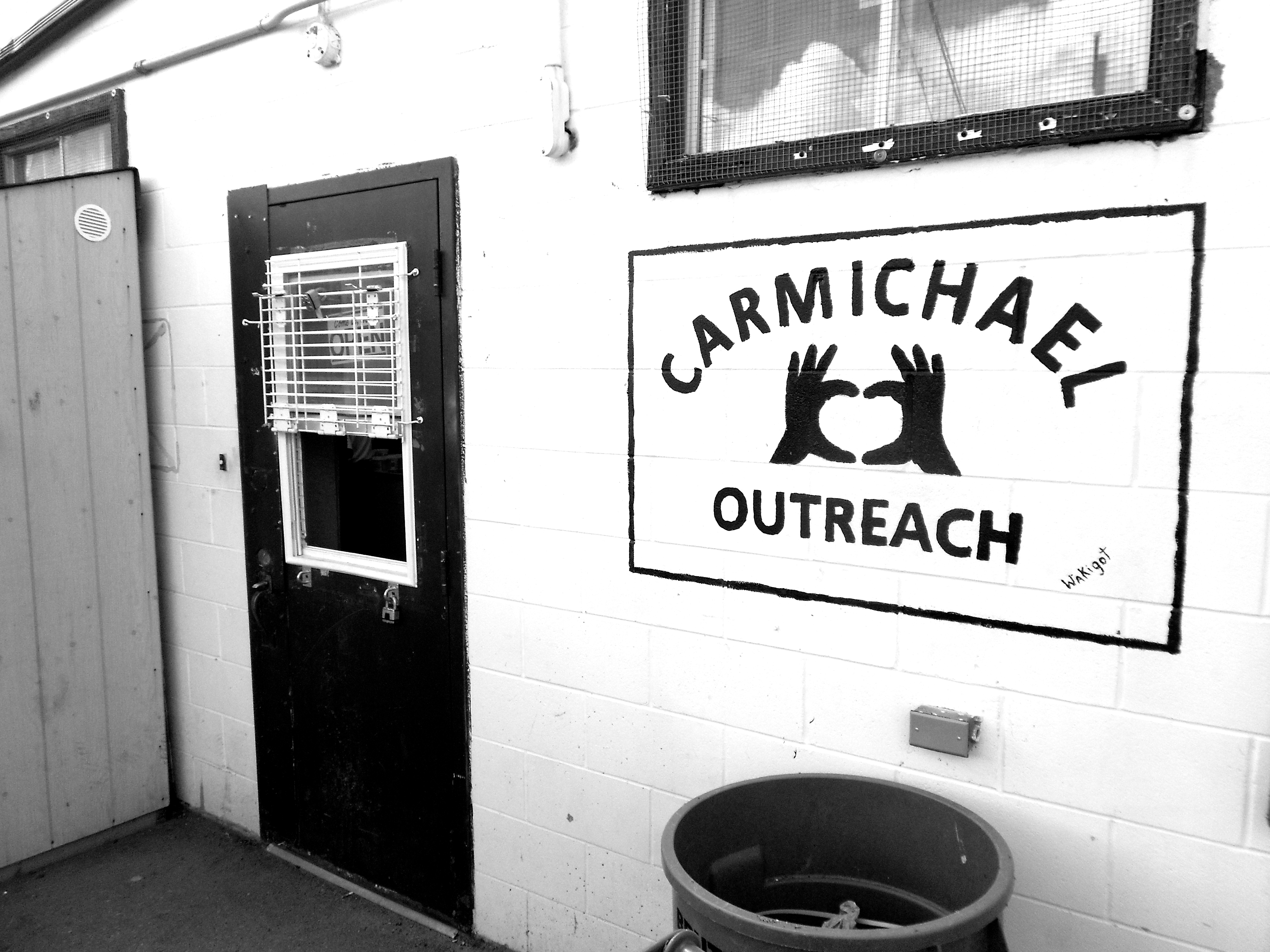
    Carmichael Outreach is a unique community unlike any other within the city of Regina. Community members, occasionally referred to in the pejorative as ‘clients’, use Carmichael for its services and programs, which are often as unique as the community itself. Community members also come to Carmichael for a sense of dignity, belonging, friendship, and community. Where most people find this in their own homes, Carmichael community members make their own family, and use the coffee room as their living room. I have experienced no greater example of belonging, dignity and respect.

    The reasons a place like Carmichael has to exist is complex and longterm. Poverty, addiction, mental illness, abuse are complicated human issues that will never be solved by the harm reduction programs run out of a small, dilapidated building with an overrun staff. But the decisions that that individuals and organizations make that cause these issues are clear, and as a non-profit, very avoidable. The systems of capitalism and colonialism are the root cause of the issues that tax the lives of the Carmichael community members. Capitalism is the economic model used by Canada’s colonial past and present. This economic system not only took over Indigenous land for the sake of giving land for new homesteads, but has played the largest role in the destruction of the traditions and governing systems for the fact that capitalism cannot exist in the presence of other traditions. The traditions and governance of Indigenous peoples are the polar opposite of capitalism, which is why colonialism had no choice but to assimilate and exterminate.

    As a community-based organization, Carmichael has the distinct opportunity to stray from its current model of governance, that is, treating the non-profit as it were a multimillion dollar company, and to treat it like the living, breathing community that it is. Top-down, hierarchal decision making has worked superficially in the past and works in other contexts, but running Carmichael in such a manner only perpetuates the reasons Carmichael has to exist in the first place. Decisions, economic and otherwise, made for a community’s well-being without direct involvement or even simple consultation of that community, will be uninformed and detrimental to healthy functioning.

    A shift to a more communicative, cooperative model of governance, still based in the Canadian laws for charitable organizations, would greatly benefit an agency like Carmichael Outreach. Board members offer a unique outside community perspective with business and executive expertise, while staff bring a frontline, community-member voice imperative to the balanced and equal decision-making to ensure that the customary neocolonial top-down approach of running an organization doesn’t take hold. Carmichael community-member input, more than once a year in patronizing AGM meetings, is imperative to the inclusion of the most important demographic; the service-user. To expect the opinions, ideas, plans, and dreams of hundreds of community-members and dozens of staff members to be filtered through a single Executive Director position is not only ineffective and impossible, it is unfair to charge the Executive Director with such an overwhelming task. Communal decision-making ensures a transparent, efficient, and effective process, and one that could slowly be transitioned into simply by allowing a Carmichael staff member to participate in the board meetings each month. Such a change would bring board members into a far greater understanding of daily operations at Carmichael, and would give staff members a clearer understanding of the necessity of process in an organization of this size. This transition could be complete with running Carmichael as a cooperative community movement that includes people of all backgrounds, incomes, and visions together in one common goal of continuing the important community work at which Carmichael already succeeds. Community requires such social mix, and a community organization’s healthy functioning is no different. Greater communication between stakeholders of Carmichael Outreach can only improve the future strength and effectiveness of such a community. I ask that you please consider a more cooperative and communicative approach to the operations of such a strong and critical community in Regina as it would be a disservice to the service-users to run it in any other way.

    I have not, and likely will never again, work in a place such as Carmichael, and I know its potential far outweighs its current impact, which is a significant statement considering Carmichael’s influential past and present. Please consider decolonizing Carmichael’s governance and shift to inclusive and cooperative styles of governanace that truly can benefit such a distinct community.

    Thank you for allowing me to be a part of this organization.

    Nicholas Olson

  • Summer of the Drunk Bike Crash: A Physics Lesson

    Milky Way

    In a group of ten cyclists at 2am, third from the front, he hit a back tire. The first rider swerved and cut off the second rider who cut off the third, who flipped over his handlebars in a mess of birthday terror in front of the ice cream shop. He bled from his face, his teeth seemed intact.

    After riding a block sitting on the curved handlebars in moments of pure dumb pleasure, he landed on his face and didn’t get up. Brothers have been killing their own brothers since Cain and Abel, sometimes accidentally. On a normal day, killing a brother would have just been a bad day. But on the day when I learned of his forthcoming marriage, killing my brother would have been a manslaughter of biblical proportions. After I knew he was alive and taken care-of I rode home with a helmet on and compared my upcoming and pathetic life to his upcoming and exciting one.

    In these experiments with physics I learnt about absolutes. The first crash taught me that particles do not have a well-defined position and velocity, rather a quantum state, which is combination of positions and velocities as defined within the limits of the uncertainty principle.* As I swerved from left to right I proved this correct in that my bicycle and myself had no well-defined position, and because of such, a handsome actor nearly lost his face. There is no absolute space, there is no absolute position. In the second crash I learnt about personal absolutes. I compared his life to mine, contemplating which was the right path.

    From day to day I can’t decide if I think that I am God’s gift to the world—intelligence, wisdom, tact, social-graces—or if I am Satan’s shit-stained underwear. I can’t decide if my lifestyle of frugality and abstinence is effective or internal. For some reason I can’t conceptualize myself in any other way than the absolute best or the absolute worst. I battle between a hunger for knowledge and a hunger for rest and in doing so I watch episodes of inane teen dramas from my highschool days in between enjoying chapters about quantum mechanics in Stephen Hawking’s A Briefer History of Time, the simpler version of the science classic, still too complicated for me.

    I can’t decide if quitting my job was the worst decision of my life, or the best.

    As if I were at my first day of second grade, sitting in a circle on a forest-green area rug stating my favourite colour, food, and subject, I instinctively feel as though there is a best and worst for everything. This summer I caught myself looking out upon the prairies, sitting atop the hill at Buffalo Effigy, the warm wind pelting my face with the view of thousands of miles ahead, the green gullies and yellow hills, and I internally stated that I thought I liked the fields better than the mountains. As though in the universe there were a clear winner as to absolute beauty, or as though my personal preference mattered even the weight of a quark fart. I caught myself creating absolutes for things that didn’t matter and have ever since been attempting to stop from deciding favourites. Having favourites—the best dessert or band or sports team or brand of shoes, is a childish form of having absolutes, and according my new favourite book, science doesn’t seem to have many of these. Such absolutes are the cause of conflict as minor as neighbourly squabbles and as horrendous as genocide.

    My mind has always stated the situation as being The Right Way To Live versus The Wrong Way To Live, and leaves out the third option, which is simply, and most importantly, just fucking living. I possibly have been conditioned to draw this binary because of early ties with an absolute God, (which is likely, because every single thing I write is either a secular sermon or a parable or both). But certainly there is no absolute. There is no right or wrong, black or white, good or bad. There is no God’s gift to the world and no Satan’s shit-stained underwear. There is no worst decision of my life, and no best. There are simply decisions, and there is simply the process of living, and the process of creating absolutes for such things destroys science, and destroys humanity.

    I have generally given every other person the free pass of just living, but I have yet to do so for myself. Maybe today is the day. Now to decide if that is the right decision or not.

    …a star that was sufficiently massive and compact would have such a strong gravitational field that light could not escape: any light emitted from the surface of the star would be dragged back by the star’s gravitational attraction before it could get very far. Such objects are what we now call black holes. (Stephen Hawking, A Briefer History of Time, Chapter 8, p77)

    …a person that was sufficiently delusional and introverted would have such a strong introspective field that positivity could not escape: any positivity emitted from the person would be dragged back by the person’s bloated or deflated sense of self-worth before it could get very far. Such people are what we now call people. (Nicholas Olson, This Moment of Time, Chapter Sept8, p2014)

    *Stephen Hawking, A Briefer History of Time, Chapter 9, p91-92

  • Slow Code Colonialism

    The following essay was published in the Summer 2014 edition of Transition Magazine, a Canadian Mental Health Association publication. Digital copy available here.

    You are lying on the street in cardiac arrest. I am obliged to inform your unconscious, breathless body of my newly acquired First Aid training. This, for some reason, is supposed to reassure you, as if my knowledge to enter three digits on a phone grabbed out of a bystander’s pocket changes the fact that your heart has ceased. All I can do is Check, Call, Care, and call bystanders to action, but according to the brawny male firefighters who taught my First Aid course, this should be reassuring. The fewer bystanders, the better, they said. According to said firefighters, CPR and portable defibrillators are so effective that you—unconscious, vulnerable, responsibility of the provincial healthcare and social services systems—shouldn’t worry about what will happen if you don’t wake up, but rather, what will happen if you do.

    The day after I became First Aid certified, I heard a piece on public radio that spoke to the misconception of the effectiveness of CPR. When it comes to the point where a human is in cardiac arrest, known as a Code Blue, healthcare professionals are obligated to administer life-saving procedures. When doctors are confident that CPR will not save a life, or will greatly reduce the quality of life that remains, they will often fake it, for it “looks and feels like a really gruesome way to usher someone out of this world.”(1) They go through the motions of CPR without actually trying to save the life. They do it so the patient can die. Slow Code—they even have a name for it. When family and friends are watching a loved-one slip away, they cannot understand a doctor who would stand by idly and let their family member die. CPR, in this case, is a system for the conscience of the bystander, not for the person in emergency. The professionals do this because the system of resuscitation is flawed.

    A friend was recently in the hospital. He got into a fight with three men half his age, he told me. Others claim that while inebriated, he tripped, the side of his head the first part of his body that struck the ground. Skull fracture and brain swelling which led to brain damage and memory loss. I visited him regularly—I sat there as an idle bystander contributing to his deteriorating health by supplying him with cigarettes which he forgot he had, as he basked in the overwhelming nature of his life of abuse and addiction. We played cards as he mumbled through the imagined traumatic experience of being locked in a house with three family members who beat him until he bled from the ears.

    When my friend is discharged, he will leave the hospital to no home and to a family who can no longer give him the support he requires. The hospital can’t keep him forever. The rehabilitation centre says he is too high-functioning—a man who cannot remember where he put his paintbrush or the names of his brothers. The province cares not for the marginalized. An ethically responsible governing body cares for the vulnerable, but my friend will end up homeless in a week, one inevitable head injury away from complete debilitation. He has never met his social worker. The social worker in his ward blankly stated that it isn’t her problem once he is discharged. The workers search on their computers and make phone calls in vain, aiming to satisfy the bystanders, knowing that whatever they do, it won’t save his life, because, whether or not they know it, the system of resuscitation is flawed. To those within the social welfare system, this is the most receptive the state will ever be—just another case file in the colonial shell game that is the Canadian welfare state.

    Those who have not dealt with the system imagine that it works for all. They imagine that the cracks through which people slip are fairy tales told from faraway lands. They can’t imagine a circumstance where someone would be left out in the cold after a traumatic event, because, they think, this is Canada, land of universal healthcare and equal aid for all. This liberal notion of equality of opportunity fails to understand the systemic racism which is fundamental to the colonial state. The gaps exist on purpose. The system of resuscitation is intentionally flawed—it is designed to appease the conscience of the bystander. But unlike a medical Slow Code, it is flawed in its design to take resources and power out from the trained field workers through lack of programs that offer proper supports. Fifty-percent of the Saskatchewan provincial budget is devoted to healthcare and social services, totalling over $5.5 billion per year.(2) With such a significant portion of the provincial budget devoted to two departments of human services, the general populace can only assume that the dollars are sufficient and effective; however, gaps in the departments are purposeful and widespread.

    Aboriginal communities have been stunted by the implementation of provincial and federal social assistance programs, contributing “to the persistence of individual and community economic dependency.”(3) These programs run on outdated living allowances, low earning allowances making a transition to employment impossible, and lack of adequate supports for Aboriginal people living in urban centres or dealing with HIV/AIDS. These programs run on cycles of poverty and death. A growing number of Aboriginal people have been forced from reserves to urban centres, where it is exceedingly difficult to live as a traditional Aboriginal person. It is a direct extension of settler colonialism, originally performed under the mandate of pre-confederation’s Indian Affairs, whose policies to ‘civilize’ Aboriginal populations introduced the residential school system. Residential schools were decentralized into the provincially-run Ministry of Social Services, a ministry which continues to perpetuate the same exterminatory mandate. Slow Code Colonialism—neocolonial institutions created to emphasize the desires of the bystander and ignore the needs of the sick. Neocolonialism is already the disguise for cultural eradication and is further masked as the unavailability of programs due to lack of financial support. Where supports exist, resources do not. My friend qualifies for a bed in a home for those with Acquired Brain Injury, but only after sifting through a waiting list of several months, and not if he continues to battle his addiction. Fairytale cracks become real. The ministry that originally took responsibility for my friend as a young boy sent to a residential school, now waives this responsibility and deliberately leaves him to flop around on shore, their program near completion.

    I was taught to Check, Call, Care. As your consciousness flickers, as shock sets in, I brush your hair from your forehead and tell you it will be alright. I lean close to your face to check your respiration. You are not breathing. Since I do not have my recommended mouth-cover, I begin compression-only CPR. I tell a bystander to call for help. I break your ribs and bounce up and down on your sternum with my arms locked at the elbows. The paramedics arrive. They are trained in emergency and begin Slow Code CPR, feigning an attempt at revival because that is what bystanders expect of them. There’s nothing we could do, they say, but I am appeased because of their valiant attempts at resuscitation. What they don’t tell me is that they were thinking about football when they were supposed to be pumping blood through your chest. You somehow survive despite the Slow Code, but you wake up with broken ribs, brain damage and you are expected to survive when you have no place to live and no family to care for you. And the system of resuscitation wins in its purposeful defectiveness.

    “Sir John A. MacDonald’s policy of starving First Nations to death in order to make way for the western expansion of European settlers,” along with the residential school system, “meets the criteria of genocide…by omission, if not by deliberate commission,” says a letter to United Nations Rapporteur for Indigenous People.(4) The policy of nineteenth-century Canada differs from today’s policy of intentionally defective programs of social service only in thin veils of supposed goodwill. There is no greater place to hide genocidal policy than behind a department of human services. The only other difference between Canada’s previous policies of starvation and the policy of today is the time elapsed in which the extent of the genocide could be fully understood. And time will again pass.

    The only way to stop Slow Code Colonialism is through a remodel of the system of resuscitation. The Ministry of Social Services is just one of the administrative programs that force subjugation by stamping out hope and dignity through “a complex web of city agencies and institutions that [regard] the poor as vermin,” Chris Hedges explains.(5) These programs work together to perpetuate the accepted state ideology by operating under the guise of being a protective force. The police who mine for crime by making arrests in communities of lower economic status work as the frontline of the repressive arms of the state. The military who break up blockades of First Nations fighting for liberation form another wing of Slow Code Colonialism. These structures work to protect the status and wealth of white middle class Canada, while ensuring the poor Aboriginal populations live in abject poverty, utterly subordinate to those who control the state. These structures project an image, and behind this image is a bloated bureaucracy focused not on remedying social evils, but on keeping these injustices out of the field of vision of polite society.

    The system must be remodelled to one that does not look to appease the taxpayer, but rather to adequately serve the marginalized. This starts when bystanders become involved and demand that governments stop these hegemonic structures of administrative programs such as Social Assistance, the judicial system, the police and RCMP, and unregulated resource development that make up the branches of colonization. This will dismantle the less visible forms of  “a very active system of settler colonialism.”(6) It starts with education and partnership that leads to real reconciliation “grounded in political resurgence” that “support[s] the regeneration of Indigenous languages, oral cultures, and traditions of governance.”(7) The system will be reformed when the programs intended to assist people do just that, instead of control, institutionalize, and cripple. As with any cooperative and proactive social system or community network, a welfare system administered by those to whom it caters is a democratizing step to reconciliation and empowerment. Aboriginal participation in the development of such strategies and programs is necessary to eventually eliminate the economic gap.(8) These state apparatuses will require more than just reform to make them democratic, but will require revolutionary change encouraged by grassroots movements like protests at Elsipogtog and Idle No More.

    First Aid isn’t as futile as it may have seemed at first. Although I still tread in the overwhelming nature of ignorance of how to respond to an emergency more serious than hunger pangs, I at least know that the symptoms for stroke, diabetic shock, and extreme inebriation are identical. I now know that the systems they taught me are evolving and changing because their legitimacy is still highly in question. I am no longer a bystander, but a person of direct action. The fewer bystanders, the better, they told me. With fewer bystanders, Slow Code Colonialism can shift to a more balanced paradigm of moral care for all.


    1. Goldman, Dr. B, (writer). Goodes, Jeff, (producer). 2013. “Slow Code.” White Coat, Black Art. CBC Radio 1. (http://www.cbc.ca/whitecoat/2013/10/18/slow-code/)

    2.  Saskatchewan Provincial Budget Summary, Ken Krawetz Minister of Finance, Government of Saskatchewan, 2013-14 GRF Expense, p44. (http://www.finance.gov.sk.ca/budget2013-14/2013-14BudgetSummary.pdf)

    3. Report of the Royal Commission on Aboriginal People. 1996. Ottawa, Indian and Northern Affairs Canada. Volume 2, Part 1, Chapter 5, Section 2.9 (http://www.collectionscanada.gc.ca/webarchives/20071211061313/http://www.ainc-inac.gc.ca/ch/rcap/sg/sh88_e.html)

    4. Fontaine, Phil. Farber, Bernie. 2013. “What Canada committed against First Nations was genocide. The UN should recognize it.” The Globe and Mail. October 14. (http://www.theglobeandmail.com/globe-debate/what-canada-committed-against-first-nations-was-genocide-the-un-should-recognize-it/article14853747/)

    5. Hedges, Chris. 2005. Losing Moses on the Freeway. New York, NY: Free Press, Chapter 1, p17

    6. Simpson, Leanne. 2013. “Elsipogtog Everywhere.” October 20. Retrieved October 21, 2005 (leannesimpson.ca/2013/10/20/elsipogtog-everywhere/)

    7. Simpson, Leanne. 2011. Dancing On Our Turtles Back. Winnipeg, MB: Arbeiter Ring Publishing, Back cover

    8. Painter, Marv. Lendsey, Kelly. Howe, Eric. 2000. “Managing Saskatchewan’s Expanding Aboriginal Economic Gap.” The Journal of Aboriginal Economic Development. Volume 1, Number 2, p42